A Japanese Study Warned Chávez About the Earthquake Risks
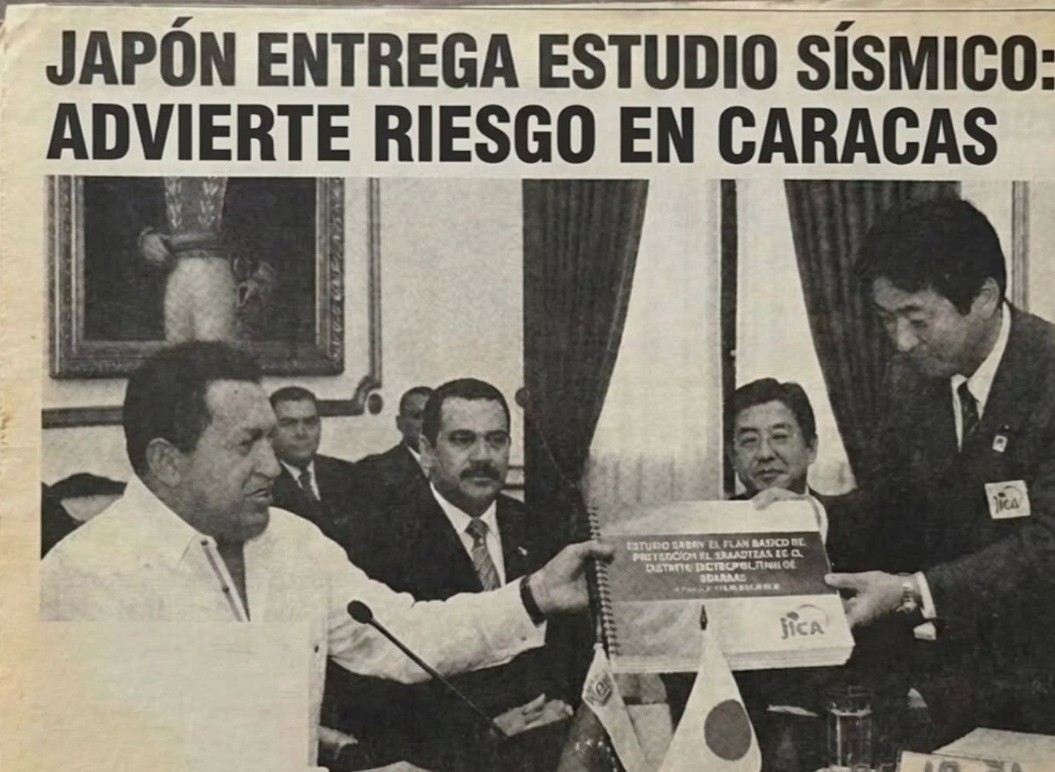
Less than 48 hours after the earthquakes of June 24, X (formerly Twitter) users mentioned that a Japanese team did a study on seismic risk in Caracas in the early 21st century. That’s true. In March 2005, the Japan International Cooperation Agency (JICA), the primary government agency responsible for managing Japan’s Official Development Assistance (ODA), released the report Basic Plan for Disaster Prevention in the Metropolitan District of Caracas in the Bolivarian Republic of Venezuela.
The technical report presented a Disaster Prevention Plan as requested by the Venezuelan government. The plan’s goal was to save lives during an earthquake by minimizing asset damage and improving the State’s response capacity.
The study covered only three of the five municipalities that form Metropolitan Caracas: Libertador, Chacao, and Sucre, because the government committed to apply its conclusions to Baruta and El Hatillo. It did not consider what is currently called La Guaira state (Vargas back then).
The Japanese team was headed by Mitsuo Miura (Pacific Consultants International, PCI) and composed of staff members of PCI and OYO International Corporation. They visited Venezuela seven times, from December 2002 to March 2005, when they discussed the results with the Venezuelan officials and conducted field surveys. Upon returning to Japan, the team finished additional studies and prepared this final report.
The diagnosis
The study defined several scenarios to estimate risks, soil displacement, and potential damage. It projected that, in the worst case, a considerable number of buildings in Caracas, depending on their age and type, would collapse, with a high human cost. Only the ones built after 2002 showed high seismic capacity. Twenty years ago, those buildings made up no more than 0.1% of the studied area.
On the other side, 98,237 buildings were vulnerable. Those built before 1967 (the year of the previous great earthquake in Venezuela) had low seismic capacity, while those built from 1968 to 2001 had a moderate capacity. Of the 1968-1982 buildings, 82% were made of brick and mortar.
“The project will reduce the number of heavily damaged buildings from around 10,000 to around 1,300, and the number of casualties from around 4,900 to around 400 in the case of a 1967 earthquake.”
The Japanese team evaluated, using Japanese standards, office buildings, homes, bridges and viaducts, and established a range of risks in several seismic scenarios. After surveying the Metro tunnels and stations, they suggested reinforcing columns and structures, as well as adding resistant materials in the gas and water networks, and improving the structure of gas stations to avoid dangerous combustible spills.
By 2005, shantytowns covered approximately 20% of Caracas’ urban area, and hosted 51.2% of the capital’s population. This study conducted, for the first time, seismic reinforcement tests on four full-scale models of the typical rancho. It demonstrated that the unengineered constructions have low seismic resistance and require reinforcement, as they could not withstand minor loads and showed failures in columns and connections. The bricks did not contribute significant resistance. If those homes were reinforced with beams, their resistance increased by 40% at an additional cost of 5% to 7%.
The solution
Their plan recommended seven big tasks. To improve safety, reinforce buildings and bridges, control the flux of sediments, and relocate the population living in high-risk areas. To improve response, implement early alert systems and emergency command centers. And to improve coordination, educate the population and stimulate citizen participation. By that time, local technologies made all these projects possible.
“The project”, they assured in the report, “will reduce the number of heavily damaged buildings from around 10,000 to around 1,300, and the number of casualties from around 4,900 to around 400 in the case of a 1967 earthquake.”
There was no plan, no authorities, no clear responsibilities to allow Venezuela’s capital and most populated city to coordinate the response in case of a disaster, the Japanese warned.
When they did the calculations back in 2005, they estimated the plan would cost around 2,800 million dollars (most of them to reinforce all the buildings that could be damaged in an earthquake) and would take 16 years to fully implement. So, if the Chávez and Maduro governments had done their part of the deal, Venezuela would have finished five years ago a seismic prevention and safety strategy in Caracas designed by the experts from a country that knows earthquakes as much as Japan, paying a quarter of the costs estimated for the 2026 earthquakes.
The Japanese team also recommended an early alert system for landslides, to be developed from 2005 to 2007, with a cost of one million dollars. This was meant to protect 19,000 Venezuelans.
The responsibilities
The Venezuelan entities involved in the plan would be the ministries of Public Works and Housing, Transportation, and Planning and Development; the Caracas Metropolitan Mayor’s office; the capital’s five municipalities; and the National Civil Protection and Disaster Management Organization (Protección Civil).
But by 2005, only a civil protection law from 2001 defined some of the corresponding responsibilities. The capital’s Disaster Prevention Administration was being developed. As the Japanese experts warned in their report, there was no plan, no authorities, no clear responsibilities to allow Venezuela’s capital and most populated city to coordinate the response in case of a disaster.
When Japan’s JICA delivered the report to Hugo Chávez, the area under assessment had 17 firefighter stations, 15 municipal police stations, 17 civil protection stations and two emergency control centers. Since then, the only visible change for the inhabitants is the increase of National Police (PMB) command centers.
On June 24, 2026, three buildings went down in Chacao municipality, and inspections are being made to assess the structural damage of several more. In Libertador municipality, at least two residential towers collapsed in San Bernardino, and there’s important damage across the city. In parts of Petare, in Sucre municipality, where many buildings are ranchos, an undetermined number of lodgings collapsed totally or partially, and basic services are not available in some places.
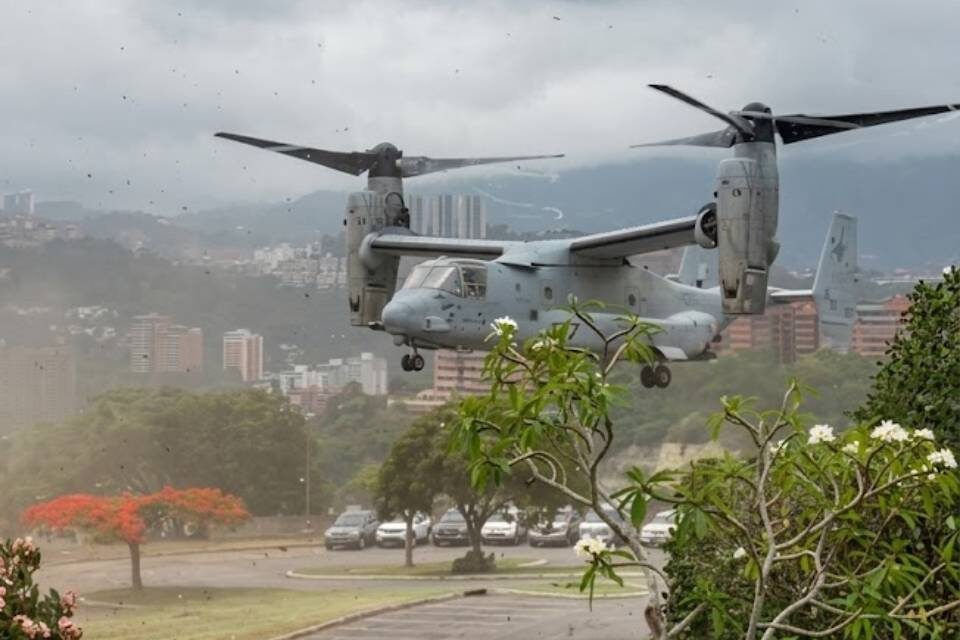
Many foreign crews came to help, especially in La Guaira. One of them is a new research team with seven JICA specialists that arrived in Caracas four days after the earthquakes to design the support measures Japan would contribute to. On June 30, after a request from the interim government, Japan sent tents, water tanks and purification equipment, and erected two campaign hospitales, one in Caraballeda, in the middle of the disaster zone in La Guaira, and another by the Dr. Domingo Luciani Hospital in Caracas.
Besides this, Miyamoto International, a Japanese organization of disaster prevention engineering, came to assess earthquakes’ impact. The team is headed by the famous engineer Hideki “Kit” Miyamoto, the organization’s founder and director. He said they are talking with the Japanese government and reviewing the previous reports. Maybe they will issue a new body of knowledge like the 2005 investigation by JICA. Let’s hope that, this time, the Japanese expertise will be used.