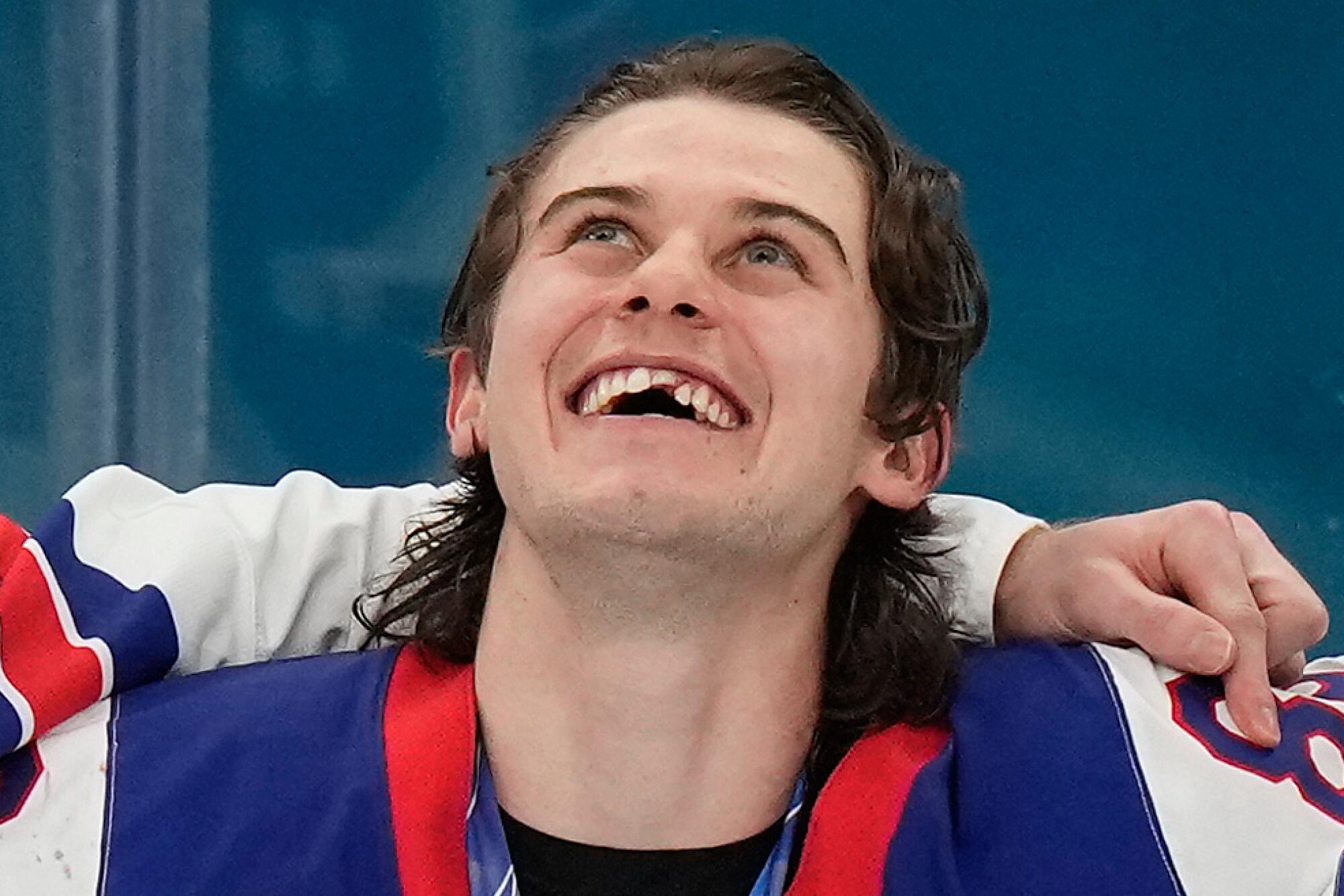
Milan-Cortina Olympics hero Jack Hughes is likely looking at a dental implant to replace teeth knocked from his mouth in the third period of the men’s hockey final between the United States and Canada on Sunday.
Once the euphoria of scoring the winning goal in overtime subsides and celebrations cease, Hughes will undergo a surgical procedure that most dentists agree is far superior to alternatives such as dental bridges or partial dentures.
Titanium posts will be inserted into his jawbone, serving as new roots for the teeth. Once the posts are secure and his mouth has healed, custom crowns matched to his natural teeth in shape, color, and size will be placed on top of each post.
Hughes, who is in year four of an eight-year, $64 million contract with the New Jersey Devils of the NHL, has no worries about affording the best care possible. Sure, health care is free in Italy and he could have remained there for the procedure, but he told reporters he wants it done on home turf.
The United States’ Jack Hughes reacts after receiving his gold medal after Team USA defeated Canada in the men’s ice hockey gold medal game.
(Luca Bruno / AP)
“I’m lucky I’m from the best country in the world, and we’ve got great dentists there, too,” Hughes said while caressing the gold medal hanging from his neck. “I’m lucky I’m American, and they’re gonna fix me right up.”
When Canadian forward Sam Bennett’s high stick slammed into his mouth in the third period, Hughes looked down and rolled his eyes.
“I looked on the ice and saw my teeth,” said Hughes, who had a tooth knocked out in an NHL game a few years ago. “I was like, ‘Here we go again.’ The last time that happened, it wasn’t very fun.”
Losing teeth is an occupational hazard for hockey players. They know implants can be as good as the real thing. Hughes played on even while resembling a Jack-o-lantern.
“Who cares at this point, to be honest?” U.S. teammate Matt Boldy said. “I think more people are looking at his medal than his teeth. I’m sure he’ll be OK.”
Attention certainly focused on Hughes’ heroics in overtime. He re-entered the game a minute into the 3-on-3 overtime and quickly found himself the only U.S. player between Canadian superstar Connor McDavid and the goal.
Oh, and McDavid had the puck on his stick.
Hughes retreated slightly, bracing for another painful collision by using his body as a barrier. McDavid couldn’t get off a clean shot and goaltender Connor Hellebuyck — whose game-long heroics will forever be remembered — slapped the puck away.
Less than a minute later, Hughes fielded a cross-ice pass from Zach Werenski and fired it past Canadian goaltender Jordan Binnington. Game over.
“I got it to the right guy,” Werenski said. “He’s been hot all tournament.”
That hasn’t been true for long. Hughes underperformed in last year’s 4 Nations Face-Off — which Canada won — before shoulder surgery ended his NHL season. This season, he missed five weeks with the Devils after slicing his right thumb open on broken glass at a team dinner.
His older brother and teammate Quinn Hughes, who led the U.S. team with eight points during the Olympics, knows the emotional roller-coaster that Jack has endured. The thrill ride couldn’t have ended any better.
“[Jack] is an animal,” Quinn said. “He’s gone through a lot with his shoulders. He takes a lot of [crap]. No one loves the game more than him. He’s got so much passion. He’s a gamer. He made it happen.”
Their parents, Jim and Ellen, were in attendance. Ellen Weinberg-Hughes is a Player Development Consultant for the U.S. women’s hockey team, which also won gold. No doubt mom will be scheduling that dentist appointment for Jack sooner than later.
MILAN — The U.S. men haven’t stood on the podium at the end of an Olympic hockey tournament in 16 years and haven’t played for a medal in 12.
In fact, it’s been so long since an American hockey team took home a prize from the Winter Games none of the players on this year’s team, the second youngest in the Milan-Cortina competition, had finished high school the last time it happened.
No one on the team was even alive the last time the U.S. won gold in 1980.
This team has a chance to end that drought after beating Sweden 2-1 in overtime Wednesday to advance to Friday’s semifinals, where they will play Slovakia. The win was the Americans’ first over Sweden in an Olympic tournament in nine games dating to 1960.
The winning goal came from Quinn Hughes 3:27 into the extra period. Canada also advanced to the semifinals, overcoming one-goal deficits twice to beat Czechia 4-3 in overtime. Canada will play Finland, another overtime winner, in its semifinals.
The first U.S. goal came from Dylan Larkin of the Detroit Red Wings but Sweden forced the overtime when it pulled its goalie, allowing Mika Zibanejad to score on a slap shot from the left circle with 91 seconds left in regulation.
Hughes, a Minnesota Wild defenseman, then ended things, circling around the ice to create space, then skating into the high slot and blasting a shot between two defenders and past Swedish goalie Jacob Markstrom.
“Quinn, he’s a special player,” said defenseman Noah Hanifin of the Vegas Golden Knights. “So much swagger and confidence on the ice. And he’s always looking to take over. He did that for us in overtime.”
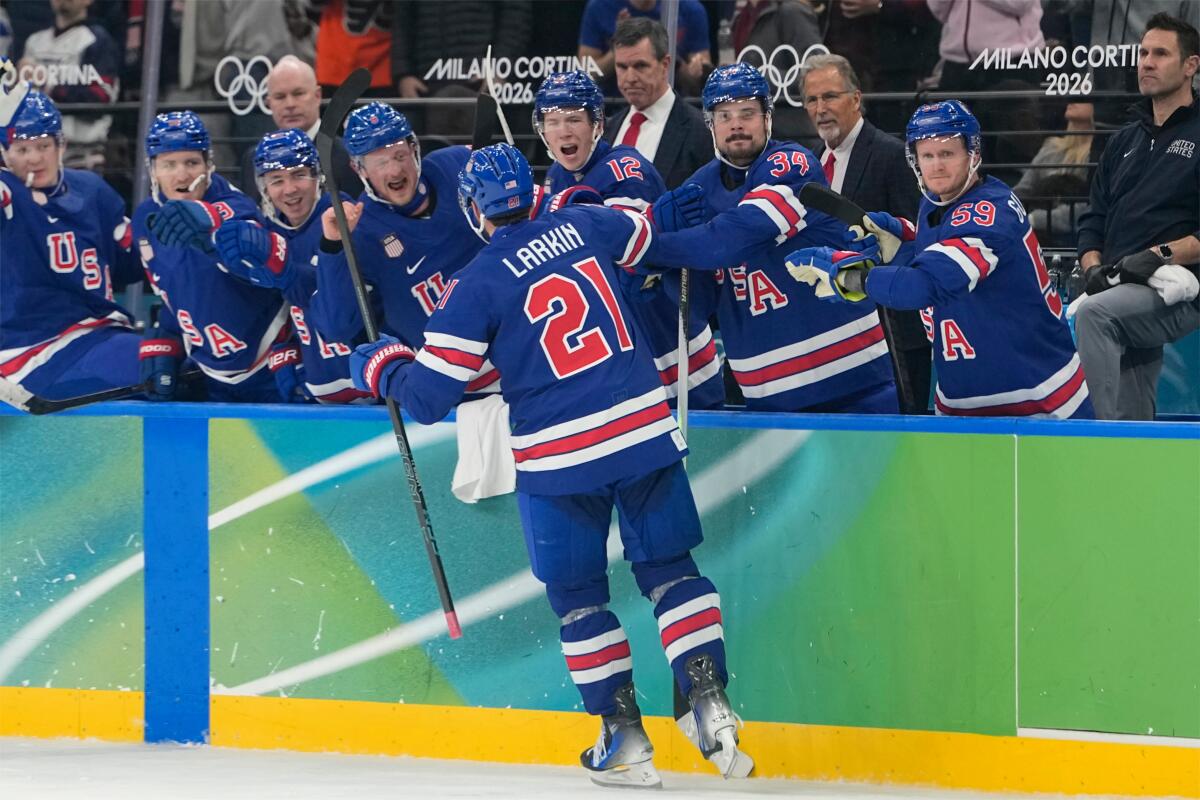
The game began like a heavyweight title fight, with both teams cautiously probing the other for weaknesses. The U.S. finally found one midway through the second period with Larkin deflecting in a one-timer from Jack Hughes at the blue line. Hughes’ shot was headed directly into the pads of Markstrom, who was perfectly positioned for an easy save, before Larkin, perched on the doorstep, reached out to deflect the puck by Markstrom on his gloved side.
The Americans haven’t trailed since the middle of the second period of their second game. But losing a lead with just 1 ½ minutes to play tested the team’s “character, just the will to win,” forward Brady Tkachuk said.
“That’s something that can deflate you and end your tournament, if you don’t just put your mind back in a good spot,” he added. “It shows the character being able to bounce back get that one.”
“That’s a big momentum shift. But there wasn’t any panic,” Charlie McAvoy added. “I got back to the bench [and] it’s just you’ve got to flush it. That was kind of what I was saying to myself. It’s a tie game now.”
Dylan Larkin (21) is congratulated by U.S. teammates on the bench as he skates off the ice after scoring a goal against Sweden during the second period Wednesday.
(Hassan Ammar / Associated Press)
It didn’t stay that way for long before Hughes broke Sweden’s heart, beating Markstrom cleanly. Markstrom was otherwise spectacular, making 38 saves — two with his helmeted head and probably deserved a better fate.
In the last two Olympic tournaments the Americans, playing without NHL players, were bounced in the quarterfinals while Canada got no further than the bronze-medal game. The top pros didn’t participate in the 2018 Games because of a dispute between the NHL and the International Olympic Committee regarding insurance, travel costs and marketing rights. They were held out four years ago over scheduling complications caused by the coronavirus pandemic.
Not surprisingly, getting some of the best players in the world back has made a difference, with the unbeaten Canadians rolling to a tournament-best plus-18 goal differential while the averaged 4 1/2 goals a game in their four wins.
“It’s been unreal,” Hanifin said of the tournament. “It’s so fun to be a part of. Anytime you get into these one-game eliminations, anything can happen so you’ve got to be to be prepared.
“But that’s part of what makes the Olympics so special and hard to win.”
Canada’s comeback spoiled good performances by a pair of Anaheim Ducks. Defenseman Radko Gudas got an assist on the Czechs’ first score while NHL teammate Lukas Dostal turned away 37 shots in goal. But Montreal Canadiens’ captain Nick Suzuki got a fortunate bounce on a deflection to tie the score with 3:27 left in regulation before Vegas’ Mitch Marner scored the game-winner 82 seconds in overtime for Canada, which led for less than six minutes.
On his way to the dressing room, Gudas picked some snow off the ice and kissed it. At 35, this was his second and likely last Olympic tournament.
“It’s a mix of emotions, because you feel sad but proud in the same time,” said Dostal, who was playing in his first Olympics. “It hurts. It’s probably gonna hurt for a long time.”
The victory might have come at a high cost for Canada, which saw captain Sidney Crosby limp to the dressing room in the second period following a collision with Gudas along the boards. Crosby, who has two goals and four assists in the tournament, will undergo an MRI exam on Thursday; his status for Friday’s semifinal is unknown.
For the U.S. and Canada, two more wins brings a gold medal while a loss Friday means that dream is over.
“It’s a one-game tournament,” Canada’s Tom Wilson said. “It’s not seven games. It’s a one-game tournament. And everybody thinks they can win.”