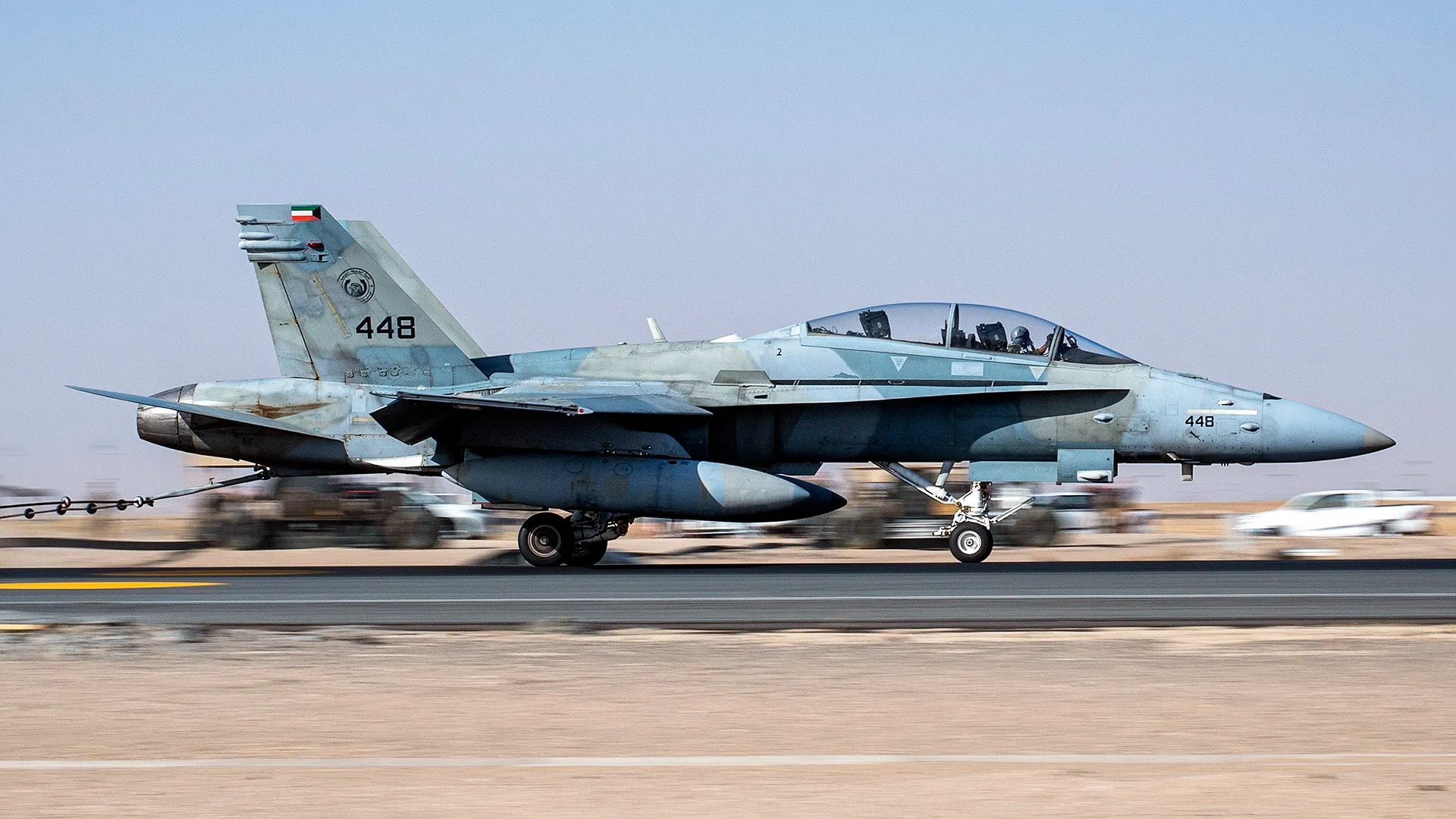
“Both aircraft were recovered intact,” a Navy official told TWZ on Tuesday morning.
“All recovered aircraft components are being transported to a designated U.S. military installation in the Indo-Pacific region for detailed analysis,” the Navy’s 7th Fleet also said in a press release. Officials have not released details about exactly where in the South China Sea the aircraft went down and were subsequently retrieved.
A U.S. Navy F/A-18F Super Hornet deployed aboard the aircraft carrier USS Nimitz in 2020. (U.S. Air Force photo by Staff Sgt. James Merriman) An MH-60R Seahawk helicopter. (USN)
The retrieval effort was conducted by Commander, Task Force 73 (CTF 73); Task Force 75; the Naval Sea Systems Command’s Supervisor of Salvage and Diving (SUPSALV); and CTG 73.6’s Mobile Diving and Salvage Unit, according to the Navy’s release. Task Force 73 is responsible for logistics activities within the 7th Fleet’s area of responsibility, while Task Force 75 oversees diving and salvage units and other expeditionary capabilities.
In addition, the Navy says it employed a “contracted Vessel of Opportunity, equipped with a government-owned, contractor-operated unmanned system, to lift and recover the aircraft.” The 7th Fleet release did not name that ship, and we have reached out for additional details. Contracted vessels have assisted in the recovery of U.S. military aircraft in the past, including in the South China Sea.
On Nov. 20, the Navy had told TWZ that the USNS Salvor (T-ARS 52), a Safeguard class salvage ship operated by Military Sealift Command, was “on-scene conducting operations in support of the recovery efforts.” It is unclear at the moment what role that ship might ultimately have played in retrieving the lost aircraft. It was seen docked in Singapore on Dec. 7, according to the MarineTraffic ship tracking website.
(U.S. Coast Guard photo by Air Station Barbers Point Public Affairs/Released)
“This recovery was a true Navy team effort across CTF 73, SUPSALV, Task Force 75, HSM 73 [Helicopter Maritime Strike Squadron 73], VFA 22 [Strike Fighter Squadron 22], and our Mobile Diving and Salvage Unit,” Navy Lt. Cmdr. Christopher Andersen, the CTF 73 officer who led the salvage mission, said in a statement. “Everyone involved brought critical expertise ensuring we could safely and successfully bring these aircraft back under U.S. custody. This operation highlights the importance of naval integration, readiness, and the unmatched capability of our salvage and diving teams.”
As we have previously noted, the tense and contested nature of the South China Sea and its proximity to China would have put additional emphasis on ensuring the aircraft, or components from them, were not recovered by the Chinese. Like the United States, China has foreign materiel exploitation, or FME, programs aimed at recovering weaponry for intelligence analysis and developmental purposes. Both crashed Navy aircraft have a number of sensitive components that would be of particular interest to a major global competitor like China. You can read more about that here.
The aircraft from Nimitz that went down in the South China Sea were recovered a day after the Navy released results of investigations into the separate losses of three F/A-18s from the aircraft carrier USS Truman. Those incidents included one in which a Super Hornet was shot down by the Ticonderoga class guided missile cruiser USS Gettysburg. Unlike the case of the Nimitz aircraft, those jets were never recovered, a Navy official previously confirmed to us.
The cause of the crashes of the Nimitz aircraft in October remains unknown. President Donald Trump previously suggested that the mishaps could have been caused by “bad fuel,” and you can read more about potential fuel issues in our initial coverage here. Navy officials have also previously confirmed to us that they believe there are no “nefarious” circumstances behind the crashes.
With the F/A-18F and MH-60R now recovered, the investigations into their crashes are continuing, the Navy said on Tuesday.
Weekly insights and analysis on the latest developments in military technology, strategy, and foreign policy.
On the approach to land on the aircraft carrier Harry S. Truman, the F/A-18F Super Hornet’s pilot looked out the canopy and saw a Standard Missile-2 (SM-2) launched from the Ticonderoga class guided missile cruiser USS Gettysburg speeding through the sky. At first, the pilot thought the missile was aimed at a Houthi drone or cruise missile, one of several fired at the carrier strike group on Dec. 22, 2024, during an attack from the Yemeni rebel group. But as the SM-2 drew closer and changed its course toward the Super Hornet, configured as an aerial refueler, the crew knew it was heading straight for them. However, they had no way of knowing that on the Gettysburg, their jet had been identified as a Houthi anti-ship cruise missile like others fired at the strike group, and thus a threat.
What happened next, the cascading series of problems that led up to it, and efforts to correct those issues are laid out in a Navy investigation report released Thursday. The investigation was one of four conducted into mishaps aboard the Truman during its troubled deployment to the Middle East. There were two additional Super Hornet losses and a collision with a merchant ship. You can read more about that in our initial story about the investigations here.
An F/A-18F Super Hornet, attached to the “Red Rippers” of Strike Fighter Squadron (VFA) 11 aboard the Truman refuels an F/A-18E Super Hornet, attached to the “Sunliners” of Strike Fighter Squadron (VFA) 81, Jan. 22, 2022. (Photo courtesy of Strike Fighter Squadron 11) USS Harry S Truman
“Are you seeing this?” the F/A-18F pilot asked the Weapons Systems Officer (WSO) as the missile came dangerously closer shortly before 2 a.m. local time.
As the stricken fighter’s crew headed down to the water and their eventual rescue, the crew of a second Super Hornet was approaching the carrier a minute later for a landing. That crew saw the explosion from the missile detonation on the first jet, which had just given them fuel a short while earlier. Then they saw another missile from the Gettysburg launch and make a course correction toward their aircraft. They briefly considered ejecting as well.
“Give it one more second,” the pilot told WSO as he hit the afterburners to try to speed past the threat. “I have my hand on the [ejection] handle.”
Aviation Structural Mechanic (Equipment) 3rd Class Jay Andrada, from Ilocos Norte, Philippines, checks the ejection safety pin on a seat in an F/A-18F Super Hornet, assigned to the “Fighting Swordsmen” of Strike Fighter Squadron (VFA) 32, in the hangar bay aboard the aircraft carrier USS Dwight D. Eisenhower. (U.S. Navy photo by Mass Communication Specialist 3rd Class Ashley M.C. Estrella) Petty Officer 2nd Class Ashley Estrella
Seeing the motor of the incoming missile burn out, the pilot paused. The missile continued its course upward, but passed about “one to two plane lengths behind the aircraft,” the pilot said. As the Super Hornet shook from the resulting turbulence, its crew watched the SM-2 crash harmlessly into the water before they landed safely on the carrier.
Both friendly fire incidents were the result of several factors and came as the Truman CSG was engaged in one of the Navy’s fiercest battles since World War II. The incident took place just seven days after the strike group entered the Red Sea and just hours after it launched its first attack on Houthi targets in Yemen. That was followed by what crew on the Gettysburg said was an “earlier than expected” response from the Houthis in the form of a volley of drones and anti-ship cruise missiles fired at the strike group, adding additional stress to the crews and the equipment they had to rely on.
A myriad of issues, some systemic, contributed to the shootdown and the near miss. How all these factors could have combined to cause the friendly fire incident is something we examined in a deep dive back in January about the stresses the Red Sea deployments were putting on Navy surface combatants’ Combat Information Center (CIC), the nerve center and tactical brain of those vessels.
Sailors assigned to the Arleigh Burke class guided-missile destroyer USS Carney man their watch stations in the combat information center (CIC) during a general quarters drill, October 14, 2023. C (U.S. Navy photo by Mass Communication Specialist 2nd Class Aaron Lau)
One factor that led to the so-called blue-on-blue incidents was “a lack of re-integrated training opportunities between USS Gettysburg and the carrier strike group,“ a senior Navy officer (SNO) told a small group of reporters, including from The War Zone, on Thursday afternoon. Amid the ongoing fights with the Houthis, the Gettysburg left the Truman, only returning to the Red Sea three days before shooting at the Super Hornets. As the strike group’s air defense command, the Gettysburg played a vital role in protecting the ships, but had limited time working to synchronize operations and didn’t take part in the pre-mission planning for the Dec. 21 attack on the Houthis.
That time apart “contributed to the misidentification and subsequent engagement of the US Navy aircraft,” the SNO explained. “This was manifested through non-following procedures, lack of forceful backup on the cruiser and lack of cohesion across striped units.”
“It is important to note that over the immediate 45 days prior to the incident, [Gettysburg] only operated with the [strike group] 15 percent of the time (seven of 45 days),” investigators concluded.
The Ticonderoga class guided-missile cruiser USS Gettysburg. (USN) Cmdr. Scott Miller
Beyond that, key crew members on the ship “failed to execute” the proper steps that would have prevented firing on friendly jets, a Navy Surface Officer (NSO) posited. There was confusion about what the Gettysburg crew was firing at, and calls to ceasefire were ignored or unheard, the report explained. The carrier and cruiser gave aircrews conflicting information. On top of all that, the Gettysburg‘s embarked MH-60R Seahawk helicopter was landing, requiring the ship’s SPY-1 radar coverage to be reduced until shortly before the engagements. In addition, the E-2D Hawkeye airborne early warning and control aircraft operating overhead at the time had problems with its radar.
Meanwhile, exacerbating the situation was the fact that, not only did these crew members fail to take the proper actions, but they were also dealing with faulty systems, according to the investigation.
There were numerous problems with the Link 16 tactical datalink system used for the exchange of related positioning, surveillance, weapons coordination, and air control information.
“In the weeks and hours prior to the friendly fire engagement, Link 16 performance on [Gettysburg] was noticeably degraded,” investigators found. The ship “suffered numerous losses of Link 16 during the days/hours before the friendly fire engagement.”
The Identification Friend Or Foe (IFF) system proved even more problematic, going on the fritz several times during this cruise.
“Multiple watchstanders stated that {Gettysburg] had frequent IFF [problems]…suffering from several types of intermittent failure manifesting as stale IFF video, IFF not displaying M5 video, IFF not correlating with CEC, and IFF spiral tracks…,” according to the investigation.
Navy Petty Officer 2nd Class Carren McMillan adjusts and aligns an Identification Friend or Foe transponder for an aircraft aboard the USS Theodore Roosevelt (CVN 71) while underway in the Atlantic Ocean. (DoD photo by Airman Stephen Early, U.S. Navy. (Released)) Master Sgt. Ray Aquino
Adding to the problems, information about these system failures was not properly reported up the chain of command. The watchstanders on duty at the time of the shootdown, for instance, did not know the IFF system, which would have properly identified the Super Hornets, was not working
Some of these technical problems existed on many surface combatants, especially involving the Aegis Weapon System, a centralized, automated, command-and-control (C2) and weapons control system allowing warships to deal with the massive volumes of air and sea surrounding them.
“We’ve had over 30 of our surface warships involved in these sustained combat operations,” the NSO stated. “There have been a number of Aegis Weapon System [software code issues] that have been identified that pose levels of risk to that team as they’re executing combat operations, primarily defensive combat operations.”
“Specific to the Gettysburg incident,” the NSO added, “the interoperability piece that has been associated with the Identification Friend or Foe, we discovered that was not just a cruiser issue. That was across the board, and we worked aggressively to identify it and then to get that software fixed, and our industry partners were committed to executing that, and we’re on a path to burn down that technical debt across the board.”
All told, “we’ve invested over $55 million since this incident to correct those Aegis Weapon System deficiencies,” the SNO pointed out. “And I will tell you, over the last two years, our industry partners have demonstrated their commitment and their ability to rapidly correct these software deficiencies, and it’s been very impressive.”
The friendly fire incident has also spurred a wide-ranging retraining effort.
Regardless of the system failures, the Navy investigation held the Gettysburg’s commanding officer responsible for shooting down one Super Hornet and narrowly missing another.
“The decision to shoot was wrong when measured against the totality of information available to the [Gettysburg’s commanding officer],” the investigation determined. “Constrained by a series of previous actions/decisions (both in and beyond his control), the [commanding officer] had low situational awareness, and his CIC team was unable to help him regain it.”
The combat information center (CIC) aboard a modernized U.S. Navy cruiser. (U.S. Navy)
Moreover, the “totality of the circumstances, including the deficient condition of the [Gettysburg’s) (IFF, CDEC and Link 16 PPLI issue), deficient unit and force watchstander proficiency, and possessing the ability to have understood and mitigated both, conclude that the [Gettysburg commanding officer’s] decision to engage was neither responsible nor prudent, and could have been prevented by action at multiple levels.”
A little more than a month later, that commanding officer, Capt. Justin Hodges was relieved and replaced by Capt. John Lucas. However, Hodges’ name appears nowhere in the investigative report.
Despite the many problems that contributed to the friendly fire incident, the Navy redacted the names of those responsible and any punishments they may have received. The same blackout was true for the other three investigations about mishaps aboard the Truman as well.
At the press conference, Navy officials stood by their decision to keep that information from the public.
“I assure you that accountability actions were taken across all the operators involved in this,” the SNO explained. “I don’t feel an obligation to publish those results to the world. I am here to tell you that everyone from the top commanders up to me…reviewed those actions and deemed them to be appropriate.”
“Each investigation was conducted independently and thoroughly, in accordance with Navy policy, immediately following the incidents,” the Navy said in a release. “Appropriate accountability actions have been taken to address these incidents.”
The summary of these investigative findings can be found below:
USS Gettysburg Friendly Fire Incident
On Dec. 22, 2024, an F/A-18F Super Hornet assigned to Strike Fighter Squadron (VFA) 11 was shot down by the Ticonderoga class cruiser USS Gettysburg as jets were returning to the supercarrier.
The Ticonderoga class cruiser USS Gettysburg. (USN)
At the time of the incident, the Truman Carrier Strike Group (CSG) was in the Red Sea and under fire from the Houthis. The CSG “shot down two anti-ship cruise missiles (ASCM) and two one-way attack uncrewed aerial vehicles (OWA UAV) with reports of other OWA UAVs in the air,” a U.S. official told us at the time, adding that the aircraft had yet to be recovered. “The wreckage has not been located and is likely at the bottom of the Red Sea. Both crew members were successfully recovered and are back on the USS Harry S. Truman. Initial reports are that one of the crew members has minor injuries. Both have been evaluated and released from medical.”
An F/A-18F Super Hornet, attached to the “Red Rippers” of Strike Fighter Squadron (VFA) 11, lands on the flight deck of the Nimitz-class aircraft carrier USS Harry S. Truman (CVN 75). (U.S. Navy photo by Mass Communication Specialist Seaman Michael Gomez) Seaman Michael Gomez
Naval Air Force Atlantic (AIRLANT) separately told us that the two-seat F/A-18F Super Hornet had been “performing a refueling mission” at the time of the friendly fire incident. Super Hornets can be configured to serve as refuelers in addition to fighters. The jet was reportedly hit by a Standard Missile-2 (SM-2) interceptor.
According to a summary, the investigation found “that a lack of integrated training opportunities between USS Gettysburg and the Carrier Strike Group, lack of forceful backup on the cruiser, and lack of cohesion across the Carrier Strike Group contributed to the misidentification, and subsequent engagement, of the friendly aircraft and near miss of another. There were no personnel casualties or major injuries.”
Collision with Merchant Vessel Besiktas-M
On Feb. 12, the Truman was involved in a collision with the merchant vessel Besiktas-M at approximately 11:46 p.m. local time, while operating near Port Said, Egypt, in the Mediterranean Sea.
“The collision did not endanger the Harry S. Truman (CVN 75) as there are no reports of flooding or injuries,” the Navy said at the time. “The propulsion plants are unaffected and in a safe and stable condition. The incident is under investigation. More information will be released as it becomes available.”
A photo taken after the incident showed multiple large tears through a sponson on the starboard side of the stern end of the ship near one of the aircraft elevators. It was unknown at the time whether there was damage elsewhere.
Damage inflicted on the Truman after its collision with a merchant ship. (USN)
In October, a photo taken of the ship during an event with President Donald Trump showed that the damage had been painted over. The Navy told us that repairs would be made during the ship’s planned Refueling Complex Overhaul (RCOH) at Newport News Shipbuilding. “Immediately following the collision, while in Souda Bay, Greece, new bulkheads were installed inside each of the damaged spaces to establish weathertight integrity.”
The Navy painted over damage to the Truman after its collision. (Via X) Via X
The Navy investigation found: “that the collision was avoidable. The carrier’s bridge team failed to safely navigate past the merchant vessel. No personnel or engineering casualties occurred on either vessel. The Navy relieved [Capt. Dave Snowden] the commanding officer of the USS Harry S. Truman in February due to a loss of confidence in his ability to command.”
“Following the collision, the Harry S. Truman pulled into U.S. Naval Support Activity Souda Bay, Greece. While in port, Forward Deployed Regional Maintenance Center personnel, Norfolk Naval Shipyard, and local industry partner Theodoropoulos Group removed exterior portions of the damaged ship and installed bulkheads inside each of the damaged spaces for weathertight integrity. Following the repairs, the Harry S. Truman returned to the Red Sea to resume combat operations. Complete repair of the damage is scheduled during the ship’s upcoming Refueling and Complex Overhaul at HII-Newport News Shipbuilding.”
Snowden was relieved on Feb. 20. Capt. Christopher Hill, commanding officer of USS Dwight D. Eisenhower (CVN 69), was temporarily assigned as Truman’s interim commanding officer.
Loss of F/A-18E Super Hornet and Tow Tractor
On April 28, an F/A-18E Super Hornet from VFA-136 fell off the side of the Truman while the ship was conducting evasive maneuvers in response to incoming Houthi threats, a U.S. official told TWZ at the time. A tow tractor that had been moving the aircraft also went over the side in the incident, in which thankfully only a single sailor suffered minor injuries. The Super Hornet was under tow in the hangar bay when the deck crew lost control of the aircraft, the Navy later said in a release. “The aircraft and tow tractor were lost overboard. Sailors towing the aircraft took immediate action to move clear of the aircraft before it fell overboard. An investigation is underway.”
Navy supercarriers like Truman are capable of making sharp and high-speed turns for ships of their size, including an evasive tactic, as seen in the video below.
In its investigation, the Navy found that the Super Hornet and tow tractor were lost “during evasive maneuvers in response to an incoming ballistic missile in the Red Sea. While all actions taken were within standard operating procedures, the investigation determined that the primary cause was an aircraft brake system failure, compounded by insufficient communication between the bridge, flight deck control, and hangar bay control. The crew’s quick thinking and resourcefulness prevented any personnel injuries or further damage.”
Failure of Arresting Wire Leading to Aircraft Loss
On May 6, 2025, an F/A-18F Super Hornet from VFA-11 crashed into the sea during its attempt to land. Both the pilot and the Weapon System Officer (WSO) were able to eject and were recovered by helicopter with only minor injuries. TWZ has confirmed that the arrestment failed on touchdown and the jet careened off the deck. MH-60 Seahawk squadron HSC-11 made the rescue.
Landing Signal Officers (LSO) watch as an F/A-18F Super Hornet, assigned to Strike Fighter Squadron (VFA) 106, prepares to make an arrested recovery aboard the Nimitz class aircraft carrier USS Harry S. Truman (CVN 75). (USN) MCSN Kevin T. Murray; Jr.
The subsequent investigation found that the jet was lost “following the failure of the #4 arresting wire aboard Truman. The investigation found the failure was caused by a malfunctioning #4 starboard sheave damper. Contributing factors included inadequate maintenance practices, low manning levels, limited knowledge, and insufficient training. The high operational tempo and combat conditions also contributed to a strained environment. No injuries occurred, and flight operations resumed within hours.”
“These investigations assessed underlying procedural compliance and standards and reviewed how a Carrier Strike Group prepares for and responds to adversity during combat operations,” the Navy said Thursday in its release. “Vice Chief of Naval Operations Adm. Jim Kilby emphasized the Navy’s commitment to learning from these events and implementing changes to prevent similar incidents in the future.”
Despite these incidents, the “Navy’s sustained combat operations in the U.S. Central Command area of operations for the past two years demonstrated our battle effectiveness and ability to maintain freedom of navigation,” Kilby explained. “As we reflect on these incidents and ongoing improvement efforts, the Navy remains laser-focused on producing battle-ready Sailors and forces to ensure the Navy provides our nation with the most lethal, combat-credible, and ready force possible.”
The four investigations “reinforce the need to continue investing in our people to ensure we deliver battle-ready forces to operational commanders,” Kilby added. “Despite the challenges, the Sailors of the Harry S. Truman Strike Group demonstrated adaptability, professionalism, and complete commitment to the mission throughout the deployment.”
More information about these investigations was revealed during a media roundtable with Navy officials at 1 p.m. We will update this story with any pertinent details provided.