Home Office

British Airways’ ‘fully booked’ update as Middle East travel chaos continues

British Airways has warned all services from Oman up until March 7 are now fully booked as the scramble to return from the Middle East continues amid regional tensions

British Airways has issued a warning that flights returning to the UK are ‘fully booked’ as the rush to get back from the Middle East intensifies.

In its most recent public statement, the UK’s flag carrier cautioned that all services departing from Oman through to 7 March are now completely full.

“Flights from Muscat on 5, 6 and 7 March are now fully booked. We will continue to review the situation and, if we are able to, we will add additional services,” a BA spokesperson stated at 2.14pm on Wednesday.

Oman is the nearest nation to major hubs, including Dubai and Abu Dhabi, with accessible airspace. Out of the 136 flights scheduled to depart from Oman today, just 14 have been axed so far. This stands in stark contrast to the UAE, Bahrain, Kuwait, Iraq and Lebanon, where most flights remain grounded.

READ MORE: Majorca set to introduce new cap on tourist numbers over summer monthsREAD MORE: FCDO travel advice updated for Thailand, Dubai and 8 other countries amid Iran tensions

The latest guidance from BA reads: “We remain unable to operate flights from Abu Dhabi, Amman, Bahrain, Doha, Dubai and Tel Aviv. We have scheduled further flights from Oman (Muscat) to London Heathrow departing on 6 and 7 March.

“Flights are for our customers with an existing booking who are in Oman or the UAE. If you wish to travel on one of these flights, please contact us via our dedicated phone line on +44 203 467 3854. Our teams will also be getting in touch with our customers.”

One BA flight bound for London Heathrow left Muscat after just a short delay this morning. Another is scheduled to leave at 2.30am local time tomorrow, and a third at the same time on Saturday.

Home Office minister Alex Norris has announced that a Government-chartered plane, which failed to depart from Muscat, is now scheduled to leave for the UK on Thursday.

However, he was unable to provide an exact departure time.

Mr Norris expressed confidence that the first Government rescue flight departing Oman amidst the escalating conflict in the Middle East would take off on Thursday, following an overnight delay. When questioned by LBC about the reason for the delay, he explained: “It didn’t take off because there are operational reasons… about getting passengers on board, and it wasn’t able to happen in the time that it had to happen. So that’s now going to go today instead.”

Earlier on BBC Breakfast, Mr Norris said: “We made sure we got them (the passengers) hotel rooms for the night as well, and we are facilitating and rebooking today’s flight. We hope that they do, and there’s multiple flights after it as well.”

In other news, Defence Secretary John Healey is en route to Cyprus in an attempt to defuse tensions with the island’s government following a drone strike on the British base RAF Akrotiri.

Mr Healey is expected to land in Cyprus later on Thursday. His visit follows the Cypriot high commissioner to Britain expressing his disappointment at the UK Government’s response to defending the island.

On Monday night, a hangar at RAF Akrotiri was struck by an Iranian-made Shahed drone, launched from Beirut in Lebanon, according to Cypriot officials. Two further drones detected on Monday were sh.

Shot down by British warplanes that took off from Akrotiri.

The UK has deployed air defence destroyer HMS Dragon to aid in the protection of Cyprus, although the Type 45 warship isn’t expected to set sail until next week.

Wildcat helicopters equipped with anti-drone capabilities have also been sent to the island and are anticipated to arrive this week.

In other developments in the conflict:

– Iran’s ambassador Seyed Ali Mousavi was summoned by the UK Government on Wednesday.

– A US submarine sank an Iranian warship in the Indian Ocean.

– Iran persisted in launching attacks at countries across the region, with Saudi Arabia and Kuwait targeted with missiles and drones.

– Western officials reported that the rate of Iranian missile strikes had declined, estimating that Tehran had several more days of capability to continue based on the current firing rate – although they warned that the decrease could also be a result of Iran trying to conserve its stockpiles.

– Turkey reported that a “ballistic munition” launched towards it from Iran was intercepted by Nato air defences.

– Economic uncertainty continued over the conflict in a region that plays a crucial role in international oil and gas supplies.

Source link

New rule on Wednesday for a million Brits means new passport or £589 fee

Some British nationals could face problems at the border when the change begins on February 25, 2026

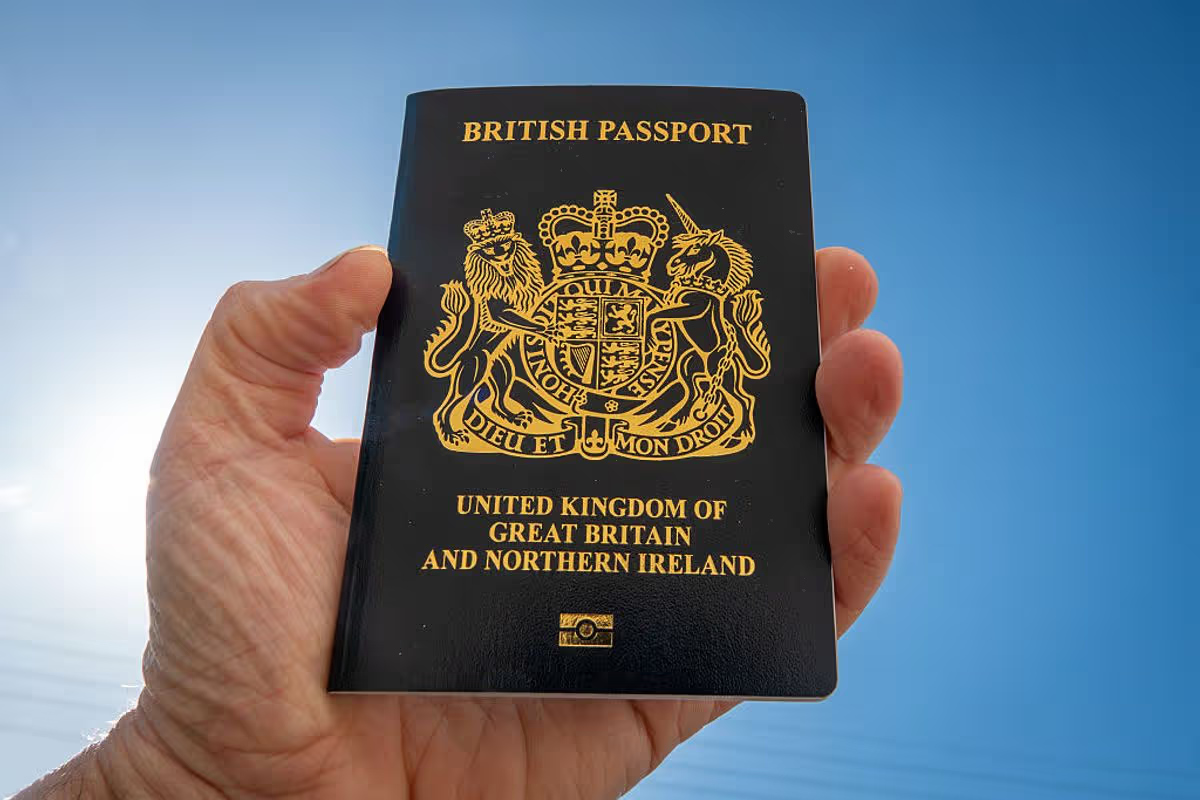
A cluster of UK citizens are bracing themselves for the prospect of obtaining a new passport or shelling out hundreds of pounds due to an impending border change set to kick in on Wednesday. Dual British nationals, including children, could be denied entry into the UK unless they hold a British passport, under fresh regulations slated to come into force later this month.

An estimated 1.2 million dual British citizens are scattered across the globe. From February 25, 2026, those journeying to the UK will need an Electronic Travel Authorisation (ETA). Travellers without an ETA will be prohibited from boarding their flight, ferry or train.

British and Irish citizens, which includes dual nationals, are exempt from this requirement but must adhere to other stipulations. To travel to the UK, dual nationals will now require a valid British passport.

Alternatively, they can fork out £589 for a certificate of entitlement to attach to their second nationality passport. In the past, dual nationals were able to enter the UK using their non-British passport at no cost.

Dual nationals attempting to gain entry to the UK solely with a foreign passport may face hurdles. Although British citizens have a legal right to reside in the UK, travellers could be subjected to extra scrutiny while their status is verified. They might also be barred from boarding if they fail to prove their right of entry.

The Government rolled out these regulations last year, but numerous dual nationals have argued the changes arrived with insufficient warning and inadequate communication. Anxiety is growing that getaways or work journeys could face disruption if people don’t obtain a passport or certificate of entitlement quickly enough.

Why have ETAs been introduced?

ETAs have been brought in as part of wider plans for a “more streamlined, digital immigration system” which the Government expects will be faster and more secure for the millions crossing the UK border each year. It’s a digital travel authorisation – not a visa or levy, simply granting someone permission to travel to the UK.

Government officials maintain that introducing ETAs mirrors the approach numerous other countries have taken for border security, such as the US and Australia.

At present, an ETA costs £16 and permits multiple journeys to the UK for stays of up to six months at a time across a two-year period. There are plans to raise the charge to £20 down the line.

A Home Office spokesperson said: “From February 25, 2026, all dual British citizens will need to present either a valid British passport or certificate of entitlement when travelling to the UK. Without one, carriers cannot verify they are a British citizen, which may lead to delays or refused boarding.

“Public information advising dual nationals to carry the correct documentation has been available since October 2024 and a substantive communications campaign about the introduction of ETA has been running since 2023. This requirement applies to all British citizens regardless of other nationality and is the same approach taken by other countries, including the United States, Canada and Australia.”

Source link