Contributor: David Hockney’s paintings gave the world a vision of L.A.
More than any other artist in the 20th century, David Hockney defined Los Angeles in the public imagination. When he first arrived in January 1964, age 26, his mental image of the city had been forged not by art but by Hollywood movies, which he had watched as a young boy in Yorkshire, England. In later life, he often recollected the sharp-edged shadows cast by the Californian sunlight in movies such as Laurel and Hardy’s “Big Business.
Before he ever went to L.A., Hockney — who died Thursday at 88 — knew that he would love it. Writing about his first descent into the city, he recalled how “as I flew over San Bernardino and looked down — and saw the swimming pools and the houses and everything and the sun, I was more thrilled than I’ve ever been arriving at any other city, including New York.” By this time, the glamour of Hollywood had been compounded by other influences, including the homoerotic magazines that an American friend had given him at the Royal College of Art in London. Titles such as Physique Pictorial, published in L.A. by the pioneering “beefcake” photographer Bob Mizer, held out a promise of California as a paradise of rippling men and permanent sunshine. A darker, no less thrilling image of the city had arisen from Hockney’s reading of “City of Night,” the 1963 novel by John Rechy that tells the story of a hustler in the gay underworld of downtown L.A.
Los Angeles itself felt young to Hockney. He loved the light, the architecture, the sense of space and the sense of possibility — not least the possibility of greater sexual freedom. West Hollywood boasted a large gay bar, the Red Raven on Melrose Avenue, that was unlike anything he had found in London or New York. There was also the lure of the beach, with its pageant of sculpted physiques. Venice Beach struck him as a more body-beautiful version of London’s Portobello Road.
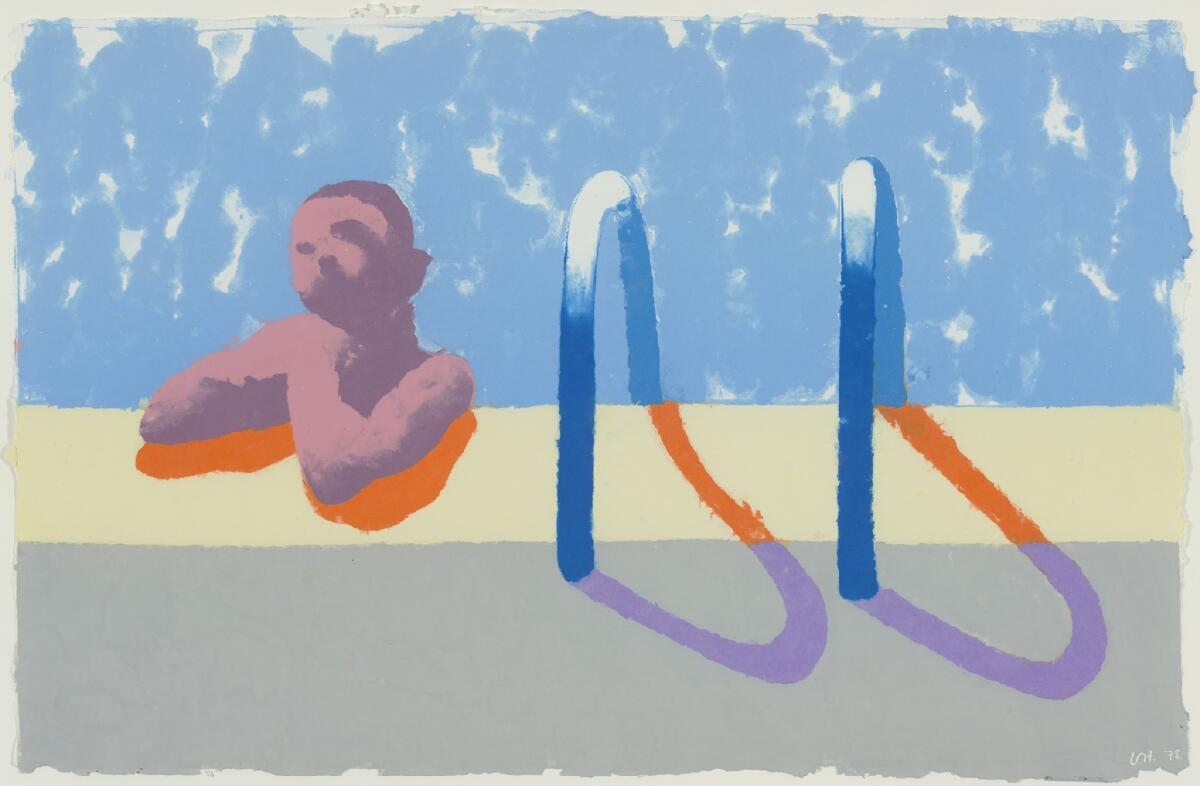
Before long, his work shifted from generic fantasies of the city (a young man showering in Beverly Hills, for instance) to vivid portrayals of its real-life pools, palm trees, architecture and people. American artists such as Edward Ruscha and Edward Kienholz were producing their own canonical images of L.A. in these years, but for Hockney, there were no artistic precedents — “no ghosts,” as he later put it — to live up to. “People then didn’t even know what it looked like,” he once said. “And when I was there, they were still finishing up some of the big freeways.… I suddenly thought: ‘My God, this place needs its Piranesi, Los Angeles could have a Piranesi, so here I am!’ ”
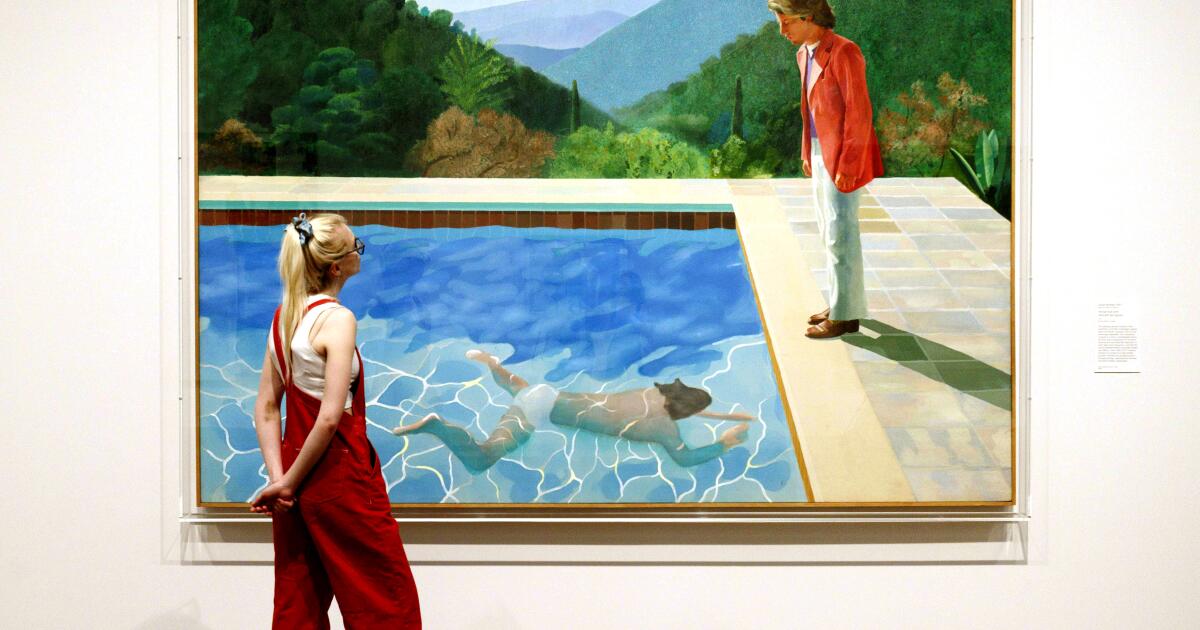
He was true to his word, even if his luminous, serene images of the city were a far cry from Giovanni Battista Piranesi’s feverish visions of Baroque Rome. “Beverly Hills Housewife” (1966), a portrait of a pink-dressed collector in her modernist home, marked the onset of a realist style that would define Hockney’s work for the next decade. This era gave rise to paintings that became icons of their time and place. Among them were “A Bigger Splash” (1967), which was based on a magazine cover that he came across on a newsstand, and “Christopher Isherwood and Don Bachardy” (1968, sold last year at Christie’s New York for $44.3 million). Inspired by Hans Holbein, this portrait of the English novelist and his artist partner was one of the first celebratory portrayals of a gay couple. Hockney would later recount how Isherwood proclaimed: “Oh David, we’ve so much in common; we love California, we love American boys, and we’re both from the north of England.” Hockney’s beloved American boy at this time was Peter Schlesinger, a young artist he had met while teaching at UCLA in the summer 1966 — and a recurring presence in the early L.A. pictures.
According to Norman Rosenthal, who curated a major survey of Hockney’s art at the Fondation Louis Vuitton in Paris last year: “It is astonishing that a boy from a poor family in Bradford became the person — partly because of his gayness, but also his talent — who defined what everybody now thinks of as California. L.A. had no real image in the world before then, unlike New York.”
Despite his enchantment with Los Angeles, Hockney didn’t settle there until 1978, after a decade of bouncing between America and Europe. In the summer of 1979 he moved into a house in the Hollywood Hills, and soon adorned its pool with swishing strokes of blue paint. In the early 1980s, he converted the paddle tennis court into a studio. The meandering routes and Mediterranean scenery of the Hills were a fresh source of amazement, giving rise to monumental depictions of Mulholland Drive and Nichols Canyon in a newly abstract style.
By this time, the city was deeply familiar — a second home — and he had a close circle of friends around him who included the patron Betty Freeman (subject of “Beverly Hills Housewife”), the designer Gregory Evans, the gallery owner Nicholas Wilder and the film producer Joe Simon. “L.A. had represented a whole new world for him,” says Simon, who remained in regular contact with the artist until his final days. “He just loved the light. He was like a kid in a candy store when he first came. But David was all about the work. Everything came back to that.”
In recent decades, Hockney’s name had become synonymous with the landscapes of his native Yorkshire, which he began painting prolifically in the early 2000s. But Los Angeles never lost its newness and promise. His house in the Hills remained a sanctuary until his final years, when he was too frail to travel. L.A. was where he had come of age, and it remained an indelible part of his life and psyche — not least in terms of its egalitarian spirit and its tendency toward the horizontal. “The great thing about Hockney was that he spoke to everybody,” says Rosenthal. “Few artists of his world and his generation could do that.”
James Cahill, a novelist and an art critic, is the author of, among other books, “David Hockney” and the forthcoming “The Beverly Hills Housewife: Hockney’s Californian Muse and the World Beyond the Pool.”