hitter

How Justin Wrobleski went from demotion to All-Star in less than two years

Dodgers left-hander Justin Wrobleski could have been content with his performance the first couple of months this season. After all, he’d come into the year fighting for a rotation spot, and he’d shown in that time that he was ready to be a full-time major-league starter.

That wasn’t enough.

While still holding on to his identity as a pitcher who goes right at hitters, Wrobleski tallied 20 strikeouts over his last two starts of the first half.

“We’re just doing a good job with the plan,” Wrobleski said last week, days before he was named a first-time All-Star. “I feel like I’m continuing to get better at knowing where to go with two strikes, knowing where to go versus a certain hitter with two strikes and just kind of reading the game.”

Wrobleski is the only Dodgers pitcher set to appear in Tuesday’s All-Star Game in Philadelphia. Yoshinobu Yamamoto and Shohei Ohtani pitched too close to the game, and Ohtani eventually pulled out of All-Star activities altogether in order to have his left knee drained on Sunday.

The story of how Wrobleski got there, in his first full season in the rotation after debuting two years ago, includes plenty of twists and turns.

“It’s a chronicle story in his young career, the down to up, but at the end of the day, he’s been a rock for us these first three months,” Dodgers pitching coach Mark Prior said in a conversation with The Times. “Was hoping he got in on the first set of announcements, but at the end of the day, he’s an All-Star, and he’s earned every bit of it.”

When Wrobleski wasn’t included on the initial National League All-Star roster, the Dodgers coaching staff went to work lobbying for him to be a replacement player. Manager Dave Roberts publicly made the case for Wrobleski and closer Tanner Scott whenever he had the chance.

Then, a week later, Wrobleski (10-2, 2.69 ERA) got the call after Cincinnati Reds right-hander Chase Burns bowed out because of tightness in his groin.

“He’s done so many intangible things that I think get lost in the shuffle of numbers and metrics,” Prior said of Wrobleski. “But he’s eaten innings, he’s provided length for us when we needed length. He went toe-to-toe with [Phillies three-time All-Star Zack] Wheeler. He went toe-to-toe with [José] Soriano when he was dealing with the Angels, kept us in ballgames.”

Admittedly, a year and a half ago, Prior wouldn’t have imagined Wrobleski would be an obvious All-Star pick this quickly.

The tipping point came when Wrobleski surrendered eight runs to the Washington Nationals in his first start last season. And it didn’t help that his last start of the previous season was a 10-run slog against the Arizona Diamondbacks.

“It was a long, raw, emotional sit-down with him,” Prior said. He said after the conversation with Roberts, assistant pitching coach Connor McGuiness and the rest of the staff, “we left with like, ‘Which way is this going to go?’”

But persistence has been a hallmark of Wrobleski’s career, dating to his college years, when he infamously bounced back from a car hitting him on a scooter and a baseball breaking his jaw. He also underwent Tommy John surgery two months before the Dodgers selected him in the 11th round of the 2021 MLB draft.

So, committing to a delivery change last season wasn’t all that intimidating.

Wrobleski returned to the majors in mostly a bullpen role. And his steadiness in those shorter outings culminated in a strong postseason run that included four scoreless appearances in the World Series.

“We talk about, who can you depend on to not let the moment get too big?” Prior said. “And I think Wrobo had proved that all the way through September, but clearly proved that the moment is not too big for him to continue to make pitches. And that was exciting to see too as a staff.”

Still, Wrobleski wasn’t guaranteed a rotation role this season. And Prior was frank about that over the offseason.

Wrobleski’s first outing of the season was in relief, but the Dodgers had earmarked him as their sixth starter for the second turn in the rotation.

In his first five starts, Wrobleski posted an eye-popping 0.56 earned-run average.

His swing-and-miss rate and strikeouts were down, but pitching to soft contact was getting him positive results. The most glaring example came against the St. Louis Cardinals in early May, when he threw six shutout innings without recording a punchout.

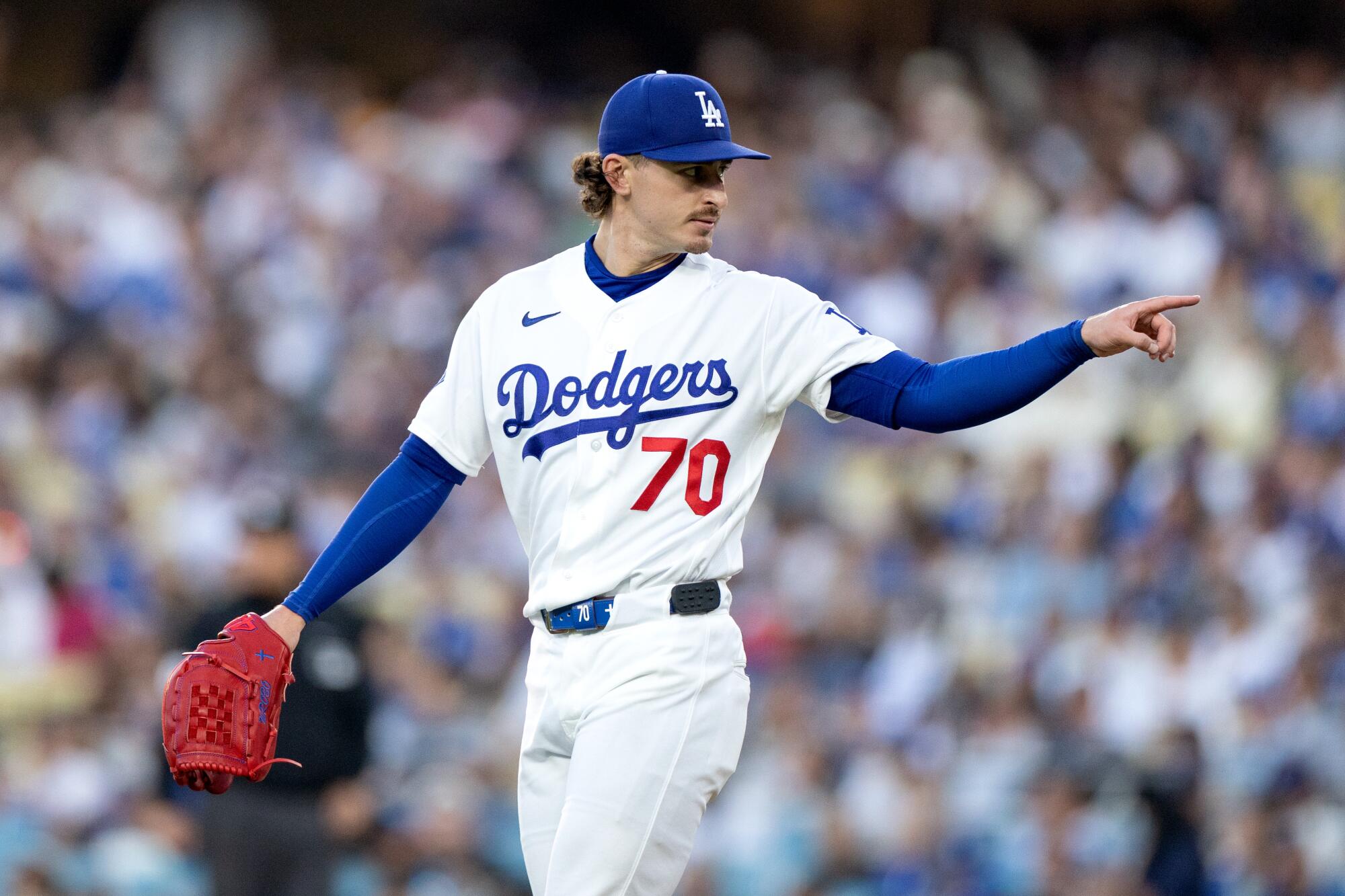
Los Angeles, CA - June 16, 2026: Los Angeles Dodgers pitcher Justin Wrobleski (70) reacts.

Dodgers left-hander Justin Wrobleski recorded 20 strikeouts in his last two starts before the All-Star Game.

(Eric Thayer / Los Angeles Times)

Wrobleski wasn’t going to coast on that early success, however. He kept fine-tuning his delivery and adjusting his pitch mix, right through a rough patch in late May and into a consistent June.

“He went from paring down his arsenal to kind of two pitches, to regrow his arsenal while he’s learning how to pitch at this level,” Prior said. “I think the big thing is now these guys have different looks.”

Wrobleski’s four-seam fastball and slider have done the heavy lifting. The rest of his secondary pitch mix has been a moving target.

He and the pitching coaches have talked through the most effective use of his curveball. He started integrating his sinker more consistently in late April, especially against left-handed hitters. He’s tinkered with different grips for his change-up, a pitch he started using more in mid-May. Three weeks ago, he introduced a sweeper. And in his last two starts, he threw that pitch 19 times.

“At the heart of it, though, is he never lets off the gas pedal,” Prior said. “He just gets the ball, he’s on the rubber, he puts the hitter on defense from the get-go before they’ve even seen a pitch. And that’s something that not everybody can do.”

So, despite the journey, when Wrobleski looks back at the pitcher he was a year and a half ago, he doesn’t see a complete overhaul.

“Same guy but different, I guess,” he said. “It’s crazy. I’ve had to go through a lot of small tweaks and changes. And it’s just all been about just having belief that I could continue to do it. And I knew that there were a lot of things that I could do just to get better, and I wasn’t as far away as maybe it seemed on the outside — or, as people thought it was.

“I felt like I was close that whole time, even though the results weren’t really there. It’s been cool to see the results come.”
Source link

How Max Muncy, vying for third All-Star selection, continues to evolve

As Dodgers third baseman Max Muncy moved fluidly through a chopper at the edge of Camelback Ranch’s infield grass and made a running throw to first, his offseason work started to snap into place.

He wasn’t thinking about the angle he took to the ball, or how to get into the right position to throw — or anything, really. He was just moving instinctively.

“That’s how I like to field it in my work, is not necessarily traditionally,” Muncy told The Times on Thursday. “I like to field it one-handed, sometimes off the wrong foot, sometimes off balance, and that’s what works for me really, really well. I just couldn’t get that into the game. And finally getting those first couple of balls [this spring] to go that way just made everything click in my head and gave me the freedom to know that I can do it when it matters.”

Muncy has put together an impressive all-around first half. His .871 OPS through Thursday leads NL third basemen. He’s on pace for his highest slugging percentage (.513) in five years. But he’s most proud of the work he’s put in on the defensive side.

“I felt like I would show flashes of this, but never the consistency,” Muncy said. “And so to be able to just do it on the consistent daily basis that I’ve been doing this year, that’s easily what I’m most proud of.”

Now, with that well-rounded body of work, he’s in position to claim the third All-Star selection of his career and first since 2021.

Muncy entered Stage 2 of All-Star fan voting this week as the favorite to claim the starting nod at third base, up against fellow finalist Alec Bohm. But voting totals reset, adding some unpredictability to the process. The All-Star starters are set to be revealed Saturday at 4:30 p.m. on Fox.

“In total, the player, the defense, the hitting, the slugging, I think this is the best version of Max,” manager Dave Roberts said. “I’m so happy that he’s leading the All-Star voting.”

Not only is this shaping up to be Muncy’s best offensive season since 2021, it’s the best defensive season of his career, regardless of position.

Entering this weekend’s series against the Padres, he had a fielding run value of plus-five runs, tied with the Giants’ Matt Chapman for the highest mark among third basemen, according to Statcast.

“He’s always been a hitter,” first-base/infield coach Chris Woodward told The Times. “And I think he took it upon himself to say, ‘I’m going to prove to everybody that I’m a really good defensive player,’ which he has been in his time here, but he’s just never had the opportunity to play one position.”

Though Muncy is in his 11th major-league season, and has played all around the infield for most of it, 2022 marked his first season making the majority of his appearances at third base. And 2023 was his first season moving there full time.

He was also limited by injuries in that span. For years, he still felt the effects of the elbow injury he suffered toward the end of 2021. And he strained his right oblique in each of the last two seasons.

“Third base was just a new position for me, and it just took time to learn it,” Muncy said. “And so just trying to get my work to translate into the game is a tough thing to do, and that’s kind of the secret to every aspect of baseball.”

Each infield position is unique, with its own quirks in footwork, angles and timing. Each has plays — like a slow-roller up the third baseline that requires a quick throw across the diamond — that no other position will encounter.

“When a righty gets around the ball, it comes off the bat a lot different than when a lefty gets around the ball,” Muncy said. “And it’s weird how that works, and it’s hard to explain, but that’s just the way it is.”

For much of Muncy’s baseball life he played on the right side of the infield, fielding pull-side contact from left-handed hitters and opposite-field contact from right-handed hitters. That was second nature.

“You have to completely flip that,” Muncy said of playing third base, “and understand which way it’s going to bounce, how it’s going to bounce, how it’s going to get to you. It just took years of experience to finally get to that point.”

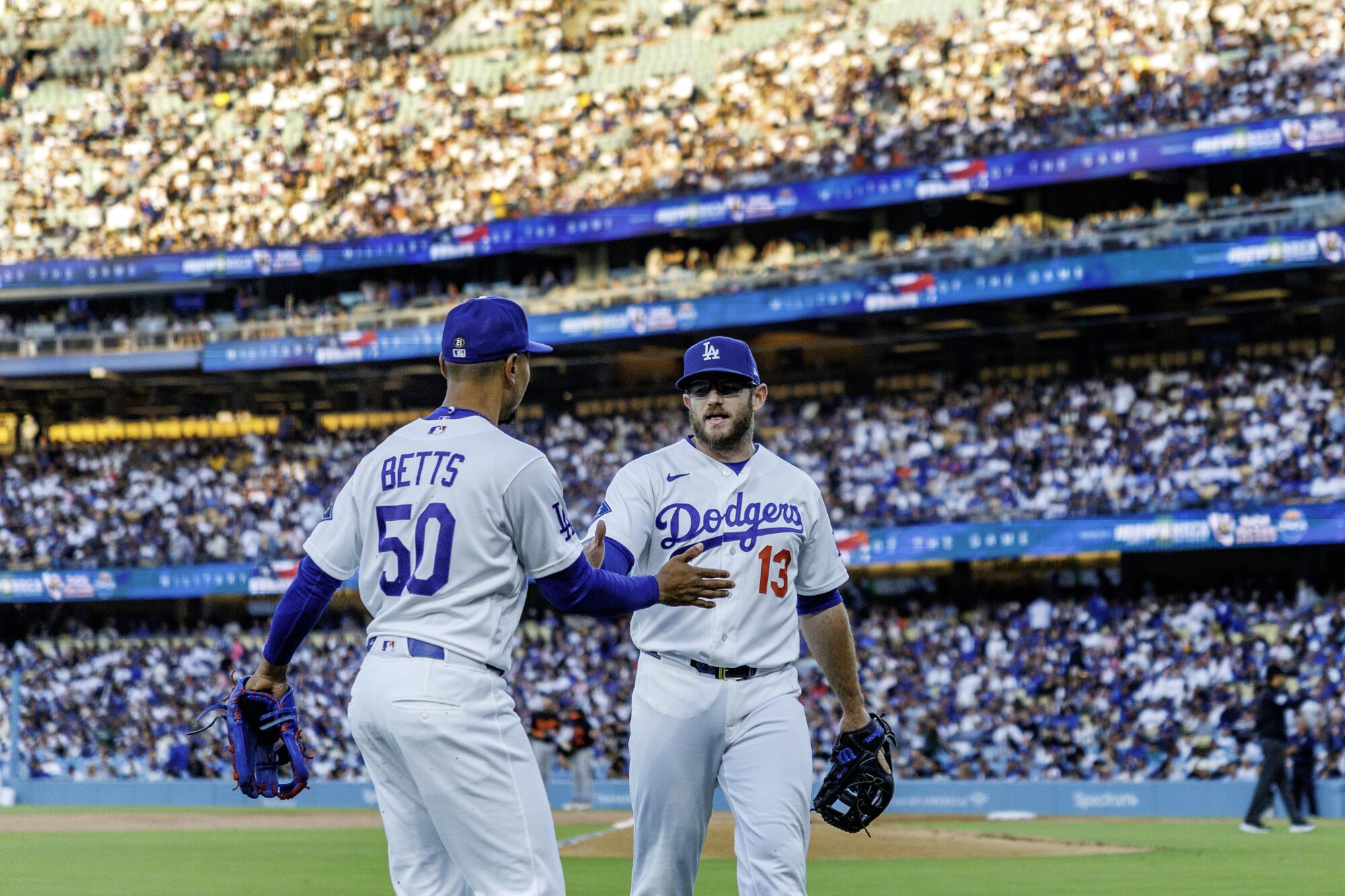
Dodgers shortstop Mookie Betts, left, and third baseman Max Muncy congratulate each other after a defensive play last month.

Dodgers shortstop Mookie Betts, left, and third baseman Max Muncy congratulate each other coming off the field after a defensive play against the Baltimore Orioles on June 19.

(Gina Ferazzi/Los Angeles Times)

Woodward has always been impressed by Muncy’s agility, surprised when the Dodgers first promoted him in 2018 (as he returned to the big-leagues for the first time since being released by the A’s the previous spring) and by how he moved at second base, despite an atypical build for a middle infielder.

Now, after an offseason with a new diet and training program, he may have leveled up that part of his game — even at 35 years old.

“In the past it was a good first step, and he couldn’t sustain his speed,” Woodward said. “And this year I think he can sustain the speed through the ball.”

Said Muncy: “I’m still beating the age curve for now.”

Woodward also noted how good Muncy is at staying on top of the mental side of the game, knowing how specific pitches to different types of hitters should change his positioning. That, along with regular communication, are some of the details that make the Dodgers infield look like it’s moving as a unit — or, as Woodward put it, an “NFL defense” because of the way they swarm to the ball.

The Dodgers’ infield defense as a whole has improved even from last season (No. 6 in fielding run value) to sit in the No. 3 spot in the majors (plus-17 runs) a little past the halfway point of the season.

Muncy unlocking even more potential in the hot corner is a big part of the Dodgers raising their defensive ceiling. That’s helped the Dodgers, who own the best record in the majors, create separation in the standings. But it’ll be even more vital in the postseason, when the margin for error is at its thinnest.

In All-Star voting, defense won’t be the determining factor. Muncy’s increased power at the plate is the far flashier aspect of his case to start the Midsummer Classic. But a well-rounded resume doesn’t hurt.

Muncy can picture it: his three children — Sophie Kate, who turns 5 this month, Wyatt James, 3, and Macie Grace, who was born in January — taking in All-Star weekend in Philadelphia, watching their dad represent the National League.

“Being able to have my kids experience the whole ordeal with me would mean everything to me,” Muncy said. “My oldest is kind of old enough now to remember these types of things, and so I think it’d be really special to just share that moment with them.”

Source link

How UCLA softball leadoff hitter Rylee Slimp manages pressure

UCLA softball coach Kelly Inouye-Perez expected sophomore Rylee Slimp to deliver under pressure.

Slimp earned first-team all-Big Ten honors as the leadoff hitter for a Bruins team that features slugging stars Megan Grant and Jordan Woolery. She leads a group of underclassmen who helped send UCLA to the Women’s College World Series.

“I have seen Rylee Slimp just play big from travel ball to big moments in high school, and she came here to play on this big stage,” Inouye-Perez said. “I think her biggest asset, besides the fact that she can hit a home run, is that she can hit to all areas of the field, and she has such a good eye.

“I think she wanted to be in this position this year. She wanted to be the leadoff and be an impact player.”

The Austin, Texas, native is hitting .428 with 16 home runs, 56 RBIs, and 94 runs. Slimp broke Natasha Watley’s UCLA single-season runs record of 75, set in 2001, with 94 runs so far this season.

The following interview with Slimp ahead of the Bruins’ WCWS opener against No. 1 seed Alabama on Thursday has been edited for length and clarity.

How do you feel about being recognized by national media, including ESPN, for your role in UCLA’s a lineup?

Slimp: It’s surreal. We’ve broken records and accomplished so much as an offense this year. I’m grateful to be the leadoff and for all of the publicity we’re receiving.

How did you get started playing softball?

Slimp: I played T-ball. My dad gave me lessons and stuff on hitting when I was four. My dad was the one who taught me everything from a young age and kind of grew with me through the sport, and as I got older.

What inspired you to continue to work at softball so that you can compete at UCLA?

Slimp: It was this dream I had when I was a little girl, just starting off playing. I always looked up to the girls playing in the College World Series, and I knew that was a dream of mine very early on.

What was your first contact with the UCLA coaching staff while you were in high school and how did that impact your decision to join the Bruins?

Slimp: Coach Lisa [Fernandez] saw me play at a tournament the summer of my sophomore year. It was right before Sept. 1st and all of that big recruiting stuff. So it happened pretty late in the process with UCLA for me. Coach Lisa saw me play a tournament, and then a few days later, I was out of camp and it kind of took off after that. … I canceled all the other [visits] that I had, and I was like, ‘Oh, I know that this is the place for me, like, I don’t want to be anywhere else.’

What has helped the younger players on this year’s team stay calm under pressure?

Slimp: We do have a new team. We have 10 returners and 10 new Bruins. So we are pretty young as a team. … I think the upperclassmen like Taylor [Tinsley] and Megan [Grant], the seniors, do a good job of sharing their wisdom and helping us grow.

What is something they have taught you?

Slimp: I think, honestly, that the game isn’t as deep as we make it. I think sometimes, as underclassmen, we can make it the end of the world if we go 0 for 3 in a game or we have a bad outing. … The game is meant to be fun, and you’re supposed to enjoy it.

What’s the story behind the Michael Jackson glove the team has been passing around the dugout and featuring on social media?

Slimp: We went and saw the [Michael Jackson] movie as a team. I think 12 of us went, something like that, and since then we’ve just been obsessed with all things Michael Jackson. … We got the gloves. We are doing the second base [celebrations.] We are all things Michael Jackson right now after that movie.

Who bought the glove?

Slimp: That’s a good question because I actually don’t know the answer. I think most of our props and stuff just pop up. I think the [stress ball in the shape of] butter started with [Tinsley] because she’s really into stress balls. … But the home run boxing gloves came from Coach Lisa [Fernandez] and her boxing analogy.

We have a team motto that we’re like boxers. … That’s been the vibe and motto of this team this year to symbolize that. … One of the girl’s sisters bedazzled them, so they are wearing bedazzled boxing gloves that we put around our necks, whoever hits a home run.

Being from Texas, do you have an opinion on what’s better — Whataburger or In-n-Out?

Slimp: I need to be careful how I answer this question because I need to know my audience here, but y’all take your In-N-Out very seriously. I do have to say, I do like In-N-Out more.

What about Texas tacos versus Los Angeles tacos?

Slimp: Oh, yeah, I can talk tacos. The tacos in Texas are definitely better because we have flour tortillas, and apparently, flour tortillas aren’t a thing in California.

What is your go-to taco?

Slimp: I love steak fajita with flour tortilla, of course, cheese, and guac. And honestly, that’s it. I’m pretty simple.

Source link