Nearly a century ago, the first World Cup went off with many hitches
Next summer’s World Cup will be the largest, most complex and most lucrative sporting event in history, with 48 teams playing 104 games in three countries. The tournament is expected to draw a global TV audience of nearly 5 billion and FIFA, the event’s organizer, is hoping for revenues of between $10 billion-$14 billion — which is why lower-bowl tickets for Iran-New Zealand at SoFi Stadium cost nearly $700.
All that seemed unlikely after the first tournament in 1930, when the idea of a soccer World Cup was nearly killed in the cradle, the victim from lack of planning, lack of money and lack of interest. That the competition survived, much less thrived, is nothing short of a miracle, says English writer and podcaster Jonathan Wilson, author of the deeply researched “The Power and Glory: The History of the World Cup.”
“1930, it’s incredibly amateurish in many ways,” Wilson said. “It’s got that sort of almost like a school sports day feel to it.”
Only 13 countries took part in the first tournament; it was supposed to be 16 but the Egyptian team missed its boat to Uruguay while Japan and Siam (now Thailand) couldn’t afford the travel costs and pulled out. England, meanwhile, not only refused to play, but the British press ignored the event, as did much of Europe.
That seemed like a wise decision at the time since the first two matches of the inaugural tournament were affected by snow, with one of the opening games drawing just 4,444 fans. The smallest crowd in World Cup history, estimated at about 300, showed up for another first-round game between Romania and Peru and the TV audience … well, there was none since TV had yet to be invented.
The officiating was beyond suspect — Romania’s manager, Constantin Radulescu, also worked two games as a linesman — and the U.S. trainer, Jack Coll, had to be stretchered off the field during his team’s semifinal — yes, the U.S. made the semifinals! — with Argentina when he lost consciousness after inhaling the fumes from a bottle of chloroform that shattered in his pocket.
In another game, the penalty spots were mistakenly marked 16 yards from goal instead of the regulation 12 — and nobody noticed.
“Some of the details don’t make sense,” Wilson said. “The whole thing is so sort of low grade compared to today.”
When Argentine captain Nolo Ferreira left the tournament and returned home to take his law exams his replacement, Guillermo Stábile, scored a tournament-high eight goals in four games — then never played for the national team again (although he did coach it, leading the La Albiceleste to six South American titles and the 1958 World Cup).
Given the farcical nature of the 1930 World Cup, the tournament probably should have ended right there. Instead, 1930 has become the foundation on which next year’s competition was built.
The origins of the tournament, however, actually make sense. Before 1930, FIFA recognized the winner of the Olympic competition as the world champion. But that event was for amateurs, a point on which the International Olympic Committee would not budge.
With professional soccer growing in popularity, FIFA decided to stage its own breakaway event and play it in Uruguay, the country that had won the last two Olympic titles.

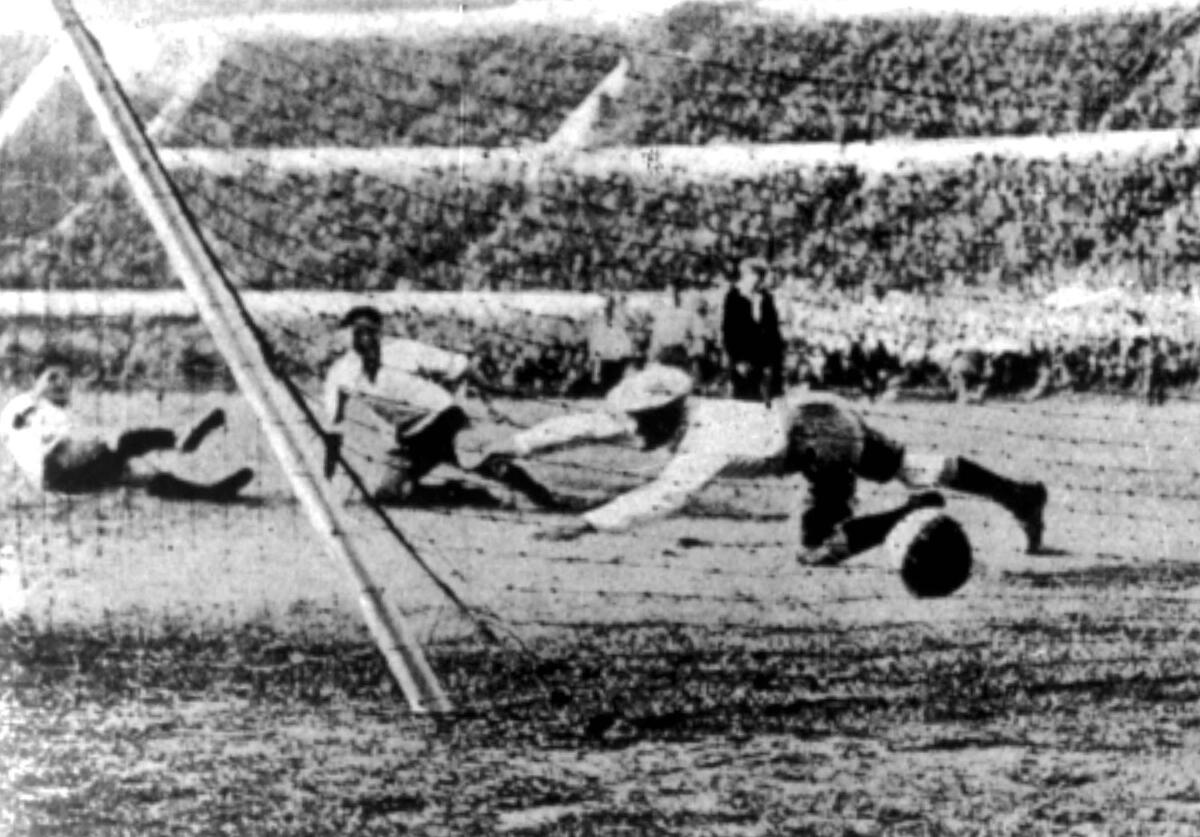
Argentina’s goalkeeper can’t stop a shot by Uruguay during the 1930 World Cup final against Argentina in Montevideo, Uruguay.
(Associated Press)
That quickly proved to be a big mistake. The growing effects of the Great Depression left many countries unable to afford the long, slow steamship trip to South America. The first tournament was open to any country that wanted to play, yet two months before the first game no European teams had agreed to come.
“It was taken very seriously by Uruguay and Argentina,” Wilson said, but not by many others.
That changed shortly after Romania’s King Carol II, who ascended to the throne in a coup that deposed his son, personally selected his country’s World Cup roster and sent it on its way. France quickly agreed to go too, entering a makeshift team under pressure from FIFA president Jules Rimet, a Frenchman. Belgium also buckled under FIFA pressure and all three teams boarded the same ship for the trip to Uruguay, working out together on the 15-day voyage aboard the SS Conte Verde, an Italian ocean liner.
“Even the four European nations who go it’s not entirely clear how seriously they took it,” Wilson said. “The French and Romanians, they kept diaries. They seem to have regarded this as a laugh. We’ll try to win but it doesn’t really matter.”
Things didn’t really get loony until the tournament began. The Bolivian team, for example, played in berets, as did an Argentine midfielder, while the 15 referees who worked the games, some of whom had traveled and socialized with the players on the long boat ride from Europe, dressed formally in knickers, long-sleeve shirts, blazers and ties.
The well-dressed officials spent much of the tournament working with police to break up fights; play was so violent at least two players sustained broken legs and the U.S.-Argentina semifinal descended into a full-out brawl, with one American having four teeth knocked out and another hospitalized with injuries to his stomach.
The tournament finally finished with the hosts beating Argentina 4-2, after which the Argentines broke off diplomatic relations with their neighbor and an angry mob in Buenos Aires stoned the Uruguayan embassy.

Uraguay’s team before the 1930 World Cup final against Argentina.
(Keystone / Getty Images)

Argentina’s soccer team before preparing for the 1930 World Cup final.
(Associated Press)
“It ended,” Wilson said of the tournament, “with everybody sort of fighting each other.”
Few disagreed with the Argentine magazine El Gráfico, which seemed to predict there was little future for the fledgling event. “The World Cup is over,” it wrote. “The development of this competition brought not only an unpleasant atmosphere, but also an ungrateful one.”
Yet nearly a century later, the World Cup is still here. And that, too, was foretold in 1930 in the story of Romanian midfielder Alfred Eisenbeisser (who was also known as Fredi Fieraru because, why not?).
On the journey home from the first World Cup, Eisenbeisser contracted pneumonia and a priest was called to administer the last rites. The ship eventually docked in Genoa and he was taken to a sanatorium while the rest of the team continued on to Romania.
Assuming her son had perished in Italy, Eisenbeisser’s mother arranged a wake — only to have her son stroll into the ceremony very much alive, causing the woman to faint. Eisenbeisser would play 12 more years of professional soccer and compete in figure skating in the 1936 Winter Olympics, where he finished 13th in the pairs competition.
Turns out the reports of Eisenbeisser’s demise, like those of the World Cup, were greatly exaggerated.
⚽ You have read the latest installment of On Soccer with Kevin Baxter. The weekly column takes you behind the scenes and shines a spotlight on unique stories. Listen to Baxter on this week’s episode of the “Corner of the Galaxy” podcast.