hiring

Supreme Court weighs freight broker liability in negligent hiring case

WASHINGTON, March 4 (UPI) — The Supreme Court on Wednesday considered whether the brokers who connect shippers with trucking companies can be held liable for irresponsible drivers.

The case, Montgomery vs. Caribe Transport II LLC, stems from a 2017 incident in which Shawn Montgomery, the petitioner, suffered significant injuries after a tractor-trailer hit his parked truck on the side of an Illinois highway.

A key part of the case is the interpretation of part of the Federal Aviation Administration Authorization Act of 1994. It prevents state laws “related to a price, route or service” of trucking companies or brokers that connect them to shippers.

However, the statute also provides an exception, stating that it will “not restrict the safety regulatory authority of a state with respect to motor vehicles.”

The outcome could redefine liability standards for freight brokers and impact the broader transportation industry and interstate commerce landscape.

The driver of the tractor-trailer, Yosniel Varela-Mojena, had been involved in a crash months earlier, but was still employed by Caribe Transport II, an interstate trucking company. Freight broker C.H. Robinson recruited Caribe II to deliver a cross-country shipment. After the crash, Montgomery sued the broker for negligent hiring under Illinois state laws.

During the arguments, the two sides disagreed about whether the phrase “with respect to motor vehicles” includes brokers.

“We do believe that ‘with respect to motor vehicles’ is the crucial question here,” said Theodore Boutrous Jr., Caribe II’s counsel. He argued Congress did not intend for brokers to be included.

The attorney for the United States agreed that the two different sections of the law being discussed should, in context, be taken altogether to mean that brokers are not included in the realm of “motor vehicles.”

“Paragraph one uses the phrase ‘with respect to the transportation of property,’ [and] paragraph two [says] ‘with respect to motor vehicles,'” said Sopan Joshi, assistant to the U.S. solicitor general. “That seems like a conscious choice that Congress made to parallel the language, but change the noun to a much narrower noun.”

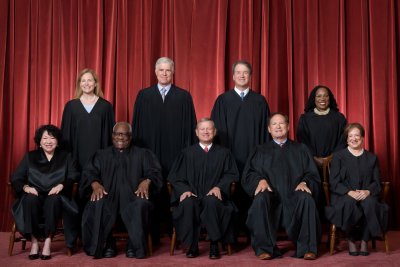
Associate Justice Brett Kavanaugh questioned Paul Clement, Montgomery’s counsel, on how brokers would address safety concerns if the court were to rule in favor of Montgomery and say that brokers are liable for consequences of negligent hiring.

For instance, Kavanaugh suggested drivers should be proficient in English to ensure safety. In April 2025, President Donald Trump signed an executive order to enforce English-language requirements for commercial motor vehicle drivers.

“If you’re hiring drivers who can’t read the signs, that seems like a safety issue,” Kavanaugh said.

Clement said brokers could work with larger trucking companies with deeper pockets and check that they have adequate programs in place to test drivers for drug use, check on prior accidents and address other potential concerns.

“One of the reasons, I think, that you do want [brokers] to have some duty of care in these circumstances is this is a margin business,” Clement said. “If they don’t have any sort of incentive to internalize any of the cost of not asking the question, they really have no good reason to ask the question. They want the cheapest carrier.”

Associate Justice Ketanji Brown Jackson asked Joshi to explain why he thought Congress did not think brokers should share responsibility for safety given the language in the 1994 law.

“The problem, I think, with the argument in the way that you’ve set it up is that you are assuming away any responsibility that a broker might have for safety,” Jackson said.

Joshi argued that Congress did not intend for brokers to have responsibility regarding safety and could have worded the law differently if it did.

“Congress has an entire chapter, several chapters, of the U.S. Code in Title 49 that deal with safety addressing carriers, safety of motor vehicles, driver qualifications, and they’re all addressed at carriers,” Joshi said. “Not a single one is addressed at brokers.”

Joshi acknowledged that the Federal Motor Carrier Safety Administration is “understaffed,” “overworked” and unable to review all of the federally registered carriers. However, he said Congress has provided ways of bringing consequences against carriers who violate federal requirements and regulations.

In his closing rebuttal, Clement told the court that 94% of registered carriers on the road do not have meaningful federal safety inspections — a number derived from 2021 Federal Motor Carrier Safety Administration data.

He said state tort law could provide a “backstop to the federal system.”

“This case doesn’t have to be that hard. The thing that triggers state tort liability is an 80,000-pound motor vehicle. That’s what devastatingly injured my client,” Clement said.

The court is expected to issue a ruling by summer.
Source link

Azov’s hiring spree: Controversial Ukrainian brigade competes for recruits | Russia-Ukraine war News

Kyiv, Ukraine – Posters advertising “The Azov school of landscape design” can be seen inside subway cars and on billboards in Kyiv.

But instead of a smiling gardener surrounded by blossoming trees and flowers, the poster depicts a bearded, smiling soldier with the Azov Corps walking away from a howitzer that spews out a shell to “design” the landscape on the Russian side.

Recommended Stories

list of 4 itemsend of list

As Ukrainian soldiers keep getting killed and wounded along the crescent-shaped, 1,250-kilometre (777-mile) long front line, Kyiv faces a dire shortage of servicemen.

Individual military units compete for potential recruits and lure them with catchy slogans, witty campaigns, text messages and social media posts that promise thorough training that reduces the risk of getting killed or jobs behind the front line.

Many Ukrainian men of fighting age – 25 to 60 – who cannot refuse the draft choose to join them. Otherwise, they could be rounded up by “conscription patrols” and undergo perfunctory training to end up as storm-troopers – a role which comes with a high risk of death.

“There’s zero training. They don’t care that I won’t survive the very first attack,” Tymofey, a 36-year-old office worker who was forcibly conscripted last year but broke out of two training centres, told Al Jazeera.

Hundreds of thousands of men dodge the draft, pay bribes to flee abroad or illegally cross into European nations amid corruption and coercion on the part of conscription officers, as documented by government officials, media and rights groups.

In the first year after Russia’s 2022 full-scale invasion, men of all ages volunteered in droves, standing for hours outside conscription offices and even travelling to other parts of Ukraine to find a less crowded conscription office that would enlist them.

“The first wave very massive, they were motivated,” a senior serviceman told Al Jazeera on condition of anonymity.

But volunteers are rare these days. The average age of conscripts has risen to above 40, and their fitness levels have dropped.

“We get what is left of what is left,” he said of the new recruits in his military unit – adding that infantrymen are “hardest to recruit”.

“They can and will be trained, but there’s a matter of condition. A man in his 50s with a white-collar job and several chronic diseases is not exactly fit,” he said.

Azov’s hiring spree

While recruitment campaigns are very visible, the hiring process is largely non-transparent.

Most of the applications should be filled online, and only prospective candidates are invited to recruitment offices whose locations are not disclosed because Russia targets them with drones, missiles or attacks by people recruited via messaging apps or the dark web.

And when it comes to picking the cream of the crop, Azov, now known as the First National Guard Corps, and its offshoot, The Third Storm Brigade, reign supreme.

Apart from the “school of landscape design,” Azov has billboards and online advertisements offering sarcastically named “courses” in “content making,” “event management” and “cross-fit”.

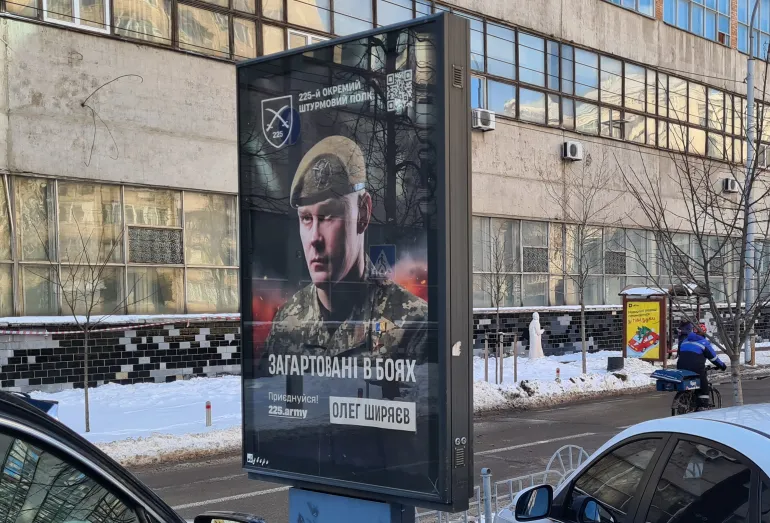
A billboard advertising service in the 225 Special Brigade in central Kyiv
A billboard with the slogan ‘Forged In Combat’ advertises the 225 Special Brigade in central Kyiv [Mansur Mirovalev/Al Jazeera]

Azov has, for years, been one of Ukraine’s most outspoken military units, and its servicemen were dubbed “300 Spartans” for their months-long defence of the southern Ukrainian city of Mariupol in early 2022 that ended only when top brass ordered them to surrender.

Some 700 of Azov fighters are still behind bars in Russia, facing torture and starvation, according to swapped servicemen and Ukrainian officials.

They have become the bogeymen of the Kremlin propaganda machine that calls them “neo-Nazis” and claims they “terrorise” civilians and stage their killings to blame Russian “liberators”.

Azov had far-right origins, but the current leadership claims to have cleaned up the brigade, denying any links with “extremist” groups. Al Jazeera is unable to independently verify these claims.

The publicity and halo of martyrdom have raised Azov’s domestic profile.

And what its recruiters offer is a “soldier-centred” approach that takes into account each potential serviceman’s background, shape, medical history and military experience – or lack thereof.

“We are building a system centred around a soldier, because a soldier is not a resource, it’s the basis of the whole system,” a senior Azov recruiter who identified himself by his call sign, Tara, told Al Jazeera in one of Azov’s open spaces in central Kyiv.

The open space is a far cry from average Ukrainian conscription centres usually located in gloom, claustrophobic Soviet-era buildings with drafty corridors and creaky floors.

It has a cafeteria with a menu most hipsters would find palatable, and a shop with trendy T-shirts, hoodies and souvenirs.

“A nation that doesn’t stand up for its heroes kneels before the enemy,” a handwritten sign on a wall reads.

Tara said that aspiring Azov servicemen undergo tests and interviews – and choose a job “with the highest efficiency

“We, for our part, guarantee that [the recruits] will serve in the exact position for which they have been approved.”

All of Azov’s recruiters are battle-tested servicemen, said Tara, who volunteered to join nascent Azov in 2014.

With a tidy moustache and at the towering height of six feet, five inches (1.95 metres) tall, he took part in Azov’s transformation from ragtag volunteer crews of football fans and nationalists who were instrumental in repelling the onslaught of Russia-backed separatists in southeastern Ukraine, into a primary military unit.

Meanwhile, smaller, less outspoken units can barely find enough recruits to replenish their losses.

“We ask around, we tell friends, we say that we can make sure they get trained properly, but it’s never enough,” Oleh, a senior officer with a military unit stationed in eastern Ukraine, told Al Jazeera.

And some are adamant that Ukraine should introduce a system of compulsory and universal military service.

“All privileges must be cancelled, all men of fighting age should undergo training and be ready for service. Otherwise, we’ll keep on losing ground,” retired Lieutenant-General Ihor Romanenko, former deputy head of Ukraine’s general staff of armed forces, told Al Jazeera.

Source link