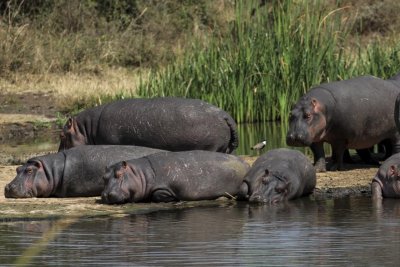
Colombia to cull up to 80 hippos tied to late drug lord Pablo Escobar

According to official data, the population in Colombia could reach 500 hippos by 2030 if control measures are not implemented. A scientific study cited by the government recommends removing at least 33 animals per year to achieve a significant reduction. File Photo by Daniel Irungu/EPA
April 13 (UPI) — The Government of Colombia said Monday it will cull up to 80 hippos descended from animals illegally introduced by drug trafficker Pablo Escobar in the 1980s as part of a plan to control an invasive population that now exceeds 160 of the animals, environmental authorities reported.
The Minister of Environment and Sustainable Development of Colombia, Irene Vélez Torres, signed a circular establishing guidelines and targets for institutional coordination in the management and control of invasive hippos in the South American country.
“With this circular, we are advancing coordinated actions with regional corporations for the management of hippos in the country. Two key protocols are adopted: translocation and euthanasia,” she said on X.
This decision, whose implementation will begin in the second half of 2026, according to local media such as El Espectador, responds to the uncontrolled growth of these animals in the Magdalena Medio region. There, they have altered local ecosystems, affected water sources and generated risks for nearby communities.
The hippos were originally brought by Colombian drug lord Pablo Escobar to his private estate, Hacienda Nápoles. After he died in 1993, the animals were left without effective state control and began to reproduce in the wild.
They now represent one of the most unusual cases of invasive species in Latin America.
The environment minister said the government evaluated for years alternatives such as sterilization and international relocation, but none have been sufficient to contain population growth.
“This ministry has carried out enormous diplomatic efforts, and at this moment no country wants to take responsibility,” Vélez said in remarks to Blu Radio.
According to official data, the population could reach 500 animals by 2030 if control measures are not implemented. A scientific study cited by the government recommends removing at least 33 animals per year to achieve a significant reduction.
The plan includes two main methods: euthanasia and translocation. Although Colombia keeps open the possibility of sending some animals abroad, authorities acknowledge that euthanasia will be the primary mechanism due to logistical and sanitary limitations.
“We have a euthanasia protocol that seeks to guarantee technical and ethical criteria to carry it out in a safe and responsible manner,” Vélez said.
The procedure includes chemical and physical euthanasia and requires prior confinement of the animals to minimize risks. The cost per hippo can reach up to $14,000, including sedation, the operation and final disposal through on-site burial, according to Blu Radio reports.
One of the main obstacles to international relocation is the genetic deterioration of the hippos.
All current hippos descend from just four individuals, which has caused inbreeding and malformations.
“The gene pool is too limited, and individuals with mutations have already been found,” Vélez said. “There are visible deformities, such as in the snout, and probably other genetic damage.”
In addition to the genetic component, authorities warn that hippos represent a direct threat to native species, such as manatees and turtles, and also affect water quality in rivers and wetlands.
“This is an invasive species that has a direct impact on water and is significantly affecting biodiversity,” the minister said.
The Colombian government allocated approximately $2 million for the implementation of the control protocols. Authorities expect the next administration, which will take office Aug. 7, to continue their execution to prevent the problem from worsening in the coming years.