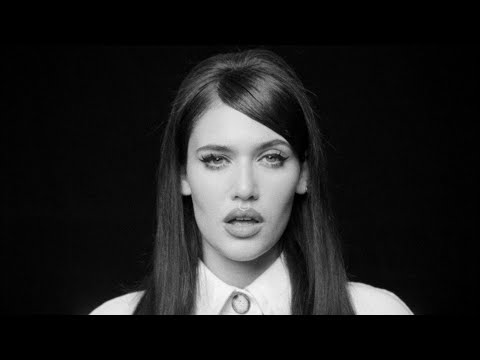
Meet Sienna Spiro, a 20-year-old Brit with ‘the voice of a generation’
Four hours before Sienna Spiro is due to launch her first U.S. headlining tour, the 20-year-old singer and songwriter from London sits upstairs in the Troubadour’s empty balcony, peering down as several crew members wheel a grand piano onstage.
“The fact that I’m 11-and-a-half hours from home and that this room is gonna be filled with people that have never met me and that I’ve never seen before — that’s just crazy,” she says. “I’m kind of scared.”
The song that brought Spiro to West Hollywood this past Tuesday is “Die on This Hill,” a showstopping pop-soul ballad about staying in a toxic relationship — “I’ll take my pride, stand here for you,” she sings, “I’m not blind, just seeing it through” — that’s been streamed more than 300 million times on YouTube and Spotify since it came out in October. Built around tolling piano chords and Spiro’s titanic vocal, the song hit No. 9 in the U.K. and broke into the Top 20 of Billboard’s Hot 100; last month, Spiro — whose famous admirers include SZA, Mark Ronson and Alex Warren — was nominated for the Critics’ Choice prize at England’s annual BRIT Awards.
With its unabashed emotion and its throwback feel, “Die on This Hill” can be heard as the latest in a long line of melodramatic ballads by young Brits such as Amy Winehouse, Duffy, Lewis Capaldi and Olivia Dean, the last of whom was just named best new artist at the Grammys. Yet Spiro’s voice stands out: Rich and pulpy, with a crack she knows how to deploy for maximum heartbreak, it might be the most impressive instrument to come out of England since Adele emerged nearly two decades ago.

“Sienna is a true artist with the voice of a generation,” says Sam Smith, one more English singer (and former best new artist winner) with a flair for ugly-cry theatrics. Late last year, Smith, who identifies as nonbinary, invited Spiro to join them onstage in New York for a performance of Smith’s song “Lay Me Down.” Spiro, Smith recalls, “blew the room away” — one reason they brought her out again Wednesday night at San Francisco’s Castro Theatre, this time to sing “Die on This Hill” together.
Says Smith of the younger artist: “The world is at her feet.”
At the Troubadour, where she’ll follow Tuesday’s sold-out concert with an encore appearance Friday night, Spiro describes singing as a life calling. “I’ve known what I wanted to do since — honestly, since I’ve been a conscious human being,” she says. Dressed in a black-and-white-striped turtleneck, she has her legs folded beneath her on a wooden bench; her dark hair hangs loose around her face, yet to be styled into the ’60s-inspired do she’ll wear come showtime.
“I always felt a bit invisible,” she adds, whether at school with friends or at home as a middle child. “Not in a victimized way. But I always struggled with that existentialism. Music is the only thing that’s made me feel real.”
Are we to believe that one of pop’s bright new stars was once … kind of a bummer?
“In my own way, yeah,” she says with a laugh. “It’s OK. It happened. Character building.”
Spiro grew up privileged in London, one of four children of Glenn Spiro, a prominent jeweler who counts Jay-Z as a client and pal. Her dad turned her onto Frank Sinatra and Nina Simone and the Italian film “Profumo di donna” when she was little; by age 10 she’d written her first song (“Lady in the Mirror,” it was called) and played her first gig (at a pub not far from Heathrow Airport).
At 16 she enrolled at East London Arts and Music, a performing arts academy she describes as “the up-and-coming version” of London’s prestigious BRIT School, whose alumni include Adele and Winehouse. Her academic career didn’t last long, though: On her first day of classes she posted a TikTok of herself covering Finneas’ song “Break My Heart Again” that triggered a wave of interest from various record-industry types; soon she dropped out and began regularly traveling to Los Angeles to work on music.
Today Spiro says she has a “love-hate relationship” with the town where she estimates she spends half her time. “I’m very English, and I think something about English people is our honesty — you don’t really have to guess what people are saying. What was shocking to me when I came here was that people didn’t say what they meant.
“I was very, very lonely, and it was hard to make music when you feel that,” she adds. “I make sad music, but it’s hard to be a teenager and be away from your family and your friends and be in a place where you kind of have to play pretend being an adult.”
Did suffering among the two-faced liars of L.A. ever lead her to question her commitment to music?
“No. It just made me question how I was doing it. And not everyone’s a two-faced liar. There are some good ones out there.”
Was she ever at risk of becoming a two-faced liar herself?
“Oh, I’m too English for that,” she says. “If I did that, I’d get a slap.”

Sienna Spiro performs this week at the Troubadour in West Hollywood.
(Ariana Drehsler / For The Times)
Spiro started releasing singles in 2024 and quickly signed a deal with Capitol Records; last year she opened for Teddy Swims on the road and turned heads with “You Stole the Show,” a luxuriously gloomy slow jam with echoes of Adele’s “Skyfall.”
For “Die on This Hill,” which she wrote with Michael Pollack and Omer Fedi (both of whom went on to produce the song with Blake Slatkin), Spiro wanted to capture the feeling of “when you go above and beyond just to feel something reciprocated back from someone,” she says. But if the writing came quickly, the recording didn’t: Spiro jokes that she cut “900 different versions” of the song, including one she says sounded like Silk Sonic and another that sounded like Lauryn Hill.
“I was desperate for something up-tempo,” she says, given that virtually everything she’d dropped so far had been a ballad. Yet Fedi pushed her to cut the tune live with just her on vocals and Pollack on piano. They did four takes, according to the producer, one of which forms the basis of the record that eventually came out.
“Very old-school, very human,” Fedi says of the process. “Maybe I’m corny but with Sienna, less is really more. Her voice is so special, so big and upfront, that you just want to put a giant flashlight on it and let it shine.”
In early January, Spiro gave a bravura performance of “Die on This Hill” on Jimmy Fallon’s late-night show; one clip on TikTok has been viewed more than 70 million times. For that appearance, she wore a retro mini dress printed with an old photo of Johnny Carson behind his desk; for a recent performance in the BBC’s Live Lounge, she wore a different dress showing the faces of the four Beatles.
On stage at the Troubadour, her dress features images of the Chateau Marmont and the Capitol Records tower — a bit of setup, she says, for her next single, “The Visitor,” which is due March 13. Spiro has been slowly assembling her debut album for the past two years, but with headlining concerts to play, she’s reaching back for some of her oldies from 2024.
Some, not all.
“To be real with you, some of my early stuff wasn’t the most authentic,” she says as her drummer starts thwacking a snare during sound check . “I was trying to be someone else because I really wasn’t comfortable with myself.”
Can she point to an example?
“‘Back to Blonde,’” she says, referring to a vaguely Lana Del Rey-ish number about a woman who dyes her hair after killing a no-good lover. “I put it out for all the wrong reasons. It was a mistake — an inauthentic move that I regret making.”
What were the wrong reasons?
“It’s a long story, and it’s not very interesting. I didn’t do it because I loved the song — that’s what I’ll say. But at the end of the day it’s my name and I have to stand by it.”
Which is why she’s taking her time on the LP. Some artists her age don’t care much about the album format but Spiro is a true believer. Among her faves: Sinatra’s “In the Wee Small Hours,” Stevie Wonder’s “Songs in the Key of Life,” Adele’s “21” — “a perfect album,” she says — and Billie Eilish’s “Hit Me Hard and Soft.”
“I love an album where you don’t ever question why a song’s on there,” she says. “Where everything feels intentional.”
She doesn’t want to divulge too much about the work in progress. “The problem with me is I have a huge mouth and I give everything away,” she says, which — hey, great.
“No, I know it is for you,” she adds with a laugh. “But not for me, because then when I actually want to do the big reveal, I’ve got nothing because I’ve said it all.”
She will allow one detail: “It won’t be 12 ballads, I’ll tell you that.” She looks toward the ceiling, jiggling her head slightly, as though she’s doing some mental math regarding the track list.
“I mean, there’s a lot of ballads,” she says. “I just love a ballad — I can’t help it.”