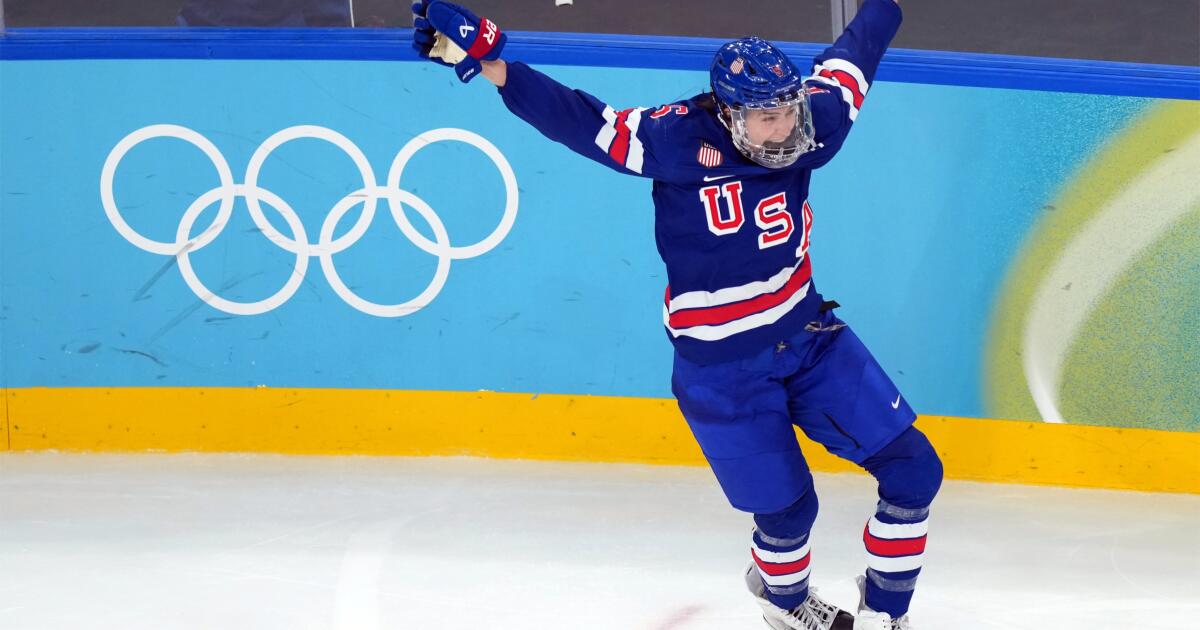
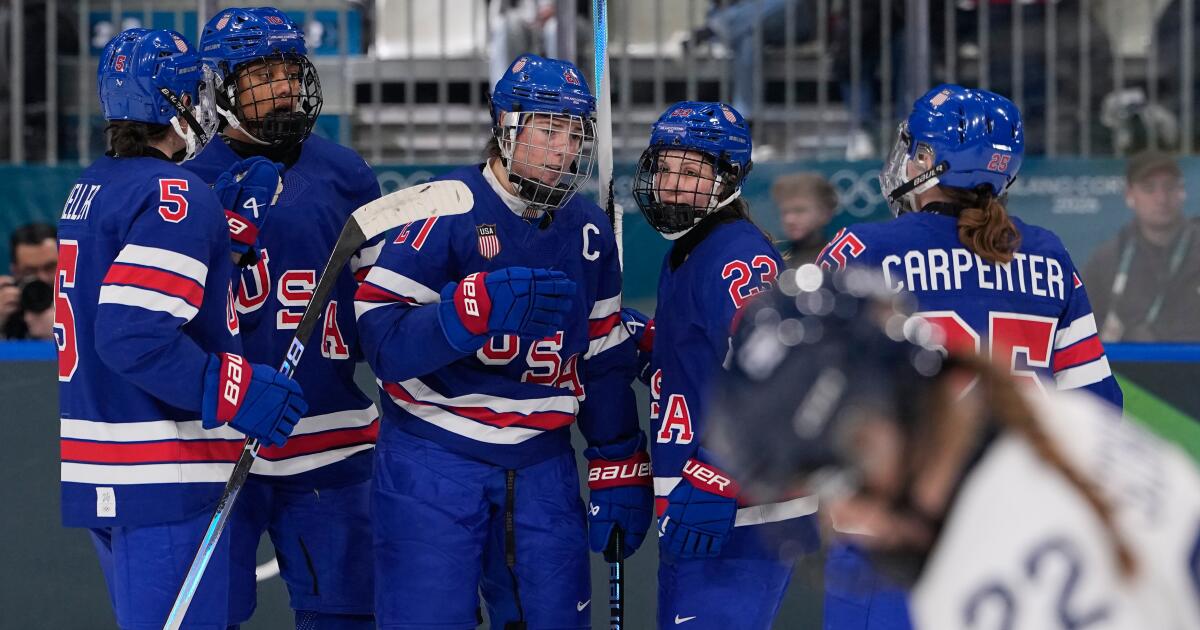
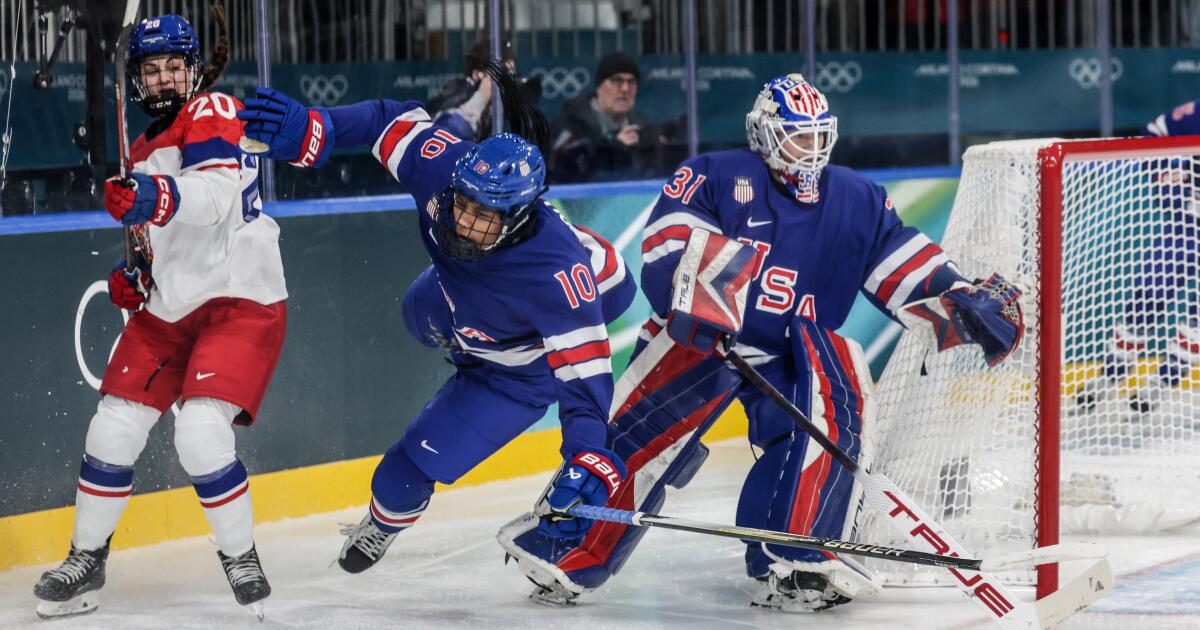
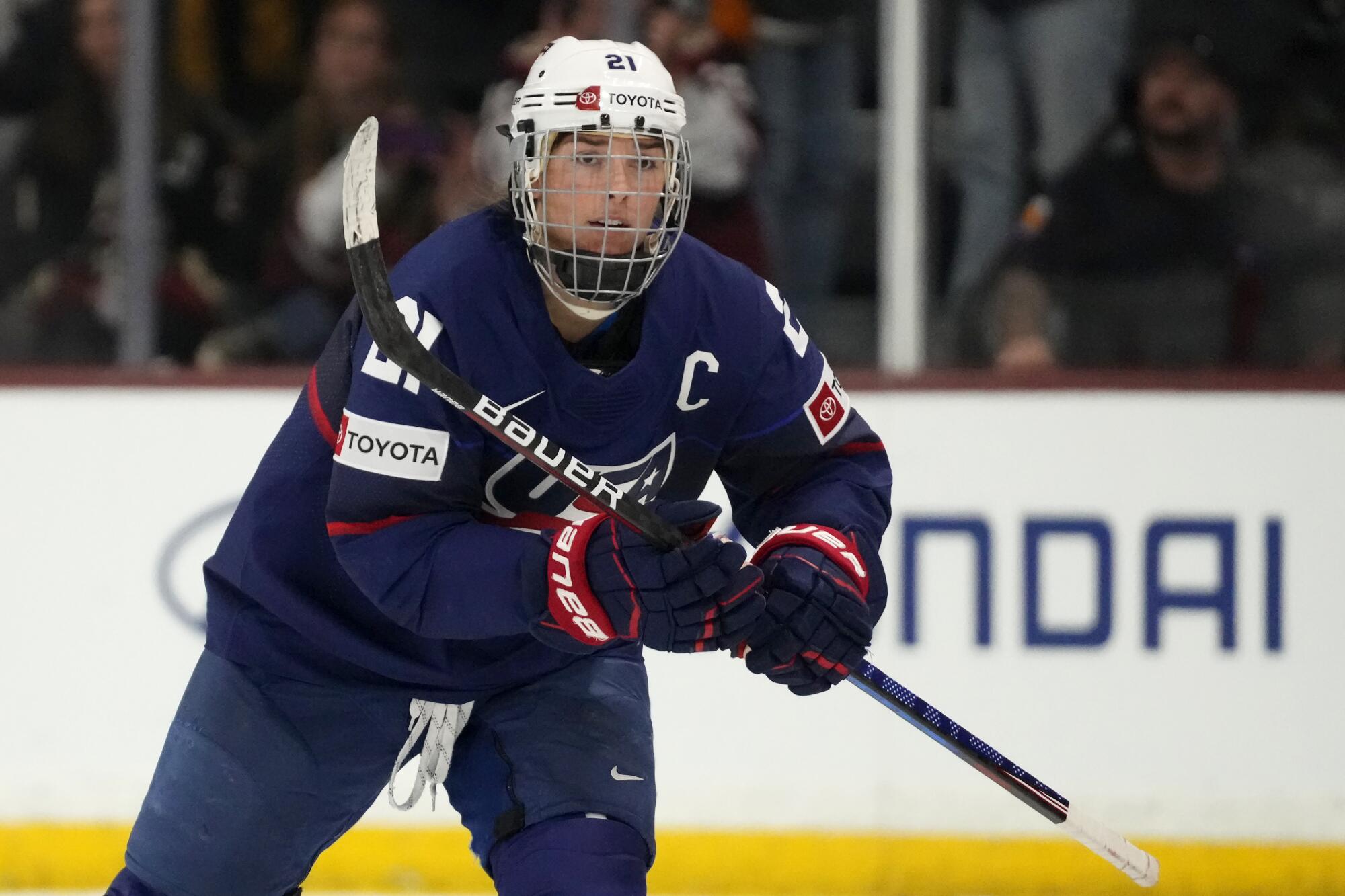
MILAN — A gold medal that seemed firmly in the grasp of the U.S. women’s hockey team nearly slipped through its fingers in the final of the Milan-Cortina Games on Thursday, but the Americans rallied to win 2-1 on Megan Keller’s goal just over four minutes into overtime.
Kristin O’Neill’s shorthanded goal less than a minute into the second period gave Canada its goal while Hilary Knight matched that for the U.S. with 2:04 to play, deflecting a Laila Edwards’ slap shot from the high slot through her legs and past Canadian goalie Ann-Renee Desbiens to send the game to the extra period.
The goal, Knight’s 15th in Olympic competition, broke the American record and came seconds after U.S. coach John Wroblewski had pulled his goalie for an extra attacker.
Keller then won it, taking a long Taylor Heise pass on the left wing, racing into the Canadian zone, stickhandling around defender Claire Thompson before beating goalie Desbiens cleanly.
The gold was the second in the last three Olympics for the Americans, who are ranked No. 1 in the world. Both have come against Canada while the victory was the eighth straight for the U.S. over their northern neighbor dating to last April’s world championship.
The overtime rules are unique for gold-medal games, with the teams playing three-on-three for 20-minute periods, with the first goal deciding the winner. Games cannot end in a shootout.
In the preliminary round, overtimes were limited to five minutes, followed by a five-round shootout. In the knockout stage, the overtime period was extended to 10 minutes, followed by a shootout.
None of that figured in Thursday’s result.
The young Americans, who had 12 women playing in their first Olympics, looked uncharacteristically rattled in a scoreless first period in which they took two penalties — one for too many players on the ice — and were outshot 8-6. It was just the third time in the tournament the U.S. went an entire period without a goal.
Things got worse 54 seconds into the second period when O’Neill outskated Edwards up the center of the ice on a breakaway, took a short centering pass from Laura Stacey, then deked U.S. goalie Aerin Frankel to the ice before beating her to her gloved side for the first goal of the game.
That snapped a 352-minute scoreless streak for the U.S. and marked the first time the Americans trailed in Milan.
For much of the game Canada was faster, smarter and more poised. And Desbiens was spectacular in goal. In Canada’s group-play loss to the U.S., she was pulled in the third period after giving up five goals. This time she came within two minutes of shutting out a team that had scored 31 times in its previous six games.
MILAN — The U.S. women’s hockey team came into the Milan-Cortina Winter Games ranked No. 1 in the world. And two games into group play, it’s shown that ranking might be something of an understatement.
With Saturday’s 5-0 victory over No. 3 Finland, the unbeaten Americans have outscored their two opponents 10-1 and outshot them 91-25. The goals Saturday came from Alex Carpenter, Taylor Heise, Megan Keller, Hilary Knight and Abbey Murphy. Keller and Laila Edwards each had two assists.
In goal, Aerin Frankel faced just 11 shots in posting the first shutout of the Olympic tournament.
Just as in its opening win over No. 4 Czechia, the U.S. eased its way into the game before going ahead to stay late in the first period on a power-play goal from Carpenter. The score came seven seconds after Finland’s Susanna Tapani was sent off for hooking.
The Americans doubled the advantage 2½ minutes into the second period at the end of a beautiful passing sequence that saw Britta Curl feed Murphy, whose cross-crease pass found Heise on the doorstep for the easy goal.
Sixty-six seconds later Keller’s unassisted goal made it 3-0 and the rout was on.
Next came a power-play goal from Knight, her 14th in Olympic play, equaling Natalie Darwitz and Katie King for the most in team history. Murphy closed out the scoring, banging in a rebound at the right post with less than five minutes to play.
With 10 goals, the U.S. is tied with Sweden for most in the tournament while the Americans’ goal differential of plus-nine is the best. It was the 11th straight Olympic win for the U.S. over Finland, the bronze medalist four years ago.
MILAN — Laila Edwards finally got out from under the spotlight and onto the ice for the U.S. women’s hockey team Thursday. It was a simple act, but one that made history.
Yet for Edwards, it was just another day at the office.
“It didn’t feel different at all,” she said. “It’s still hockey at the end of the day. Even though it’s the highest level, it’s still hockey.”
With her first shift in Thursday’s 5-1 win over Czechia, on the first day of hockey at the Milan-Cortina Winter Games, Edwards became the first Black woman to play for the U.S. national team in an Olympic tournament. On a team full of record-breakers, it was a significant milestone, one that has become a storyline for the world’s top-ranked team.
“Cameras constantly in her face. She does a good job of whatever she needs to do,” said teammate Tessa Janecke, who had two second-period assists. “It’s very inspiring for us as her teammates, but as well as the next generation.”
And that, of course, is the point.
“Representation matters,” Edwards said. “There’s been a lot of young kids or parents of young kids who have reached out or I’ve run into that say, ‘You know, my daughter plays sports because of you. And she feels seen and represented,’ and that’s just really motivating.”
Just 22, Edwards is already accustomed to breaking barriers and being the youngest this or the first that.
In 2023, she became the first Black player on the women’s senior national team in any competition; a year later, she became, at 20, the youngest player to win the MVP award in the World Championship.
But if doing that has been easy, talking about it has taken some work.
“I could not do interviews or not talk about it, but then the story doesn’t get out there,” she said. “And maybe a little girl doesn’t see me, who looks like her. So I think that’s what’s more important.”
On Thursday, playing before Vice President JD Vance, Secretary of State Marco Rubio and a packed house at the Milano Rho Ice Hockey Arena, Edwards marked her Olympic debut by helping put the Americans ahead to stay, feeding Megan Keller in the high slot for a slap shot that Alex Carpenter redirected in a first-period power-play goal.
Second-period goals from Joy Dunne and Hayley Scamurra — both on assists from Janecke — and third-period goals from Scamurra and Hilary Knight, sandwiched around one from Czechia’s Barbora Jurickova, accounted for the final score in a game in which the top-ranked Americans outshot the fourth-ranked Czechs 42-14.
Still, the night belonged to Edwards, a player Knight calls “the future of the sport.” But she’s doing pretty well in the present too, having already won two national championships with Wisconsin and two world championship medals with Team USA.
Edwards started skating shortly after she learned to walk, then switched to hockey before starting kindergarten, when her father Robert, who played the game as a child, enrolled her and three siblings in a youth hockey program. By 8, she was so advanced she was playing with boys’ teams and for high school she left her native Cleveland Heights, Ohio, for the elite girls’ hockey program at Bishop Kearney High School in Rochester, N.Y.
Although she was a high-scoring forward in high school and college — she led the nation with 35 goals as a junior at Wisconsin — she’s proven versatile enough to play on the blue line in the Olympics. That’s a little like playing a running back at right guard.
“I couldn’t even imagine that,” forward Abbey Murphy said of Edwards, who skated a team-high 25 shifts Thursday. “She took it and she just kind of ate it up and she made defenseman look easy. She’s magic on the blue line.”
At 6-foot-1 and 185 pounds — making her the biggest and most physical player on the U.S. team — Edwards was well-suited for the move.
“She’s so dynamic, so athletic, you could put her in goal and she would perform,” said Caroline Harvey, a teammate in high school, college and now with the national team. “She’s just adjusted so well. It’s seamless. It doesn’t even seem like she’s switched positions.”
Edwards hasn’t made her journey to the Olympics alone, however, a fact she acknowledged after Thursday’s game. Although her father is responsible for her start in hockey, it looked like he wouldn’t be able to travel to Milan to see his daughter make history. So Edwards’ parents started a crowdfunding campaign to pay for flights and accommodations.
Jason and Travis Kelce, brothers and former Super Bowl players who also grew up in Cleveland Heights, learned of the campaign and quickly kicked in $10,000, allowing 14 members of Edwards’ family to come to Italy — where their cheers were audible every time her name was announced.
“They show support,” Edwards said. “And they’re really cool guys.”
After her Olympic debut Thursday, there are a lot of little girls who can say the same about Edwards.
If Hilary Knight is the GOAT of women’s ice hockey, then Caroline Harvey is the kid.
That isn’t just a reference to her age, 23, which makes her the seventh-youngest player on the U.S. Olympic team. The term is also used for baby goats. And with Knight, the oldest player on the U.S. team, expected to retire from Olympic competition after the Milan Cortina Games, that makes Harvey the GOAT in waiting.
“Hilary is a great role model,” Harvey said. “She did blaze that trail. It’s been exciting to see what she did, the legacy she left.”
Like the 10 world championship gold medals, most by a hockey player of either gender; the soon-to-be five Olympic appearances, most by any American hockey player; the scoring titles and MVP awards. But the real legacy she’ll leave will have little to do with any of that.
In 2019, while at the height of her career, Knight risked everything when she joined more than 200 other players in boycotting the existing women’s hockey leagues to form the Professional Women’s Hockey Players Assn. Four years later that led to the creation of the well-funded Professional Women’s Hockey League, with eight teams playing in the U.S. and Canada.
Knight said she took inspiration for that campaign from the 1999 Women’s World Cup soccer team of Mia Hamm, Julie Foudy and Brandi Chastain, which not only won the title but soon after began the decades-long fight with the U.S. Soccer Federation that eventually ended with the women getting the same pay and benefits as the men’s team.
“We credit the ‘99ers to sort of helping us with our vision and creating more equitable space,” she said. “We’re far from there but we’re taking great steps in that direction.”
In fact, women’s hockey has never been better, a popularity both Knight and Harvey hope to build on in the Olympic tournament, which begins Thursday with the U.S. facing Czechia.
“Visibility is really important; continuing to get those eyes,” said Knight, a tireless promoter of the game. “We’re going to have some new and unique viewership. With the Olympics in itself [viewers] might accidentally watch hockey and be like ‘I love this sport.’
“Just having more programming elevates the game on the global stage. And that’s really exciting.”
U.S. forward Hilary Knight skates to the bench after scoring against Canada in November 2023.
(Ross D. Franklin / Associated Press)
The game Knight, 36, is championing is really one she built, especially in the U.S. A two-time NCAA champion at Wisconsin, she’ll be going for her fifth Olympic medal — and second gold — in Milan. Yet she insists the experience never gets old.
“Every Olympics feels like my first Olympics,” she said. “Each is so unique. You’re in a different country, a different culture, just so much fun to be able to explore. The Olympics are so special, whether it’s your first or your fifth.”
These Games are likely to feel a little different, though, since they’ll end with her passing the baton to Harvey, who followed Knight to Wisconsin. The two women have more in common than just their alma mater, though.
Both were the youngest players on the team when they made their Olympic debuts, Knight as a high-scoring forward in 2010 and Harvey as a physical, offensive-minded defenseman in 2022. Both have won multiple world championships and both began their careers playing on boys teams. As children, they both told relatives they would someday play in the Olympics — a prediction that was particularly bold for Knight since women’s hockey wasn’t even an Olympic sport then.
When Harvey joined the national team ahead of the 2021 world championships, Knight shared some advice.
“She said something to the effect of ‘it’s the same game, no matter what level you’re at. Trust your instincts, play natural, play free,’” Harvey said. “That just really stuck with me.
U.S. defenseman Caroline Harvey shoots during a Rivalry Series game against Canada in November.
(Jason Miller / Getty Images)
“Hopefully at some point [I] grow into that leadership role,” she continued. “I’ve had some years now and that past Olympics, it was more of a being a sponge. I’m always trying to learn something new every day from the veterans.”
One thing she’s learned recently is how to beat Canada, which could come in handy in Milan since the U.S. will face its northern neighbors in the final game of group play, and likely a second time in the knockout rounds.
Canada has won five of the last six women’s Olympic tournaments, beating the U.S. in four of the those finals, including the most recent one in 2022. But the U.S. swept Canada in the pre-Olympic Rivalry Series, winning the four games by a combined 24-7. Knight and Abbey Murphy led the tournament in scoring with five goals each.
“When the puck drops, your heart is beating out of your chest,” Knight said of playing Canada. “You’re like ‘am I human? This is insane. This is awesome.’”
Still, when Knight finally does hang up her skates for the final time, those won’t necessarily be the memories she holds closest from her Olympic career.
“I get to do cool things with cool people on a daily basis,” she said. “What I’ve been able to accomplish in my career is incredible. And I’ve obviously played with amazing women and I’m so grateful for every opportunity that I’ve had.
“I’m just at a place where I want to embrace these lasting memories and moments with teammates and friends and family, all those people that go into this journey. That’s what I’m looking forward to.”