USAF Stands Up Unit To Fly HH-60W Helicopters In Doomsday Evacuation Role In Nation’s Capital
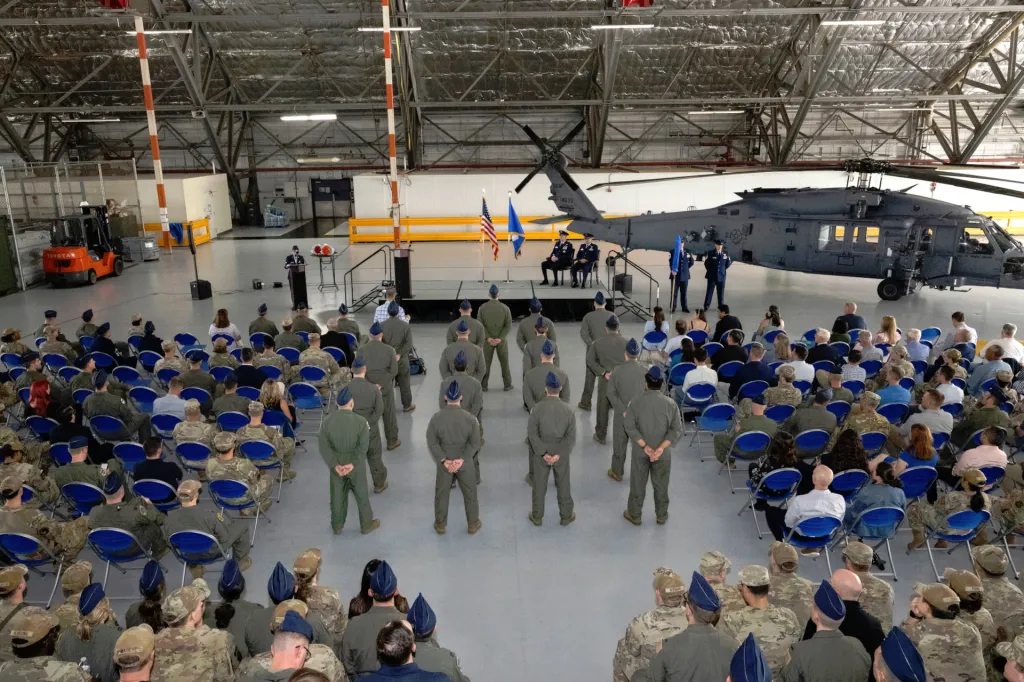
The U.S. Air Force has stood up a new squadron at Andrews Air Force Base to manage the arrival of HH-60W Jolly Green II helicopters to replace aging UH-1N Twin Hueys. Originally designed for combat search and rescue (CSAR) missions, the HH-60Ws assigned to the 5th Helicopter Squadron will be in a specialized configuration to take on the tasks of ferrying VIPs around the nation’s capital and supporting continuity of government plans. Questions have been raised about using Jolly Green IIs in these roles, and how this may impact the ability of the overall fleet of these helicopters to meet CSAR demands.
The Air Force held a ceremony at Andrews yesterday to mark the formal activation of the 5th Helicopter Squadron, also sometimes abbreviated as 5 HS. The 1st Helicopter Squadron (1 HS), with its UH-1Ns, will continue to operate throughout the transition to the HH-60W, which is expected to be completed in 2030, to avoid any gaps in capacity to meet critical operational requirements. A total of 26 Jolly Green IIs are set to be based at the facility, which is situated just outside Washington, D.C., a one-for-one replacement for the Twin Hueys that are there now. The arrival of the new helicopters will also lead to a small increase in total personnel, 60 in total, at Andrews.

The Air Force originally planned to supplant all of its UH-1Ns worldwide with new MH-139 Grey Wolf helicopters, which is a more direct replacement in terms of size and capability. The service is still acquiring MH-139s to supplant UH-1Ns elsewhere, including ones assigned to Air Force Global Strike Command (AFGSC) units that help provide security around Minuteman III intercontinental ballistic missile (ICBM) silos. We will come back to this later on.

“The HH-60W’s increased speed, range and carrying capacity will better deliver safe operations for U.S. senior leaders, service members, and the communities around the region,” the Air Force said in a press release regarding the 5th Helicopter Squadron’s activation.
The Jolly Green II also has in-flight refueling capability, something that is not found on the UH-1N or MH-139, and could be very valuable for missions around Washington, D.C. The HH-60Ws heading to Andrews are set to receive additional modifications, including to the main cabin seating arrangement, communications suite, and defensive capabilities, as you can read more about here.

Combat Rescue Helicopter Successfully Executes Major Test Milestone: Aerial Refueling

“In the next few years, the 5 HS will train aircrew and maintainers, establish operational and maintenance processes, and receive new aircraft as it prepares to execute the national security mission within the National Capital Region,” the release yesterday added.
National Capital Region (NCR) refers to a larger area that surrounds Washington, D.C., proper. Air Force operations in and around the NCR are primarily managed through a unit called the Air Force District of Washington (AFDW).
The HH-60Ws will be taking over an AFDW mission set from the UH-1Ns that currently includes daily airlift sorties transporting U.S. and foreign VIPs around the nation’s capital. The helicopters will also be in position to swing into action as part of continuity of government plans. In such a scenario, the Jolly Green IIs would be tasked to help rush senior officials and lawmakers to safety to ensure the continued functioning of federal authorities following an attack or a similarly serious contingency. 1st Helicopter Squadron’s role in responding to the terrorist attack on the Pentagon on 9/11 was highlighted during the activation ceremony at Andrews yesterday.

The NCR presents particular challenges for crisis response missions and routine day-to-day flight operations. The airspace around Washington, D.C., is most densely defended and heavily monitored anywhere in the United States, and packed full of military and civilian air traffic every day. Where and when military helicopters can operate over the nation’s capital has been a hot topic of debate since a fatal mid-air collision involving an Army UH-60 Black Hawk and a PSA Airlines Bombardier CRJ700 regional jet in January 2025. The Black Hawk was conducting a continuity of government training flight at the time. This has been more recently highlighted by an incident involving a Marine One helicopter carrying President Donald Trump earlier this month. A subsequent Federal Aviation Administration (FAA) investigation has highlighted communication issues and factors tied to the construction of a new helipad at the White House.
It is also worth noting here that Marine Helicopter Squadron One (HMX-1), the primary unit responsible for the Marine One presidential helicopter mission, would play a role in any continuity of government scenario in the NCR. Helicopters from the U.S. Park Police, as well as ones belonging to other law enforcement and civilian agencies, would be utilized, too.

Military and police helicopters land at the US Capitol this evening.
As mentioned, there are significant questions about the impacts of basing HH-60Ws at Andrews will have on the rest of the Air Force’s Jolly Green II fleet. This is something TWZ highlighted when the Air Force confirmed it was moving ahead with the AFDW HH-60W plan with the release of its 2027 Fiscal Year budget request earlier this year.
A particular issue is the Air Force’s decision years ago to scale back total purchases of HH-60Ws, from 113 helicopters down to 91. If the service does not order more Jolly Green IIs in the coming years, this will mean that roughly a third of the entire fleet will be assigned to the AFDW mission.

Up close with the HH-60W Combat Rescue Helicopter at Nellis AFB for The War Zone.
The Air Force previously confirmed the plan will involve taking HH-60Ws out of “back up inventory.” In the past, the service has defended this decision as being “more cost effective” than a move to “procure additional MH-139A aircraft” to meet AFDW requirements. Whether or not there were other specific operational considerations that factored into the decision to use Jolly Green IIs to meet these needs instead is unknown. The acquisition plan for the Grey Wolf has also been significantly truncated, with the Air Force now planning to buy just 56 of these helicopters instead of 80.
“The MH-139A Grey Wolf was competitively selected to replace the UH-1N for intercontinental ballistic missile security and National Capital Region missions, including continuity of government and transport of United States government officials and security forces,” members of the House Armed Services Committee wrote in a report accompanying a draft of the annual policy bill, or National Defense Authorization Act (NDAA), for the 2027 Fiscal Year, back in May. “The committee remains concerned regarding the justification for transitioning these missions to an alternate rotary-wing platform and seeks additional details on cost and operational implications.”
At that time, the House Armed Services Committee explicitly directed “the Secretary of the Air Force to submit a report to the congressional defense committees not later than December 1, 2026, assessing operational, cost, infrastructure, and readiness impacts of assigning any non-MH-139A rotary-wing aircraft to continuity of government and transport of United States government officials and security forces in the National Capital Region.” The lawmakers stressed that the report had to include “a comparison of procurement cost, cost per flight hour, infrastructure and aircraft modification requirements, and training and manpower impacts” and an assessment of the cost, schedule, and operational disruption associated with required upgrades to Joint Base Andrews facilities for each aircraft type.”
Separate questions have been raised in recent years about the utility of traditional CSAR helicopters in future operations, especially in the context of a high-end fight, such as one between the United States and China in the Pacific. Air Force officials openly talked about exploring alternatives for rescuing aircrew downed deep inside contested environments, but details about those plans remained limited.
At the same time, demand for traditional CSAR capabilities has certainly not gone away entirely. This was underscored by the operation to retrieve the crew of an F-15E Strike Eagle that went down inside Iran in April. HH-60Ws were part of the larger force package sent into Iranian airspace to help recover those aviators.
In the meantime, the Air Force’s UH-1Ns, a type the service first began operating in the early 1970s. are only getting older and harder to sustain, too. Three of the UH-1Ns currently assigned to 1st Helicopter Squadron saw combat during the Vietnam War. Just last week, one of the unit’s Twin Hueys made a precautionary landing in an open field in Maryland “after experiencing unusual mechanical noise” while on a training flight. This is hardly the first time such an incident has occurred.
There is a possibility that Congress could more directly intervene in the Air Force’s move to start flying HH-60Ws around Washington, D.C. With the expectation that UH-1Ns will remain in service at Andrews for another four years, there is time for the service’s own plans to evolve further.
With the activation of 5th Helicopter Squadron, the Air Force has now taken an important step toward an all-new helicopter force in the nation’s capital.
Contact the author: joe@twz.com