‘Blue Heron’ review: Filmmaker recreates family’s past to process grief
Sophy Romvari’s luminous debut feature “Blue Heron” is a loving and studious act of remembrance. Her protagonist and surrogate, Sasha (Amy Zimmer), attempts to understand her family’s past through a reverent process of recreation. While she finds that not everything can be understood, there is beauty and solace in the journey itself — and maybe a kind of catharsis.
“Blue Heron” is an autobiographical project, but it’s more apt to call it a memoir. Sasha admits she doesn’t remember much of her childhood and doesn’t even trust the fragments. But she will try anyway. As Sasha zooms in on her iPhone, standing at the bluff overlooking her hometown, Romvari rolls up the back of a moving truck to deliver a lush slice of ’90s childhood nostalgia, picking up the memory as her Hungarian immigrant family — two parents, three brothers and one sister — arrive at their new home on Canada’s Vancouver Island.
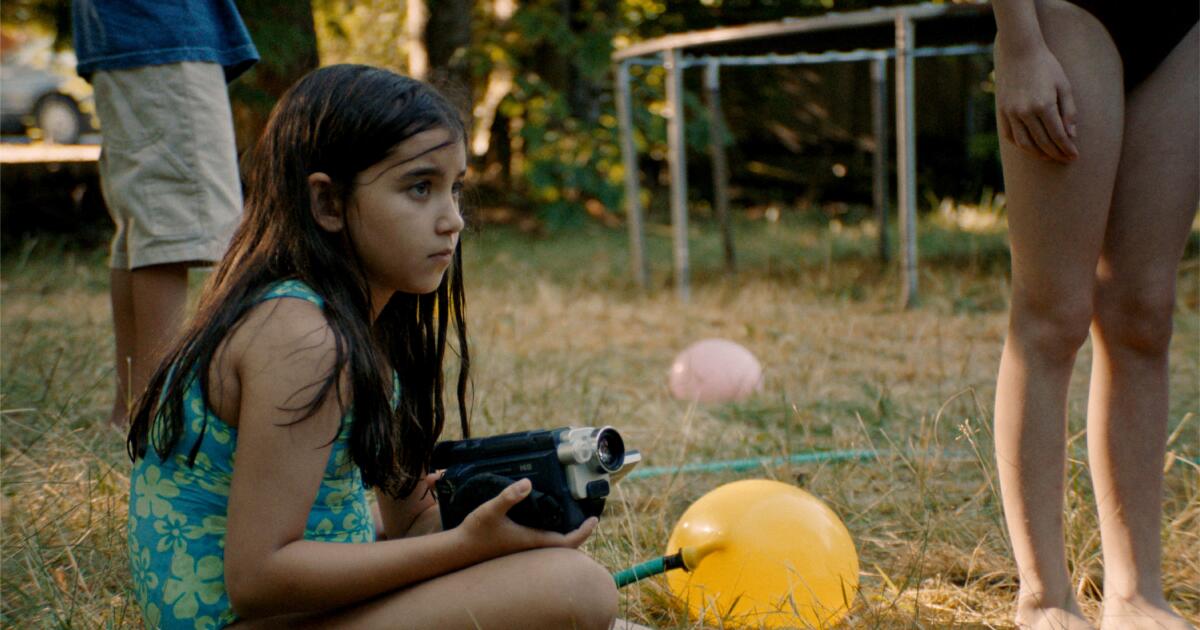
Father (Ádám Tompa) settles into work on the home computer; Mother (Iringó Réti) attempts to amuse the kids with trips to the beach and nature preserves. Snippets of summer filter through the eyes and ears of 8-year-old Sasha (Eylul Guven) and in the photos snapped by their parents.
But a disquieting presence looms: Jeremy (Edik Beddoes), the eldest son. Blond, light-featured and tall, he is visually distinct from the three other children and his silent rebellion permeates the atmosphere.
His misbehavior is minor — irritating but untenable when stacked together — like bouncing a ball against a wall, disappearing for fun or climbing on the roof. He mostly just seems like a moody, unsatisfied teen, drawing elaborate maps and sometimes playing with his siblings sweetly. It all seems like harmless mischief until it escalates.
The movie’s title refers to a key chain from a gift shop that Jeremy, who almost never speaks, presents to his younger sister. Like him, the film is quiet and meditative, bathed in the cool blues and verdant greens of the setting, captured in Maya Bankovic’s saturated cinematography. We are transported to a place of natural beauty and a period of seemingly unlimited time. But Jeremy-related tension simmers beneath the domestic surface, just as it does in Chantal Akerman’s 1975 landmark “Jeanne Dielman, 23 Quai du Commerce, 1080 Bruxelles,” referenced in a shot of a mother and daughter peeling potatoes.
“Blue Heron,” though, is not just going to simply be a throwback family drama about a troubled boy and his younger sister. The film suddenly zooms out, linearly, to two decades later. Zimmer’s older version of Sasha is grappling with her brother’s void and she does so with her mind, her work, her actions. She conducts a focus group of social workers for a documentary in order to try to understand Jeremy’s behavior and the treatment he got at the time. She scrubs through video and photos and interviews a case worker. She escapes into old movies.
In Romvari’s award-winning 2020 short “Still Processing,” a companion piece to “Blue Heron,” she processes the loss of two brothers through photography, sifting through boxes of old photos and film negatives shot by her father, who trained as a cinematographer in Hungary. It seems natural for Romvari to access the emotional through artistic practice, to give her — and Sasha — something to do with their hands. The tactility of the photographs in “Still Processing” provide an access point to the past. Romvari weeps as she spreads them out on a table, saying “hi” softly to her brothers. But there’s a remove in the rigorous focus on the snapshots that perhaps also protects her from the full crushing weight of these emotions.
But in a film like “Blue Heron,” anything is possible, including time travel, and for Romvari, it’s the channel that she offers Sasha to achieve the closure that she needs: a visit to a time she doesn’t really remember, even as she’s building an archive of materials to bolster herself.
If young Sasha watches (and Guven is absolutely terrific at watching), the older Sasha speaks. Zimmer, a New York City comedian, is tasked with a heavy, grief-laden dramatic role, and she’s utterly convincing, entrancing in her stillness. But she also has a way with words, a clarity that rings with a rare kind of honest empathy, especially in a letter that Sasha reads to her parents.
That letter is what “Blue Heron” represents for its filmmaker — an attempt to re-create the past, to bring it back to life. Even if imperfect, the value is in the effort, in the ongoing practice of remembering, as an act of devotion to family and self.
‘Blue Heron’
In English and Hungarian, with subtitles
Not rated
Running time: 1 hour, 30 minutes
Playing: Opens Friday, April 24 in limited release