Wales had endured more than half a century in the international wilderness, absent from major tournaments since the 1958 World Cup.
There followed decades of false dawns and agonising stumbles at final hurdles, until a golden generation of players emerged to inspire a new hope.
Bale, Aaron Ramsey and the rest had been around a while by the time the Euro 2016 campaign came around and, as those stellar talents approached their peak, they were ready to take Wales to new heights.
“There was definitely optimism, a quiet belief I would say,” says Hal Robson-Kanu, the former Wales forward who started up front against Bosnia.
“We’d begun to get results which typically you wouldn’t expect Wales to get at that level. We knew we could do something special.”
Having won three and drawn two of their first five qualifiers, Wales truly started to believe this could be their time when they beat Belgium – then ranked second in the world – in Cardiff.
Coleman’s side then missed the opportunity to seal qualification when they were held to a goalless draw by Israel but knew a point in Bosnia or at home to minnows Andorra would get them over the line.
And so to that night in Zenica, a hard, industrial city in the heart of Bosnia, soaked by driving rain.
Even with the security of the Andorra game to come, Wales could not hide their dejection after second-half goals from Milan Djuric and Vedad Ibisevic gave Bosnia a 2-0 win.
“It was the first game in that campaign we’d lost, so that feeling was just hurting us,” Coleman tells BBC Sport Wales.
“We were playing Andorra at home in our final game, we needed a point, and I remember thinking about our history, how we always fall at the last hurdle and I was thinking, ‘Come on, really?’ I fancied us to do something against Andorra, but you never know, do you?
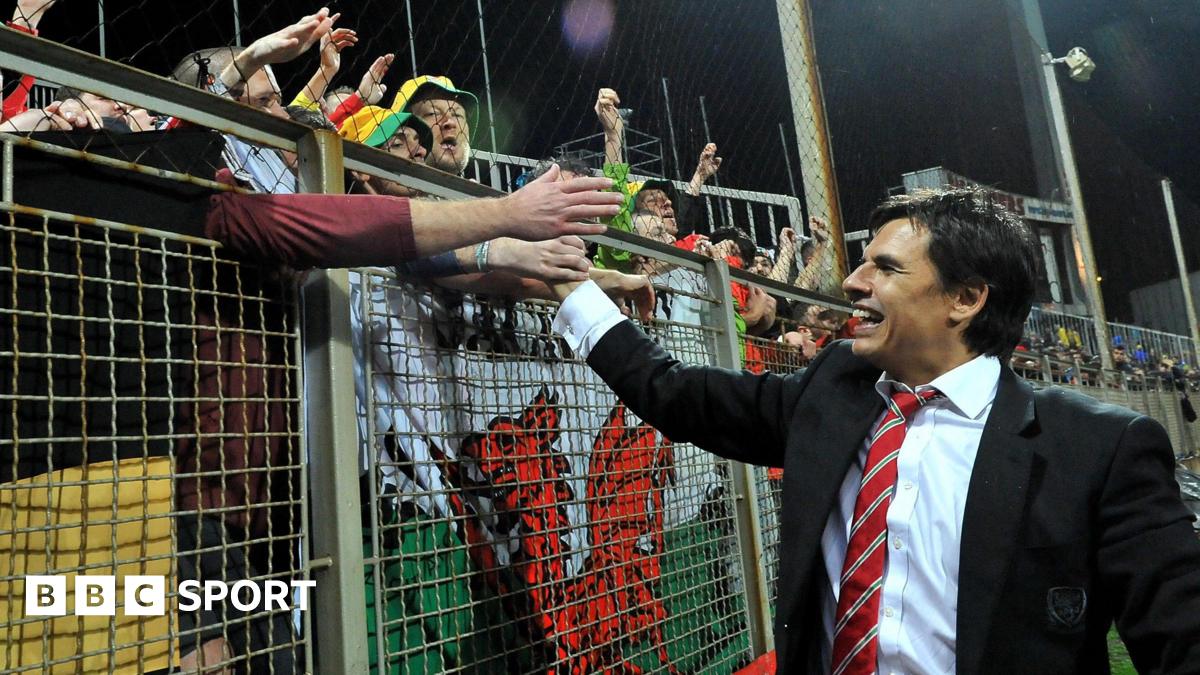
“Then I was coming off the pitch. Our fans are to the left. I remember thinking, ‘They’re a bit joyful. We’ve just lost 2-0. Why are you doing this?’
“Then I saw Mark Evans (the Football Association of Wales’ head of international affairs), who had a look on his face. He said Israel won. And I swear he waited three or four seconds and then he said: ‘Cyprus two.’ He paused again and said: ‘Israel one, Cyprus two’.
“He said we’d qualified and then I just remember turning around and all the players were waiting for me because I think they knew before I did, and I just couldn’t contain myself. I just ran to anybody.”
As word evidently reached activists in the last few weeks that disturbing allegations of sexual abuse against Chicano civil rights icon Cesar Chavez were forthcoming, things started to happen without much explanation.
Groups began to cancel long-planned parades, dinners, lectures and fundraisers scheduled for Chavez’s birthday on March 31. People who I’ve known for years suddenly weren’t returning calls or texts about what was going on. Longtime defenders of Chavez — who stood by their hero even as revelations in this paper and in biographies over the past generation showed there was a dark side to the man — suddenly became hard to reach.
When the United Farm Workers and the Cesar Chavez Foundation put out statements Tuesday morning that “troubling allegations” against their patriarch were considered credible enough for them to offer help to his victims, the silence transformed into dread. There was a discomfort similar to waiting for a tsunami — that whatever was coming would change lives, shake institutions and make people question values and principles that they had long held dear.
And like a natural disaster, what emerged about Chavez was far worse than anyone could’ve expected.
Wednesday morning, the New York Times published a story where two women whose families marched alongside Chavez in the fields of California during the 1960s and 1970s disclosed that he sexually abused them for years when they were girls. Just as shocking was the revelation by Dolores Huerta, Chavez’s longtime compatriot and a civil rights legend, that he had once raped her at a time when their leadership in the fight to bring dignity to grape pickers earned national acclaim and amounted to a modern-day Via Dolorosa.
The silence has transformed into screams. Politicians and organizations that long commemorated Chavez and urged others to follow his ways are releasing statements by the minute. My social media feed is now a torrent of friends and strangers expressing empathy for Chavez’s victims and outrage, disgust and — above all — disappointment that someone considered a secular saint by many for decades turned out to be a human more terrible than anyone could’ve imagined.
There will be questions and soul-searching about these horrifying disclosures in the weeks, months and years to come. We will see a push for the renaming of the dozens of schools, parks and streets that bear Chavez’s name across the country and even the rebranding of Cesar Chavez Day, a California state holiday since 2000 devoted to urging people to give back to their communities and the least among us.
The reckoning is only right. Much of the Latino civil rights, political and educational ecosystem will have to grapple with why they held up Chavez as a paragon of virtue for too long above others just as deserving and, as it turns out, nowhere near as compromised.
In any event, the myth has been punctured.
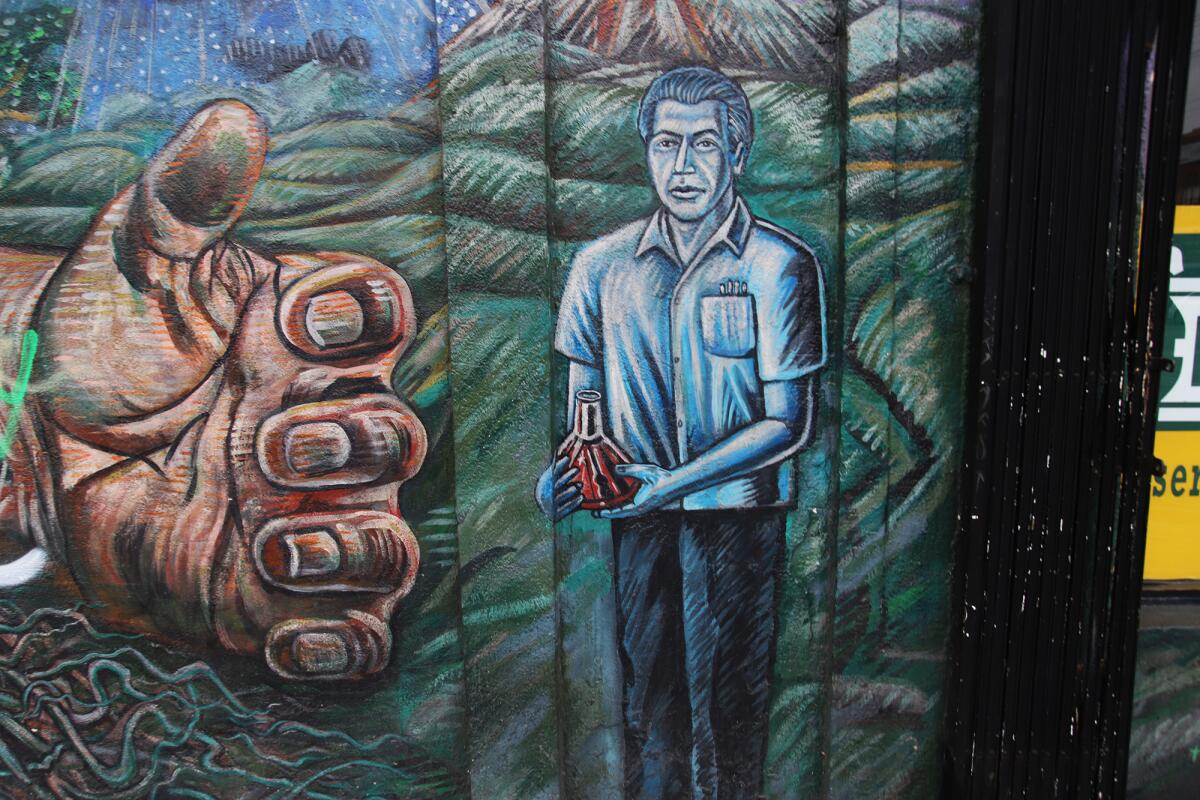
A portrait of Cesar Chavez on a mural on Farmacia Ramirez, 2403 Cesar E Chavez Ave. in East Los Angeles.
(James Carbone / Los Angeles Times)
Chavez’s biography always reads like an entry in the “Lives of the Saints” genre of books that Catholics used to read about the holy men of their faith. The son of farmworkers who became a Mexican American Moses trying to lead his people to the promised land of equity and political power. An internationally famous leader who lived a mendicant’s life. Who devoted decades to some of the most exploited people in the American economy. Honored with awards, plays, posters. Murals, movies and monuments. President Biden even kept a bust of Chavez at his Oval Office desk.
It was a beatific reputation that largely persisted even as the union he helped to create lost its influence in the fields of California and a new generation of activists looked down on Chavez for his long-standing opposition to immigrants who came to this country to work without legal status. Admirers kept him on a pedestal even as former UFW members alleged over the last two decades that the boss they once idolized purged too many good people in the name of absolute control. The hagiography continued even as a new generation of Latinos came of age not knowing anything about him other than an occasional school lesson or television segment.
I was one of those neophytes. I first heard his name at Anaheim High School in the mid-1990s and thought my teacher was talking about Julio Cesar Chavez, the famous Mexican boxer. I was thrilled to discover that someone had bravely fought for the rights of campesinos like my mom and her sisters, who toiled in the garlic fields of Gilroy and strawberry patches of Orange County as teenage girls in the 1960s, the same time that Chavez and the UFW were enjoying their historic wins.
“Who’s Cesar Chavez?” my Mami responded when I asked if his efforts ever made her work easier.
My admiration for Chavez continued even as I learned about some of his faults. I was able to separate Chavez the man from the movement for which he was a figurehead. Long-maligned communities seek heroes to emulate, to draw hope from, to hang on their walls and share their quotes on social media. We create them even as we ignore that they’re flesh and blood just like us.
Chavez seemed like the right man at the right moment as Mexican Americans rose up like never before to battle discrimination and segregation. Now, Latinos and others who admired Chavez have to grapple with his moral failings of the worst possible magnitude at the worst possible time: when there’s an administration doing everything possible to crush Latinos and we’re looking for people to look up to like never before.
He remains one of the few Latino civil rights leaders known nationwide — and Chavez is nowhere near as known as acolytes make him out to be. Some people will argue that it’s unfair he will likely get wiped away from the public sphere while other predatory men from the past and present largely maintain their riches and reputations.
But that’s looking at the abuse revelations the wrong way. For now, I will follow what those most directly affected by Chavez’s actions are telling us to do.
The UFW and Cesar Chavez Foundation were wise to not try to defend the indefensible in their statements and instead consider any victims first before deciding how to decide what’s next for them.
The Chavez family put out a news release that states “we honor the voices of those who feel unheard and who report sexual abuse.”
Huerta wrote in an online essay: “Cesar’s actions do not reflect the values of our community and our movement. The farmworker movement has always been bigger and far more important than any one individual.”
Another of his victims told the New York Times of Chavez’s legacy: “It makes you rethink in history all those heroes. The movement — that’s the hero.”
The fountain in the Memorial Garden surrounds the gravesite of Cesar Chavez and his wife Helen Chavez at Cesar E. Chavez National Monument in Keene, Calif.
(Francine Orr)
The face of that movimiento brought inspiration to millions and improved the lives of hundreds of thousands. That’s why we shouldn’t cancel the good that Chavez fought for alongside so many; we should direct the adulation he once attracted and the anger he’ll now rightfully receive toward the work that still needs to be done.
To quote an old UFW slogan that Chavez transformed into a mantra, la lucha sigue — the fight continues. It’s a statement that’s more pertinent than ever, damn its imperfect messenger.