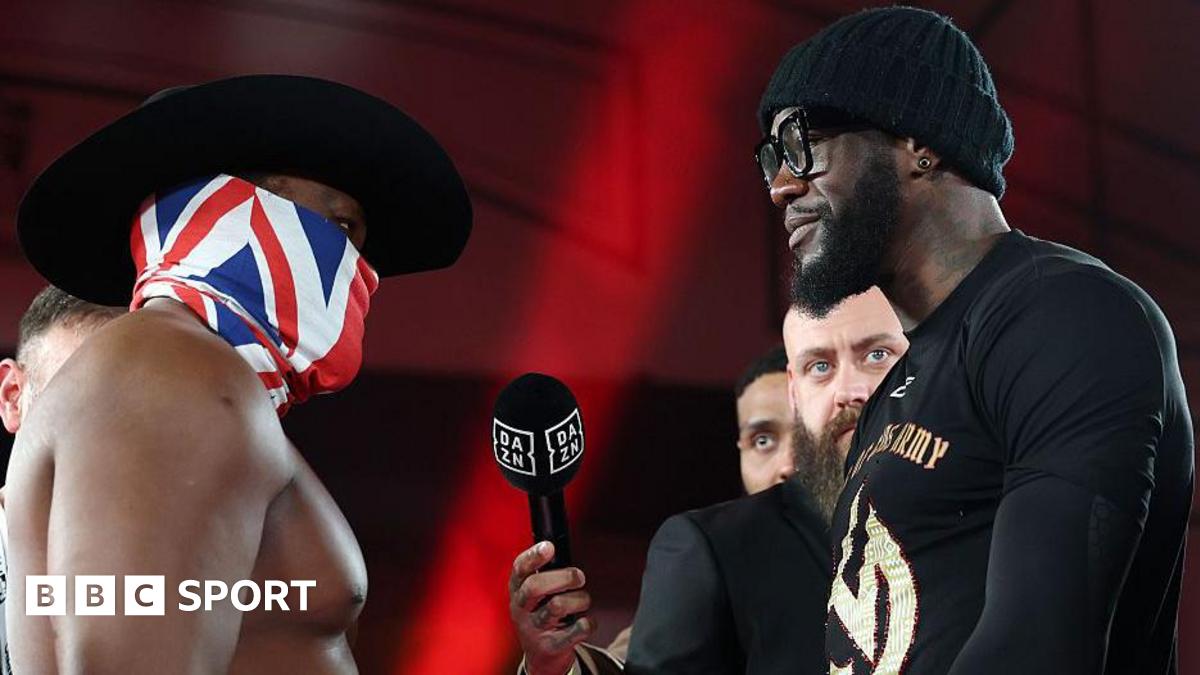
MIAMI — Anthony Joshua knocked out Jake Paul in the sixth round of their heavyweight fight Friday night.
The two-time heavyweight champion displayed why he is one of the sport’s elite punchers when he dropped the fading Paul twice in the fifth round.
Sensing the YouTuber was finished, Joshua rocked him with a right uppercut early in the sixth. The native of England then floored Paul with a combination to the head.
Although Paul (12-2) reached his feet again, Joshua (29-4, 26 knockouts) finally crushed Paul’s upset dream when he dropped him a fourth time with a right to the head. Referee Christopher Young counted Paul out at 1:31 of the round in front of a capacity crowd of 19,600 at the Kaseya Center.
Anthony Joshua punches Jake Paul during their heavyweight boxing match Friday.
(Lynne Sladky / Associated Press)
With the victory, Joshua now can angle to reclaim the heavyweight title he lost against Oleksandr Usyk. Joshua also has talked about a long-discussed match with countryman and former champion Tyson Fury. However, Fury is retired following consecutive losses to Usyk last year.
It was Joshua’s first bout since Daniel Dubois knocked him out in five rounds in September 2024.
Joshua methodically established pace against Paul from the opening round as neither fighter engaged early. Midway through the round, Paul threw an overhand right that Joshua blocked with his glove. In the closing seconds Joshua scored with a right to the head near the ropes.
In the second, Joshua began utilizing his six-inch reach advantage by leading with a left jab.
Jake Paul falls on the canvas after being hit by Anthony Joshua during their heavyweight fight Friday.
(Lynne Sladky / Associated Press)
Paul scored with a short right to the head early in the fourth. Later in the round Paul twice fell to the canvas awkwardly as he again attempted to cut distance during close exchanges
Paul weighed 216 pounds and Joshua weighed 243 for the bout.
The 28-year-old Paul, who began his career in January 2020, originally targeted an exhibition in Miami with lightweight champion Gervonta Davis last month. But Davis encountered legal problems that scrapped the event. Paul quickly pivoted and landed the bout against Joshua in the same venue.
Celebrities in the crowd included golf champion Rory McIlroy, New York Mets slugger Juan Soto, Barstool Sports founder Dave Portnoy and retired NFL receivers Michael Irvin and Brandon Marshall.
In an undercard bout between retired UFC champions, 50-year-old Anderson Silva scored a second-round technical knockout of Tyron Woodley.
Former heavyweight champion beats social-media-star-turned fighter with a sixth-round knockout in Miami.
Published On 20 Dec 202520 Dec 2025
Share
Former world heavyweight champion Anthony Joshua knocked out YouTuber-turned-boxer Jake Paul in their controversial Netflix-backed bout in Miami.
Two-time world champion Joshua made hard work of defeating his vastly less experienced opponent on Friday night, but finally made his superior size and power count in the later stages of the eight-round fight.
Recommended Stories
list of 4 itemsend of list
A mediocre contest at the Kaseya Center – with the two men reportedly splitting a mammoth purse of $184m – descended into farce at times, with Paul repeatedly dropping to the canvas and grappling at Joshua’s legs.
At one stage even referee Christopher Young appeared to be losing patience, warning the fighters in the fourth round: “The fans did not pay to see this crap.”
As Paul tired, Joshua finally began to land punches with more regularity and after knocking down the American twice in the fifth round the end came swiftly in the sixth.
Joshua backed the 28-year-old into a corner and after teeing up Paul with a crunching left, delivered the knockout blow with a right to the chin that sent his opponent crashing to the canvas.
“It wasn’t the best performance,” Joshua, 36, admitted afterwards. “But the end goal was to get Jake Paul, pin him down and hurt him.
“That was the request leading up, and that was on my mind. It took a bit longer than expected but the right hand finally found its destination.”
Joshua meanwhile praised Paul for lasting into the later rounds.
“I want to give him his props – he got up time and time again,” Joshua said. “It was difficult in there for him, but he kept on trying to find a way. It takes a real man to do that.”
Paul, meanwhile, his mouth bloodied from Joshua’s final assault, said he believed his jaw had been broken – but was satisfied with his performance.
“That was fun. I gave it my all,” Paul said. “I had a blast. I think my jaw is broken by the way. But Anthony’s one of the best to ever do it so. I’m gonna come back and get a world championship.
“I just got tired to be honest – like it was so much handling his weight. I think with better cardio I could have kept it up and kept on fighting. But he hits really hard.”
The bout was carried live to Netflix’s approximately 300 million subscribers.
Friday’s made-for-streaming contest, which came just over a year after Paul had fought a 58-year-old Mike Tyson in a much-derided Netflix fight, had triggered alarm across boxing given the disparity in size and experience between the two men.
Yet the devastating first or second round knockout by Joshua that most had predicted failed to materialise as Paul scrambled desperately to stay outside of the 2012 Olympic champion’s range.
Joshua, fighting for the first time in 15 months, always looked the more threatening fighter though, landing 48 of 146 punches thrown compared to Paul’s meagre total of 16 punches landed.
British heavyweight Anthony Joshua needed six rounds to stop boxing novice Jake Paul, who spent much of the contest in survival mode in one of the most striking mismatches in the sport’s history.
Joshua, a two-time world champion, cut an increasingly frustrated figure as Paul danced around the ring for long spells, refusing to engage, before Joshua finally imposed himself by knocking down the YouTuber-turned-boxer twice in the fifth round.
Paul was down again in the sixth, before Joshua landed a powerful and clean right hand that brought a surreal night to an abrupt conclusion at Miami’s Kaseya Center.
The American did not beat the count, although there was palpable relief inside the arena when he was able to rise to his feet and leave the ring without assistance.
When armed soldiers in the small West African nation of Benin appeared on national television on December 7 to announce they had seized power in a coup, it felt to many across the region like another episode of the ongoing coup crisis that has seen several governments toppled since 2020.
But the scenes played out differently this time.
Recommended Stories
list of 4 itemsend of list
Amid reports of gunfire and civilians scampering to safety in the economic capital, Cotonou, Beninese and others across the region waited with bated breath as conflicting intelligence emerged. The small group of putschists, on the one hand, declared victory, but Benin’s forces and government officials said the plot had failed.
By evening, the situation was clear – Benin’s government was still standing. President Patrice Talon and loyalist forces in the army had managed to hold control, thanks to help from the country’s bigger neighbours, particularly its eastern ally and regional power, Nigeria.
While Talon now enjoys victory as the president who could not be unseated, the spotlight is also on the Economic Community of West African States (ECOWAS). The regional bloc rallied to save the day in Benin after their seeming resignation in the face of the crises rocking the region, including just last month, when the military took power in Guinea-Bissau.
This time, though, after much criticism and embarrassment, ECOWAS was ready to push back against the narrative of it being an ineffective bloc by baring its teeth and biting, political analyst Ryan Cummings told Al Jazeera.
“It wanted to remind the region that it does have the power to intervene when the context allows,” Cummings said. “At some point, there needed to be a line drawn in the sand [and] what was at stake was West Africa’s most stable sovereign country falling.”
People gather at the market of Dantokpa, two days after Benin’s forces thwarted the attempted coup against the government, in Cotonou, December 9, 2025 [Charles Placide Tossou/Reuters]
Is a new ECOWAS on the horizon?
Benin’s military victory was an astonishing turnaround for an ECOWAS that has been cast as a dead weight in the region since 2020, when a coup in Mali spurred an astonishing series of military takeovers across the region in quick succession.
Between 2020 and 2025, nine coup attempts toppled five democratic governments and two military ones. The latest successful coup, in Guinea-Bissau, happened on November 28. Bissau-Guineans had voted in the presidential election some days before and were waiting for the results to be announced when the military seized the national television station, detained incumbent President Umaro Sissoco Embalo, and announced a new military leader.
ECOWAS, whose high-level delegation was in Bissau to monitor the electoral process when the coup happened, appeared on the back foot, unable to do much more than issue condemnatory statements. Those statements sounded similar to those it issued after the coups in Mali, Burkina Faso, Niger, and Guinea. The bloc appeared a far cry from the institution that, between 1990 and 2003, successfully intervened to stop the civil wars in Liberia and Sierra Leone, and later in the Ivory Coast. The last ECOWAS military intervention, in 2017, halted Gambian dictator Yahya Jammeh’s attempt to overturn the election results.
Indeed, ECOWAS’s success in its heyday hinged on the health of its members. Nigeria, arguably ECOWAS’s backbone, whose troops led the interventions in Liberia and Sierra Leone, has been mired in insecurity and economic crises of its own lately. In July 2023, when Nigeria’s President Bola Ahmed Tinubu was the ECOWAS chair, he threatened to invade Niger after the coup there.
It was disastrous timing. Faced with livelihood-eroding inflation and incessant attacks by armed groups at home, Nigerians were some of the loudest voices resisting an invasion. Many believed Tinubu, sworn in just months earlier, had misplaced his priorities. By the time ECOWAS had finished debating what to do weeks later, the military government in Niger had consolidated support throughout the armed forces and Nigeriens themselves had decided they wanted to back the military. ECOWAS and Tinubu backed off, defeated.
Niger left the alliance altogether in January this year, forming the Alliance of Sahel States (AES) with fellow military governments in Mali and Burkina Faso. All three share cultural and geographic affinities, but are also linked by their collective dislike for France, the former colonial power, which they blame for interfering in their countries. Even as they battle rampaging armed groups like Jama’at Nusrat al-Islam wal-Muslimin (JNIM), the three governments have cut ties with French forces formerly stationed there and welcomed Russian fighters whose effectiveness, security experts say, fluctuates.
Sierra Leone’s President Julius Maada Bio, who chairs ECOWAS, walks with Guinea-Bissau’s transitional president, Major-General Horta Inta-A, during a meeting in Bissau, Guinea-Bissau, on December 1, 2025 [Delcyo Sanca/Reuters]
But Benin was different, and ECOWAS appeared wide awake. Aside from the fact that it was one coup too far, Cummings said, the country’s proximity to Nigeria, and two grave mistakes the putschists made, gave ECOWAS a fighting chance.
The first mistake was that the rebels had failed to take Talon hostage, as is the modus operandi with putschists in the region. That allowed the president to directly send an SOS to his counterparts following the first failed attacks on the presidential palace at dawn.
The second mistake was perhaps even graver.
“Not all the armed forces were on board,” Cummings said, noting that the small group of about 100 rebel soldiers had likely assumed other units would fall in line but had underestimated how loyal other factions were to the president. That was a miscalculation in a country where military rule ended in 1990 and where 73 percent of Beninese believe that democracy is better than any other form of government, according to poll site Afrobarometer. Many take particular pride in their country being hailed as the region’s most stable democracy.
“There was division within the army, and that was the window of opportunity that allowed ECOWAS to deploy because there wasn’t going to be a case of ‘If we deploy, we will be targeted by the army’. I dare say that if there were no countercoup, there was no way ECOWAS would have gotten involved because it would have been a conventional war,” Cummings added.
Quickly reading the room, Benin’s neighbours reacted swiftly. For the first time in nearly a decade, the bloc deployed its standby ground forces from Nigeria, Ghana, the Ivory Coast, and Sierra Leone. Abuja authorised air attacks on rebel soldiers who were effectively cornered in a military base in Cotonou and at the national TV building, but who were putting up a last-ditch attempt at resistance. France also supported the mission by providing intelligence. By nightfall, the rebels had been completely dislodged by Nigerian jets. The battle for Cotonou was over.
At least 14 people have since been arrested. Several casualties were reported on both sides, with one civilian, the wife of a high-ranking officer marked for assassination, among the dead. On Wednesday, Beninese authorities revealed that the coup leader, Colonel Pascal Tigri, was hiding in neighbouring Togo.
At stake for ECOWAS was the risk of losing yet another member, possibly to the landlocked AES, said Kabiru Adamu, founder of Abuja-based Beacon Security intelligence firm. “I am 90 percent sure Benin would have joined the AES because they desperately need a littoral state,” he said, referring to Benin’s Cotonou port, which would have expanded AES export capabilities.
Nigeria could also not afford a military government mismanaging the deteriorating security situation in northern Benin, as has been witnessed in the AES countries, Cummings said. Armed group JNIM launched its first attack on Nigerian soil in October, adding to Abuja’s pressures as it continues to face Boko Haram in the northeast and armed bandit groups in the northwest. Abuja has also come under diplomatic fire from the US, which falsely alleges a “Christian genocide” in the country.
“We know that this insecurity is the stick with which Tinubu is being beaten, and we already know his nose is bloodied,” Cummings said.
Revelling in the glory of the Benin mission last Sunday, Tinubu praised Nigeria’s forces in a statement, saying the “Nigerian armed forces stood gallantly as a defender and protector of constitutional order”. A group of Nigerian governors also hailed the president’s action, and said it reinforced Nigeria’s regional power status and would deter further coup plotters.
Nigerian ECOWAS Ceasefire Monitoring Group (ECOMOG) soldiers guard a corner in downtown Monrovia during fighting between militias loyal to Charles Taylor and Roosevelt Johnson in Liberia in 1996. Between 1990-2003, ECOWAS successfully intervened to help stop the Liberian civil war [File: Reuters]
Not yet out of the woods
If there is a perception that ECOWAS has reawakened and future putschists will be discouraged, the reality may not be so positive, analysts say. The bloc still has much to do before it can be taken seriously again, particularly in upholding democracy and calling out sham elections before governments become vulnerable to mass uprisings or coups, Beacon Security’s Adamu said.
In Benin, for example, ECOWAS did not react as President Talon, in power since 2016, grew increasingly autocratic, barring opposition groups in two previous presidential elections. His government has again barred the main opposition challenger, Renaud Agbodjo, from elections scheduled for next April, while Talon’s pick, former finance minister Romuald Wadagni, is the obvious favourite.
“It’s clear that the elections have been engineered already,” Adamu said. “In the entire subregion, it’s difficult to point to any single country where the rule of law has not been jettisoned and where the voice of the people is heard without fear.”
ECOWAS, Adamu added, needs to proactively re-educate member states on democratic principles, hold them accountable when there are lapses, as in the Benin case, and then intervene when threats emerge.
The bloc appears to be taking heed. On December 9, two days after the failed Benin coup, ECOWAS declared a state of emergency.
“Events of the last few weeks have shown the imperative of serious introspection on the future of our democracy and the urgent need to invest in the security of our community,” Omar Touray, ECOWAS Commission president, said at a meeting in the Abuja headquarters. Touray cited situations that constitute coup risks, such as the erosion of electoral integrity and mounting geopolitical tensions, as the bloc splits along foreign influences. Currently, ECOWAS member states have stayed close to Western allies like France, while the AES is firmly pro-Russia.
Another challenge the bloc faces is managing potential fallout with the AES states amid France’s increasing closeness with Abuja. As Paris faces hostility in Francophone West Africa, it has drawn closer to Nigeria, where it does not have the same negative colonial reputation, and which it perceives as useful for protecting French business interests in the region, Cummings said. At the same time, ECOWAS is still hoping to woo the three rogue ex-members back into its fold, and countries like Ghana have already established bilateral ties with the military governments.
“The challenge with that is that the AES would see the intervention [in Benin] as an act not from ECOWAS itself but something engineered by France,” Adamu said. Seeing France instigating an intervention which could have benefitted AES reinforces their earlier complaints that Paris pokes its nose into the region’s affairs, and could push them further away, he said.
“So now we have a situation where they feel like France did it, and the sad thing is that we haven’t seen ECOWAS dispel that notion, so the ECOWAS standby force has [re]started on a contentious step,” Adamu added.