healthcare cost

Republicans take a victory lap as House gathers to end shutdown

President Trump and Republican lawmakers took a victory lap on Tuesday after securing bipartisan support to reopen the government, ending the longest shutdown in U.S. history without ceding ground to any core Democratic demands.

House members were converging on Washington for a final vote expected as early as Wednesday, after 60 senators — including seven Democrats and an independent — advanced the measure on Monday night. Most Democratic lawmakers in the House are expected to oppose the continuing resolution, which does not include an extension of Affordable Care Act tax credits that had been a central demand during the shutdown negotiations.

The result, according to independent analysts, is that premiums will more than double on average for more than 20 million Americans who use the healthcare marketplace, rising from an average of $888 to $1,904 for out-of-pocket payments annually, according to KFF.

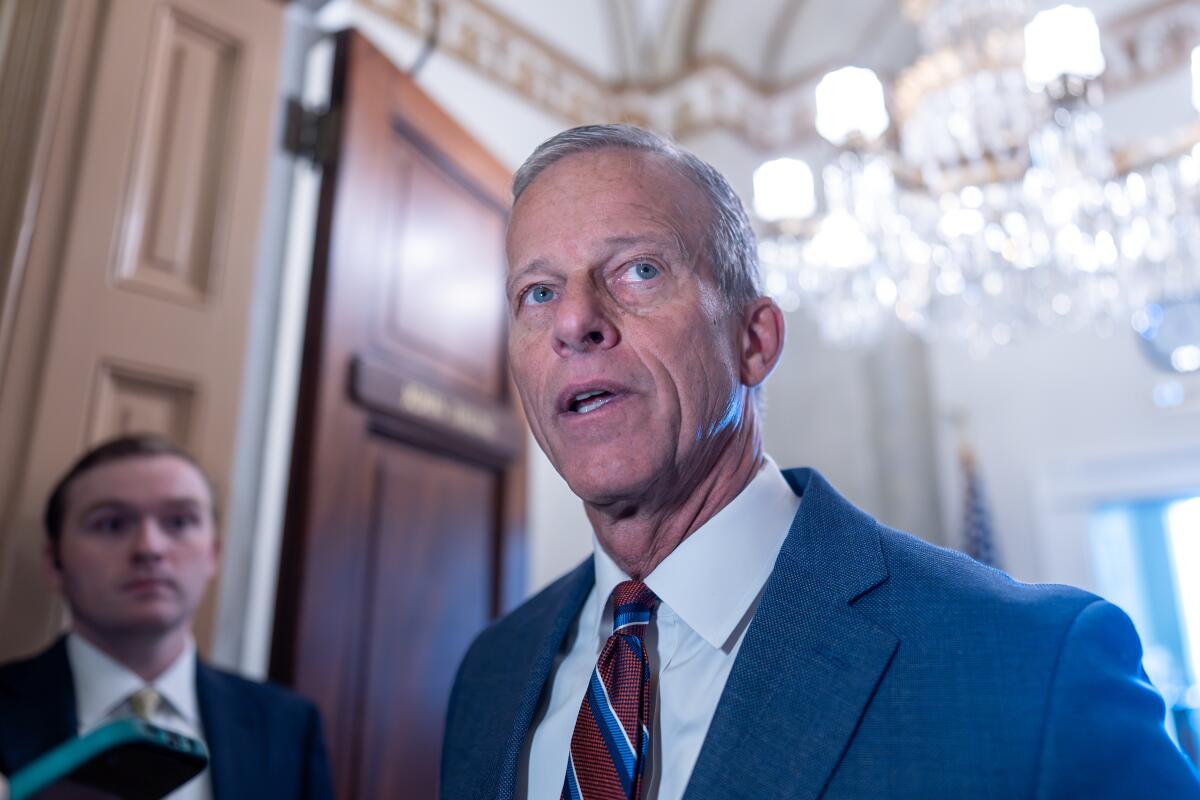
Democrats in the Senate who voted to reopen the government said they had secured a promise from Majority Leader John Thune, a Republican from South Dakota, that they would get a vote on extending the tax credits next month.

But the vote is likely to fail down party lines. And even if it earned some Republican support, House Speaker Mike Johnson, a Republican from Louisiana, has made no promises he would give the measure a vote in the lower chamber.

An end to the shutdown comes at a crucial time for the U.S. aviation industry ahead of one of the busiest travel seasons around the Thanksgiving holiday. The prolonged closure of the federal government led federal employees in the sector to call out sick in large numbers, prompting an unprecedented directive from the Federation Aviation Administration that slowed operations at the nation’s biggest airports.

Lawmakers are racing to vote before federal employees working in aviation safety miss yet another paycheck this week, potentially extending frustration within their ranks and causing further delays at airports entering the upcoming holiday week.

It will be the first time the House conducts legislative work in over 50 days, a marathon stretch that has resulted in a backlog of work for lawmakers on a wide range of issues, from appropriations and stock trading regulations to a discharge petition calling for the release of files in the Jeffrey Epstein investigation.

“We look forward to the government reopening this week so Congress can get back to our regular legislative session,” Johnson told reporters Monday. “There will be long days and long nights here for the foreseeable future to make up for all this lost time that was imposed upon us.”

To reopen the government, the spending package needs to pass the House, where Republicans hold a slim majority and Democrats have vowed to vote against a deal that does not address healthcare costs.

Still, Trump and Republican leaders believe they have enough votes to push it through the chamber and reopen the government later in the week.

Trump has called the spending package a “very good” deal and has indicated that he will sign it once it gets to his desk.

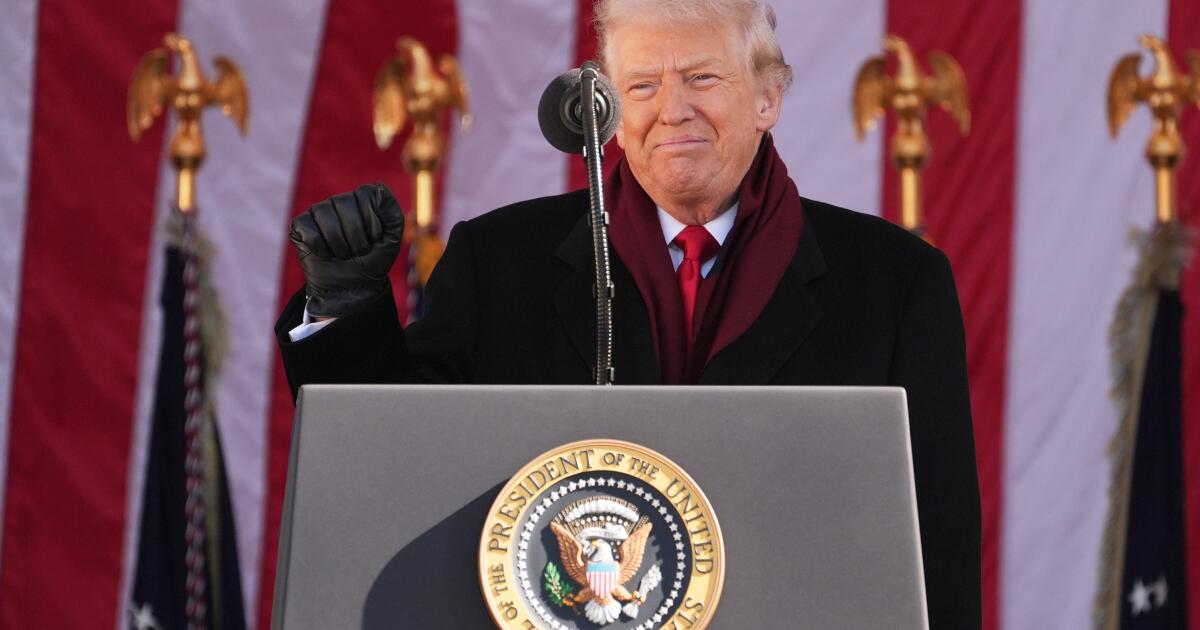
At a Veterans Day event on Tuesday, Trump thanked Thune and Johnson for their work on their work to reopen the government. Johnson was in the crowd listening to Trump’s remarks.

“Congratulations to you and to John and to everybody on a very big victory,” Trump said in a speech at Arlington National Cemetery. “We are opening back our country. It should’ve never been closed.”

While Trump lauded the measure as a done deal, House Minority Leader Hakeem Jeffries, the top Democrat in the chamber, said his party would still try to delay or tank the legislation with whatever tools it had left.

“House Democrats will strongly oppose any legislation that does not decisively address the Republican healthcare crisis,” Jeffries said in a CNN interview Tuesday morning.

Just like in the Senate, California Democrats in the House are expected to vote against the shutdown deal because it does not address the expiring healthcare subsidies.

Rep. Nancy Pelosi said the shutdown deal reached in the Senate “fails to meet the needs of America’s working families” and said she stood with House Democratic leaders in opposing the legislation.

“We must continue to fight for a responsible, bipartisan path forward that reopens the government and keeps healthcare affordable for the American people,” Pelosi said in a social media post.

California Republicans in the House, meanwhile, have criticized Democrats for trying to stop the funding agreement from passing.

“These extremists only care about their radical base regardless of the impact to America,” Rep. Ken Calvert of Corona said in a social media post.

Rep. Kevin Kiley (R-Rocklin) publicly called on Johnson to negotiate with Democrats on healthcare during the shutdown. He said in an interview last month that he thought there was “a lot of room” to address concerns on both sides of the aisle on how to address the rising costs of healthcare.

Kiley said Monday that he was proposing legislation with Rep. Sam Liccardo (D-San José) that proposed extending the Affordable Care Act tax credits for another two years.

He said the bill would “stop massive increase in healthcare costs for 22 million Americans whose premium tax credits are about to expire.”

“Importantly, the extension is temporary and fully paid for, so it can’t increase the deficit,” Kiley said in reference to a frequent concern cited by Republicans that extending the credits would contribute to the national debt.
Source link

Shutdown deal nears passage as Democrats balk at lack of healthcare relief

A deal that could end the longest government shutdown in U.S. history is poised to head to the House, where Democrats are launching a last-ditch effort to block a spending agreement reached in the Senate that does not address healthcare costs.

The push comes as Speaker Mike Johnson (R-La.) urged House members on Monday to start making their way back to Washington in anticipation of the chamber voting on a spending package later in the week. The Senate began taking a series of votes Monday night, a day after Senate Republicans reached a deal with eight senators who caucus with Democrats.

The spending plan, which does not include an extension of the Affordable Care Act subsidies that are set to expire at the end of the year, has frustrated many Democrats who spent seven weeks pressuring Republicans to extend the tax credits. It would, however, fund the government through January, reinstate federal workers who were laid off during the shutdown and ensure that federal employees who were furloughed receive back pay.

Senate Majority Leader John Thune (R-S.D.) also promised senators a vote in December that would put lawmakers on record on the healthcare subsidies. Thune said in a speech Monday that he was “grateful that the end is in sight” with the compromise.

“The American people have suffered long enough,” he said. “Let’s not pointlessly drag this bill out. Let’s get it done, get it over to the House so we can get this government open.”

Senate Democrats who defected have argued that a vote is the best deal they could get as the minority party, and that forcing vulnerable Republicans in the chamber to vote on the issue will help them win ahead of next year’s midterm elections.

As the Senate prepared to vote on the deal Monday, Sen. Chuck Schumer of New York, the Democratic leader of the chamber, continued to reiterate his opposition to what he called a “Republican bill.” Schumer, who has faced backlash from Democrats for losing members of his caucus, said the bill “fails to do anything of substance to fix America’s healthcare crisis.”

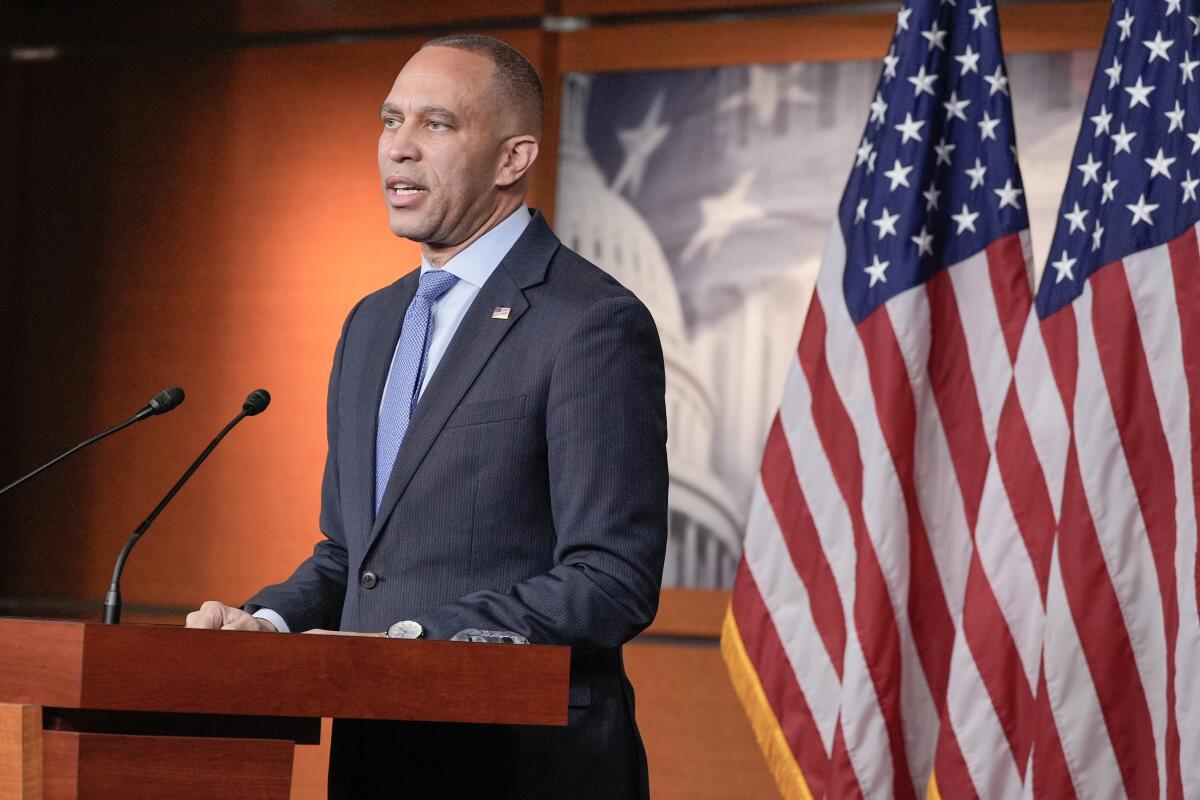
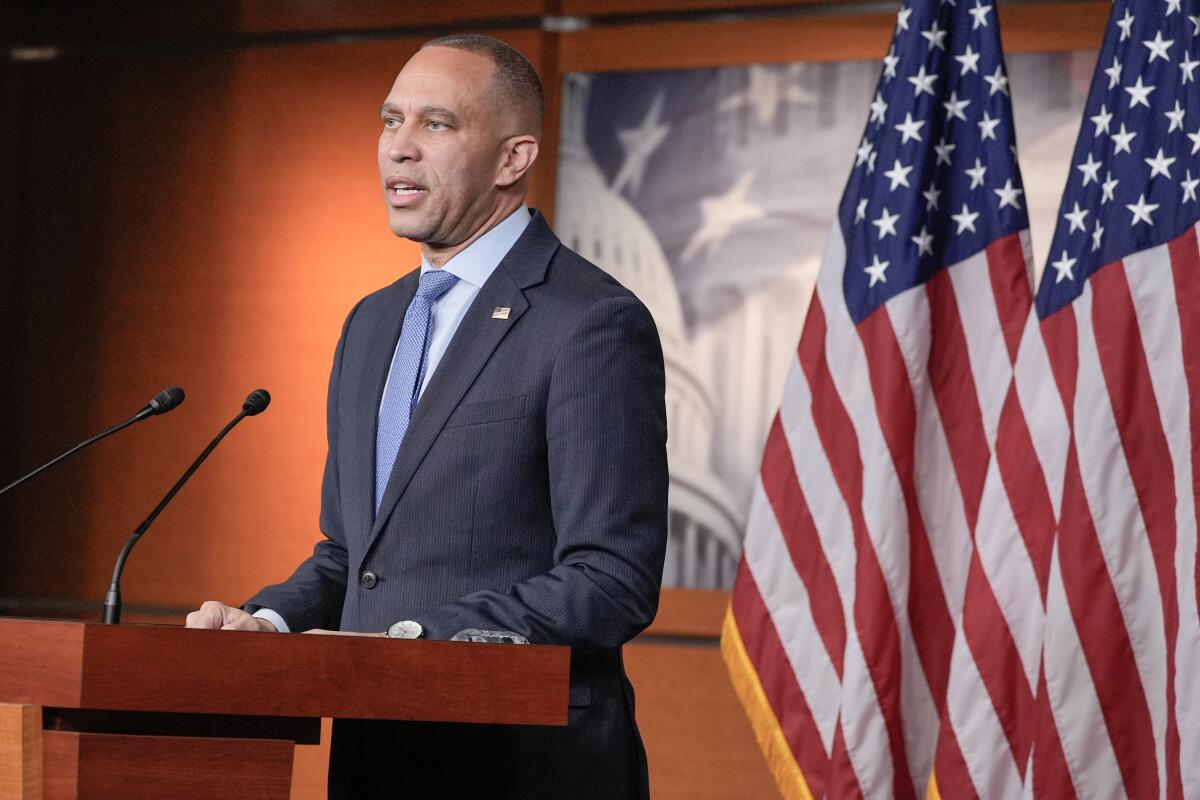
A man speaks at a lectern, with two American flags behind him.

House Minority Leader Hakeem Jeffries (D-N.Y.) speaks to reporters about the government shutdown.

(Mariam Zuhaib / Associated Press)

Thune’s promise to allow a vote in the Senate does not guarantee a favorable outcome for Democrats, who would need to secure Republican votes for passage through the chamber. And the chance to address healthcare costs will be made even harder by Johnson, who has not committed to holding a vote on his chamber in the future.

“I’m not promising anybody anything,” he said. “I’m going to let the process play out.”

House Minority Leader Hakeem Jeffries (D-N.Y.), meanwhile, told reporters that House Democrats will continue to make the case that extending the subsidies is what Americans are demanding from elected officials, and that there is still a fight to be waged in the chamber — even if it is a long shot.

“What we are going to continue to do as House Democrats is to partner with our allies throughout America is to wage the fight, to stay in the Colosseum,” Jeffries said at a news conference.

Some Republicans have agreed with Democrats during the shutdown that healthcare costs need to be addressed, but it is unlikely that House Democrats will be able to build enough bipartisan support to block the deal in the chamber.

Still, Jeffries said the “loudmouths” in the Republican Party who want to do something about healthcare costs have an opportunity to act now that the House is expected to be back in session.

“They can no longer hide. They can no longer hide,” Jeffries said. “They are not going to be able to hide this week when they return from their vacation.”

Democrats believed that fighting for an extension of healthcare tax credits, even at the expense of shutting down the government, would highlight their messaging on affordability, a political platform that helped lead their party to victory in elections across the country last week.

If the tax credits are allowed to lapse at the end of the year, millions of Americans are expected to see their monthly premiums double.

In California, premiums for federally subsidized plans available through Covered California will soar by 97% on average next year.

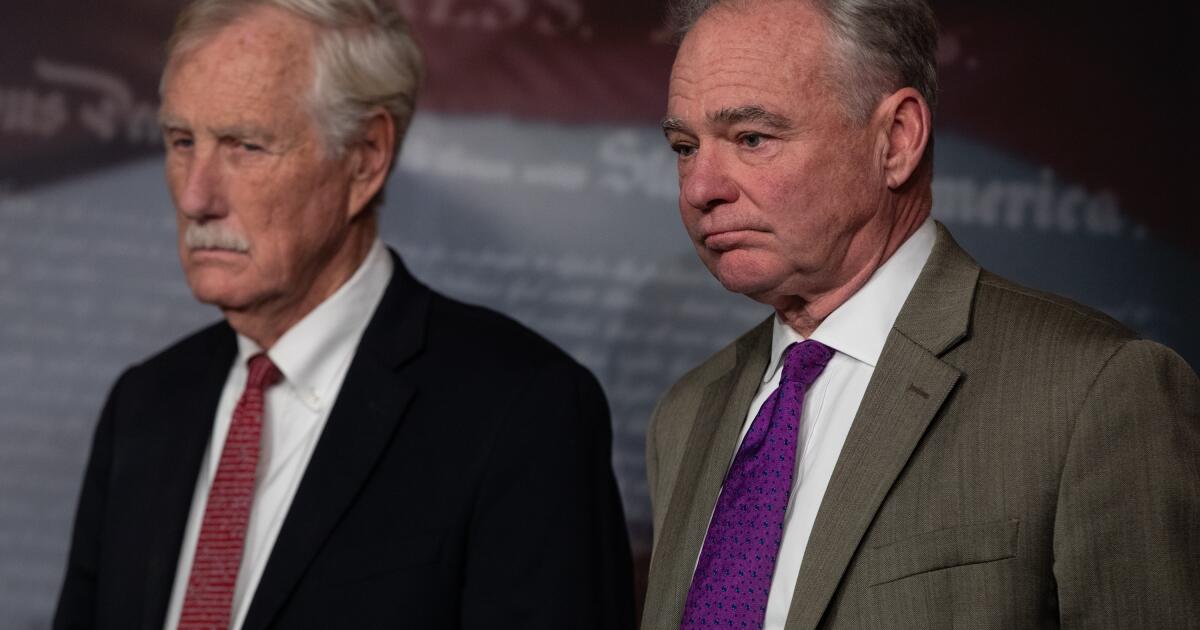
Two men.

Senate Majority Leader John Thune answers questions Monday about a possible end to the government shutdown after eight members of the Democratic caucus broke ranks and voted with Republicans.

(J. Scott Applewhite / Associated Press)

California’s U.S. senators, Adam Schiff and Alex Padilla, were among the Democrats who voted against the deal to reopen the government because it did not address healthcare costs.

“We owe our constituents better than this. We owe a resolution that makes it possible for them to afford healthcare,” Schiff said in a video Sunday night.

Some Republicans too have warned that their party faces backlash in the midterm elections next year if it doesn’t come up with a more comprehensive health plan.

“We have always been open to finding solutions to reduce the oppressive cost of healthcare under the unaffordable care act,” Johnson said Monday.

A final vote could still take several days. Republican Sen. Rand Paul of Kentucky, for one, has said he supports an expeditious vote to reopen the government, but is insisting on a prior vote on an amendment that would eliminate language from the spending deal he says would “unfairly target Kentucky’s hemp industry.”

Without unanimous consent to proceed, the final Senate vote could end up bogged down by procedural delays.

Johnson, meanwhile, has asked members to return by Wednesday in anticipation of a vote in the latter part of the week. Republicans expect to have the votes to pass it, Johnson said.

Any piece of legislation needs to be approved by both the Senate and House and be signed by the president.

Speaking to reporters in the Oval Office on Monday, President Trump said he would support the legislative deal to reopen the government.

“We’re going to be opening up our country,” Trump said. “Too bad it was closed, but we’ll be opening up our country very quickly.”

Trump added that he would abide by a provision that would require his administration to reinstate federal workers who were laid off during the shutdown.

“The deal is very good,” he said.

Johnson said he spoke to the president on Sunday night and described Trump as “very anxious” to reopen the government.

“It’s after 40 days of wandering in the wilderness, and making the American people suffer needlessly, that some Senate Democrats finally have stepped forward to end the pain,” Johnson said. “Our long national nightmare is finally coming to an end, and we’re grateful for that.”

Source link

Democrats crumble like cookies. Is this really the best they can do?

Democrats just crumbled like soft-bake cookies.

The so-called resistance party has given up the shutdown fight, ensuring that millions of Americans will face Republican-created skyrocketing healthcare costs, and millions more will bury any hope that the minority party will find the substance and leadership to run a viable defense against Trump.

Sunday night, eight turncoat Democrats sold out every American who pays for their own health insurance through the affordable marketplaces set up by President Obama.

As has been thoroughly reported in past weeks, Republicans are dead set on making sure that insurance is entirely out of financial reach for many Americans by refusing to help them pay for the premiums with subsidies that are part of current law, offered to both low- and middle-income families.

Republicans — for reasons hard to fathom other than they hate Obama, and apparently basics such as flu shots — have long desired to kill the ACA and now are on the brink of doing so, in spirit if not actuality, thanks to Democrats.

Trump must be doing his old-man jig in the Oval Office.

The pain this craven cave-in will cause is already evident. Rates for 2026 without the government subsidies have been announced, and premiums have doubled on average, according to nonpartisan health policy researchers KFF. Doubled.

Insurance companies are planning on raising their rates by about 18%, already devastating and symptomatic of the need for a total overhaul of our messed-up system. That increase, coupled with the loss of the subsidies beginning at the start of next year, means a 114% jump in costs for the folks dependent on this insurance. Premiums that cost an average $888 in 2025 will jump to $1,904 in 2026, according to KFF.

But it’s the middle-income people who will really be hit.

“On average, a 60-year-old couple making $85,000 … would see yearly premium payments rise by over $22,600 in 2026,” KFF warns, meaning that instead of paying 8.5% of their entire income toward health insurance, it will now jump to about 25%.

Merry Christmas, America.

While the eight Democrats who broke from their party to allow this to happen are directly responsible (thankfully our California senators are not among them), Democratic leadership should also be held accountable.

A party that can’t keep itself together on the really big votes isn’t a party. It’s a a bunch of people that occasionally have lunch together. Literally, they had one job: Stick together.

The failure of Democratic leadership to make sure its Senate votes didn’t shatter in this intense moment isn’t just shameful, it’s depressing. For all of the condemnation of the Republican members of Congress for failing to uphold their duty to be a check on the power of the presidency, here’s the opposition party rolling over belly up on the pivotal issue of healthcare.

As California Rep. Ro Khanna put it on social media, “Senator Schumer is no longer effective and should be replaced. If you can’t lead the fight to stop healthcare premiums from skyrocketing for Americans, what will you fight for?”

If the recent elections had any lessons in them, it’s that Democrats — and voters in general — want courage. Love or hate Zohran Mamdani, his win as New York City mayor was due in no small part for daring to forge his own path. Ditto on Gov. Gavin Newsom and Proposition 50.

Mamdani put that sentiment best in his victory speech, promising an age when people can “expect from their leaders a bold vision of what we will achieve, rather than a list of excuses for what we are too timid to attempt.”

Before you start angry-emailing me, yes, I do understand how much pain the shutdown in causing, especially for furloughed workers and those about to see their SNAP benefits cut off. I feel for every person who doesn’t know how they will pay their bills.

But here are the facts that we can’t forget. Republicans have purposefully made that pain intense in order to break Democrats. Trump has found ways to pay his deportation agents, while simultaneously not paying critical workers such as airport screeners and air traffic controllers, where the chaos created by their absence is both visible and disruptive. He has also threatened to not give back pay to some of those folks when this does end.

And on the give-in-or-don’t-eat front, he’s actually been ordered by courts to pay those SNAP benefits and is fighting it. Republicans could easy band together and demand that money goes out while the rest is hashed out, but they don’t want to. They want people to go hungry so that Democrats will break, and it worked.

But at what cost?

About 24 million people will be hit by these premium increases, leaving up to 4 million unable to keep their insurance. Unable to go to the doctor for routine care. Unable to pay for cancer treatments. Unable to have that lump, that pain, the broken bone looked at. Unable to get their kid a flu shot.

In many ways, this isn’t a California problem. The majority of these folks are in southern, Republican states that refused to expand Medicaid when they had the chance. About 6 in 10 subsidy recipients are represented by Republicans, according to KFF, led by those living in Florida, Georgia and Mississippi. But Americans have been clear that we want access to care for all of us, as a right, not an expensive privilege.

Which makes it all the more mystifying that Democrats are so eager to give up, on an issue that unites voters across parties, across demographics, across our seemingly endless divides.

But I guess that’s just how the cookie crumbles.

Source link