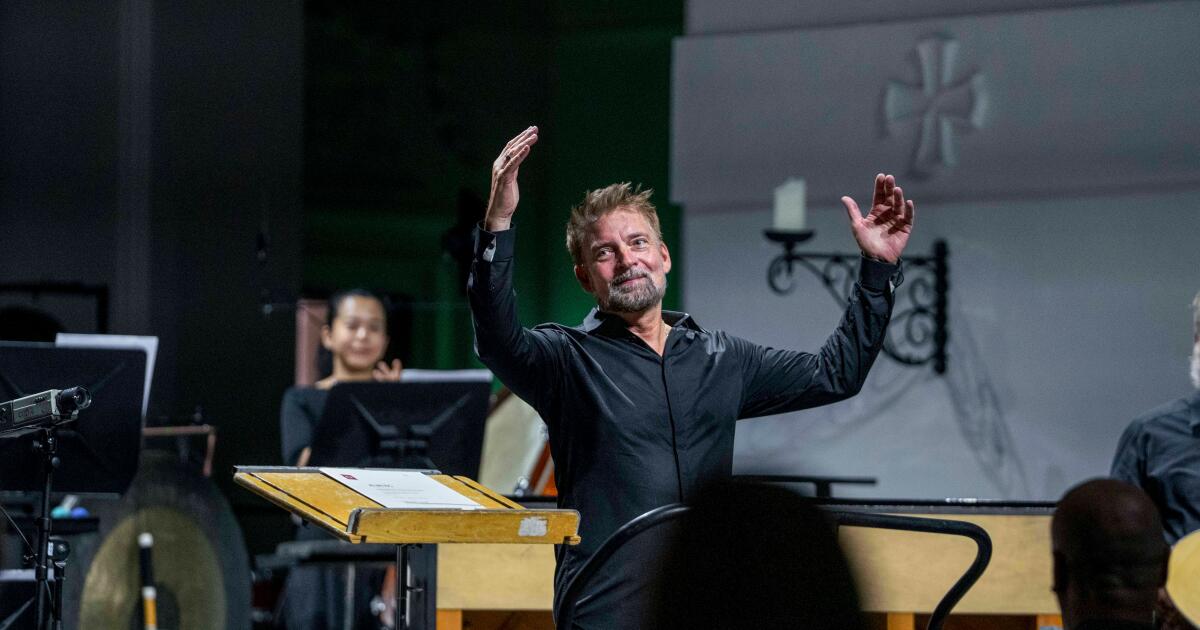
Matthias Pintscher to become new music director of LACO
SALZBURG, Austria — With the Los Angeles Philharmonic and Gustavo Dudamel heading off on a brief tour to London and Edinburgh, the Los Angeles Chamber Orchestra steps in Tuesday night at the Hollywood Bowl with an all-Mozart program. Mozart has long been a specialty of LACO.
And it so happens that the orchestra is using the Mozartean occasion to announce that its next music director will be German composer and conductor Matthias Pintscher, who has been busy conducting in Mozart’s birthplace, Salzburg, where I caught up with him.
Pintscher, who will succeed current music director Jaime Martín beginning in 2027-28 season, augurs a new era for LACO. The orchestra will have a part-time residence when the Colburn Center opens next fall. The innovative 1,000-seat hall for concert, opera and dance looks to be Frank Gehry’s last music-meant masterpiece certain to usher in a new era for the Grand Avenue cultural district.
It also means a sort of homecoming for LACO, which gave its first concert in 1969 in the then-new Mark Taper Forum, the last of the Music Center’s initial three venues. The orchestra had been founded as an outlet to Hollywood studio musicians, and its first music director was the lively Mozartean, Neville Marriner. LACO’s first nine seasons included a Monday night series when the theater, originally meant to be a chamber music hall, was otherwise dark.
A little odd, perhaps, but the Taper remains until now the most intriguing venue of the peripatetic ensemble that has roamed through the years from Santa Monica to Pasadena, and that helped give the ensemble a distinctive image.
That is still the case. Once the Colburn Center opens, LACO will continue its series at the Wallis as well as at various chamber music programs around town.
Pintscher made his LACO debut in 2016 and already there was talk about him succeeding Jeffry Kahane, at two decades, who was the longest-running and most admired music director. Pintscher then served as its artist-in-residence, during which he oversaw a stab at the avant-garde. Not all LACO patrons were pleased.
It was out of the modernism, if not exactly avant-garde (but close), that Pintscher emerged first as a composer of colorfully complex orchestral and vocal scores that reflect a dizzying technical command and often a deep philosophical concept, sometimes taken from ancient Judaic tradition. His first big break as a conductor was as music director of France’s premiere new music Ensemble Intercontemporain that was founded by Pierre Boulez. But Pintscher also expanded in other directions. At the same time, he guest conducted orchestras in Europe and America with programs, while heavily weighed on the 20th century, that went back to Mozart and Haydn. He developed a surprising reputation as an interpreter of Rachmaninoff and other romantics disliked by modernists.
In 2008, he moved to New York, where he has remained, teaching composition at the Juilliard School and guest conducting widely (including the Los Angeles Philharmonic). Two years ago, he became the unlikely music director of the Kansas City Symphony. It was, he said over coffee at Salzburg hotel terrace, love at first rehearsal. His programming is a kind of wish-list of the new and recent with newly-buffed chestnuts, and it’s worked. His contract has been extended to 2034.
Pintscher, who is 55, says he is not ready to make any grand statements about LACO other than being eager to explore West Coast music and that he loves combining old with everything else. There is always room for Mozart and Haydn, to say nothing for his recent infatuation with Aaron Copland. He also described a mission for collaborative and theatrical projects, noting eager discussions with the Los Angeles Master Chorale (expect a Haydn “Creation” sooner rather than later) and director Peter Sellars.
When asked whether he saw himself as a composer who conducts or a conductor who composes, he simply laughed. But Pintscher did say he had no intention, at least for the present, of conducting his own works, feeling that to be a kind of self-promotion. But his mind can be changed. After two years Kansas City talked him into doing a piece, even if a small one.
Meanwhile, a new opera by Pintscher, “Das Kalte Herz” (The Cold Heart), which had its premiere in Berlin earlier this year, happened to be directed by the Long Beach Opera artistic director and chief creative officer, James Darrah Black. Watch this space.
Pintscher was enticed to the Salzburg Festival as part of this summer’s homage to the ageless Hungarian composer György Kurtág, who turned 100 this year. Pintscher conducted two programs with Vienna’s new music ensemble Klangforum Wien. In one, noting Kurtág’s affinity to Samuel Beckett, Pintscher led a transfixing performance of Morton Feldman’s “For Samuel Beckett” holding an audience prisoner for 50 minutes within a chord that won’t go away.
A mystical aura filled the heat-wave-sweaty Kollegienkirche, a voluminous central Salzburg church. Written on his deathbed in 1988, Feldman‘s piece reflects a final harmonic vision combining mismatched patterning of Turkish rugs and Hebraic chant. It remains super soft throughout and nothing seems to happen. But under the surface, little bits of notes fall precisely in and out of place in a rhythmic structure almost too hard to count.
The world’s complexity and emptiness simultaneously filled the church. Afterward, I walked past the home where Mozart was born. It was late at night. The tourists had turned in. My hotel was nearby, just across the river. But I made a lost, wrong turn.
Pintscher had put a peaceful, Feldman-esque, Twilight Zone spell on Mozart.