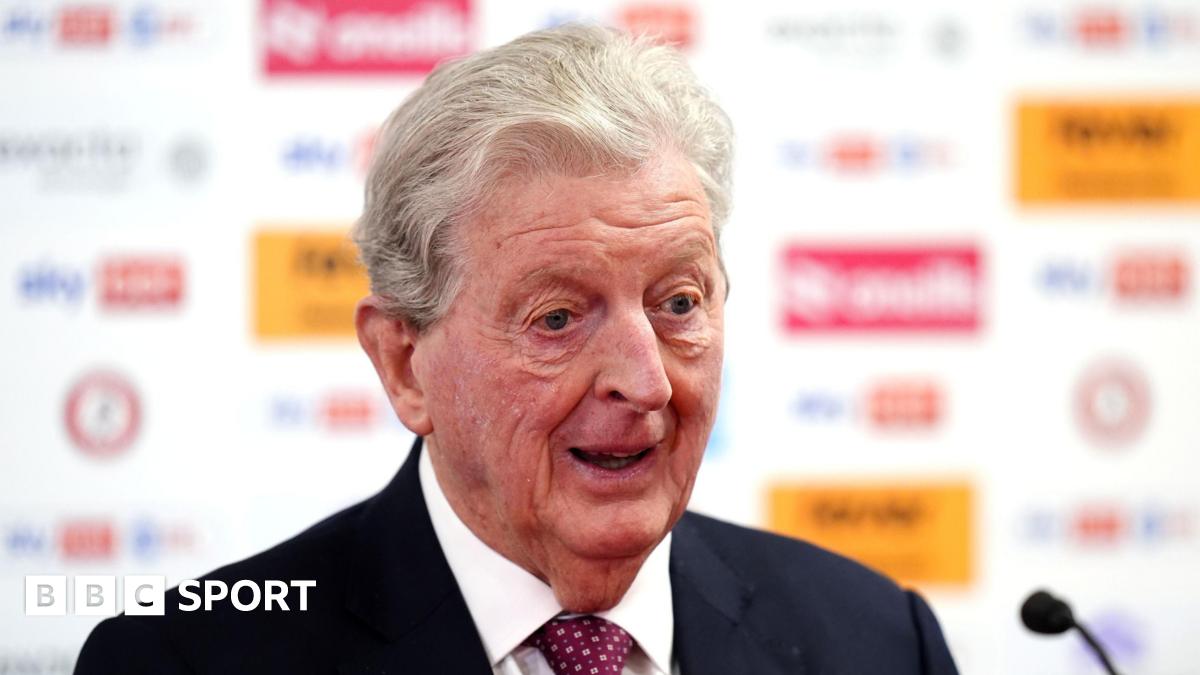
Roy Hodgson said there was much he missed about football after coming out of retirement to return to the dugout as caretaker manager of Bristol City.
The 78-year-old accepted the role at the Championship club until the end of the season following the sacking of Gerhard Struber on Friday.
The former England manager has not worked since leaving Crystal Palace in 2024 and confirmed he will only be in the position for City’s seven remaining games, insisting he was “too old” for a long-term position.
“You don’t work at top-level football at my age really very often,” Hodgson said.
“I’d come to terms with that quite well then something like this happens and you realise that there’s a lot I do miss.
“Having this opportunity to get a feel for that again, and have a chance to work with a good group of players – it seems from what I saw this morning – and to relive being on the grass and doing the coaching, which I’ve always been really keen to do, and with a group of players without necessarily having all the drawbacks.”
Hodgson returns to the club where he began his career in 1982, spending four months as Bristol City manager during a turbulent financial time when the club nearly went out of business.
“I’ve been perfectly happy in my retirement period – a little bit bored from time to time – but a challenge like this was hard to turn down,” Hodgson said.
“Plus the fact it is Bristol which is a lovely city and I do have fond memories of my time here, despite the fact I shouldn’t have fond memories – I should be having nightmares.”
JEDWARD star John Grimes hard launched his new girlfriend on social media today, and she’s absolutely stunning.
It comes just before the singer is due to appear on CelebrityEx On The Beach.
Sign up for the Showbiz newsletter
Thank you!
John Grimes hard launched his new girlfriend on Instagram todayCredit: InstagramThey posed together in sparkles in front of Tower BridgeCredit: Instagram
Taking to the official JedwardInstagram page that he shares with twin brother Edward, John shared some cosy snaps of himself with his lady on a day out in London.
In the photos the loved-up duo are standing in front of the iconic Tower Bridge.
The beautiful brunette rests her hand on John’s chest while he wraps his around her waist.
The happy couple beam at the camera, both dressed up with sparkles as the sun sets.
In thefirst-look at the new episodes, John is stunned to be reunited with former flame Sarah Carragher – but it’s not long before they pick up where they left off.
He tells her: “No one really ever came close to what we had.”
John and Sarah are then seen kissing, suggesting the shock reunion was a successful one.
While he’s never publicly spoken about his relationship with Sarah, John previously revealed he prefers to keep his private life separate from his work after shooting to fame on The X Factor in 2009.
He said in 2017: “I’ve had two long-term relationships that were private. That wasn’t part of my career.”
John is one half of the Irish musical duo, JedwardCredit: Getty Images – GettyThey rose to fame on The X Factor in 2009Credit: Reuters
If I had a nickel for every time an editor has sent me an SFGate story and asked me to match it, I’d be at least a couple dollars richer. The San Francisco-based news website provides solid coverage of California public lands, especially our national parks.
So when my colleague Jaclyn Cosgrove told me the National Park Service had reportedly blacklisted SFGate, I wasn’t exactly shocked.
The L.A. Times climate team gets you up to speed on climate change, energy and the environment. Sign up to get it in your inbox every week.
By continuing, you agree to our Terms of Service, which include arbitration and a class action waiver. You agree that we and our third-party vendors may collect and use your information, including through cookies, pixels and similar technologies, for the purposes set forth in our Privacy Policy such as personalizing your experience and ads.
I emailed the National Park Service to learn more. “Unfortunately, SFGate has distorted the facts and has caused confusion with their reporting with the mainstream media,” a spokesperson replied. “This has caused the Department to spend countless hours correcting their false narrative with other media outlets.”
Although the statement came from a park service email address, the wording is identical to a statement provided to SFGate by an Interior Department spokesperson.
But others — like questions about whether the park service is relying more heavily on seasonal employees amid a decline in permanent staff — went unreturned. And some — like an inquiry for a previous edition of a Boiling Point newsletter about an interpretive exhibit under scrutiny at Death Valley National Park — were fielded by a spokesperson for the Interior Department , rather than the park itself.
I’m not alone. When our wildlife and outdoors reporter Lila Seidman wrote about a wildfire that ripped through Joshua Tree National Park during last year’s government shutdown, she received responses from the Interior Department, but emails to the park service went unreturned.
Jack Dolan, an investigative reporter who often covers public lands, said he hasn’t received meaningful responses from the National Park Service since early last year.
And Cosgrove, who writes The Wild newsletter, said that park rangers remain friendly and helpful, but any communication involves a demand for all questions in writing.
Park service sources and advocates describe all this as part of a broader effort to centralize communications from sub-agencies to the Department of the Interior. Since last year, roughly 230 communications employees have been moved from the National Park Service to the Department of the Interior — part of a broader push in which more than 5,700 employees at the 11 agencies the Interior Department oversees were shifted from the agencies to the department, according to figures provided by the National Parks Conservation Assn., a nonprofit that advocates for the park system.
What’s more, the Interior Department must now approve many park service communications that were once left up to the parks themselves, said John Garder, senior director of budget and appropriations for the National Parks Conservation Assn. That includes exhibits, news releases, website updates and even social media posts, said a source within the park service who asked to remain anonymous over fears of retaliation.
The consolidation “creates significant inefficiencies and removes a layer of accountability to the parks themselves,” Garder said. “It makes it difficult for parks to act nimbly using their professional discretion to make decisions about informing the public about developments in the park,” like a closed road, wildlife hazard or natural disaster.
In an email to The Times, the park service accused National Parks Conservation Assn. employees of donating to Democratic political campaigns and pointed out the nonprofit’s X account follows progressive politicians and groups. “Our parks are nonpartisan, but the NPCA isn’t and they are using you to further raise money off of our parks while never giving those funds to our parks,” a spokesperson wrote in an emailed statement.
National Parks Conservation Assn.’s X account follows over 55,000 users of the platform, including both Democratic and Republican lawmakers and organizations. Garder also noted that the association’s longstanding role has been to advocate for national parks, rather than to raise money directly for them.
The park service email confirmed that officials are “modernizing” the Department of the Interior so that it “will share one voice when communicating the priorities of the Department.”
“The unification of the communication functions will allow for a more collaborative, creative and hands-on approach to Department communications,” the statement said, “and will modernize the federal government by providing a product that is not only better for the American taxpayer but also showcases the state-of-the-art communications capabilities of the United States of America.”
I asked whether I should attribute the statement to a spokesperson for the park service or the Interior Department. The spokesperson replied that I could attribute it to either.
A quick announcement
If you’re a Southern California local, you are probably familiar with PBS SoCal. On April 22, the public media organization is premiering the seventh season of the award-winning program “Earth Focus,” which will be followed by the eighth season in May. We’re excited for the eighth season in particular, because we collaborated with the PBS SoCal team on a few stories about the complexities of rebuilding Los Angeles. You can stream the show for free at pbssocal.org/earthfocus.
More recent land news
Karen Budd-Falen, the third highest-ranking official at the Department of the Interior, has been granted an ethics waiver to work on grazing issues despite potential conflicts of interests that prompted her to recuse herself from such matters during the first Trump presidency, according to Chris D’Angelo of Public Domain.
A pair of Republican senators have officially moved to overturn the management plan for Utah’s Grand Staircase–Escalante National Monument, casting uncertainty on its future and raising new questions about the future of public lands management, Caroline Llanes of Rocky Mountain Community Radio reports.
The Interior Department has officially pulled back more than 80% of its regulations tied to implementing the National Environmental Policy Act in a bid to streamline the environmental review process for major projects on federal public lands. Conservation groups say the changes will block public input and violate federal law, according to Hannah Northey and Scott Streater of E&E News by Politico.
The Trump administration is taking the final steps to undo the Public Lands Rule, which elevated conservation to an official use of Bureau of Land Management lands, Streater also reports. The rule allowed conservation groups to obtain leases for restoration work, similar to how the Bureau of Land Management awards leases to private contractors for extraction and development, points out Sage Marshall of Field & Stream.
Meanwhile, the U.S. Forest Serviceis expected to soon release an updated proposalfor the rescission of the Roadless Rule, which blocked new road building and commercial logging on some 58 million acres of backcountry. The rollback would strike a big blow to hunting and fishing opportunities, according to a report from Trout Unlimited.
A few last things in climate news
Amid a global energy crisis that’s seen oil prices skyrocket, California has been particularly hard-hit due to a dearth of refineries and higher taxes and fees, all of which have left politicians, consumer groups and business interests arguing over who’s to blame, write Ivan Penn and Kurtis Lee for the New York Times.
In the latest maneuver in its campaign against renewable energy, the Trump administration will pay a French company $1 billion to walk away from two U.S. offshore wind leases, according to Jennifer McDermott of the Associated Press.
Southern California’s most destructive wildfires, wettest holiday season and hottest March heat wave have all taken place in the last 15 months, and there’s one clear through line connecting them all, scientists told my colleague Clara Harter.
Mosquitoes have gone year-round in Los Angeles, but business owners have indicated they’re not willing to pay to expand a promising effort to help control their numbers, my buddy Lila Seidman reports.
This is the latest edition of Boiling Point, a newsletter about climate change and the environment in the American West. Sign up here to get it in your inbox. And listen to our Boiling Point podcast here.
Viewers of the BBC documentary were left in tears after watching paramedics battle to save a 67-year-old man
23:02, 25 Mar 2026Updated 23:09, 25 Mar 2026
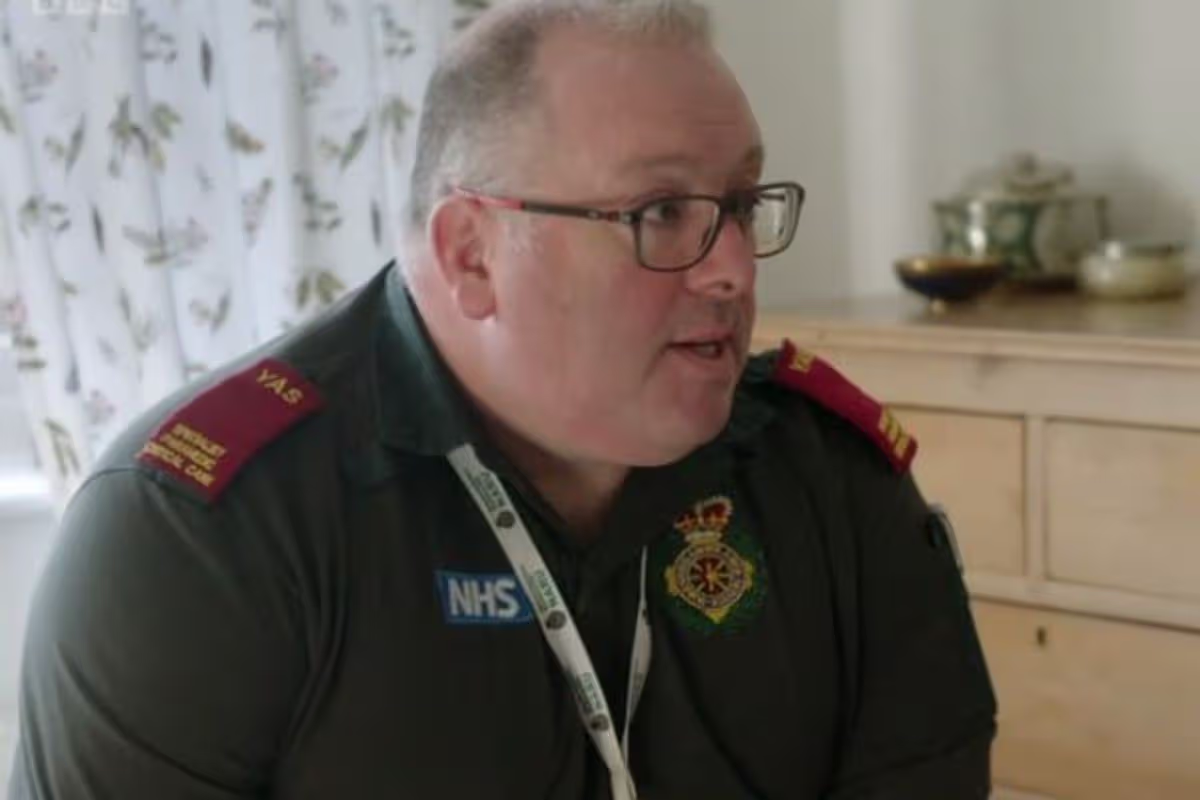
Ambulance left viewers in tears(Image: BBC screengrab)
Viewers were left emotional after a man tragically died during TV show Ambulance on Wednesday’s episode.
The most recent instalment of the BBC series, which follows ambulance crews in Yorkshire, saw an emergency team respond after receiving a call reporting that 67-year-old Steve had stopped breathing.
Critical care paramedic John was amongst those who raced to the location. As the team began CPR, John informed Steve’s partner Penny: “At the moment, the heart rhythm, Steve’s heart, there’s no electrical activity at all. It’s really not good I’m afraid.”
“I think you need to prepare yourself,” he continued. Penny mentioned that Steve was “quite stubborn”, with John responding: “So maybe, maybe he’ll prove me wrong. We’re not there yet.”
However, following 32 minutes of CPR, the decision was taken to stop and John had to deliver the devastating news to Penny, reports Yorkshire Live.
“Penny we’ve stopped,” he informed her. “I am really sorry.”
As they discussed what had happened, John reassured her: “Don’t second guess it. It wouldn’t have changed anything. Nothing you could have done, would have stopped that from happening.”
Penny recalled that there had been an “incredible sunset” that week, saying: “At least he saw that.”
Audiences were left devastated by the scenes, with one sharing on social media: “Sobbing for Steve and Penny. So glad he saw the beautiful sunset. With love.”
“I can’t deal with cardiac arrests,” one viewer wrote on X, including a crying emoji.
“This is brutal,” another individual commented on the platform. “This programme never fails to have me in tears,” admitted one viewer. “So much respect for the call handlers and paramedics.
“Awww wee Penny xxx, bless that paramedic man for his words of comfort,” wrote another, as a fellow viewer remarked: “Oh my goodness this programme Ambulance is so hard to watch.”
“Poor Penny,” said another moved viewer, while one more observed: “Such a dignified response from this lady to her partner just dying. Bless her heart.”
Ambulance airs on BBC One and BBC iPlayer on Wednesdays at 9pm.
PHOENIX — The first pitch of the Dodgers’ 2026 season won’t capture the exuberance of the last pitch of 2025. But it will be meaningful in its own right, as the official first step of the team’s quest for a third straight championship.
How poetic that the same arm should deliver both pitches.
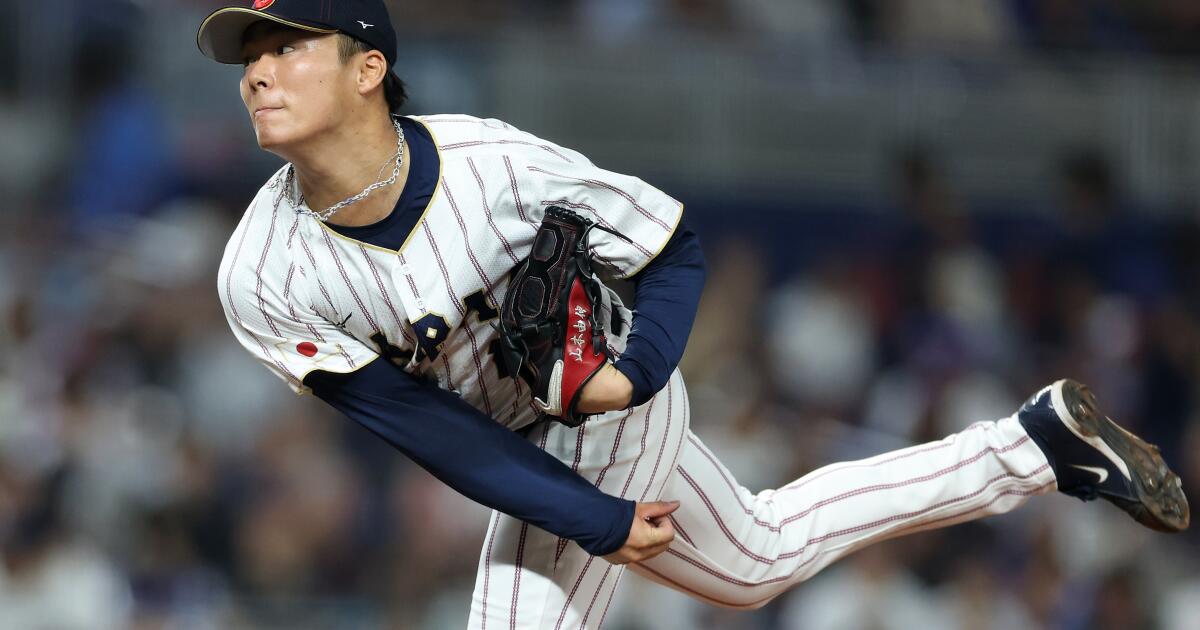
“It’s an honor for me,” Dodgers opening day starter Yoshinobu Yamamoto said Tuesday through interpreter Yoshihiro Sonoda. “And then it’s opening day at a Dodger Stadium home game, and that’s very [much an] honor to me. I also feel the responsibility.”
Yamamoto is scheduled to make one more Cactus League start, against the Padres on Friday, before taking the Dodger Stadium mound next Thursday when the Diamondbacks come to town. It will be the second opening-day start of Yamamoto’s MLB career, and his first at home.
It will also mark the end of a whirlwind offseason and spring training for Yamamoto, who not only shouldered a demanding postseason workload, but also navigated an especially quick turnaround to pitch for Team Japan in the World Baseball Classic.
“It’s hard to put into words,” manager Dave Roberts said. “He is just very driven, he’s very disciplined in his work. That’s some of the things that allows him to compete at a high level. Where most people would feel that you win the World Series MVP, you don’t have enough to pitch in the WBC. He wanted to pitch for his country, and now he’s really excited about the start of 2026.
“He is a very determined person. He really is. We’re just lucky he’s on our team.”
No one needs to be reminded that Yamamoto was a playoff hero last year, but let’s really break down his efforts.
On Oct. 14, Yamamoto made his third start of the postseason and threw a complete game against the Brewers to put the Dodgers ahead 2-0 in the NL Championship Series.
Eleven days later, he tossed another nine innings to help the Dodgers even the series against the Blue Jays. And he wrapped up the World Series with appearances on back-to-back days, starting Game 6 and finishing Game 7.
Yamamoto threw 526 pitches in the postseason, 235 in the World Series alone, and he still touched nearly 97 mph in his final inning of work.
Most pitchers would need at least a full offseason to recover. When Blake Snell slow-played his offseason because of lingering shoulder discomfort after the World Series run, the decision made all the sense in the world.
Yamamoto, however, was already pitching in meaningful games by March 6.
In Yamamoto’s first start of the WBC, he held Chinese Taipei hitless for 2 ⅔ innings. Then in the quarterfinal game against Venezuela last Saturday, he surrendered a leadoff homer to Ronald Acuña Jr. and a second-inning RBI double to Gleyber Torres before settling in for two scoreless innings. The eventual 8-5 loss eliminated Team Japan from the WBC.
“As Team Japan, the result was not what we were aiming for,” Yamamoto said. “But at a personal level, my condition was good.”
The season will be the true test for Yamamoto’s training methods, which have been infamous since before his transition from Japan’s Nippon Professional Baseball, and are already spreading across the Dodgers’ clubhouse. Look no further than shortstop Mookie Betts this week lauding the effects of throwing a javelin.
If they continue to work, Yamamoto could be in the running for the Cy Young Award, after finishing third in National League voting last year.
“There’s high competition, there are a lot of great pitchers out there,” Yamamoto said, “but I hope that I get there.”
Yamamoto’s offseason work, however, wasn’t simply geared toward getting to opening day or winning an individual award. He knows as well as anyone that this team has set a high bar with back-to-back championships.
“The same goal,” Yamamoto said of 2026, “winning a world championship with this team.”
Now over four months removed from that final pitch of the 2025 World Series, one lesson has stuck with Yamamoto.
“I learned how difficult [it is] to get one win,” he said. “As a team, I want to be able to share that joy.”
She simply kept showing up for it anyway, through the long and often anonymous slog of the professional tour.
Now 32 and the oldest player in the top 10, Pegula is having her best season start yet.
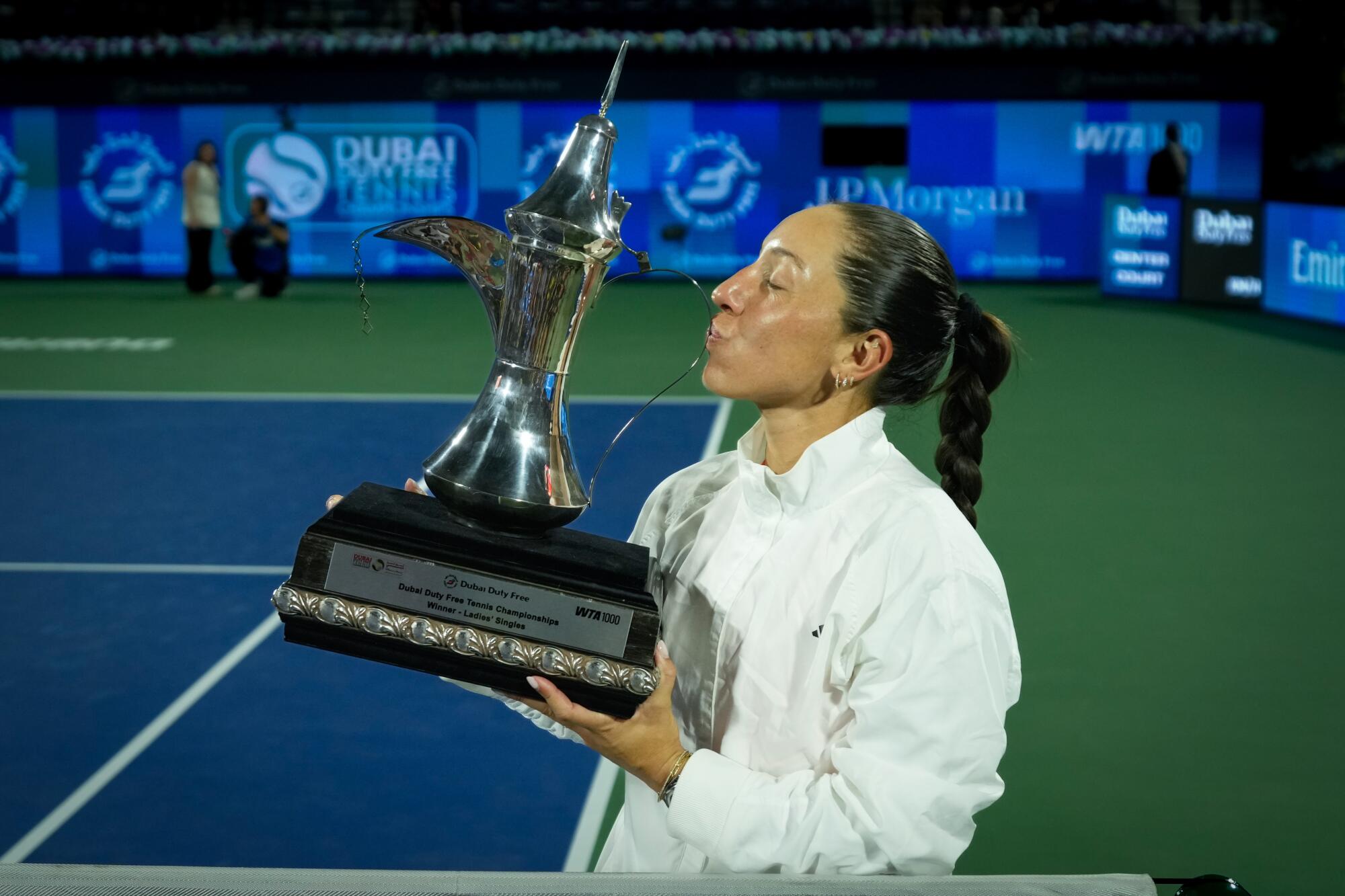
The fifth-ranked American reached the Australian Open semifinals for the first time in January, falling to eventual champion Elena Rybakina. She followed that by capturing the Dubai 1000-level tournament, just a rung below the majors.
She is 15-2 so far in 2026, tied with Victoria Mboko in match wins and second only to Ukraine’s Elina Svitolina (17-3), who she defeated 6-2, 6-4 in the Dubai final.
Pegula is guaranteed to emerge from this week’s BNP Paribas Open in Indian Wells as the top-ranked American, overtaking No. 4 Coco Gauff, if she reaches the final.
Jessica Pegula kisses the Dubai trophy after defeating Elina Svitolina in the finals on Feb. 21.
(Altaf Qadri / Associated Press)
First, she will have to get past No. 12-seed Belinda Bencic of Switzerland, her fourth-round opponent on Wednesday. Bencic has not dropped a set in four previous meetings with Pegula.
“That will be a challenge for me,” said the characteristically even-keeled Pegula after defeating former French Open champion Jelena Ostapenko in the third round on Monday.
A late bloomer, Pegula has taken the long road.
She failed to qualify for Grand Slam main draws in 12 of 14 attempts from 2011 to 2018, and didn’t reach the third round at a major until the 2020 U.S. Open at age 26. All three of her Grand Slam semifinal runs — along with her 2024 U.S. Open final — have come after she turned 30.
Pegula said this week that her patience and persistence stem from “always being a little more mature for my age even when I was younger.”
“I think as I’ve gotten older, your perspective changes as well,” she added.
Pegula, whose parents are principal owners of the NFL’s Buffalo Bills and the NHL’s Buffalo Sabres, acknowledges that her wealthy family background can cut two ways.
Financial security offers freedom to push through the sport’s early years on tour, when results are uncertain and the grind is relentless. That same cushion might make it easier to walk away if the climb becomes too frustrating.
Jessica Pegula plays a backhand against Donna Vekic during their match at the BNP Paribas Open at Indian Wells.
(Clive Brunskill / Getty Images)
Pegula says her motivation to pursue tennis came well before her family’s fortune grew.
“I’ve been wanting to be a professional tennis player and No. 1 in the world since I was like 7,” she said in a small interview room after beating Ostapenko this week.
“It’s a privilege, but at the same time I don’t want to do myself a disservice of not taking the opportunity as well,” she explained. “I’ve always looked at it that way.”
In the last few seasons, that maturity on the court has dovetailed with a growing leadership role off it.
Pegula has served for years on the WTA Player Council and was recently tapped to chair the tour’s new Tour Architecture Council, a working group tasked with examining the increasingly demanding schedule and structural pressures players say have intensified in recent seasons. The panel is expected to explore changes that could reshape the calendar and player workload in coming years.
Pegula said she hadn’t put up her hand to be involved but agreed after several players approached her to take the lead role — though she declined to say who they were.
“I think maybe as you mature … you realize how important it is to give back to the sport,” she said last week.
Life has also provided grounding and a wider lens.
The Buffalo native and Florida resident also married businessman Taylor Gahagen in 2021. Gahagen helps “holds down the fort” at home with the couple’s dogs and travels with her when possible. He is with her in Indian Wells.
“I have an amazing support system,” Pegula says.
Despite winning 10 WTA singles titles, achieving a career singles high of No. 3 in 2022 and the No. 1 doubles ranking, Pegula’s low-key demeanor means she flies a bit under the radar.
She’s not one for fashion statements, outlandish antics or attention-seeking initiatives, her joint podcast with close friend Madison Keys notwithstanding.
Instead, Pegula tends to go about her business quietly, relying on a calm temperament and a methodical style that wears opponents down over time.
She gets the job done — the Tim Duncan of the women’s tour.
“She’s just all about lacing them up and competing between the lines, and then trying to be as big an asset as she can to her peers off the court,” says Mark Knowles, the former doubles standout who has shared coaching duties with Mark Merklein since early 2024.
“I think one of her great attributes is she’s very level-headed,” Knowles adds. “She doesn’t get too high, doesn’t get too low.”
Her tennis identity echoes her steadiness.
Instead of bludgeoning opponents with power, the 5-foot-7 Pegula beats them with savvy, steadiness and tactical variety. A careful student of the game, she studies matchups and patrols the court with a composed efficiency that incrementally drains big hitters and outmaneuvers most rivals long before the final score confirms it.
Keys calls that consistency her “superpower.”
“She doesn’t lose matches that she shouldn’t lose,” the 2025 Australian Open champion said this week.
Because of injuries in the early part of her career, Knowles says Pegula might have less wear-and-tear than other players her age. And he and her team have prioritized rest and recovery, which included the decision to skip the tournament in Doha last month following her tiring Australian Open run.
On brand, there was no panic in Pegula after dropping the first set in her two matches so far at Indian Wells. As she’s done all season, she steadied herself to earn three-set wins.
Bucket-list goals remain, however. Chiefly, capturing a Grand Slam title.
Jessica Pegula returns a shot to Jelena Ostapenko during the BNP Paribas Open in Indian Wells on Monday.
(Matthew Stockman / Getty Images)
Pegula jokes that she briefly interrupted a run of American female success when she fell in the 2024 U.S. Open final to No. 1 Aryna Sabalenka. But seeing close friend and teenage phenom Keys capture her major in Melbourne last year — after many wondered if her window had passed — hit closer to home.
“I think Madison winning Australia just motivated me even more,” Pegula says.
Although Pegula believes she is among the best hardcourt players in women’s tennis, that confidence hasn’t translated into success in the California desert. She has reached the quarterfinals just once in 10 previous appearances in Indian Wells.
“Why not try and add that one to the resume?” says Knowles, noting that she had never won the title in Dubai until last month. “She’s playing still at a very high level.”
Pegula says the key to keeping things fresh is maintaining her love of the game by continuing to improve and experiment with new ideas, a process that keeps her engaged mentally and eager to compete.
“I’m not afraid to kind of take that risk of changing and working on different things,” she says, “which just keeps my mind working and problem solving.”
For a player who never needed tennis, she remains determined to see how much more it can give her.