‘The Audacity’ review: Unsympathetic characters fill this tech drama
Anyone who has spent any time in the digital agora will know the chilling feeling of seeing some supposedly secret thing about yourself suddenly reflected in a targeted advertisement. In a new Silicon Valley soap, “The Audacity,” Duncan (Billy Magnussen) founds a company called PINATA, for Privacy Is Not a Thing Anymore, which will allow subscribers to snoop at a deep level on just about anyone in the world; the war against the date eaters, the name suggests, is long since lost, and is none of your business, anyway.
Created by Jonathan Glatzer who has written for “Succession” and “Better Call Saul,” the series premieres Sunday on AMC, the network of “Breaking Bad,” “Mad Men” and an earlier tech-related series, “Halt and Catch Fire,” about the rise of the personal computer — shows that focus on difficult, sometimes amoral characters whose shenanigans might change the world, not necessarily for the better. “The Audacity,” though well made enough, is not in their league.
Duncan made his fortune as a co-founder of a community app something along the lines of Facebook (which, along with Mark Zuckerberg, doesn’t exist in this silicon reality — “If only,” do I hear you sigh? Or was that me?) Now he’s trying to sell his information-gathering startup to “Cupertino” (as in the home of Apple), “the most important tech company to ever exist,” and leaking rumors he imagines will be to his advantage. Duncan is not himself a creator, or particularly smart — he thinks it’s “Schroeder’s Cat,” for example — but does have a gift for selling; his “genius” late partner, Hamish — a suicide — did the real work. Now a new Hamish enters his life in the form of Harper (Jess McLeod, whose blonde bob may remind viewers of the brilliant coder played by Mackenzie Davis on “Halt and Catch Fire”) the creator of the “algo” mentioned above.
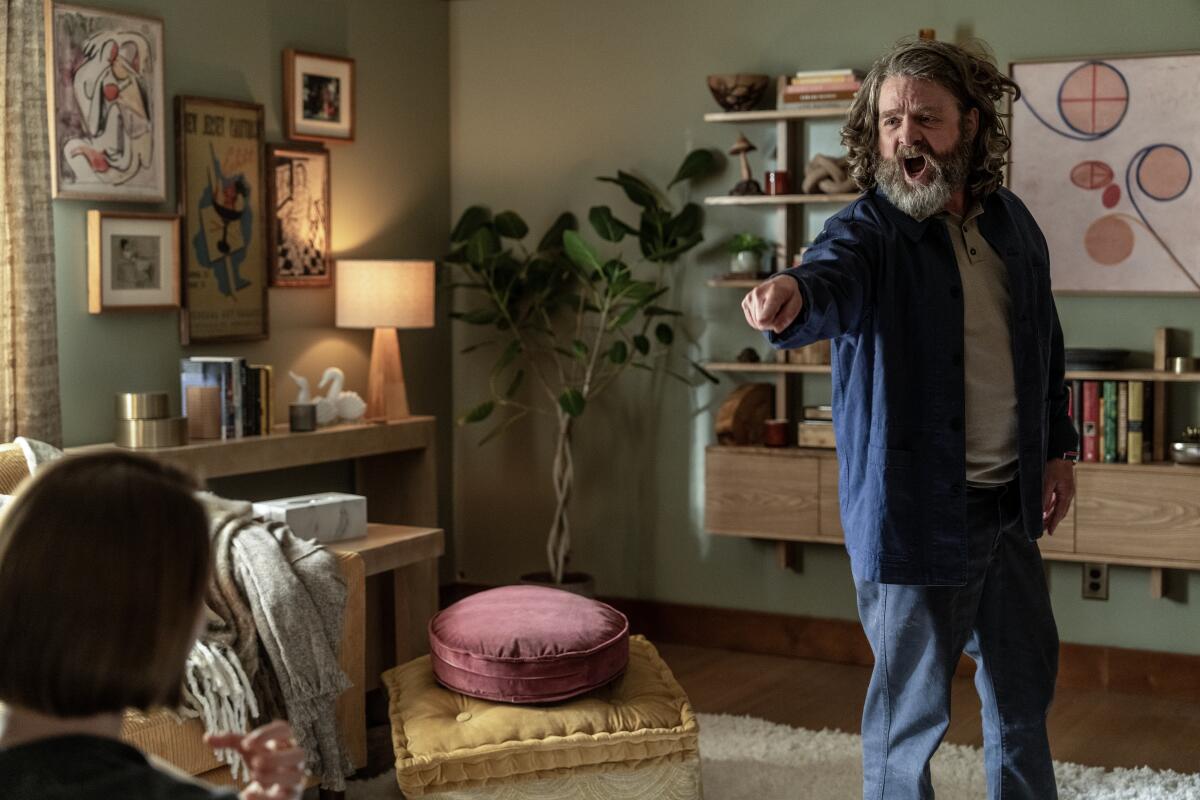
Despite his riches, Duncan is unhappy enough to be a patient of the series’ other main character, therapist JoAnne (Sarah Goldberg). (He also has an “ayahuasca guy.”) Most prominent among her other clients is Carl (Zach Galifianakis), a semi-retired industry legend who made his money from a spam platform and whom Duncan will spend much of this eight-episode season attempting to impress. “People act like we took something as if we didn’t build everything they touch,” Carl will complain to JoAnne. “Where’s our parade? All I see are pitchforks and ingratitude.”

Sarah Goldberg plays Joanne, therapist to Duncan and Carl (Zach Galifianakis) in “The Audacity.”
(Ed Araquel/AMC)
JoAnne conducts her business from her rented home, as does her child psychiatrist (second) husband, Gary (Paul Adelstein), one of the few figures in this roundelay you will be given no reason to dislike. (It’s an old house, to contrast it with the modernist leviathans inhabited by the overly moneyed class.) Sharing the place is her weedy, newly arrived 15-year-old son, Orson (Everett Blunck), sent reluctantly from Baltimore, where his father is being treated for cancer. Orson has embarrassing gastric issues and watches alpha-male videos in the basement, where he also practices the bassoon. (That he’s working on “The Sorcerer’s Apprentice,” in its way a story of runaway tech, might have some thematic meaning, though it does also have a killer bassoon part.)
Something Duncan says in a session with JoAnne leads her to unload some stock, like Martha Stewart in 2004, and Duncan, working this out, blackmails her into passing on inside information from her clients to him. “You think you know everything because you have information, but information is not insight,” says JoAnne, who has insight to spare, making herself even more valuable to Duncan, whose pronouncements are more in the line of “Cheaters never lose, and losers, they never cheat” and “Empathetic is just pathetic with a prefix — I am an apex predator.”
Anushka (Meaghan Rath), a power player who works for Duncan, is also a toothless director of ethical innovation on the board at Cupertino. She’s married to Martin (Simon Helberg), who is working on something he calls Alexander, or Xander — he would say “someone,” probably — “an intelligent entity, more of an autonomous companion, for alienated teens based on personal data ecosystems.”
He has less time for his own alienated teen, Tess (Thailey Roberge) — “Dad, eyes on me,” she says, as the family sits at a comically long dinner table, the parents looking at their phones — who has been expressing herself through low-level vandalism and thievery. “I hear you’re klepto now,” says Jamison (Ava Marie Telek), the daughter of Duncan and Lili (Judy Punch), whose body mass is under constant review by her mother. Seemingly, all the children of the Valley are being shuttled by their parents toward Stanford, where they will matriculate by hook or by crook.
Though Lili has been configured as shallow and spoiled, Punch (a great comic actor) injects her with some warmth and keeps her from being the joke she might have been. Galifianakis has a native oddball energy, though some of Carl’s assigned interests feel tacked on and out of joint — he’s involved with a fight club, where “control alt delete” serves for saying “uncle,” and, even weirder, has been made a World War Ire-enactor and military fetishist; it’s a point that exists only to make him receptive to Tom (Rob Corddry), the deputy undersecretary of Veterans Affairs who has come to Palo Alto looking for a partner to digitize truckloads of files that will in some way help to better their plight. (“Straightforwardly, what’s the quant ben for us?” he’s asked. Translation: “What’s in it for us?”) The series’ designated tragic figure, he’s granted a karaoke performance, with original lyrics, of Peggy Lee’s “Is That All There Is?”
Much of the action has to do with characters buying and selling various enterprises, or failing to, and creating and breaking and creating alliances, and it ceases to matter after not too long awhile what person or which company does what. Much less of it has to do with people being people. The cast is very good and the dialogue good enough, but because few of these characters are developed beyond a handful of identifying characteristics, it’s a generally cold, dispassionate watch. As to Duncan, the nominal star of the show, it doesn’t matter whether he’ll win or lose — there’s not enough to hang on to. Past being unlikable, he’s unsympathetic, and worse, for all his noisy behavior, uninteresting. JoAnne, though her journey is more twisted, doesn’t fare all that much better.
To signal that he has considered these things, Glatzer gives Anushka, who has had a revelation, a speechy little speech to voice the thoughts already on your mind. “When was the last time we saw tech help? … Truth be told, what have we actually made better? Did we spread knowledge? No. People used to occasionally agree on truth. Are we more tolerant of those different from ourselves? Please. Absolutely blew it on climate. Data centers emit more greenhouse gas than all of air travel. And have we made made the lives of our children better? Probably, no. But we can have Q-tips at our door in an hour. Huzzah.” So true.
We also get a reminder, from Harper, to check the box that keeps a website from selling your information. It’s good advice.