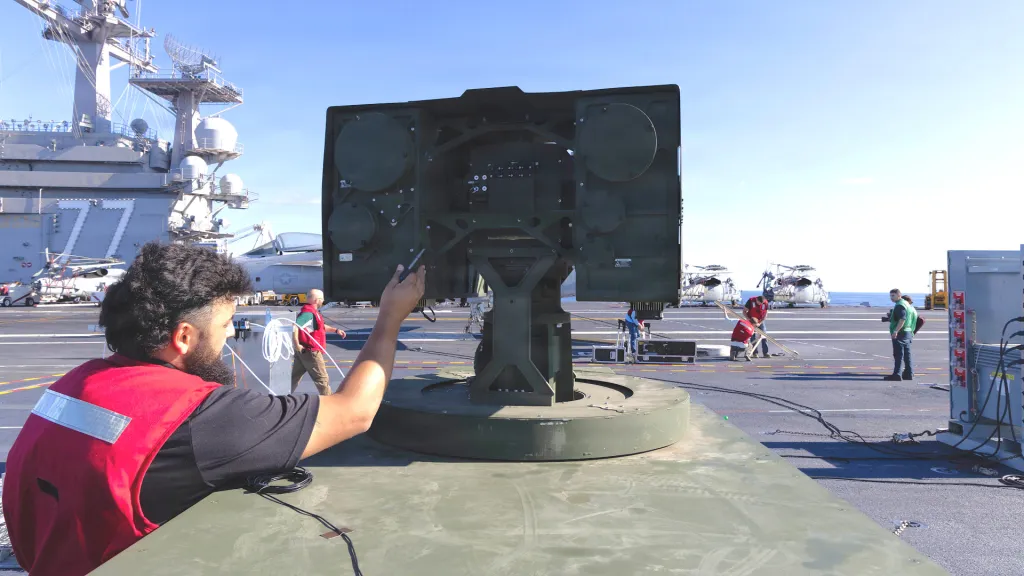
Navy Fires Drone-Frying LOCUST Laser From Supercarrier USS George H.W. Bush
The U.S. Navy has disclosed the test of an AeroVironment LOCUST laser counter-drone system, which has been in the news recently, aboard the Nimitz class aircraft carrier USS George H.W. Bush. As far as TWZ is aware, this looks to be the first time a laser weapon has been fitted to a carrier. Earlier this year, Chief of Naval Operations Adm. Daryl Caudle, the Navy’s top officer, said his goal was for directed energy weapons to eventually be the go-to choice for the crews of American warships when facing close-in threats.
The Navy has shared three pictures of the LOCUST system onboard USS George H.W. Bush, seen at the top of this story and below. They were all taken on October 5, 2025, but released today. This coincides with the start of the Navy League’s annual Sea-Air-Space exposition, at which TWZ is in attendance.

The captions to each of the images include the following: “During the live-fire event, [the] LOCUST LWS [laser weapon system] effectively detected, tracked, engaged, and neutralized multiple unmanned aerial vehicles marking a milestone toward fielding operational directed energy capabilities.”
TWZ has reached out to the Navy for more information.

“The successful demonstration of its palletized LOCUST Laser Weapon System (LWS) aboard the USS George H.W. Bush (CVN-77) in October 2025″ was conducted “in collaboration with the U.S. Navy and the U.S. Army Rapid Capabilities and Critical Technologies Office (RCCTO),” according to a press release from AeroVironment.

“During the live-fire event, the Palletized High Energy Laser (P-HEL) system tracked, engaged, and neutralized multiple target drones – marking a major milestone toward fielding operational directed energy capabilities across all domains and platforms,” the release adds. “This achievement validates that the LOCUST LWS is truly platform-agnostic, seamlessly transitioning from fixed-site and land-based mobile platforms, such as the Joint Light Tactical Vehicle (JLTV) and Infantry Squad Vehicle (ISV), to the dynamic and demanding environment of a maneuvering aircraft carrier.”

The central element of LOCUST is a laser directed energy weapon in a turret, which also includes built-in electro-optical and infrared video cameras for target acquisition and tracking. Tertiary sensors, including small-form-factor high-frequency radars and passive radio frequency signal detection systems, can also be used to cue the laser. The JLTV and ISV-based configurations mentioned in AeroVironment’s release both feature small radars.


LOCUST’s power rating is generally understood to be in the 20-kilowatt range at present. When it comes to laser directed energy weapons, this is at the lower end of the power spectrum, fully in line with a system intended to defeat smaller drones. LOCUST has also been demonstrated with a 26-kilowatt power rating, but how much more it could be scaled within the existing form factor is unclear.
As of December 2025, the U.S. Army was known to have taken delivery of palletized LOCUST systems, as well as ones mounted on JLTVs and ISVs. The Army has at least deployed the palletized versions overseas operationally in the past. One of the service’s LOCUST systems was also at the center of a widely criticized and controversial shutdown of airspace around El Paso, Texas, in February of this year, as you can read more about here. The system had been on loan to U.S. Customs and Border Protection (CBP) at the time. Earlier this month, the Pentagon signed an agreement with the Federal Aviation Administration (FAA) regarding the continued use of anti-drone laser systems along the southern border with Mexico.
The U.S. Marine Corps has also moved to acquire JLTV-based LOCUST systems in the past. In addition to appearing to be the first instance of a laser-directed energy weapon going aboard a carrier, last year’s test aboard USS George H.W. Bush also looks to be the first known instance of the Navy even evaluating LOCUST for use on ships or in any other context.

Navy interest in using LOCUST to defend ships, especially very high-value ones like aircraft carriers, is not surprising. For years now, the service has been very active in pursuing shipboard laser and microwave directed energy weapons with a particular eye toward providing additional layers of counter-drone defense.
Experience gained in recent years from operations in and around the Red Sea, as well as against Iran, has only underscored the critical importance of bolstering the ability of U.S. warships to protect themselves against uncrewed aerial threats. The Navy has also been adding counter-drone systems that use physical interceptors as their effectors to a growing number of ships to help address this reality.
In general, lasers like LOCUST offer the promise of functionally unlimited magazine depth, which could be exceptionally valuable in the counter-drone role when faced with large volumes of incoming threats. The dangers that uncrewed aerial systems pose are only set to increase as artificial intelligence and machine learning-driven capabilities, including automated targeting and fully networked swarming, continue to improve while the barrier to entry steadily drops.
Palletized and containerized systems like the P-HEL version of LOCUST can also be employed with more flexibility on a wide variety of ships, as long as sufficient deck space and available power. The test aboard USS George H.W. Bush involved simply lashing the system to the flight deck. This also means the systems can be installed and/or removed more readily depending on mission requirements. The Navy also has a demand for counter-drone capability on land to protect key facilities and assets abroad and at home, where LOCUST would also be relevant.

LOCUST Laser Weapon System
At the same time, especially when it comes to employing lasers on ships, there are also potential pitfalls. As TWZ has previously written:
“A single laser can only engage one target at once. As the beam gets further away from the source, its power also drops, just as a result of it having to propagate through the atmosphere. This can be further compounded by the weather and other environmental factors like smoke and dust. More power is then needed to produce suitable effects at appreciable distances. Adaptive optics are used to help overcome atmospheric distortion to a degree. Altogether, laser directed energy weapons generally remain relatively short-range systems.”
“In addition, laser directed energy weapons, especially sensitive optics, present inherent reliability challenges for use in real-world military operations. Shipboard use adds rough sea states and saltwater exposure to the equation. There is also the matter of needing to keep everything properly cooled, which creates additional power generation and other demands.”
Over the years, the Navy has faced continued and significant hurdles in attempting to field operational laser weapon systems more broadly across its fleets. U.S. military officials have often sought to temper expectations, while also being open about their frustrations with the lack of greater progress, in recent years.
Still, the Navy, in particular, has persisted in its pursuit of these capabilities, given the benefits mentioned earlier. Lasers are set to be a particularly important component of the full arsenal aboard the future Trump class “battleships.”

“My thesis research at [the] Naval Post Graduate School was on directed energy and nuclear weapons,” Adm. Caudle told TWZ and other outlets at a roundtable back in January. “This is my goal, if it’s in line of sight of a ship, that the first solution that we’re using is directed energy.”
In particular, “point defense needs to shift to directed energy,” the admiral added, emphasizing that “it has an infinite magazine.”
“What that does for me is it improves my loadout optimization, so that my loadout, my payload volume is optimized for offensive weapons,” Caudle added at the time. Furthermore, “as you increase power, the actual ability to actually engage and keep power on target, and the effectiveness of a laser just goes up.”
Laser directed energy weapons with higher power ratings could potentially defend ships against other threats, including certain types of incoming missiles.
Whether or not the Navy decides to acquire and field LOCUST operationally on its ships, the service’s general demand for more counter-drone capabilities across the board does not look set to decrease any time soon.
Contact the author: joe@twz.com