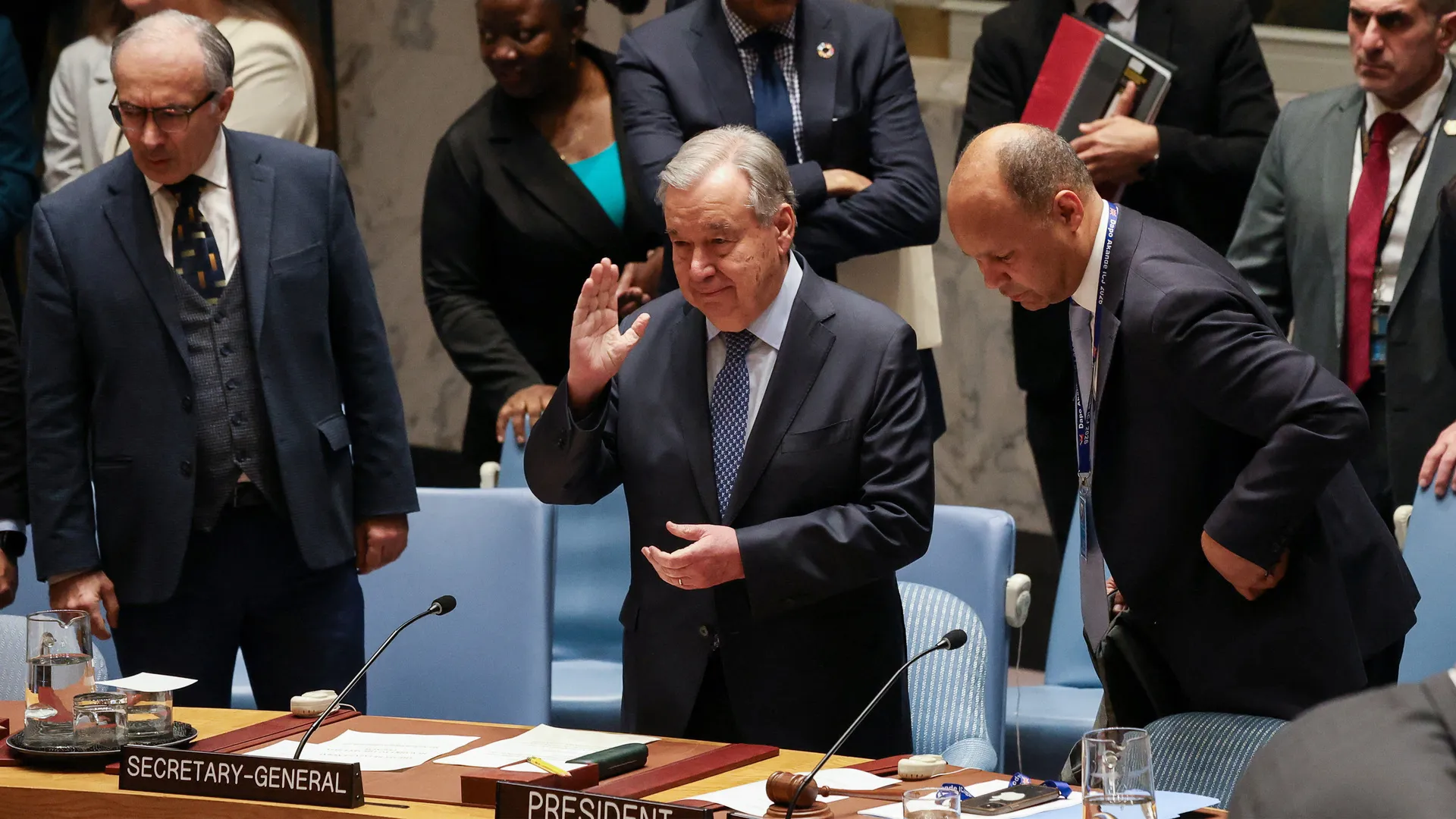
Guterres

UN chief Guterres calls on Israel to reverse NGO ban in Gaza, West Bank | United Nations News

Guterres says pending ban targets groups ‘indispensable to life-saving’ work, undermines ceasefire progress.

United Nations Secretary-General Antonio Guterres has called on Israel to reverse a pending ban on 37 nongovernmental organisations (NGOs) working in Gaza and the occupied West Bank.

In a statement on Friday, Guterres called the work of the groups “indispensable to life-saving humanitarian work”, according to spokesperson Stephane Dujarric. He added that the “suspension risks undermining the fragile progress made during the ceasefire”.

Recommended Stories

list of 3 itemsend of list

Israel banned the humanitarian groups for failing to meet new registration rules requiring aid groups working in the occupied territory to provide “detailed information on their staff members, funding and operations”. It has pledged to enforce the ban starting March 1.

Experts have denounced the requirements as arbitrary and in violation of humanitarian principles. Aid groups have said that providing personal information about their Palestinian employees to Israel could put them at risk.

The targeted groups include several country chapters of Doctors Without Borders (known by its French acronym, MSF), the Norwegian Refugee Council, and the International Rescue Committee.

To date, Israel has killed about 500 aid workers and volunteers in Gaza throughout its genocidal war. All told, at least 71,271 Palestinians have been killed in Gaza since October 7, 2023.

In his statement, Guterres said the NGO ban “comes on top of earlier restrictions that have already delayed critical food, medical, hygiene and shelter supplies from entering Gaza”.

“This recent action will further exacerbate the humanitarian crisis facing Palestinians,” he said.

Nearly all of Gaza’s population has been displaced throughout the war, with many still living in tents and temporary shelters.

Israel had maintained severe restrictions on aid entering the enclave prior to a ceasefire going into effect in October. Under the deal, Israel was meant to provide unhindered aid access.

But humanitarian groups have said Israel has continued to prevent adequate aid flow. Ongoing restrictions include materials that could be used to provide better shelter and protection from flooding amid devastating winter storms, according to the UN.

Earlier on Friday, the foreign ministers of Qatar, Egypt, Jordan, Saudi Arabia, the United Arab Emirates, Turkiye, Pakistan and Indonesia warned that “deteriorating” conditions threatened to take even more lives in Gaza.

“Flooded camps, damaged tents, the collapse of damaged buildings, and exposure to cold temperatures coupled with malnutrition, have significantly heightened risks to civilian lives,” they said in a statement.

They called on the international community “to pressure Israel, as the occupying power, to immediately lift constraints on the entry and distribution of essential supplies including tents, shelter materials, medical assistance, clean water, fuel, and sanitation support”.

Source link

UN chief Guterres condemns Houthi detention of 10 more UN staff in Yemen | Houthis News

A spokesperson for Antonio Guterres calls for UN staffers’ immediate release, as 69 now detained in the country.

United Nations Secretary-General Antonio Guterres has condemned the detention of 10 more UN staff members by the Houthis in Yemen.

Stephane Dujarric, a spokesperson for Guterres, confirmed on Friday that the previous day’s arrests had brought the total of detained local staffers to 69, calling for their immediate release.

Recommended Stories

list of 3 itemsend of list

“These detentions render the delivery of UN humanitarian assistance in Houthi-controlled areas untenable. This directly affects millions of people in need and limits their access to life-saving assistance,” Dujarric said.

The Houthis, who control most of northwestern Yemen, including the capital Sanaa, have stepped up their arrests of UN staff since the start of Israel’s genocidal war on Gaza in October 2023, accusing them of spying for the United States and Israel.

The UN has repeatedly rejected Houthi accusations that its staff or operations in Yemen are involved in spying, a charge that carries the death penalty in the country.

On Thursday, the organisation confirmed that the detainees were all Yemeni nationals.

The latest arrests came days after Guterres discussed detained UN, diplomatic and NGO staff with Sultan Haitham bin Tariq of Oman, which has served as a mediator in the conflict in Yemen.

Guterres also commented this week on the Houthis’ recent referral of three detained UN staffers to a criminal court, saying they had been charged in relation to “their performance of United Nations official duties” and calling for charges to be dropped.

Shift in balance of power

A decade of civil war has plunged Yemen into one of the world’s worst humanitarian crises, according to the UN.

Guterres said this week that 19.5 million people in the country – nearly two-thirds of the population – need humanitarian assistance.

The conflict has recently entered a new phase, as separatists with the Southern Transitional Council (STC) extended their presence in southeastern Yemen – marking one of the largest shifts in power since the war began.

They now claim to control areas including the eastern governorates of oil-rich Hadramout and al-Mahra and the port city of Aden.

The STC, which wants to establish an independent state in the south of Yemen, has fought in the past alongside the internationally recognised, Saudi-backed government, which is based in Aden, against the Houthis.

However, the STC’s advance in the south brings it into direct confrontation with the government in Aden, known as the Presidential Leadership Council (PLC), which condemned the seizure of territory as “unilateral and a blatant violation”.

The STC’s leader, Aidarous al-Zubaidi, has a seat on the PLC, officially as one of its vice chairmen.

But relations have often been shaky between the group and the internationally recognised government, which came under major pressure in areas under its control over power outages and a currency crisis this year.

The two entities have previously fought, most notably in 2018 and 2019, in Aden and its surrounding governorates.

This week, Guterres urged all parties to exercise “maximum restraint, de-escalate tensions, and resolve differences through dialogue”.

Source link