BROOKLYN Beckham was offered a public show of support by Sir Elton John — who made him a VIP guest at his Oscars party.
The 27-year-old, locked in a family feud, was seen at the bash alongside wife Nicola Peltz deep in conversation with the singer, 78.
Sign up for the Showbiz newsletter
Thank you!
Brooklyn Beckham and wife Nicola at Elton John’s Oscars partyCredit: GettyElton chats with Brooklyn and Nicola at the party in West HollywoodCredit: GettyElton and Victoria Beckham at his 2009 Oscars bashCredit: WireImage – Getty
We revealed last year that the I’m Still Standing singer has been acting as a peacemaker between Brooklyn and estranged parents David and Victoria.
And the VIP invitation to Sir Elton’s Academy Awards viewing party in West Hollywood on Sunday night showed his continued love and support for his godson.
A source said: “Elton has seen Brooklyn all adrift without his biological family and he’s stepped up for Brooklyn.
“Inviting him and Nicola to the party was a public show of support for him.
“Elton doesn’t want to get involved in the row — as far as he’s concerned that’s between Brooklyn, David and Victoria.
“But he has been watching everything that has unfolded over the past ten months.
“Brooklyn lives in Los Angeles and when Elton is in town, he’ll often touch base with him.
“Brooklyn knows he has Elton’s ear and support.”
Brooklyn and US actress Nicola, 31, were among a string of celebs at the Elton John Aids Foundation bash, co-hosted by the singer and his husband, David Furnish.
They were photographed with Sharon Osbourne and her I’m a Celebrity star son Jack, while singer Dua Lipa and her actor fiancé Callum Turner were also there.
A source added: “Brooklyn and Nicola had a fantastic time with Elton and David.
“He just wants to move on with his life and is happy to have the support of Elton and David, who have always looked out for him.”
Sir Elton, who has two sons Zachary and Elijah with his hubby, has been very close friends with Posh and Becks for several years.
Brooklyn and Nicola pose with Sharon Osbourne and her son JackCredit: GettyElton and fellow singer Dua LipaCredit: Getty
They asked the singer to be godfather to their first-born son Brooklyn in 1999, and they did the same with Romeo three years later.
Former Spice Girl Victoria was also a guest at Sir Elton’s Oscars party in 2009.
Victoria posted pictures of their trip on Instagram with the caption: “Happy Summer with friends. Kisses @davidfurnish @eltonjohn. We love u both and your boys so much.”
In May 2023, David and Victoria supported Elton on the final night of his Farewell Yellow Brick Road tour and shared videos and photographs from a box at London’s O2 Arena.
He told Nicola’s mum, Claudia, “Love u so much”, as she turned 71.
Brooklyn posted a tribute to wife Nicola Peltz’s mumCredit: InstagramBrooklyn with parents Victoria and David Beckham before the feudCredit: Getty
Who won on Hollywood’s biggest night?
One Battle After Another ran away with the night with six Oscars, while Sinners, which was nominated for a record-breaking 16 awards, came away with four. See the full winners list below:
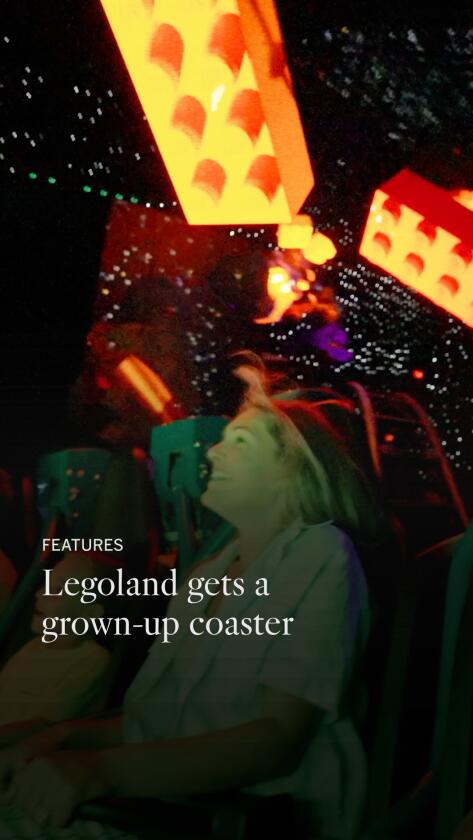
The Carlsbad theme park will on Friday open Lego Galaxy, a new 2.4-acre themed land that will feature its most adult-focused attraction yet in the Galacticoaster. An indoor, space-themed thrill ride, Galacticoaster is brief but impressionable, a spinning race through a darkened landscape to save a Lego-infused galaxy from an “asteroid of probable destruction.”
At 40 mph, it’s the park’s fastest ride, but coming in at about 60 seconds and focusing on banking and turning means it still has full family appeal. Expect it to serve as an introductory, big kid coaster for many. It’s infused with lighthearted humor — floating farmers and barnyard animals cruise among the stars — lending it a rather relaxed atmosphere for a save-the-world, fast-paced attraction. In other words, it’s sleek, it’s hurried and it’s cutesy.
Share via
“My favorite is the surfing alien,” says Tom Storer, North American project director for Merlin Magic Making, the creative team behind Lego experiences. “She’s my favorite thing to see in there. It’s right after the blast. It will sneak up on you.”
The Galacticoaster is the centerpiece of Lego Galaxy, which also includes two smaller outdoor attractions, a vintage-style shoot-’em-up video game and a play area for little ones. Its part of a $90-million investment in Legoland’s California and Florida parks on behalf of parent Merlin Entertainment (an identical Galacticoaster can be found in Lego’s Florida park). Lego Galaxy hopes to draw visitors — and perhaps new audiences — by focusing on slicker, more modern technology and injecting in the park the sort of excitable ride more commonly found at Legoland’s Southern California competitors.
Storer, for instance, isn’t shy about the Galacticoaster’s inspiration.
A view of the stars and scenery that surrounds the Galacticoaster track.
(Legoland / Merlin Entertainment)
“What is the space roller coaster of 2026? Space Mountain is a classic from back in the day,” he says, referring to the Disneyland Resort staple launched in 1977. “But this is kind of the new way.”
It is faster and brighter than Space Mountain, as the Galacticoaster is heavily populated with twinkling stars, planetary projections and many a Lego brick creation. But while Space Mountain tops off at about 32 mph, it likely still has Galacticoaster beat in the intensity factor due to its lift hill, sudden dips, jolting turns and near pitch-black darkness. No matter, says Storer, as here the objective was to place guests in a welcoming adventure with plenty to look at.
“When you think of outer space, you instantly think of stars and planets,” Storer says. “We have a really cool digital planet and we have stars everywhere.”
The Galacticoaster sits four per car, loading attendees parallel in a row via a moving platform. Once seated and locked in, it nearly immediately takes off, jetting riders into a darkened hallway with white lights before injecting them into a Lego galaxy. Lego aficionados or those who grew up with the sets will likely spy many an allusion to past toys. In the ride’s queue, for instance, guests in line will walk past a wall that features a timeline of many a Lego space set. Action comes fast, but surrounds guests, as the coaster cars rotate around a hurtling asteroid.
Legoland’s new Galacticoaster is an indoor space-themed roller coaster with twinkling stars and many Lego brick projections.
(Legoland / Merlin Entertainment)
While it twists from side to side, which has drawn light comparisons to Guardians of the Galaxy: Cosmic Rewind at Walt Disney World’s Epcot, with some referring to this as sort of a starter version of that more powerful coaster, it’s a smooth and relatively unobtrusive twisting. Those prone to motion sickness — and I am one of them — likely need not be too concerned here.
While Legoland has other coasters, many are known as what Storer refers to as “pink knuckle” coasters, slang for safe for kids and families. Galacticoaster, with a minimum height requirement of 36 inches, certainly is as well, but the creative executive hopes it falls somewhere between the pink and white knuckle level of force, the latter term reserved for the most thrilling of coasters.
“We’re known for having ‘pink knuckle’ coaster, where it’s not too scary,” he says. “It’s kind of, ‘My first coaster.’ This is family-friendly. We’d never do anything that’s not family-friendly. We want to make sure our guests from 5 to 12 have lots to do, but it’s a little more punchy and has that cool launch with a space blast-off feel.”
Theme park aficionados will be keen to know that this is the first attraction in the park to feature an animatronic figure. The character of Biff Dipper, an engineer, will be found in the ride’s preshow, familiarizing guests with the story of the asteroid that spells impending doom. Stout and slightly gruff, Dipper has a digital face that can approximate more than 40 expressions. The animatronic, says Storer, was an important investment for the park, as Legoland in Lego Galaxy was cognizant of guests becoming bored in what will surely be one of the park’s longest lines this upcoming spring and summer season.
There are interactive elements throughout Lego Galaxy. In the Galacticoaster, for instance, riders will build a virtual approximation of a spaceship from a touchscreen, selecting options for wings, cannons and more. Some are militant. Others look like burgers or rainbows. There are 625 variations, and the creation will then appear at the start and finish of the attraction, injected into the ride’s projectors via a guest wristband. Legoland officials like to refer to Galacticoaster as a 10-minute experience, a time that takes in the preshow with the Dippper figure as well as the construction of the spacecraft.
The character of Biff Dipper is Legoland’s first animatronic figure. Dipper is in the preshow of the Galacticoaster.
(Legoland / Merlin Entertainment )
Elsewhere in Lego Galaxy, there’s a full video game-like experience called the Rocket Assembly Bay. Here, guests will first build their own spaceship, and then have it scanned into the game for a cooperative shoot-’em-up. Rocket Assembly Bay is good fun, and rewarding even, to see a virtual scan of a hand-built ship injected into the game, this despite that fact that the play experience is largely a modern update of old coin-op “Asteroids.”
“There’s something about the simplicity of some of the things that have been done,” Storer says.
Two other core attractions dot the land. The G-Force Test Facility is a spinner that’s pitched as an astronaut training experience. Guests with a minimum height of 40” will be elevated off the ground via vehicles situated on rotating arms. There’s plenty of swinging and rotating action in this more standard amusement park-like creation, although Storer notes that riders won’t experience any actual G-forces. Still, here’s one that those with a propensity to motion sickness may want to take a pass on.
Lego Galaxy is rounded out with a play area and the preschool-focused ride Launch & Land. For those with a minimum height of 34 inches, this is a casual, patient experience, one in which seated guests will gently lift off into the air for a slightly elevated view of the land. Nominally designed as a spaceport, Lego aliens and spaceships populate the area. Press a button near one of the ships, and initiate, for instance, an engine test.
But don’t expect anything too serious. The Galacticoaster, after all, has a farting space cow.
Universal Studios Hollywood has begun peeling back the curtain — or opening the garage? — on its new “Fast & Furious”-inspired coaster coming to the park this summer.
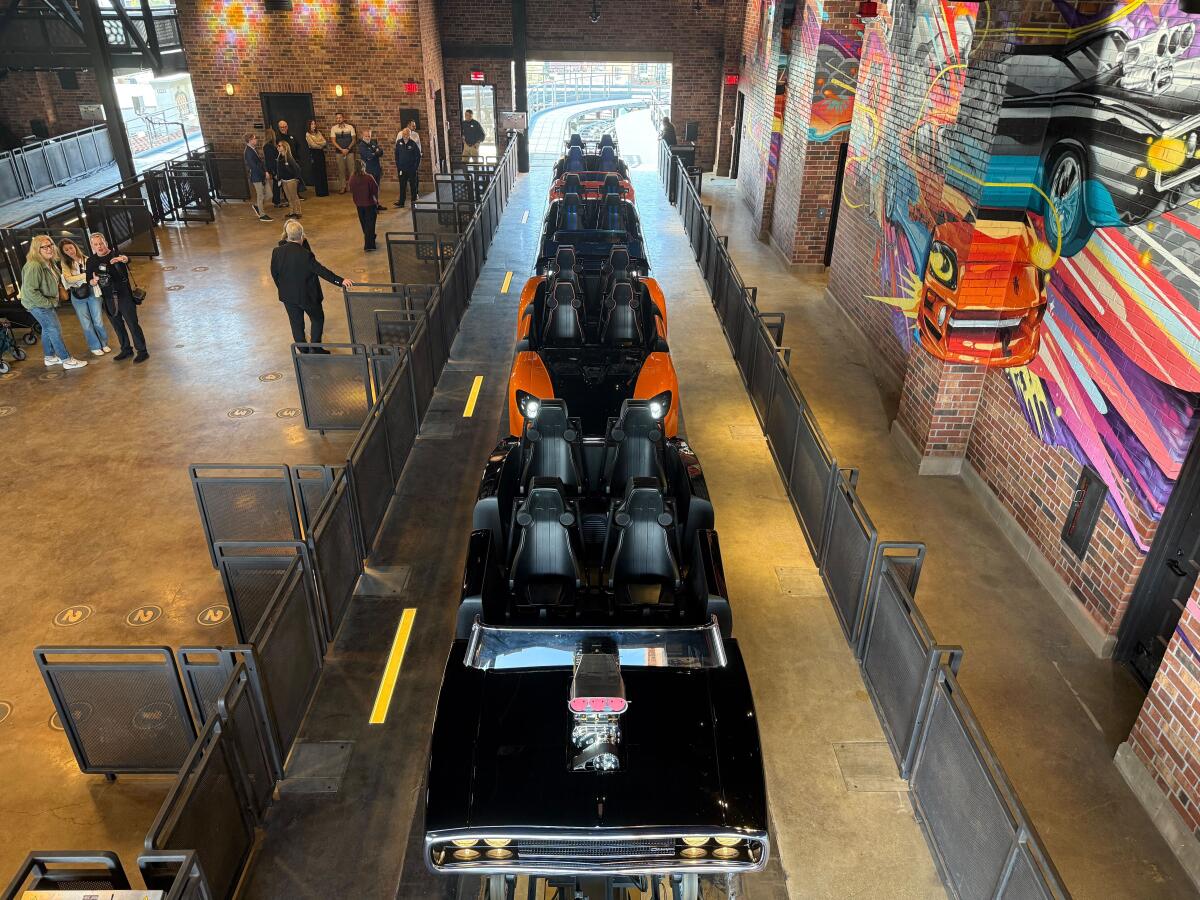
The coaster will feature four heavily detailed miniature cars as ride vehicles. These four-seaters — mimicking a Dodge Charger, Mazda RX-Y, Nissan Skyline GT-R and Toyota Supra, all complete with pull-down lap-bars and working taillights — were unveiled at a media event Wednesday.
But perhaps the most exciting news out of the event is just how meaty of a coaster Fast & Furious: Hollywood Drift looks to be.
Fast & Furious: Hollywood Drift will launch this summer at Universal Studios Hollywood and boast ride vehicles that are miniatures of actual cars. The show building is themed like a warehouse with a vibrant, spray-painted mural.
(Todd Martens / Los Angeles Times)
The attraction, the second outdoor coaster at the park after the more kid-focused “Harry Potter” ride Flight of the Hippogriff, was timed at running about two minutes around the track, which goes over and under the park’s famed hillside escalators. Hollywood Drift will reach a top speed of 72 mph.
While a representative for the company said the coaster is intended to reach that 72-mph milestone at various points on the ride, it’s worth noting that it’s still in testing mode and the final speeds and run-time may change. Still, the fact that Universal has been able to pack such a mighty experience into a tight piece of real estate should be positive news for coaster enthusiasts.
By comparison, the family coaster Flight of the Hippogriff is only about a minute, whereas Disney California Adventure’s Incredicoaster comes in at more than 2 and a half minutes. It’s not uncommon for modern coasters today, due to their increasing emphasis on speed and thrills, to last only about a minute.
A look at the ride vehicles and inside mural in the passenger load area of Fast & Furious: Hollywood Drift.
(Todd Martens / Los Angeles Times)
Though packing storytelling into a fast-moving outdoor ride is always a theme park challenge, Universal is doing what it can to make guests feel as if they’re sitting in actual tiny, authentic cars. Check, for instance, the brightly orange Supra, or the black, vintage-style Charger. Each car will be equipped with onboard audio and has unique details, right down to the different placement of the odometers on the dashboard.
One question: Do those odometers actually work and measure speed? A Universal rep declined to answer, but no matter, as most guest will likely be focused on the scenery outside the vehicle, such as the next-door golf course or bird’s-eye views of the park.
An artist rendering of Universal Studios Hollywood’s Fast & Furious: Hollywood Drift, the park’s first high-speed outdoor coaster.
(Universal Studios Hollywood)
The coasters will board two at a time inside the red brick, warehouse-themed show building, which features spray-painted murals from artist Tristan Eaton. Each coaster train holds four cars. There will be a single rider line for solo guests, and the coaster will boast 360-degree rotation, which is meant to create the sensation of a car drifting. The track is 4,100 feet and will take guests on a hillside journey between the park’s upper and lower lots.
The “Fast & Furious” saga spans 11 films, and will soon be recognized with an exhibit at the Petersen Automotive Museum. “A Fast & Furious Legacy: 25 Years of Automotive Icons” opens March 14 and will feature various movie-used vehicles and stunt cars. Among the cars on display will be an early ‘90s Supra driven by Paul Walker’s character Brian O’Conner, one of the vehicles Universal mimicked for the roller coaster.
BBC Breakfast shared a heartbreaking story on Wednesday, as a guest broke down in tears
09:12, 04 Mar 2026Updated 09:39, 04 Mar 2026
BBC Breakfast guest in tears as star confirms sad death after cancer diagnosis(Image: BBC)
A BBC Breakfast star confirmed a sad death during the latest live show.
Wednesday’s (March 4) edition of the hit BBC programme was hosted by Sally Nugent and Ben Thompson, who updated viewers on the latest news from across the UK and around the world.
They were joined in the studio by Carol Kirkwood, who presented regular weather forecasts, while John Watson handled the sports segment. Meanwhile, Peter Ruddick shared highlights from the Chancellor’s recent spring statement.
Later in the show, Sally and Ben shared a heartbreaking story of a sub postmaster who was wrongfully convicted in the Post Office Horizon IT scandal. Tom Millward has now had his conviction quashed, eight years after his death.
Sally explained: “[He] was accused of stealing £5,000, convicted of false accounting, and forced to move his young family into a static caravan to live.”
Tom’s daughter, Isobel Saunders, emotionally spoke to reporter Debbie Tubby in a pre-recorded segment.
“Tom Millward’s daughter finally has the letter she’s been waiting for and campaigning for – The Ministry of Justice quashing her father’s conviction. But it’s been delivered all too late, eight years after he died from cancer,” Debbie said.
Tom died in 2018, just one year before the scandal reached a turning point. “He never got to see that he was innocent, and never got to know that other people would know that he was innocent,” Isobel said.
Reflecting on her dad’s change in behaviour after his conviction, Isobel continued: “I think there was a lot of internalised shame. He stopped talking, he just became very, very quiet to us and to the family as well.”
Tom tried balancing the books on the Post Office Horizon computer system by cashing in his life insurance and re-mortgaging their home.
After watching the hit ITV drama, Mr Bates vs The Post Office, Tom’s wife, Margaret, realised that her late spouse wasn’t the “only one” affected. She sadly passed away last year.
Isobel soon became emotional as she continued speaking about her father’s struggles. “Sorry,” she said, as she tried to compose herself.
She went on: “We had decided a little bit, sort of feeling-wise, that it probably was this that had happened, [but] it’s different to know. To have that confirmed by the Ministry of Justice really meant a lot.”
Isobel concluded: “I’m angry [at] the people at the top, who knew about it. Fair enough, honest mistake, fine. But once they knew and carried on, I think that’s the bit that makes me angry.”
In a statement, the Post Office chairman says he wants to make a “clear and unequivocal apology” to everyone affected by the scandal.
BBC Breakfast airs daily on BBC One at 6am
Ensure our latest headlines always appear at the top of your Google Search by making us a Preferred Source.Click here to activateor add us as your Preferred Source in your Google search settings