‘Like hitting a lotto ticket.’ Why memorabilia collectors pursue chase cards
Trading sports cards is a game of negotiation for Greg Petikyan. Within seconds, he talked to multiple vendors at Frank and Son Collectible Show last month offering the same card: a 2025 Panini Donruss Saquon Barkley Downtown.
The first deal consisted of a 3-for-1 exchange, with an additional couple of hundred dollars to sweeten the deal or a straight purchase for $460. As the vendor looked through his phone for the value of the cards he asked for, Petikyan told him he’ll circle back.
Instead, the entrepreneur offered it to Eric Mitchel, another booth owner, across the aisle and sold it. A rectangular cardboard collectible with the Super Bowl-winning running back in front of the Philadelphia skyline sold for $300.
What about the other deal?
“Too late,” Petikyan said. “I’ll still buy those cards I asked for.”

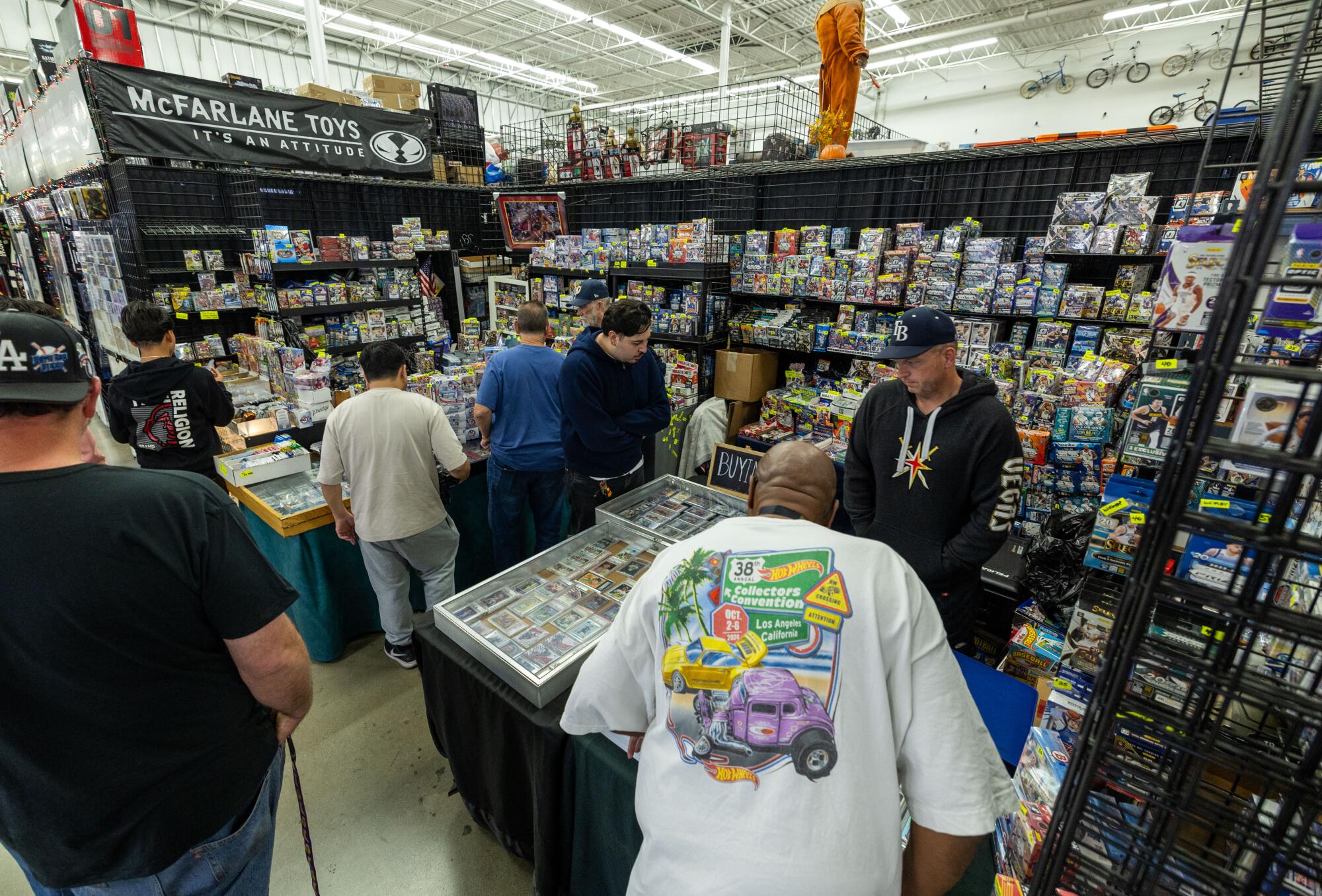
Customers browse and shop for cards at vendor Eric Mitchel’s booth at Frank and Son Collectible Show.
(Ronaldo Bolanos / Los Angeles Times)
Nothing personal, just business.
Trading and collecting cards, an industry valued at $14.9 billion in 2024, is estimated to reach $52.1 billion within the next decade, according to Market Decipher report. The sports memorabilia business, as a whole, is estimated to reach a value of $271.2 billion by 2034.
E-commerce platforms like Fanatics Live and Whatnot have turned business transactions involving the cards of sports legends into entertainment and helped grow the market. Heritage Auctions sold the most expensive card in August. The collectible known as the “holy grail” by basketball collectors was a 2007-08 Upper Deck Exquisite Collection Dual Logoman Autographs Michael Jordan and Kobe Bryant card.
The one-of-one sold for $12.932 million, a sum that topped a Mickey Mantle card that went for $12.6 million in August 2022. The Jordan-Bryant card is the second-most expensive sports collectible of all time, trailing Babe Ruth’s 1932 World Series Jersey, which he wore when he called his shot, that cost $24.12 million.
Last Friday, Heritage Auctions set a sales record for the year by crossing the $2 billion mark. The cards sold that day included a 2003 Upper Deck Exquisite Collection Dual Logoman Jordan-Bryant card for $3,172,000 — this one was not autographed.
The trading card business has grown so much, the ecosystem has created specialized markets within it. Collectors can chase a specific team; stick to vintage cards; complete a set of prints with mistakes; chase specific relics of their favorite team; or even just buy cards to resell them for the sole purpose of buying more to flip.
“I know for a fact, a lot of men like to show off their collection,” Adam Campbell, sports cards specialist with Heritage Auction, said. “People love to have good, cool collections,” he added.
The type of chase can change the direction of a business transaction, said George Peña, 53, another booth owner at Frank and Son, an old Sam’s Club that now houses more than 200 vendors selling and showcasing collectible merchandise three days a week.
Kids go into his booth and negotiate with him. Most of the time he doesn’t necessarily need a card from them but engages with them to give them the experience.
“Family members get all excited for them,” Peña said.
But when dealing with people like Petikyan, the stakes change.
“Negotiations are a little different with those kinds of people because they want to make money and we want to make money,” he said as he quipped with Petikyan.
Some collectors have turned into investors because the value of cards is so volatile. It changes in real time — it’s fast, unpredictable and relentless. The moment Dodgers designated hitter and pitcher Shohei Ohtani hit three home runs and struck out 10 batters in Game 4 of the 2025 NLCS, the value of his cards went up. But it cuts both ways — the moment Cleveland Guardians pitcher Emmanuel Clase was indicted on federal charges for wire fraud conspiracy and bribery, the value of his cards dipped.
“The value of cards is not based on anything else, whatsoever, except for hype and buzz” Campbell said. “[It’s] entirely arbitrary.”

Vendor Marion Owens completes a transaction at Frank and Son Collectible Show last month. Owens has been selling cards since 1992.
(Ronaldo Bolanos / Los Angeles Times)
Collecting trading cards has been a part of the culture since Goodwin Tobacco Company released the first set of individual players’ baseball cards in 1886. The N167 Old Judge sets were inserted into tiny cigarette boxes to increase sales and to make sure the cards were not damaged in transit.
Since the tobacco industry started the trade, sports cards have endured changes through generations, each defined by specific characteristics.
The vintage era, before the 1980s, ushered in simpler designs, lower print runs and sets featuring the legends of all the sports. Then came the junk wax period, marked by mass overproduction that devalued the product. The current ultra modern era evolved the market into investments, scarcity, and digitized the business with websites like Arena Club, which repackages pre-graded cards as slab packs.
No matter the changes, there remains a common thread within collectors throughout the years: opening packages and feeling a bump of euphoria when a chase card, a sought-after item, appears.
“It’s the best feeling ever, imagine getting a $1,000 card for like 20, 30 bucks?” Petikyan said. “It’s like hitting a lotto ticket, but better, because it could go up in value depending on the player.”
Petikyan, 27 from Montebello, runs a page called Strictly Pullz on the shopping app Whatnot where he opens boxes and auctions the items within them. Any card pulled from a team that’s purchased by the individual will be shipped to them. On occasion, he inserts a card with higher value to hype a specific set.
To some, the business is intertwined with collecting.
“I’ll use some of the money that I am able to make on the business side, to add to my personal collection,” Mitchel said. “Finding items for the personal collection, I wouldn’t find if I wasn’t out for the business part of it.”
Regardless of motivation, pulling a card worth more than the price paid for will remain priceless.
“I just bought a pack and I pulled a card worth $1,000,” Campbell said, speaking as a collector. “It can change your whole day, and maybe your whole week, maybe a whole month or even a whole year every time you open a pack.”
But, collecting cards is more than just the value of each, Campbell said.
“Do this because you like sports, do this because you love collecting.”