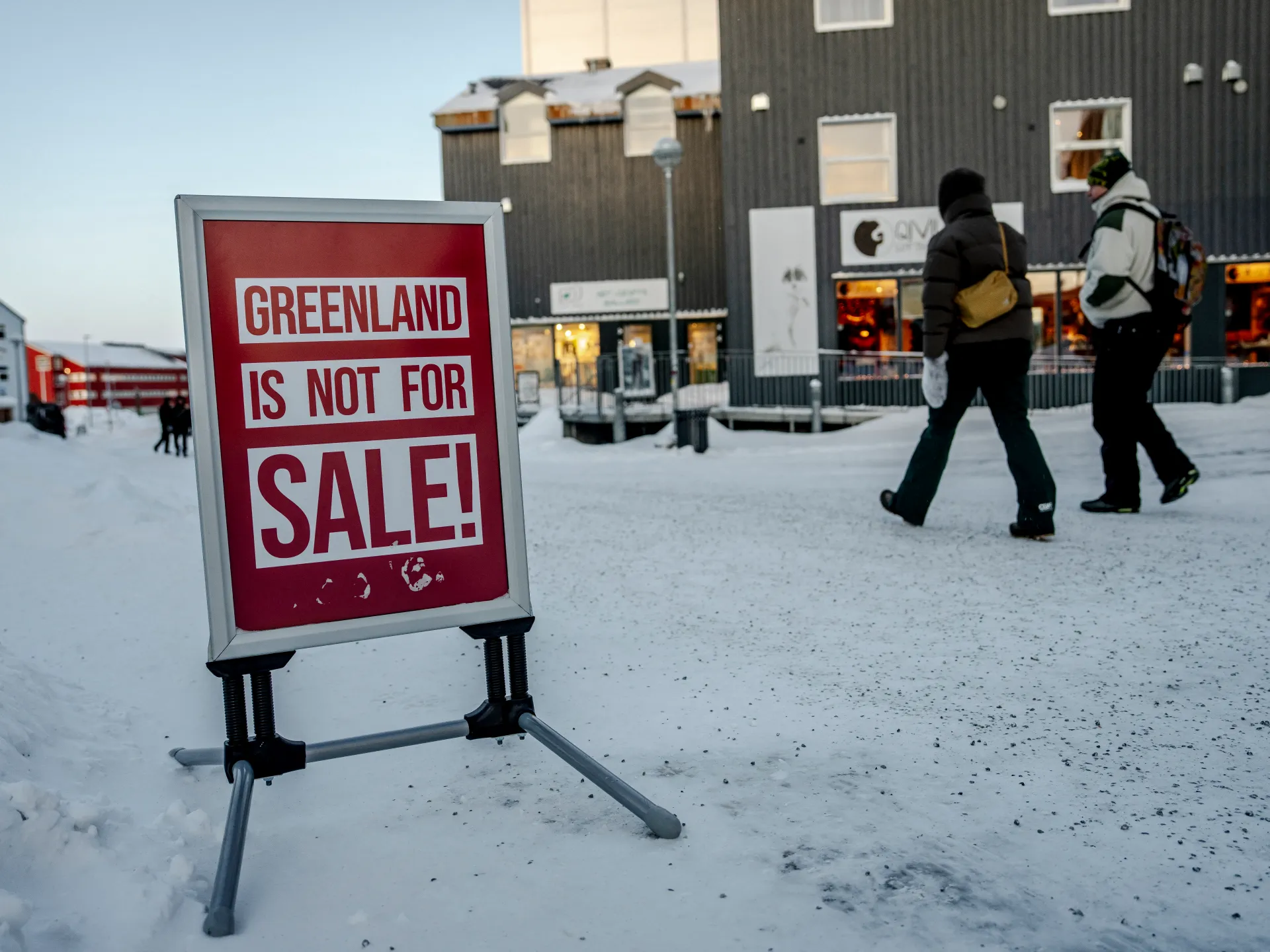
Recent US-Greenland-Denmark agreement excludes mining or drilling rights while reinforcing Greenland’s sovereignty.
Published On 14 Oct 202614 Oct 2026
Denmark has demanded that US resource exploration in Greenland respect the island’s laws amid President Donald Trump’s claim that oil, gas and mineral extraction will soon begin there.
The Danish Foreign Ministry reaffirmed on Wednesday that last month’s agreement between Denmark, Greenland and the US did not alter the rules for extraction.
Recommended Stories
list of 3 itemsend of list
The agreement “does not grant investors from the US any preferential treatment” over investors from other NATO and EU countries when it comes to access to natural resources in Greenland, the ministry said.
In a post on Truth Social, US President Trump called the semi-autonomous Danish territory “our new and beautiful Greenland”.
“Massive Oil, Gas, and Mineral Exploration is getting ready to begin,” he wrote, without providing details.
What the deal covers
Trump, Danish Prime Minister Mette Frederiksen and Greenland’s Prime Minister Jens-Frederik Nielsen signed the 10-page agreement on the sidelines of the United Nations General Assembly in New York on September 22, ending months of tensions over Trump’s threats to control Greenland.
The deal allows the US to “modernise and expand” its activities at the Pituffik Space Base, a remote US military installation in northwest Greenland.
It also paved the way for two new military bases and Trump’s “Golden Dome” missile defence system, while reaffirming Danish sovereignty and Greenlanders’ right to self-determination.
It did not allocate any rights for mining or drilling.
Greenland’s ban
Greenland banned uranium mining and all future oil exploration in 2021.
Its government is reviewing whether a Texas firm, Greenland Energy, can use permits that predate the ban.
The company said in August it planned to drill for oil in 2027 at an untested basin on Greenland’s east coast, although it lacked its own permit.
Danish security policy adviser Jacob Kaarsbo said Trump’s comments could signal that his desire to control Greenland remains unchanged.
“It is extremely dangerous to view this agreement between the Trump administration and Denmark as something that has altered Trump’s intentions,” he said.
Mikkel Olesen, a senior researcher at the Danish Institute for International Studies, told Al Jazeera that details regarding mining and exploration rights remained unclear and that information coming mostly from the US side should be taken “with a grain of salt”.
Richard Weitz, a fellow at the NATO Defense College in Rome, said Trump “backed down and settled for less” than he sought, but still “got pretty much everything he wanted, except formal annexation”.
The anonymous arts group known as Secret Handshake has gone international with its piquant form of satirical anti-Trump artwork, this time placing a playable video game console called “Nuuk ‘Em All” in, yes, Nuuk, Greenland. The group sent a picture of the console to The Times. It sits alone on a barren cliff above the sea, with a smallish iceberg visible in the water below. The peaked roofs of a nearby town can be seen in the distance.
Secret Handshake has created more than a dozen pieces of guerrilla art mocking Trump since last year — all of which appeared on the National Mall in Washington, D.C., until July when a golden, 10-foot tall “Iran War Participation Trophy,” cropped up in New York City. That piece arrived at the Minnesota State Capitol in early August.
Greenland is ambitious though, even for a collective that revels in creating outsize splashes with its work (see the Trump-Epstein “Best Friends Forever” sculpture). Asked via email how the group transported the full-size video game console to the country — which has weathered a series of unwelcome overtures from Trump to become part of the U.S. since he retook office early last year — a representative wrote, “You have no idea — it was honestly very difficult. A true ‘planes, trains, and automo … ships’ situation. Did you know that the arctic is actually quite far? And they’re not used to whipping over arcade games.”
“Nuuk ‘Em All” is the second satirical video game Secret Handshake has released since July when it first introduced the world to “Operation Epic Furious: Strait to Hell,” which finds Trump waging a futile war with Iran while making all kinds of bumbling choices including whether to order a Diet Coke or bomb the country.
The game arrives in Greenland shortly after the Trump administration signed an agreement with the country and Denmark to expand the U.S. military presence in the Arctic while seemingly dropping threats to annex the semi-autonomous Danish territory.
Three additional cabinets of the game were simultaneously placed at the D.C. War Memorial on the National Mall, and can be played online on any old computer. The game begins with an animation of the White House, its lawn covered with cranes and backhoes. “The year is 2026,” the scrolling text reads. “The White House is under constant construction, reconstruction and construction of the reconstruction.”
The action moves to Trump’s Mar-a-Lago headquarters where Trump is approached by Defense Secretary Pete Hegseth, who apologizes for waking Trump from his “tactical nap” to tell him about some “issues with Iran.” Trump asks if the Strait of Hormuz is 100% open and Hegseth replies, “Yes, sir. It’s so open that we’ve used up all our missiles, and gas now costs more than bourbon.”
I haven’t had the chance to play the game for long, but Secret Handshake’s email details what to expect, “In this game, Iran is going great (spoiler — it’s not), so Trump heads north to check on his new frozen frontier. Along the way, he battles unthinkable evils like Fully Vaccinated Children, Woke Yetis, and the happiest people on Earth, the Danish. All the while, the player’s greatest challenge is trying to keep President Trump from falling back asleep.”
Secret Handshake didn’t have any information about how Greenland has responded to the game, with the rep noting, “I think there is a lot of hope and relief over there right now that this agreement is the end of the barrage of bullying and threats from the US. But our feeling—and I truly hope we’re wrong— is that it’s just the beginning. Especially with Trump refusing to answer if an invasion is completely off the table now.”
Regardless of what happens in Greenland, the rep continued, “the thing I really like the most about this new game is that between all the satire, and jokes, and silliness, it actually ends up back in reality — the character is still stuck in an endless loop of war in Iran. And that, sadly, is still just as true as when we released the Iran game almost half a year ago.”
I’m Arts editor Jessica Gelt screaming into the void. This is your arts and culture news for the week.
You’re reading Essential Arts
Our critics and reporters guide you through events and happenings in the SoCal arts scene. In your inbox every Friday.
By continuing, you agree to our Terms of Service, which include arbitration and a class action waiver. You agree that we and our third-party vendors may collect and use your information, including through cookies, pixels and similar technologies, for the purposes set forth in our Privacy Policy such as personalizing your experience and ads.
The week ahead: A curated calendar
FRIDAY
Boston Marriage David Mamet’s 1999 epigram-filled comedy about two women sorting out their affairs while maintaining their standard of living at the turn of the 20th century. Directed by Bernardo Cubría. With Nicole Pacent, Heather Wake and Dulce Valencia. 8 p.m. Fridays-Saturdays (and one Thursday, Oct. 22): 2 p.m. Sundays, through Oct. 24. European House LA, 12355 Rye Street, Studio City. ticketsource.com
Yvette Janine Jackson With Radio Opera Workshop The ensemble integrates electronics, acoustic instruments, voice and images to produce new music by the award-winning composer and sound artist. Presented by CAP UCLA in collaboration with the UCLA Herb Alpert School of Music and the UCLA Center for Musical Humanities. 8 p.m. The Nimoy, 1262 Westwood Blvd. cap.ucla.edu
The Little Women Ballet in action.
(Edie Tyebkhan-Melissa O’Gara)
Little Women Ballet The dance troupe’s Autumn Immersive Experience brings audiences into the world of Louisa May Alcott through movement amid Victorian Era architecture. 6:30 p.m. Friday, 3 and 6:30 p.m. Saturday-Sunday. Heritage Square Museum, 800 Homer St., Montecito Heights. littlewomenballet.org
Outside Mullingar An Irish romance written by Pulitzer Prize and Academy Award winner John Patrick Shanley that premiered on Broadway in 2014 finds a middle-age man and woman, longtime neighbors, circling an uneasy relationship in uncertain times. Michael Kirby, Liza Seneca, Armin Shimerman and Kitty Swink star. Directed by Matthew Leavitt. 8 p.m. Fridays-Saturdays, 2 p.m. Saturdays, 4 p.m. Sundays, through Oct. 25. Sierra Madre Playhouse, 87 W. Sierra Madre Blvd. sierramadreplayhouse.org
Gretchen Parlato The jazz singer-songwriter performs music from her new album, “The Wise Ones,” joined by her band Alan Hampton on bass and guitar, Mark Guiliana on drums and percussion and Gerald Clayton on piano and keyboards. 8 p.m. Carpenter Center, 6200 E. Atherton St., Long Beach. carpenterarts.org
SATURDAY
Isaiah Collier performs Saturday at the Segerstrom Center for the Arts.
(Johanna Brinckman)
Isaiah Collier Plays Coltrane The rising jazz musician and composer pays tribute to the saxophone legend by applying his own sound and reaffirming the music’s ability to evolve. 7:30 p.m. Segerstrom Center for the Arts, Samueli Theater, 600 Town Center Drive, Costa Mesa. scfta.org
Democracy Sessions 2026 Music collective Wild Up expands upon its successful election-themed 2024 event examining how art can function as a democratic practice in this time of censorship, polarization and shifting public trust. The new month-long festival was developed in partnership with MOCA, REDCAT and CalArts, with related programming independently conceived and presented by Clockshop, 2220 Arts + Archives, Human Resources, Performance Art Museum and Living Earth, for the run-up to the Nov. 3 midterms. Saturday through Nov. 3, various locations. wildup.org
A calavera mask designed by artist Leo Limon and a paper marigold for Self Help Graphics & Art’s Dia de los Muertos Community Art Workshop Series in October 2026.
(Self Help Graphics & Art)
Día de los Muertos Community Art Workshop Series Self-Help Graphics & Art launches the holiday season with five free Saturday community art workshops. Participants of all ages will learn crafts to honor ancestors and loved ones. Each week features papel picado (tissue paper with cutout shapes) and a paper marigold craft activity, plus a special project: Stamp collages with SHG Lead Printer Dewey Tafoya (Oct. 3); Calavera (skull) masks featuring a design by artist Leo Limon (Oct. 10); Recuerdo (memory) posters with Victoria Delgadillo (Oct. 17); “Living candle” mini paintings with Ivan Zuno (Oct. 24); and Candle decorating with Nupur Behera (Oct. 31). Noon-3 p.m. Saturdays through Oct. 31. East Los Angeles County Library, Community Room, 4837 E. 3rd St. selfhelpgraphics.com
Woof A revised version of “Go Play,” written and directed by Barra Grant, featuring the same loquacious dogs with new insights into their clueless owners. Previews, 2 and 7 p.m. Saturday, 2 p.m. Sunday and Oct. 10; opens 7 p.m. Oct. 10; 2 and 7 p.m. Saturdays, 2 p.m. Sundays, through Nov. 8. Odyssey Theater, 2055 S. Sepulveda Blvd. odysseytheatre.com
SUNDAY
Come From Away The award-winning Broadway hit musical, written by the husband-and-wife team of Irene Sankoff and David Hein, tells the true story of a Canadian town that sheltered thousands of airline passengers whose flights had been diverted on Sept. 11, 2001. Directed by Julia Rodriguez-Elliott, with music direction by Rod Bagheri. Previews, 2 p.m. Sunday, 7:30 p.m. Wednesday, Thursday and Oct. 9; opens Oct. 10 through Nov. 8. A Noise Within, 3352 E. Foothill Blvd. Pasadena. anoisewithin.org
WEDNESDAY
The Best Medicine Caroline Aaron stars in the West Coast premiere of this solo comedy by playwright Robin Gerber and directed by Jane E. Unger. Previews, 8 p.m. Wednesday-Friday; Opening, 8 p.m. Saturday; 8 p.m. Fridays-Saturdays, 2 p.m. Sundays, through Nov. 15. Odyssey Theatre, 2055 S. Sepulveda Blvd. odysseytheatre.com
B+ Mom (An Enthusiastic Guide to Imperfect Parenting) Melissa Greenspan wrote and performs this solo comedy directed by Guy Picot. 7:30 p.m. Wednesdays, through Oct. 28. Rogue Machine at the Matrix Theatre, upstairs on the Henry Murray Stage, 7657 Melrose Ave. roguemachinetheatre.org
Charlemagne Palestine The Brick and Piano Spheres presents the visual artist and musician performing “Strumming Music,” which he describes as “an evolutionary liquid sound continuum process” and performed hundreds of versions over the last 50+ years. 8 p.m. The Brick, 518 N. Western Ave. the-brick.org
THURSDAY
Ronald K. Brown / Evidence The landmark African diasporic dance company led by choreographer Brown recently celebrated its 40th anniversary. West Coast fans will have the chance to experience the New York-based company’s unique blend of contemporary, African and African American dance traditions with this program of four pieces that includes tributes to some of Brown’s most enduring collaborators. (Eloise Rollins-Fife) 7:30 p.m. Thursday-Oct. 10. The Wallis, 9390 N. Santa Monica Blvd., Beverly Hills. thewallis.org
Wives East West Players presents the Southern California premiere of Jaclyn Backhaus’ feminist comedy examining a selection of “great men” in 16th century France, 1920s India and 1960s Idaho. A primarily South Asian and South Asian American cast, under the direction of Hypokrit Live Arts NYC co-founder and artistic director Arpita Mukherjee, brings this redress of women’s erasure in history to astringent comic life. (Charles McNulty) Through Nov. 1, check website for specific dates. East West Players, Union Center for the Arts, David Henry Hwang Theater, 120 Judge John Aiso St. eastwestplayers.org/wives
Yamel Cucuy Austin’s Glass Half Full Theatre returns with this production, last seen in L.A. at the Latino Theater Company’s 2024 Encuentro theater festival. The tale of a girl on the verge of adulthood facing the threat of immigration agents and haunted by specters from Mexican folklore is told through live actors, sophisticated puppetry and an original score of Indigenous percussion. Written by Gricelda Silva, Indigo Rael and Caroline Reck, with additional writing by Jesus I. Valles and Connor Hopkins. Directed by Reck. 8 p.m. Thursdays-Saturdays, 2 p.m. Sundays, through Nov. 1. Los Angeles Theatre Center 514 S Spring St. latinotheaterco.org
The SoCal scene
Wendy Raigosa, 27, Long Beach, uses repurposed materials in her art project at Kate Ingold’s bi-monthly Samizdat Sundays workshop at the Wende Museum.
(Carlin Stiehl / For The Times)
Times contributor Miranda Huang wrote about bi-monthly classes at the Wende Museum called “Samizdat Sundays” in which teacher Kate Ingold teaches participants samizdat, “a practice in which Soviet dissidents hand-typed literature, criticism and poetry to bypass state censorship. Each week, Ingold opens the workshop with a new prompt related to speech suppression — an issue with renewed currency today.”
Vincent Price Art Museum is currently staging a unique exhibit featuring the work of Anida Yoeu Ali, a Cambodian-born artist who lives in Tacoma, Wash. It’s called “The Buddhist Bug” and features a 328-foot-long orange insect, which Ali will occupy on opening day, and again on closing day. “Ali’s numerous performance-based exhibits explore her Cambodian American identity and Buddhist and Muslim religions. The bug is her ‘totally humorous take on hybridity’,” writes contributor Siran Babayan.
Ed Ruscha’s new poster for Alejandro Iñárritu’s “Digger,” featuring the Boy Scout Utility Modern font, which Ruscha designed himself and has used exclusively since around 1980.
Segerstrom Center for the Arts turned 40 last month and Times contributor Jenelle Riley made the drive to interview the organization’s leaders, including President and Chief Executive Casey Reitz, about how the campus grew out of windswept lima bean fields to become the epicenter of art and culture in Orange County.
Architecture critic Sam Lubell went to the Lucas Museum of Narrative Art last weekend and was sorry to see that the museum has erected gates around its main courtyard. Lubell, like many, had been under the impression that the courtyard was meant to function as a grand civic plaza, so he penned a piece of commentary questioning the founders’ motives for cordoning off the area. “It’s hard not to wonder whether these barriers represent something more than security: the extension into public space of the gated, closely guarded world inhabited by co-founders George Lucas, Mellody Hobson and those in their orbit,” Lubell writes.
Enjoying this newsletter? Consider subscribing to the Los Angeles Times
A rendering of the Las Vegas Museum of Art, designed by architect Francis Kéré.
(Kéré Architecture / Las Vegas Museum of Art)
Culture News
Earlier this week the long-gestating Las Vegas Museum of Art hosted a preview of its Grand Central Galleries — a multipurpose media lab and exhibition space located in Symphony Park down the street from the museum’s future main building. Scheduled to open in April 2027, the 15,000-square-foot space will act as an entry point to the museum and is slated to host a variety of exhibitions and programs while the museum’s Francis Kéré-designed building remains under construction through 2029.
The Grand Central Galleries exhibition program was organized by the LVMA in collaboration with LACMA, and will open with “A Shared Light: Monet, Impressionism, and the American Landscape,” organized by Shannon Vittoria, LACMA’s associate curator of American art, along with David Bardeen, LACMA’s assistant curator of European painting and sculpture. It features nearly 60 works by artists including Claude Monet, Paul Cézanne, John Singer Sargent, Pierre-Auguste Renoir and James McNeill Whistler.
The United States, Denmark and Greenland are preparing to sign an agreement that could reshape the American military presence in the Arctic and ease a diplomatic dispute that has strained relations within NATO.
US President Donald Trump is due to meet Danish Prime Minister Mette Frederiksen and Greenland Prime Minister Jens Frederik Nielsen in New York on Tuesday for a trilateral signing ceremony. The agreement is expected to allow Washington to expand its military infrastructure on Greenland, a strategically located and mineral rich territory of the Kingdom of Denmark.
The deal follows months of tension after Trump refused to rule out using military or economic pressure to bring Greenland under US control. The comments triggered a diplomatic crisis with Denmark and raised concerns about divisions within NATO.
The US military presence is set to expand
The agreement is expected to give the United States access to two additional military sites in Greenland, alongside the existing Pituffik Space Base.
Stay ahead of the geopolitical week.
MD Briefing delivers expert analysis across five global fronts — the Indo-Pacific, energy, geoeconomics, European security, and the Middle East — every Monday morning. Free.
One of the proposed locations is Narsarsuaq, a former Cold War airbase where only a small population remains. The other is Mestersvig, which is currently used by the Sirius Dog Sled Patrol, an elite Danish special forces unit.
The expansion would significantly increase the US military footprint on the island and mark the first major expansion of American military infrastructure there since the Cold War.
During that period, the United States operated 17 installations in Greenland and had more than 10,000 personnel on the island.
Greenland’s location between North America and the Arctic gives it considerable strategic importance. Its geography also places it close to major Arctic routes and areas of growing competition involving Russia, the United States and other NATO members.
NATO could play a larger role
Danish Foreign Minister Lars Lokke Rasmussen has said the agreement would place Arctic security more firmly within NATO’s collective framework rather than leaving responsibility primarily to Washington and Copenhagen.
That could be significant because the Greenland dispute exposed tensions within the alliance at a time when NATO members are already facing growing security concerns in the Arctic.
The Arctic has become increasingly important to NATO because of its geography, military access and emerging economic opportunities. Greater US military activity in Greenland could therefore become part of a wider alliance approach to Arctic security.
However, the precise role NATO would play remains unclear because the full text of the agreement has not yet been published.
What happens to Greenland’s sovereignty?
The agreement also leaves questions about the balance between US security interests, Danish sovereignty and Greenland’s aspirations for greater autonomy.
Greenland is a self governing territory within the Kingdom of Denmark. Its government has repeatedly maintained that decisions about Greenland’s future must involve Greenlanders themselves.
Trump said on Friday that the agreement would give the United States “permanent control over security, and all other needs, in Greenland.”
Denmark has not endorsed that description. Copenhagen has instead said that the agreement respects the kingdom’s sovereignty and Greenland’s right to self determination.
It remains unclear whether the agreement will modify the 1951 US Denmark defence treaty, which has provided the legal basis for America’s military presence on the island, or establish a separate framework.
From acquisition ambitions to military access
The agreement represents a significant shift from Trump’s earlier push to acquire Greenland outright.
Greenland is roughly three times the size of Texas but has a population of only about 57,000 people, concentrated in small communities along its coastline. The island is also rich in natural resources, adding an economic dimension to its strategic importance.
Trump’s earlier comments about potentially using economic or military pressure to obtain Greenland created an unusual dispute between the United States and Denmark, both members of NATO.
The new agreement appears to offer a different approach: rather than changing Greenland’s sovereignty, Washington would gain a substantially larger military presence on the island.
Why does Greenland matter to the US?
Greenland’s strategic location makes it important to North American and Arctic defence. It sits between the United States, Europe and the Arctic and can provide access for monitoring activity across the region.
For Washington, expanding military infrastructure could strengthen its ability to monitor Arctic air and maritime activity and support wider North American defence.
For Denmark and Greenland, however, the issue involves more than military strategy. Any expansion of US activity has to operate within Denmark’s sovereignty over the territory and Greenland’s right to determine its political future.
The agreement therefore seeks to address two competing pressures at once: the United States’ desire for greater Arctic security access and Denmark and Greenland’s insistence that such cooperation must not amount to a transfer of sovereignty.
If signed as expected, the deal could mark a new phase in the Arctic relationship between the three governments. It would not resolve every disagreement over Greenland’s future, but it could replace the earlier confrontation over US acquisition with a more structured framework for American military access and NATO security cooperation.
WASHINGTON — President Trump on Monday headed into a week full of high-stake meetings with world leaders after spending a 72-hour period banning reporters from the White House, mulling whether it was time to “blow … up” Iran, and proposing to house military drones and snipers in his triumphal arch in the nation’s capital.
The weekend — which also included the announcement of a security deal over Greenland and the creation of a new “A.I. Force” — captured an American president operating unpredictably across multiple fronts even as each one drew friction. The actions now stand to color the backdrop of a week that will feature meetings with world leaders at the United Nations General Assembly in New York and a state visit by Chinese President Xi Jinping in Washington.
Each of those moves carries its own political weight ahead of the diplomatic talks, but also ahead of the midterm elections, where these topics are front and center in key races.
Trump’s handling of the Iran war, its subsequent shocks to the global economy, his push to fast-track the development of artificial intelligence and the Greenland agreement are likely to come up in meetings with world leaders. His deal with Denmark to bolster U.S. military presence in Greenland, a territory Trump has repeatedly tried to annex, is expected to be signed Tuesday in New York, though action is still needed by the Danish and Greenland governments before it can be enforced.
While all the details of the Greenland deal are not public yet, Trump has said it is a “dream come true for the United States of America.”
“This solution is a great one for the United States of America, Denmark, Greenland and all of our Allies,” Trump wrote on social media Friday. “We look forward to working with the wonderful people of Denmark and Greenland toward a magnificent future with respect to this large, and highly strategic, parcel of land. We will be very protective of it.”
In an interview Sunday, Trump also indicated that he was trying to make a decision on Iran as the war stretches into its eighth month. The president said he would “probably be open” to meeting with Iranian President Masoud Pezeshkian during the U.N. General Assembly.
“My question is, if and when do I blow the entire nation up?” Trump told Fox News. “They better behave.”
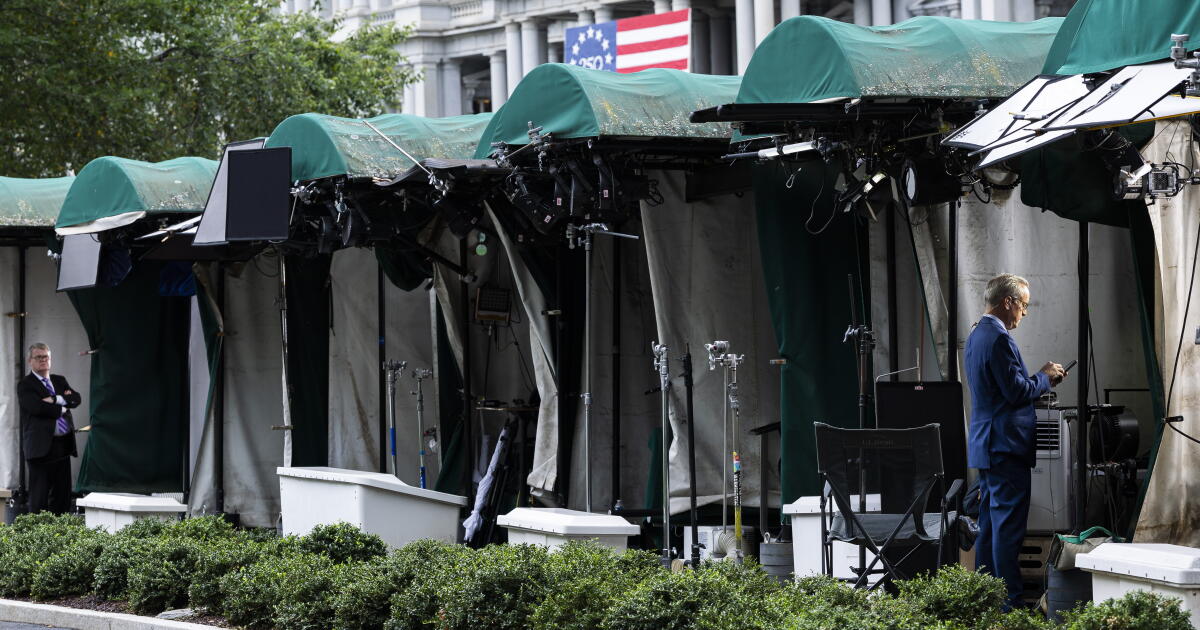
Of all the actions Trump took, the press dispute has become the most contentious and drawn an immediate legal response. Three major news outlets — CNN, MS NOW and Politico — sued the Trump administration Monday for banning their reporters from the White House grounds, and major television networks suspended their pool coverage of the president’s activities.
In a joint statement, the organizations said the White House has acted “without notice or process” and called the arbitrary decision a “blatant violation” of the 1st Amendment.
Trump, meanwhile, argued Monday that the banned news outlets are “corrupt” and a “threat to our national security.”
Vice President JD Vance defended the press ban.
“He’s not banning media outlets. What he’s doing is saying we’re not going to give you special access to the White House if you engage in what is effectively propaganda,” Vance said Monday, arguing that the three outlets push out “negative” coverage of Trump.
The tense showdown between Trump and the White House press corps led to audio problems during the president’s ribbon-cutting ceremony for a new helipad on the South Lawn. Without television cameras and microphones set up by the major TV networks, it was impossible to hear what Trump was saying through the White House’s official YouTube stream, signaling further technical difficulties in the week ahead.
Behind the public displays of control, news reports have painted a picture of a president increasingly frustrated by the lack of credit he feels he is owed. At a recent closed-door meeting, reported by the Wall Street Journal, Trump told advisors he was aggravated that his allies hadn’t lauded him enough for his efforts to take over the Kennedy Center or other accomplishments made during his second term.
Trump has tried to put his name on the building’s facade and run into resistance from Democrats, arts patrons and a federal judge who blocked the move last week. Trump was then photographed aboard Air Force One looking at a large printout appearing to show demolition plans for the center.
Over the weekend, Trump posted on social media a link to a news article that claimed he was seeking to fix “safety hazards” at the performance center. He then posted an image of him watching the Western Hemisphere with the words, “His Hemisphere,” and wrote that his proposed triumphal arch near the National Mall would be used as a military complex for drones and snipers.
Trump also announced that he would be creating the “A.I. force,” modeled after the Space Force he launched during his first term, to ensure the country does not “in any way hinder or stifle the growth of the industry.” The announcement came amid growing backlash to data centers and the fast-paced development of artificial intelligence, an issue that in recent weeks has prompted stark warnings about the technology’s power and its threats to humanity.
Tech executives, including Dario Amodei and Sam Altman, have even called for a slowdown on the technology’s advancement and last week, four leading AI companies — Anthropic, OpenAI, SpaceXAI and Google — faced a lawsuit claiming they made an illegal deal to slow the pace of their respective AI development.
Trump’s announcement over the weekend comes as lawmakers, including congressional Republicans in tight races, have called for new guardrails on the technology.
Despite technology becoming a political flashpoint during the midterms, Trump has dismissed concerns about AI as a hoax and asserted that those who oppose data centers are intent on being “backwards and poor.”
Sen. John Kennedy (R-La.) is among the lawmakers who have called for action on regulating the technology, and he has warned that not doing so could come at a cost on Nov. 3.
“We really need to send a memo around explaining we’ve got midterm elections coming,” Kennedy told Politico. “I may send that out.”
Denmark, Greenland and the United States are set to sign a security agreement that Copenhagen says will give NATO a larger role in protecting the Arctic, potentially shifting responsibility beyond the United States and Denmark alone.
The agreement is expected to be signed at the United Nations General Assembly in New York on Tuesday. Its full contents have not been made public, although US President Donald Trump has described it as giving Washington “permanent control” over Greenland’s security.
Denmark and Greenland have not endorsed Trump’s description. Both have said the agreement will benefit Greenland while respecting the island’s sovereignty.
The deal follows months of pressure from Trump, who has repeatedly argued that the United States should control Greenland and at times declined to rule out military or economic measures to acquire the semi autonomous Danish territory.
Stay ahead of the geopolitical week.
MD Briefing delivers expert analysis across five global fronts — the Indo-Pacific, energy, geoeconomics, European security, and the Middle East — every Monday morning. Free.
His demands triggered a diplomatic crisis within NATO and pushed Copenhagen and Nuuk into negotiations with Washington to address US security concerns while maintaining Greenland’s status within the Kingdom of Denmark.
A broader NATO role
Danish Foreign Minister Lars Lokke Rasmussen said the agreement would change the way Arctic security is handled.
“It will be in a form where responsibility for security in the Arctic is not only Danish or American,” Rasmussen told Danish broadcaster TV2 on Sunday. He added that NATO would play a major role in protecting the region.
A NATO spokesperson said the alliance welcomed the agreement, describing it as a step that could advance security, stability and cooperation in the Arctic.
Rasmussen travelled to New York for the signing but has declined to disclose the agreement’s details.
He said Denmark had been open from the beginning to addressing what he described as legitimate US security interests.
The negotiations therefore appear to have focused on finding a framework that can accommodate Washington’s strategic concerns without formally transferring Greenland’s sovereignty to the United States.
Trump’s claim raises questions
Trump has offered a different description of what the agreement means.
In a post on Truth Social on Friday, he said the deal gives the United States “permanent control over security, and all other needs” in Greenland. He also said no US adversary would be able to establish a base or military presence on the island without Washington’s written approval.
Copenhagen has not publicly responded to that characterization.
The difference between Washington’s description and Denmark and Greenland’s public statements leaves important questions about the agreement unresolved.
Among the most significant is whether it changes the 1951 US Denmark defence agreement, which provides the legal basis for the American military presence in Greenland.
The document’s provisions on US access, military infrastructure and the role of NATO have not been made public.
Greenland at the centre
The agreement comes as Denmark acknowledges that it underinvested in Greenland’s defence for decades.
Copenhagen has since pledged to increase its military presence on the island and strengthen Arctic surveillance, including through greater NATO involvement.
Greenland’s government has sought to reassure residents that the negotiations do not compromise the island’s sovereignty.
Erik Jensen, an opposition lawmaker in Greenland, said on Facebook that he had read the draft agreement and felt reassured by its contents. He also praised Greenland’s foreign minister for handling the negotiations.
For Greenland, the issue is particularly sensitive because the island has extensive autonomy within the Kingdom of Denmark and has long maintained a political debate over eventual independence.
What the agreement could mean for the Arctic
The deal could mark a significant change in the security architecture of the Arctic.
Greenland occupies a strategically important position between North America and Europe, making it valuable to the United States and NATO as competition over the Arctic increases.
A larger NATO role could provide a multilateral framework for responding to concerns about military activity and strategic infrastructure in the region. At the same time, the agreement’s precise legal and operational arrangements will determine how far that shift actually goes.
Until the text is released, it remains unclear whether the agreement represents a substantial restructuring of Greenland’s defence arrangements or primarily a political framework for closer cooperation.
What is clear is that the negotiations have moved Arctic security from a dispute centred on US ambitions for Greenland toward a broader discussion about NATO’s collective role in one of the world’s increasingly contested strategic regions.
Trump has wanted a foothold in Greenland for some time, as a strategic battle unfolds for supremacy in a warming Arctic.
Published On 19 Sep 202619 Sep 2026
Denmark has hailed a “binding” deal by United States President Donald Trump to give Washington “permanent control” over Greenland’s security and bar Russian and Chinese military bases from the Arctic territory.
But Denmark and Greenland – an autonomous Danish territory – said on Saturday that any deal with the US would not compromise Greenland’s sovereignty, and the two countries would sign the agreement next week at the United Nations General Assembly in New York.
Recommended Stories
list of 4 itemsend of list
“A long period of uncertainty will hopefully be replaced by a binding agreement that strengthens security in the Arctic and North Atlantic, and thereby our shared security within NATO and Europe – while respecting the [Danish] Kingdom’s red lines,” Danish Foreign Minister Lars Lokke Rasmussen said in a social media post.
Since returning to the White House in January 2025, Trump has repeatedly insisted that Washington needed to control Greenland for strategic reasons, alarming NATO ally Denmark and sparking fierce pushback from the alliance.
Key details of the agreement have not been made public, including the scale of the US military presence in the self-governing Danish territory and whether any formal power over foreign policy and resources would be ceded to Washington.
Greenland’s Prime Minister Jens-Frederik Nielsen said the agreement “recognises Greenland’s interests” and is “to the benefit of us all”.
Denmark’s Prime Minister Mette Frederiksen said it is “great for NATO and Europe”, as it “strengthens our common security in the Arctic and the North Atlantic Area”.
‘I have mixed feelings’
But in Greenland’s capital Nuuk, residents had mixed feelings.
“I don’t know exactly what the agreement is or what has been signed. But whenever the US and Trump are mentioned, I have mixed feelings. I’m not entirely comfortable with how much attention Greenland has right now,” Soren Kreutzmann, a 29-year-old hairdresser, told the AFP news agency.
“We hope the leaders have made a good agreement, because our country needs to be protected, both from the air and sea. Denmark had not given that enough attention for many years,” said Bibbi Kleist Jepsen, a 64-year-old educator.
Trump, who had previously said the US needs “ownership” of Greenland, announced that Washington would immediately start building up a large military presence in the territory.
“From now on, no US adversary can EVER have a base in Greenland, have a military presence in Greenland, or make sensitive investments in Greenland, without our express written approval”, he said.
Trump has repeatedly warned of Russia and China trying to establish a foothold in Greenland as a strategic battle unfolds for supremacy in the warming Arctic region. The State Department left no doubt that they would not be allowed to do so.
“This agreement guarantees that China and Russia cannot have a base in Greenland, they cannot send troops to Greenland and the necessary mechanisms are in place to prevent investment in sensitive sectors,” a State Department official said.
United States President Donald Trump claims the US has reached a deal with Denmark granting it “permanent control” over Greenland’s security “and all other needs”.
The announcement comes more than a year after the US president threatened to seize the self-governing Arctic territory, which is part of Denmark. Those threats roiled the NATO security alliance that Washington and Copenhagen are part of.
Recommended Stories
list of 3 itemsend of list
According to Denmark, the deal is expected to be signed during next week’s United Nations General Assembly meeting in New York. Copenhagen has stressed that it retains sovereignty over Greenland, and this deal will still need to be ratified in the Danish and Greenland parliaments.
Here’s what we know about the deal and what it could mean for the US and Greenland:
What’s in the deal?
The official text has yet to be released. But according to Trump, the deal gives the US permanent control over Greenland’s security and “all other needs”, at no cost to the US.
The deal bars US adversaries from establishing a military presence or making “sensitive investments” in Greenland without US approval, said Trump.
A US Department of State official cited by the BBC said the deal will mean non-NATO states won’t be able to set up bases in Greenland and will be barred from “making investments in Greenland that could threaten the United States”.
The official said that means China and Russia won’t be able to build bases or send troops to Greenland, and that those states would be blocked from investing “in sensitive sectors”.
However, Mikkel Olesen, a senior researcher at the Danish Institute for International Studies, told Al Jazeera that it is unlikely to be a major concession because “the Danes and Greenlanders never wished for Russia or China to have bases in Greenland.”
However, it is unclear whether other countries could similarly be labelled “adversaries” to the US in the future, subjecting them to these restrictions.
Trump called the deal an “‘Infinite Life’ Agreement”, meaning “it never ends”.
The State Department official also said the agreement gives the US the right to build more military sites on the island without Greenland or Denmark approving. According to the official, the deal would remain in force even if Greenland were to become an independent state in the future.
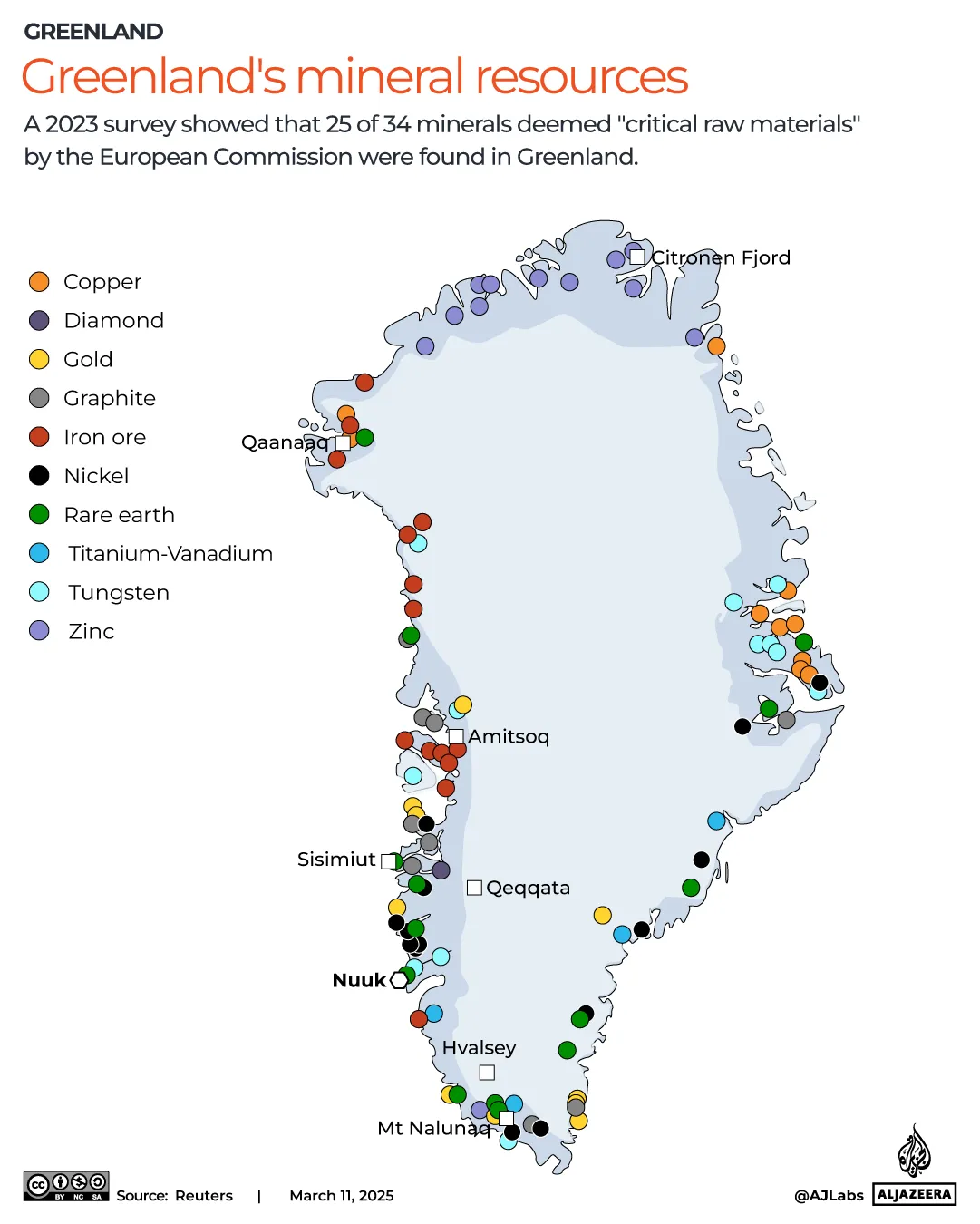
There was no specific mention of potential US mining rights in Greenland, which has a rich deposit of rare-earth minerals, including zinc, iron, uranium and graphite, that are likely to interest Trump. These minerals are highly sought after and are used in the manufacture of hundreds of technological products, from smartphones to fighter jets.
However, some observers think this could be what Trump means by his mention of “sensitive investments”.
The US president has sought to expand the US’s global access to rare-earth metals, especially as China, a global leader in the technology, AI and renewables industries with 60 percent of the world’s known deposits of these minerals in its territory, restricts their exports.
(Al Jazeera)
What have Greenland and Denmark said?
Greenland and Denmark acknowledged the deal on Friday, but neither gave specific details about its terms. They said the agreement would be announced next week.
Greenland’s Prime Minister Jens-Frederik Nielsen said it “recognises Greenland’s interests” and is “to the benefit of us all”.
Denmark’s Prime Minister Mette Frederiksen said it is “great for NATO and Europe”, as it “strengthens our common security in the Arctic and the North Atlantic Area”.
Olesen stressed that details of the deal remain unclear and that available information should be taken “with a grain of salt” as most of it has so far come from the US side.
Denmark’s Frederiksen said the agreement “recognises the sovereignty and territorial integrity of the Kingdom and the Greenlandic people’s right to self-determination”.
Olesen said the deal could be positive for Greenland and Denmark as it “has the potential to end the crisis” caused by Trump’s insistence on acquiring Greenland last year, without sacrificing sovereignty.
Trump’s earlier threats to seize control of Greenland were met with high resistance on the island of 56,000 people. A January 2025 poll found that 85 percent of Greenlanders opposed becoming part of the US.
People protest against Trump’s policy towards Greenland in front of the US Consulate in Nuuk, Greenland, January 17 [Evgeniy Maloletka/AP Photo]
What military rights does the US already have in Greenland?
A substantial number. Under a 1951 treaty, the US has broad overflight and basing rights on the island.
In addition to giving the US the right to build bases and maintain personnel, the treaty also stipulates that the US can “control landings, takeoffs, anchorages, moorings, movements, and operation of ships, aircraft, and waterborne craft”.
As part of the treaty, the US currently operates a Space Force base in a remote part of northwestern Greenland – the Pituffik Space Base. It has more than 100 personnel stationed there.
What would actually change under this new agreement?
That largely remains to be seen. Trump said the US will “immediately” begin building up a large military presence on Greenland. However, the US already had the right to build bases and send personnel there under the 1951 treaty.
Imran Bayoumi, a former Pentagon official, told the Reuters news agency that it would be new if the US could now build bases unilaterally, but “it seems that Washington could have achieved a lot of these objectives through diplomacy and dialogue without straining the broader US-NATO relationship.”
Trump has also said the US will support Greenlanders with “development and construction”, without elaborating.
Richard Weitz, a fellow at the NATO Defense College, told Al Jazeera the deal “defuses perhaps one of the most severe sources of internal tension” within NATO.
While Trump “backed down and settled for less” than he sought with respect to Greenland, he still “got pretty much everything he wanted, except formal annexation”, added Weitz.
Richard Weitz, a senior fellow at the NATO Defense College tells Al Jazeera that the new US-Denmark security deal over Greenland gives US President Trump a diplomatic agreement without delivering his earlier ambition to annex the territory.
US President Donald Trump says the US will gain ‘permanent control over security’ in Greenland under a deal reached with Denmark. The agreement is expected to be signed next week, following months of Trump’s threats to ‘take’ the Danish territory.
Denmark and Greenland plan to sign a US defence pact next week, pending approval from both parliaments.
Published On 18 Sep 202618 Sep 2026
United States President Donald Trump claimed on Friday that Washington has entered into an agreement with Denmark and Greenland that gives the United States “permanent control over security and all other needs”.
In a post on his Truth Social platform, Trump said, “At my direction, we worked with representatives of Denmark and Greenland to guarantee that the US will FOREVER have the complete ability to do what is necessary in Greenland”.
Recommended Stories
list of 3 itemsend of list
He added that US adversaries will be barred from establishing military bases or personnel in Greenland unless they receive written authorisation from the United States.
Trump alleged that plans will begin immediately to build a significant US military footprint in suitable areas across Greenland, noting there are numerous potential locations.
Denmark and Greenland released a joint statement on Friday indicating that a pact with the US is set to be signed during next week’s high-level United Nations General Assembly summit.
The statement added that the agreement remains subject to formal parliamentary approval in both Nuuk and Copenhagen.
Denmark’s Prime Minister Mette Frederiksen said the agreement “recognizes the sovereignty and territorial integrity of the Kingdom and the right of the Greenlandic people to self-determination.”