How the Masters protects its green jackets and other inside stories
AUGUSTA, Ga. — Lawrence Bennett wasn’t only a guardian of the green jackets — the iconic garment of Augusta National — but he also oversaw their cremation.
That was among his many responsibilities in a career that spanned 51 years, where he first picked up litter then picked up everyone from celebrities to sports heroes to ex-presidents as the club’s top chauffeur.
“All I’ve known from Day 1 was Augusta National,” said Bennett, 72, sitting in the living room of his tidy home six miles from the storied course. His hallways are painted Masters green. Paintings of the course hang on the walls, as do photographs of famous people with heartfelt inscriptions.
For decades, he embraced the club. The members hugged him back, from bankrolling his college tuition to sending him generous gifts when he retired in 2013 and donations when his beloved wife, Cheryl, died in 2020 after suffering a massive stroke.

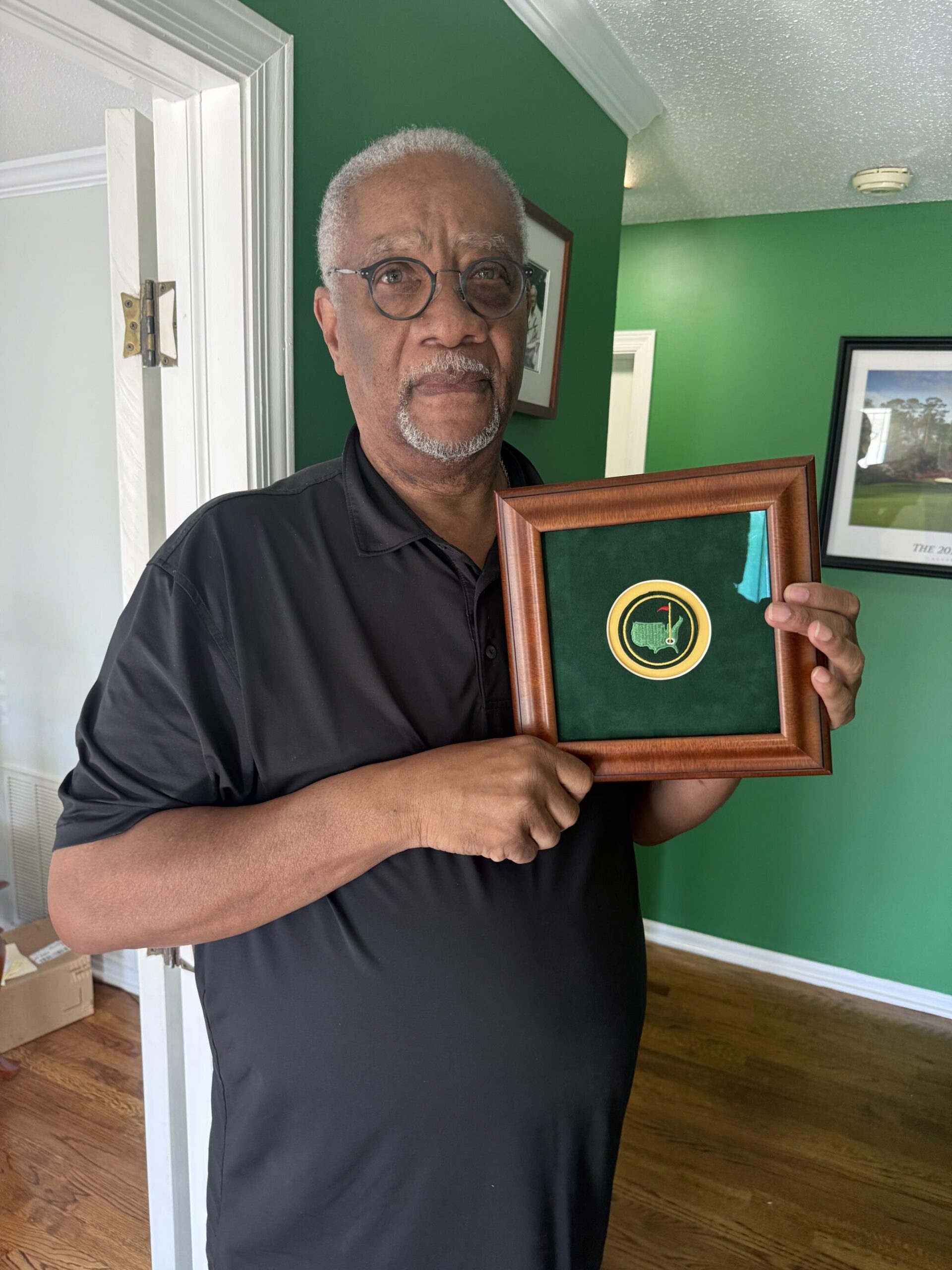
Lawrence Bennett, a longtime chauffeur at Augusta National, holds a framed portion of the logo that appears on the green Masters jackets.
(Sam Farmer / Los Angeles Times)
Bennett isn’t watching the Masters this week — he tuned in for Jack Nicklaus, Tiger Woods and some other greats over the years — and he said he’s never swung a golf club. But his job was his life, even though he moonlighted as a high school teacher and administrator.
His father, too, bled green. The late and legendary Freddie Bennett began as a young caddie and worked his way up to caddie master, looking for that ideal chemistry between club members or tournament competitors and the men who carried their golf bags and advised them on putting lines.
“Once you work at Augusta National, they don’t want half of your time,” the younger Bennett said. “They want all of your time. And that’s what he did, and that’s what I did.”
Father and son were highly regarded at the club.
“There’s no doubt they commanded respect,” said Ward Clayton, author of “The Legendary Caddies of Augusta National.” “But at the same time, they understood, whether you’re working for Augusta National or a top corporation, you’ve got to follow the guidelines of the place you’re working for. I think they understood that to the highest degree.”
Augusta National opens its gates to the world every April but otherwise is so secretive that it won’t confirm how many members it has, let alone name them. The waiting list for Masters tickets has been closed for decades and patron badges are passed down through families like heirlooms. The club is closed from mid-May until October, and new buildings appear as if by magic, yet fit in as if they’ve been around forever.
As his father and other club employees did, Bennett signed a non-disclosure agreement that lasted 10 years. Now, more than a decade after his retirement, he’s telling some of his stories.
Hot pockets
When an Augusta member died, left the club or simply wanted a new green jacket, Bennett was responsible for disposing of the old garments. That meant cutting off a coat’s emblem on the pocket, buttons and name tags in the lining, then taking what was left to a local funeral home for cremation. It wasn’t an everyday event. Bennett and a security guard from the club would bring 20-30 of the jackets that would be placed in a coffin-like cardboard box and pushed into a 2,400-degree oven.

Lawrence Bennett, longtime chauffeur at Augusta National, points to a painting of the course in his home.
(Sam Farmer / Los Angeles Times)
“We had to wait until the ashes cooled down to make sure we weren’t leaving buttons or anything identifying about it, and the funeral home would take care of the rest,” Bennett said. “They would just toss it.”
Occasionally, deceased members were buried in their green jackets.
“Some members’ families started to request that,” he said. “And I know one guy — I had to go take the jacket, a local member — I had to watch them put it on him. Didn’t like that too good. Watch them put it on, fixing it neat, and report back to the club manager that it was on.”
Watch your speed
The club had three station wagons and a long blue limousine when Bennett began chauffeuring at age 17. He was well spoken and polite, so his bosses soon began sending him on the most important jobs.
Once, a member named Alexander Chisholm from Mississippi had come into town for a party and round of golf, then stayed over for a dinner at a fancy place called the Green Boundary Club in Aiken, S.C. Bennett brought him in the limo.
“My dad said, `Boy, if you’re going to South Carolina, slow down because they’ll give you a ticket in a minute. They watch for Augusta tags to give you tickets,’” Bennett recalled.
He started slow and cautious.
“Mr. Chisholm, with a big cigar in his mouth, said, ‘Can you go any faster than this?’” he said. “Now, I’m 19. That’s all I needed to hear. I stepped on the gas.”
As soon as he crossed the Savannah River, the police lights pulled up behind him.
“The officer wasn’t real nice,” Bennett said. “He said, `Boy, can’t you read? Can’t you see that speed limit?’ Mr. Chisholm was in back and said, `How much is the ticket?’ The officer said it was going to cost me $150.”
Chisholm peeled off three $100 bills.
“Here,” the member told the officer. “Take $300, because we’re going to be coming back the same damn way.”
Hail to the chief
Back when he was in first grade, Bennett feigned illness so he could get sent home and spend some time with his dad, whom he hadn’t seen in two weeks.
“I would hear him come home and get in the bed, but I didn’t see him because he came home when I was asleep,” he said. “He left when I was asleep. So one day I was at school, and I played sick. So I told my teacher my stomach was hurting.”
His mother was working at the time, so the school called the club.
“Dad came to get me, and he took me to work, gave me a Coca-Cola and a little pack of crackers,” he recalled. “He said, `You can’t be running around, because the President is here.’ Well, I’m 6 or 7. I thought he was talking about George Washington.”
Then, his father pulled a milk crate up to a hedge.
“He said, `You want to see the President?’ So I went out, and he put me on this box, and I could look over the top of the hedge, and there was Eisenhower. That was Clifford Roberts, and that was Bobby Jones,” he said, referencing the Roberts and Jones, co-founders of Augusta National.
Bennett has some snapshot memories of the president.
“I remember him being a big man, big stomach,” he said. “He had brown pants on with pleats, and he got up and made his tee shot off number one, and he looked over and saw me. He did just like this [crisply saluting the child]. I did it back at him.”
The moment left an impression.
“That was my first really inkling of what my daddy did,” he said, “and the type of people that were at the club.”
Supreme honor
As a young chauffeur, Bennett had all sorts of driving duties. He would take members’ wives antique shopping or sit through movies with the children of members who were bored at the tournament.
He picked up Christopher Lee at the airport once, and — as a big fan of Dracula — he half-believed he saw the English actor transforming into a vampire while they drove to the club.
“As we got back, it was getting dark, and all I could see — this was in my mind now — those fiery red eyes in the rear view mirror,” said Bennett, recounting the meeting on the “70 Years of Masters Magic” podcast.

Lawrence Bennett, longtime chauffeur at Augusta National, shows some Augusta National keepsakes at his home.
(Sam Farmer / Los Angeles Times)
“When he got out, I had to tell him. I said, `You know what? I was nervous because all I saw was your eyes and your face in the mirror.’ And it was illegal to get an autograph, but I got it.”
In 2013, the last Masters for Bennett, he drove Arnold Palmer back to the airport and they both got teary rolling back down Magnolia Lane and out of the club.
Maybe the most memorable assignment was picking up Sandra Day O’Connor. He was especially excited because he had just been teaching his ninth-grade students about her, the first female justice on the U.S. Supreme Court.
The two became fast friends, and O’Connor gave him her personal pocket constitution. She inscribed it: “For Lawrence Bennett and his ninth-grade class, always remember the constitution protects you. Sandra Day O’Connor.”
Her husband, John Jay O’Connor, told Bennett: “Do you know what she has given you? She takes that to the bench every day she goes to work.”
It’s framed in Bennett’s den.
From the heart
Bennett, whose mother was a nurse and semi-professional bowler, was the first in his family to finish high school, and first to go to college, where he would earn three degrees. His younger sister followed him, earning a degree in nursing.
Tuition at Paine College wasn’t easy on the family. That’s where the club stepped in.
“Sometimes my dad didn’t have the money, so the club manager [Phil Wahl] said, `Lawrence, Freddie, everything OK?’ My dad said, `No, Mr. Wahl, I’ve got to pay $855.53 for that boy’s semester.’ Mr. Wahl said, `Go to the front desk and get a petty cash slip.’ They gave daddy $855.53 per semester for four or five years. Never asked for it back.
“So I owe a lot to Augusta National. I tried to pay it back but they wouldn’t take it.”
Freddie Bennett retired in 1999 after 46 years as caddie master and 51 years on the property — just as long as his son would work there. He died in 2006.
“Paine College, this huge chapel, we had daddy’s funeral down there,” the younger Bennett said. “It was packed. If you looked at the private field, you thought it was tournament time. The private jets came to his funeral.
“The club manager got up and spoke, and he talked about all of the things that Freddie had done, all the achievements he had done. But he said Freddie’s greatest accomplishment at this club: `He gave us Lawrence.’
“I lost it,” he said, tears welling, “I never thought anybody thought that of me.”