Lakers are trying to unlock the greatness in Deandre Ayton
Welcome back to the Lakers newsletter, where we dive into how to get the best out of big man Deandre Ayton and hear iconic Lakers coach Pat Riley praise current Lakers coach JJ Redick and his team.
The conundrum that is Deandre Ayton is now living with the Lakers.
They see the talent and skills. But they still are searching for the right ways to maximize what Ayton can offer.
They see the passion and love for the game. They want to get that out of Ayton on a consistent basis.
They see his sensitivity. They know that to bring out the best in Ayton takes patience and constant encouragement.
When the Lakers watched film of their loss to the Boston Celtics on Sunday, Redick used lines like “there’s positive trends” with Ayton and lines like “he could be better” in certain instances.
That is the paradox of Ayton.
As the Lakers enter the stretch run of the season with 26 games remaining, they need Ayton to play at a higher level more frequently if they are to be successful.
Against the Celtics, Ayton had just four points on two-for-six shooting. He had seven rebounds, one assist and one blocked shot.
“There’s positive trends,” Redick said after practice Monday. “We did watch some film today. There was some real positive trends defensively. I think his spirit and engagement and stuff has been really good. I think for all the guys, if he has a smaller player on him, that’s an advantage for us. Let’s just get him the ball. I think it’s just thematically across the team, we have to pass it to each other more and trust each other more. …
“There was a clip last night or a play last night, Jaylen Brown goes to the floor. We’ve got a five-on-four and he [Ayton] goes at about 20% speed where it’s clearly a man-down situation. So in terms of him running and putting pressure on the rim and offensive rebounding, particularly against switches and smaller players, he could be better there.”
However, Redick, his staff and Ayton’s teammates want to be clear that they support him at all times.
Earlier this season, Redick gave his 7-foot center a T-shirt featuring Ayton’s face combined with the likeness of a lion.
“We want him to be the lion,” Redick said then.
“I have his back,” Redick said Monday. “These guys, we try to make them understand my job is to help the Lakers try to win basketball games. And so nothing is ever personal. If he doesn’t close a game, it’s not personal. It’s because I think there’s a better option. And that’s not just true for him personally. There’s essentially three guys on our team that if they’re on the lineup, they’re going to close games and everybody else [will rotate]. We talked about that today.”
Ayton is producing the lowest averages of his NBA career in points (13.0), rebounds (8.4) and minutes (28.1). His field-goal attempts (8.9) and makes (5.9) are lows too, but he’s shooting a career-high 66.6%.
“He’s done OK,” said Marcus Smart, who sits next to Ayton in the ’ locker room. “You know, he definitely could be better; we all could. But the thing I love about it is he understands it and he’s working. We all are trying to figure it out; this is new to everybody. He’s doing his best, but he understands it’s another notch that we need him to go to, and we’re going to try to get him there and help with that. But he knows he’s got to do his part as well.”
Ayton plays on a team with three dominant ballhandlers in Luka Doncic, LeBron James and Austin Reaves, and it is their job to feed the 7-footer. Getting Ayton activated has been a positive for the Lakers. When he doesn’t get the touches, Ayton hasn’t been as productive.
Still, NBA scouts say Ayton can do a little more himself. He can run harder on the fast break, seal his man down low and play with force, roll to the basket with a purpose, use his athleticism to his advantage and play defense and rebound at a higher level.
Ayton came into the NBA with high expectations, the first overall pick in the 2018 draft, even going ahead of Doncic. Over five seasons with the Phoenix Suns, Ayton was a double-double machine, averaging 16.7 points and 10.4 rebounds. He shot the ball more, averaging 12.5 field goal attempts per game. He averaged 12.8 in two seasons in Portland.
With the Lakers, he’s had to adjust his game.
“I’m sure it’s a big adjustment,” Smart said. “It was an adjustment for me when I came in … The type of player I was in college and coming in and the way I played both offensively and defensively, [now I’m] taking a more defensive approach more than offensive. So it definitely can be frustrating and it’s definitely a challenge because you still value and look at the opportunity that you have to be that person. But unfortunately, sometimes the circumstances don’t call for it. That’s the hard part, understanding that early. Like I said, we all could do better at that because we all want to win. Deandre is doing the best he can, and we appreciate that. We love it too because he also uses that to motivate himself, which can be a good thing.”
Riley praises Redick, Lakers

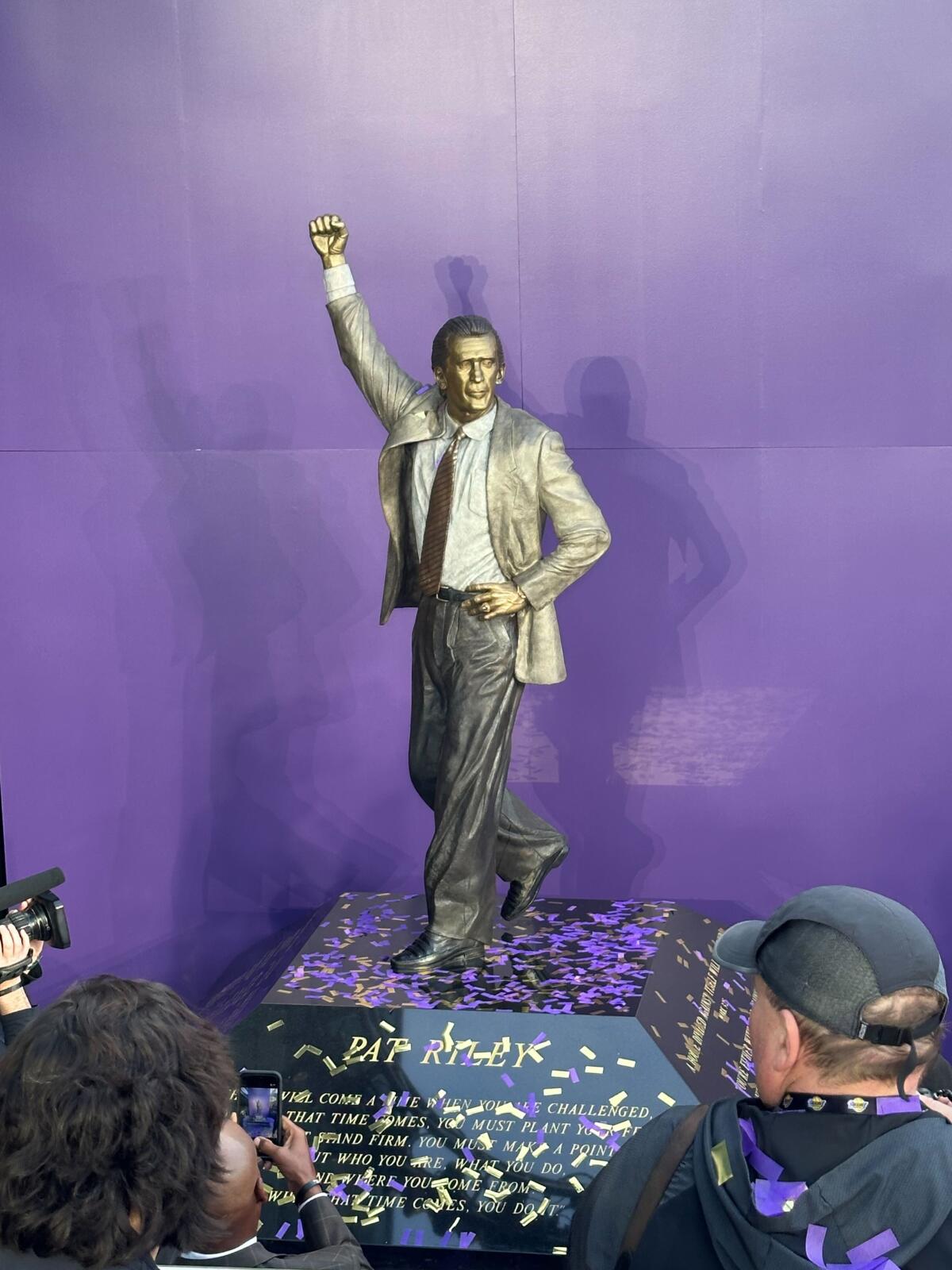
A statue of former Lakers coach Pat Riley is unveiled outside Crypto.com Arena.
(Greg Beacham / Associated Press)
After Pat Riley had his statue unveiled Sunday on Star Plaza outside of Crypto.com Arena, he took time to praise Redick.
Riley led the Lakers to four NBA championships in the ‘80s, his coaching style a big part of the Showtime era. He likes what he sees out of Redick and the Lakers.
“I love JJ. I really do,” Riley said. “I competed against him. My teams competed against him, you know, in various teams that he played with. He’s a fiery guy. He could shoot the hell out of the ball. He was tough as nails, you know. I don’t know. Sometimes I look back and I remember myself at that time and I looked at JJ and I think they picked the right person [for the Lakers job]. There’s just a quality about him, I think, that goes above and beyond.
“And they have a hell of a team for him right here, right now with Doncic and Reaves and obviously with LeBron. And so I think Rob [Pelinka, president of basketball operations] will continue with the new ownership to build that team and to complement those players. But they have a great opportunity and I think JJ will be a great coach for it.”
On tap
Tuesday vs. Orlando (30-26), 7:30 p.m.
The Magic are a deep and versatile team, with six players who score in double figures. Paolo Banchero leads them in scoring (21.5) and rebounds (8.4) and is second in assists (5.0). He’s shooting 45% from the field. Desmond Bane is one of three Orlando players averaging more than 20 points at 20.1, making 48.3% of his shots and 38.8% of his threes. He just dropped 36 in a win over the Clippers on the second night of a back-to-back.
Thursday at Phoenix (33-25), 7 p.m. PST
Injuries are starting to take a toll on the Suns. Dillon Brooks has a broken left hand and reportedly is out four to six weeks. This comes on the heels of All-Star Devin Booker missing at least one week because of a right hip strain and fellow guards Grayson Allen (ankle/knee) and Jordan Goodwin (calf) also dealing with injuries.
Saturday at Golden State (30-27), 5:30 p.m.
The Warriors don’t have All-Star guard Stephen Curry (knee) and forward Jimmy Butler (torn ACL), leaving them without a lot of offensive firepower. The Warriors have been leaning on guard Brandin Podziemski to keep them afloat. He is averaging 12.1 points per game.
Sunday vs. Sacramento (12-46), 6:30 p.m.
The Kings have the worst record in the NBA. They have three players with season-ending surgeries — De’Andre Hunter (eye), Domantas Sabonis (knee) and Zach LaVine (hand).
Status report
Jaxson Hayes: right ankle injury
Redick said Hayes, who left Sunday’s game, got an MRI on Monday that showed his ankle had “a little bruise.” Hayes, the backup center, is day to day, Redick said. The Lakers listed Hayes as doubtful for Tuesday night’s game against the Magic at Crypto.com Arena.
“We’ll see how he feels tomorrow morning,” Redick said..
Favorite thing I ate this week

Risotto col codeghin e la peara from Tre Risotti Trattoria.
(Thuc Nhi Nguyen / Los Angeles Times)
Ciao! It’s Thuc Nhi checking in a final time from the Olympics. My final dinner of the Games had to honor northern Italy, so instead of just pizza or pasta, I went searching specifically for risotto. In Verona, before the closing ceremony, I asked the server at Tre Risotti Trattoria what the most popular risotto was and she suggested the risotto col codeghin e la peara (risotto with sausage and pepper sauce). She didn’t miss. The salty, creamy bite with the crunchy crouton around the plate was the ideal way to end my third Olympics Games. Arrivederci!
In case you missed it
With Pat Riley watching, Lakers routed by Celtics in rivalry game
Plaschke: During statue unveiling, Pat Riley reminds the disjointed Lakers of keys to winning
Statue outside Lakers’ arena is another first for Pat Riley, the consummate coach
Luka Doncic and Lakers hold off Clippers after Kawhi Leonard exits late
Lon Rosen to take over business operations for the Lakers
Until next time…
As always, pass along your thoughts to me at thucnhi.nguyen@latimes.com, and please consider subscribing if you like our work!