grammy museum

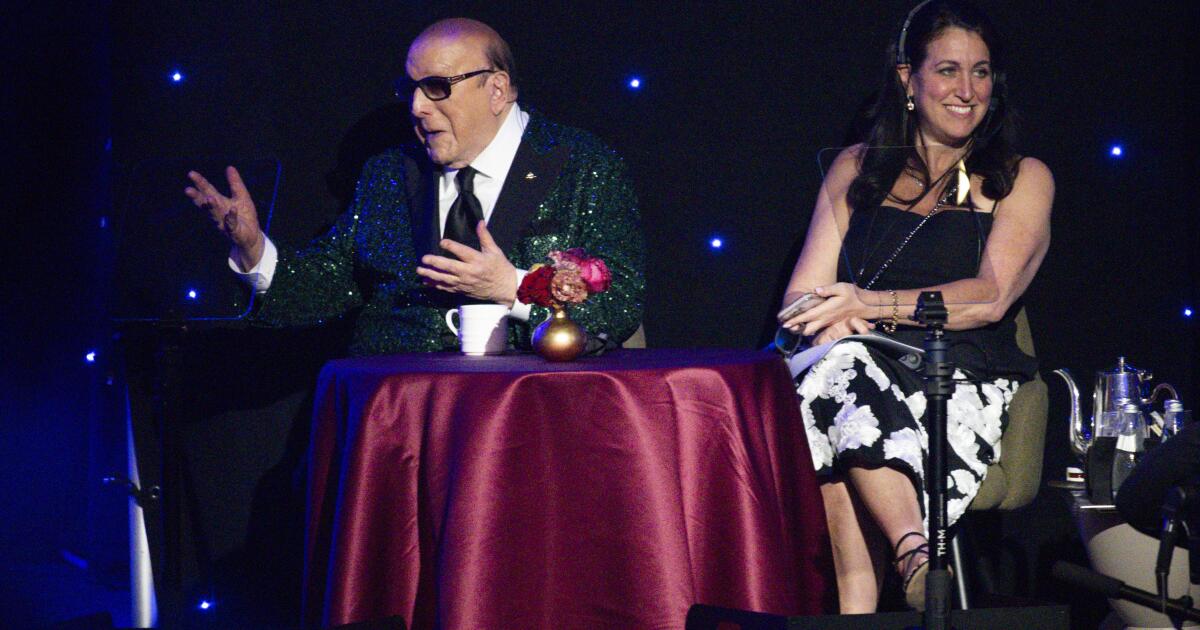
Clive Davis helped build the Grammy Museum in downtown Los Angeles

Walk into the Grammy Museum in downtown L.A., and you’ll see Clive Davis’ legacy everywhere.

The museum’s intimate performance space is named for the late record executive, and his visage greets guests at the front door. (Davis was the first million-dollar donor to the nascent Recording Academy archive and exhibition space.) His sprawling roster of acts — Bruce Springsteen, Miles Davis, Whitney Houston, Alicia Keys, Earth, Wind & Fire — defined an entire art form and business model as preserved in the Grammy Museum. Davis’ pre-Grammy gala was the most coveted invitation in music every awards season.

Davis’ death at 94 is “devastating,” said Michael Sticka, chief executive and president of the Grammy Museum. “Clive was always a north star of music and talent and artistry. We’re all lucky to have his legacy to look up to.”

Davis’ death marks the end of perhaps the most important and enduring career in the record industry. Sticka spoke to The Times about Davis’ remarkable longevity, creative vision and how a career like his will likely never be possible again.

Clive was a giant of the record business. How did his career shape the modern record industry?

His career was iconic. He really had a unique ability to not just bring an artist to their fullest potential artistically, but commercially. From attending Monterey Pop and first seeing Janis Joplin to Whitney Houston and Alicia Keys, I don’t think anybody had that ear in them the way that he did.

With Clive, what you got was not just hearing commercial viability, but an understanding of what was going on in the zeitgeist. That’s what propelled his career and legacy beyond most record executives.

His name’s on the building at Grammy Museum’s theater. What did he mean to the institution — not just for fundraising but as a living connection to music history?

He didn’t just donate to the museum. He donated his time, his historical knowledge of music, his firsthand perspective. He always kept tabs on what was happening in music. I always say the Clive Davis Theater is the toughest ticket in town for its intimacy and the level of programming we do. But he did an annual program at the museum where people could come hear stories directly from him. Once he decided he was in, he was all in.

His gala was the place to be every Grammy season too.

I don’t think anybody could gather a roomful of luminaries like that from entertainment, tech and politics in the way that Clive did. We were lucky to be a part of that. Even with the stature he had, he was still a physical presence there, he was approachable. He was always looked at as this living legend, but his legacy was continuously being built.

That’s true over the arc of his career, which saw him lead Columbia, Arista, J Records and more. He had a lot of resurrections as well as successes.

He had this ability to resurrect. Look at Santana and “Supernatural,” he was a producer on that album that was inducted into the Grammy Hall of Fame just last year. So many of us would just give up, but he just had this resolve to continue, and thank God he did.

The record industry is so different now than when he began his career. Artists find audiences on social media rather than being discovered by label executives. Is a career like his — a famous executive driven by their own taste and individual savvy — even possible today?

That’s true, artists break on social media before they’re even on record executives’ radars now. I don’t know if we’ll see that kind of career arc again. Clive had a rare combination of gravitas and being recognized so publicly. The man and his legacy are not going to be replicated.

Beyond the name on the theater, how do you hope the Grammy Museum will honor him with its programming in time to come?

I don’t know yet. We weren’t really prepared for this. We’re gonna have to sit down and think how to pay tribute to such a legacy. I think that the impact the Clive Davis Theater has, bringing in 120 artists a year — I couldn’t think of a more apropos name on the door.
Source link

Koe Wetzel on toxic relationships and his favorite pretzel

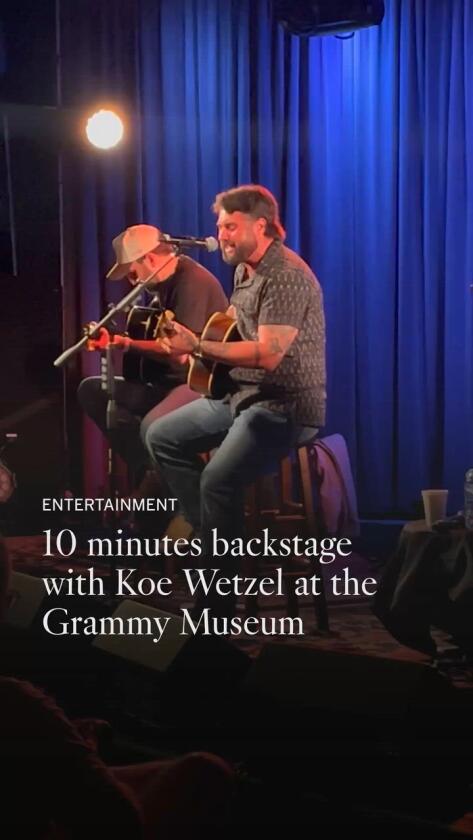
Koe Wetzel brought his brawny yet soulful new country-rock album, “The Night Champion,” to the Grammy Museum in Los Angeles on Monday night. It’s the 33-year-old Texas native’s follow-up to 2024’s hit “9 Lives,” which spun off a chart-topping single in “High Road”; it’s also his first LP since the birth last year of his daughter, Woods. After the show — in which he was accompanied by his producer Gabe Simon, who’s also known for his work with Noah Kahan — I spoke with Wetzel about the album’s inspirations and about the food-court staple that rhymes with his last name.

My favorite song, you didn’t play it: “I’ll Lock Up.” That’s a song where your vocal is mournful, but you’re resigned — it’s an emotionally sophisticated song. How’d you write it?
We kind of came into it to be as realistic as possible. When people go through stuff like that — through breakups, whatever it is — no matter what it is, I’m probably still gonna take you back at the end of the day. And I think kind of being in that situation, kind of going back on past relationships, we just took a lot of past experiences from different folks and made it what it was. The scornful sadness from it, that might have came from a couple bottles of wine that I had before I got in the vocal booth.

  • Share via

You write about toxic relationships, but now you appear to be in a stable relationship with the mother of your child. Have you lost the juice?
I don’t think so — I think it’s always gonna be there. Those are the easiest songs to write. It’s really hard for me to write a love song. And who knows, maybe this is the turning of the tide. I’ve got almost 12 years of toxic relationship songs, so maybe these next 10 years is the love, happy-go-lucky songs.

You’ve talked about cleaning up your act a little bit: drinking less, eating better, working out. Was there an animating head-on-the-floor moment?
I think whenever I found out that I was gonna be a dad, that was obviously a moment for me. I’d started cleaning up before she got here. And then when she got here, it was like, “All right, you got to get your s— together.” Not to say that I’m completely reformed — I still have my nights.

Back in your dark days, best bar in L.A.?
I never really went out a whole lot.

Drinking in the hotel room, huh? Dark.
That’s where all the songs come from.

You have two bar-restaurants, Koe Wetzel’s Riot Room — one in Fort Worth, one in Houston. I want to have a salad tonight. Should I have the blackened chicken Caesar or the grilled chicken Cobb?
Grilled chicken Cobb, for sure.

OK, great.
Do we serve those at the restaurant?

Biggest mess you’ve ever gotten into as a restaurateur?
I don’t know, honestly. I’m more on the party side of things, so they don’t ask me about, “Hey, we’re gonna make this tweak to the menu — what do you think about it?” It’s more like, “What are the bottle girls wearing tonight?”

One more food-service-related question: You’re at the mall, you want a pretzel. Auntie Anne’s or Wetzel’s Pretzels?
Wetzel’s Pretzels all day, man. Go get you some — I get a little royalty there.

According to Mediabase, your song “High Road” was the most-played song on country radio in 2025. In what month did you start changing the channel when it came on?
I started changing it before it even came out. We finally got the new record out, and I’m sick and tired of it, because I’ve been listening to it for a year and a half now. But that’s pretty much how it was with “High Road.” So grateful for all the success — it’s really cool that people have jived with it and listened to it the way they have. But whenever I hear it now, I kind of turn a deaf ear to it, if that’s possible.

Your friend Morgan Wallen had a viral moment recently where he tipped over a piano. What instrument have you smashed?
Quite a few. Depending how much Jack Daniel’s I drank onstage, I was definitely smashing the bottle — glass everywhere. I destroyed the drums. There was actually a shirt we had that says “Koe Destroys Everything.” My bass player and guitar players, they know that whenever I get that stare, it’s kind of like: Protect your s—, or I’m gonna come smash it.

By my count, you say “f—” nine times on this record. Is that your favorite four-letter word?
It’s a pretty good one, man. Only nine times on the record?

Seems low to you.
I’m a big Tarantino and Scorsese fan, so I don’t know. I think it’s just such a fun word.

Last one: Your current radio single is called “Hurts Like You.” I’m gonna give you three songs that have “hurt” in the title, and you have to pick your favorite.
OK.

“Hurt” by Nine Inch Nails or Johnny Cash. “Hurts So Good” by John Mellencamp. “Everybody Hurts” by R.E.M.
“Hurt,” Johnny Cash.

I’m sorry, that’s not right.
It’s not? What is it? Is there a right answer?

Your favorite song is John Coug, “Hurts So Good.”
OK. [Sings] “Hurts so good…” Is that my favorite song?

Yeah.
All right. Let’s go, Coug.


Source link