goat

‘Goat’ review: Young viewers deserve more-inspiring sports movies

We’ve seen animated animals belt out tunes in the “Sing” movies. We’ve learned about “The Secret Life of Pets” (twice). And we’ve visited them in “Zootopia” (also on two occasions). Now we get to see them play basketball. “Goat,” produced by Golden State Warriors prodigy Stephen Curry, is yet another underdog story about following your dreams wrapped in a by-the-numbers sports movie. It feels utterly unoriginal on multiple fronts.

Taking the popular acronym GOAT (Greatest of All Time) to its most literal form, the first feature by TV animation veteran Tyree Dillihay — from a screenplay by Aaron Buchsbaum and Teddy Riley — follows an anthropomorphic young goat who aspires to become the GOAT.

A lifelong fan of roarball (this film’s version of basketball), Will, who is voiced by Caleb McLaughlin, dreams of playing for his hometown team, Vineland. His admiration for the sport is embodied by Jett Fillmore (Gabrielle Union), Vineland’s most accomplished player, who carries the entire team on her back — she wants all the glory of victory for herself.

The world of “Goat” is divided between “smalls” and “bigs” (unlike “Zootopia” where the separation is between predators and prey). Will considers himself a “medium” but in the eyes of professional roarball players, he’s tiny. Still, after going viral for bravely challenging Mane Attraction (Aaron Pierre), one of the sport’s major stars who is double his size, Will lands a chance to play in the big leagues.

To the credit of the writers, roarball is a rather inclusive sport. There are no gendered teams, nor any discrimination based on species. Will might be the first “small” to make it big, but that stems from the public’s prejudice, not from rules that ban animals like him from playing.

Desperate for instant relevancy (like plenty of animated features these days), “Goat” is steeped in vapid internet references, from crypto to online memes. Sports fans, however, will find specific allusions, like contentious press conferences and even the kiss cam. Rowdy and kinetic from start to finish, “Goat” does in fact reflect the fast-paced dynamism of basketball, but it soon reveals itself a sugar rush without much substance.

Once Will joins the team, a “never meet your heroes” lesson ensues, since Jett feels like he’s usurping her position. Animosity on her part creates tension until Will opens up about his personal reason for playing. The emotions are not complex here, but they are heartfelt, thanks to how McLaughlin and Union conjure up larger-than-life personalities via their voice performances.

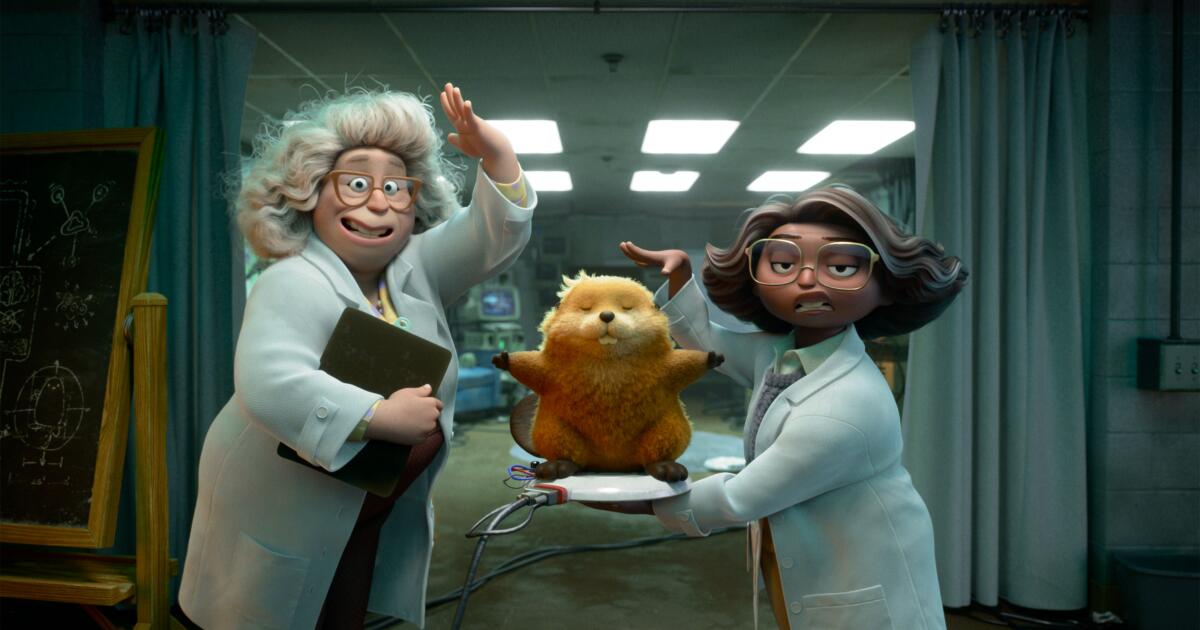
Meanwhile, Will’s other teammates — a rhinoceros, a giraffe (played by Curry himself), an ostrich and a Komodo dragon — don’t feel distinct enough from the ensemble casts of other animated projects like “Sing.” Each member of the assortment has their quirks, some of which occasionally yield a chuckle: Archie (David Harbour), the rhino, has two comically violent kid daughters.

There’s no denying “Goat” has a vibrant aesthetic, but that alone can’t overwrite its defects. Back in 2018, Sony Pictures Animation dazzled the industry when “Spider-Man: Into the Spider-Verse” introduced an approach that mixed 3D CGI with traditional hand-drawn animation. This combination of techniques doesn’t make “Goat” particularly unique anymore.

What’s most impressive, visually, about “Goat” is the way the natural world blends with the urban settings. Vineland, Will’s neighborhood, is indeed covered in vines and yet the vegetation appears organically integrated into the infrastructure. Each game takes place in a different ecosystem. The finale, for example, unfolds amid cracked volcanic rocks and lava. There’s visible handcraft and care in creating these backdrops for the action.

A mixed bag of eye-catching imagery and formulaic writing, “Goat” disappoints because it follows every expected path toward a triumphant conclusion. Its premise could have offered up a kid-friendly reading on failure that doesn’t simplify a way out of adversity. If talking animals will continue to be used as surrogates for human experiences — especially for young viewers — some nuance would be appreciated.

‘Goat’

Rated: PG, for some rude humor and brief mild language

Running time: 1 hour, 40 minutes

Playing: Opens Friday in wide release

Source link

Hilary Knight’s hockey achievements go beyond gold medals and titles

If Hilary Knight is the GOAT of women’s ice hockey, then Caroline Harvey is the kid.

That isn’t just a reference to her age, 23, which makes her the seventh-youngest player on the U.S. Olympic team. The term is also used for baby goats. And with Knight, the oldest player on the U.S. team, expected to retire from Olympic competition after the Milan Cortina Games, that makes Harvey the GOAT in waiting.

“Hilary is a great role model,” Harvey said. “She did blaze that trail. It’s been exciting to see what she did, the legacy she left.”

Like the 10 world championship gold medals, most by a hockey player of either gender; the soon-to-be five Olympic appearances, most by any American hockey player; the scoring titles and MVP awards. But the real legacy she’ll leave will have little to do with any of that.

In 2019, while at the height of her career, Knight risked everything when she joined more than 200 other players in boycotting the existing women’s hockey leagues to form the Professional Women’s Hockey Players Assn. Four years later that led to the creation of the well-funded Professional Women’s Hockey League, with eight teams playing in the U.S. and Canada.

Knight said she took inspiration for that campaign from the 1999 Women’s World Cup soccer team of Mia Hamm, Julie Foudy and Brandi Chastain, which not only won the title but soon after began the decades-long fight with the U.S. Soccer Federation that eventually ended with the women getting the same pay and benefits as the men’s team.

“We credit the ‘99ers to sort of helping us with our vision and creating more equitable space,” she said. “We’re far from there but we’re taking great steps in that direction.”

In fact, women’s hockey has never been better, a popularity both Knight and Harvey hope to build on in the Olympic tournament, which begins Thursday with the U.S. facing Czechia.

“Visibility is really important; continuing to get those eyes,” said Knight, a tireless promoter of the game. “We’re going to have some new and unique viewership. With the Olympics in itself [viewers] might accidentally watch hockey and be like ‘I love this sport.’

“Just having more programming elevates the game on the global stage. And that’s really exciting.”

U.S. forward Hilary Knight skates to the bench after scoring against Canada in November 2023.

U.S. forward Hilary Knight skates to the bench after scoring against Canada in November 2023.

(Ross D. Franklin / Associated Press)

The game Knight, 36, is championing is really one she built, especially in the U.S. A two-time NCAA champion at Wisconsin, she’ll be going for her fifth Olympic medal — and second gold — in Milan. Yet she insists the experience never gets old.

“Every Olympics feels like my first Olympics,” she said. “Each is so unique. You’re in a different country, a different culture, just so much fun to be able to explore. The Olympics are so special, whether it’s your first or your fifth.”

These Games are likely to feel a little different, though, since they’ll end with her passing the baton to Harvey, who followed Knight to Wisconsin. The two women have more in common than just their alma mater, though.

Both were the youngest players on the team when they made their Olympic debuts, Knight as a high-scoring forward in 2010 and Harvey as a physical, offensive-minded defenseman in 2022. Both have won multiple world championships and both began their careers playing on boys teams. As children, they both told relatives they would someday play in the Olympics — a prediction that was particularly bold for Knight since women’s hockey wasn’t even an Olympic sport then.

When Harvey joined the national team ahead of the 2021 world championships, Knight shared some advice.

“She said something to the effect of ‘it’s the same game, no matter what level you’re at. Trust your instincts, play natural, play free,’” Harvey said. “That just really stuck with me.

U.S. defenseman Caroline Harvey shoots during a Rivalry Series game against Canada in November.

U.S. defenseman Caroline Harvey shoots during a Rivalry Series game against Canada in November.

(Jason Miller / Getty Images)

“Hopefully at some point [I] grow into that leadership role,” she continued. “I’ve had some years now and that past Olympics, it was more of a being a sponge. I’m always trying to learn something new every day from the veterans.”

One thing she’s learned recently is how to beat Canada, which could come in handy in Milan since the U.S. will face its northern neighbors in the final game of group play, and likely a second time in the knockout rounds.

Canada has won five of the last six women’s Olympic tournaments, beating the U.S. in four of the those finals, including the most recent one in 2022. But the U.S. swept Canada in the pre-Olympic Rivalry Series, winning the four games by a combined 24-7. Knight and Abbey Murphy led the tournament in scoring with five goals each.

“When the puck drops, your heart is beating out of your chest,” Knight said of playing Canada. “You’re like ‘am I human? This is insane. This is awesome.’”

Still, when Knight finally does hang up her skates for the final time, those won’t necessarily be the memories she holds closest from her Olympic career.

“I get to do cool things with cool people on a daily basis,” she said. “What I’ve been able to accomplish in my career is incredible. And I’ve obviously played with amazing women and I’m so grateful for every opportunity that I’ve had.

“I’m just at a place where I want to embrace these lasting memories and moments with teammates and friends and family, all those people that go into this journey. That’s what I’m looking forward to.”

After that, the GOAT will give way to the kid.

Source link