Review: Philip Glass’ ‘Akhnaten’ is back at L.A. Opera, this time with a magnificent John Holiday
By my count, Philip Glass has written 28 operas, the same number as Verdi. The count is iffy because Glass pushes the boundaries between what we tend to call opera and the fuzzier idea of music theater. His first, “Einstein on the Beach” in 1976 — a collaboration between the composer and the late, innovative theater maker Robert Wilson — is a non-narrative effusion of imagery, movement, music and text, each a brilliantly independent entity that somehow excites a hard-to-pin-down purpose.
His latest (and probably his last, Glass turns 90 this year) is “Circus Days and Nights” — a touching and thrilling opera for a circus and staged at a circus in Mälmo, Sweden, in 2021 — caps a wondrous 45 years of operatic advancement. You would have to go back to Handel’s 42 operas, Mozart’s 22 or Verdi’s oeuvre for operatic equivalence.
Glass’ subject matter varies widely in epochs and ethoses, from ancient Egypt to Walt Disney’s Hollywood. Taken as a whole, these 28 operas reveal how we got to be who we are historically, artistically, spiritually, politically and fancifully, often including more than one of those categories, as in his third opera, “Akhnaten,” which Los Angeles Opera has now remounted at the Dorothy Chandler Pavilion. The instantly recognizable musical style has remained, over the years, consistently abstract and refreshing. It doesn’t tell you how to think, how to feel, even how to understand. It simply grabs your attention; you do the interpreting.
Still, America knows little of Glass’ operatic enormity. The early “portrait” operas — “Einstein,” “Satyagraha” (about Gandhi) and “Akhnaten” (the 14th century BC Egyptian pharaoh) — appear in repertory here and there (meaning mostly in Europe) as do a trio of operas based on Jean Cocteau films. The rest remain little mounted, while several but not all have been recorded. The Metropolitan Opera, for instance, commissioned “The Voyage” in 1992 to celebrate the 500th anniversary of Columbus’ arrival in the Americas, but the epic opera is nowhere to be found in our semisesquicentennial year. It is sadly no longer even thinkable that “Appomattox,” Glass’ revelatory reminder of an America that once honored goodwill negotiation over political self-interest, return to the Kennedy Center, where its final version had its premiere 11 years ago.
L.A. Opera has been better than most American companies in its attention to Glass. It has excellently presented the three portrait operas on its main stage, beginning with “Einstein” in the final and most brilliant revival of the original Wilson staging. The “Satyagraha” and “Akhnaten” revivals have been the designed-to-dazzle inventions of quirky director Phelim McDermott, a co-founder of Impossible, an eccentric British theater company. When new in the last decade, they felt the most arresting productions of these operas since Achim Freyer’s in Stuttgart, Germany, in the early 1980s. Almost every performance at the Dorothy Chandler Pavilion has sold out.

John Holiday as the titular ruler in Philip Glass’ “Akhnaten” at the Dorothy Chandler Pavilion.
(Ariana Drehsler / For The Times)
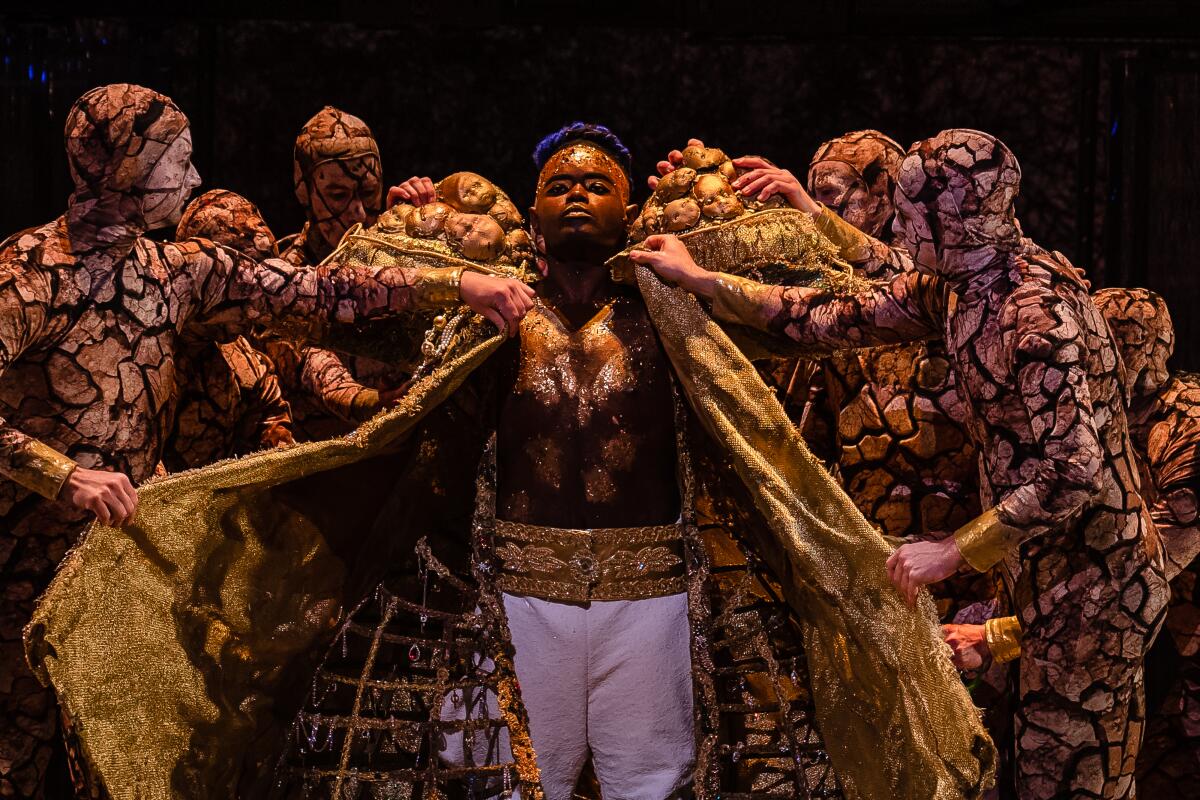
McDermott’s “Akhnaten” got the most attention thanks to breathtaking jugglers and lavish costumes, along with a touch of full-frontal novelty as Akhnaten gets clothed in his kitschy, glittery getup for his inauguration. Glass had chosen the pharaoh because he is thought to have been the first monotheistic ruler.
Akhnaten is revealed in episodes of his life that are not fleshed out but presented as ritual, including the ravishing love duet with his wife, Nefertiti. The revolutionary pharoah builds a great city and reduces spiritual chaos by focusing on a single-minded form of worship. He looks androgenous in portraits, which led Glass to create the role for countertenor.
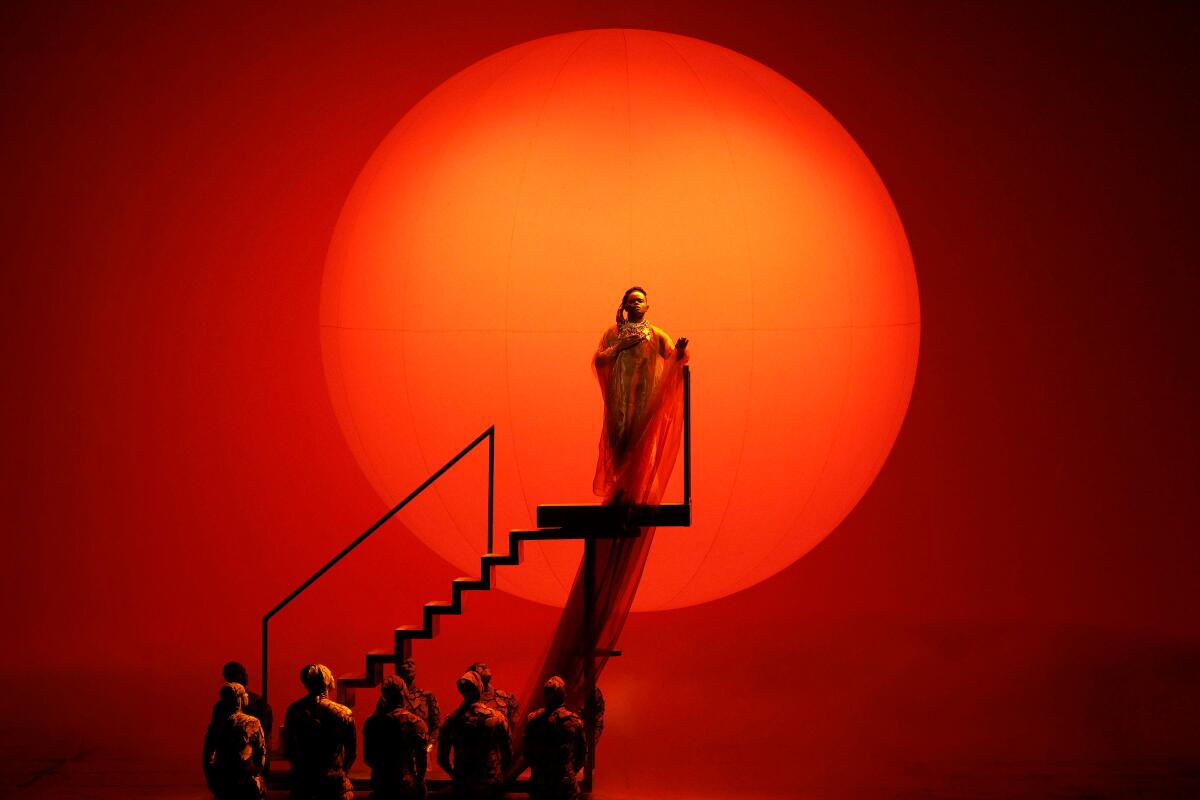
The sung texts are in ancient languages, and there are no projected song titles. Instead, a narrator gives a somewhat notion of what’s what in the language of the audience, as is Akhnaten’s great aria, a hymn to Aten (god of the sun).
Ultimately, the pharaoh’s prescient spiritual optimism comes in conflict with the all-powerful establishment priests, who kill Akhnaten and Nefertiti. The opera ends with Akhnaten’s son, presumably Tutankhamun, restoring polytheism, and then, once the staging jumps millennia into the future, it’s rediscovered by modern-day tourists. The currency couldn’t be missed Saturday, the Shia cleric and Iran’s supreme leader Ali Khamenei having just been assassinated along with his wife at the start of America’s and Israel’s Iran war.

Sun-Ly Pierce as Nefertiti and John Holiday as Akhnaten in Philip Glass’ “Akhnaten” at the Dorothy Chandler Pavilion.
(Ariana Drehsler / For The Times)
In the opera, it so happens, the ghosts of Akhnaten, his wife and mother, have the last word in a glorious trio.
When first performed at L.A. Opera a decade ago, the lavish production, co-produced with English National Opera, helped recover a neglected opera. In the meantime, “Akhnaten” has gone practically mainstream. The Metropolitan Opera, which also mounted McDermott’s production, released it on CD and DVD, winning a Grammy for best opera recording.
Since then, the choreographer Lucinda Childs, veteran of “Einstein on the Beach,” has staged a stunningly chic “Akhnaten” in Nice, France, that is available on YouTube. Last year, director Barrie Kosky created a sensation with his staging at Komische Oper Berlin, which starred American countertenor John Holiday.
Holiday happens to be the Akhnaten in the L.A. Opera revival, and he is magnificent. McDermott had built his production around the gracefully emotive Anthony Roth Costanzo, slight and luminous in voice and build and game for nudity. If Costanzo’s disarming enthusiasm for the role has been significant in mainstreaming “Akhnaten,” Holiday, who is a very different presence, may be the next step.
Although he can be a popularly gregarious crossover performer, here he suggests a ruler of profound, unflappable dignity, rather than vulnerability. His hymn to Aten is an exercise in majesty, an ode not just to the sun but to the expanses in which our solar system circulates.
In general, the singers class up the production. Sun-Ly Pierce as Nefertiti and So Young Park as Queen Tye add allure. The large cast of smaller roles and chorus is excellent. Zachary James returns as both Amenhotep III, Akhnaten’s father, and the engaging narrator who occasionally threatens to get carried away. McDermott had perfectly employed James as the droll animatronic Disneyland Lincoln in his animation-friendly, slightly goofy production of “Perfect American” in Madrid, where the opera premiered. Here McDermott’s inspired staging demonstrated that Glass’ forgiving personal portrait of Walt Disney makes it the quintessential Hollywood opera that no one dares bring to squeamish Hollywood.

Zachary James as Amenhotep III in Philip Glass’ “Akhnaten” at the Dorothy Chandler Pavilion.
(Ariana Drehsler / For The Times)
Hollywood, however, is hardly squeamish when it comes to synchronized jugglers. For McDermott, they suggest somber ritual and were, in fact, known in Akhnaten’s Egypt. For the audience, they are a thrill a minute. For Glass, they may take on deeper meaning now that the circus is where he landed 26 operas later.
As for Finnish conductor Dalia Stasevska, making her L.A. opera debut, she keenly keeps score and bounding balls together with cinematic flair. Glass removed violins from the orchestra to achieve a dark, primordial orchestral sound along with pounding percussion. Stasevska finds light, color and action. She conducts for the moment. Picturesque wind instruments suddenly burst forth as if a flock of birds were flying over the pyramids. Solo brass can sound momentous. The percussion pounds like nobody’s business, opening the score up to all the implied emotion and glitter on an over-stuffed stage.
Childs’ exalted use of dance and Kosky’s dazzling theatrical imagination may have moved us into a sleeker, more sophisticated and paradisal Glassian realm, but the sheer passion McDermott and Stasevska bring continues its own attraction.
In the meantime, McDermott has worked with Glass on a theatrical show, “The Tao of Glass,” that has been seen in New York and will run throughout much of the summer in London. In a better world of Glass, it would be running alongside “Akhnaten” at the Ahmanson. But the Labèque sisters will be at Walt Disney Concert Hall at the end of the month with a two-piano program based on Glass’ operatic Cocteau trilogy. Also check out L.A. Opera’s several excellent podcasts on “Ahkhnaten” — the company has quietly become a leader in the medium.
‘Akhnaten’
Where: Dorothy Chandler Pavilion, 135 Grand Ave., L.A.
When: Through March 22
Tickets: $33.50-$415
Running time: About 3 hours, 40 minutes, with 2 intermissions.
Info: (213) 972-8001, laopera.org