Weekly insights and analysis on the latest developments in military technology, strategy, and foreign policy.
Boeing Australia has teamed up with Rheinmetall, the largest arms manufacturer in Germany, to offer the MQ-28 Ghost Bat drone to the German military. The Ghost Bat collaborative combat aircraft (CCA) is the latest contender for a German requirement, and is likely to face competition from the XQ-58A Valkyrie drone and potentially the homegrown Airbus Wingman.
In a statement today, Rheinmetall said that the plan was to pitch the MQ-28 as “a mature solution for the Bundeswehr’s procurement of collaborative combat aircraft (CCA) into Germany by 2029.” Describing the Ghost Bat as “a world-leading, proven CCA,” Rheinmetall noted that the drone “can be modified to meet Germany’s sovereign requirements” — as we have discussed before, the highly modular nature of the MQ-28 is a key part of its design.
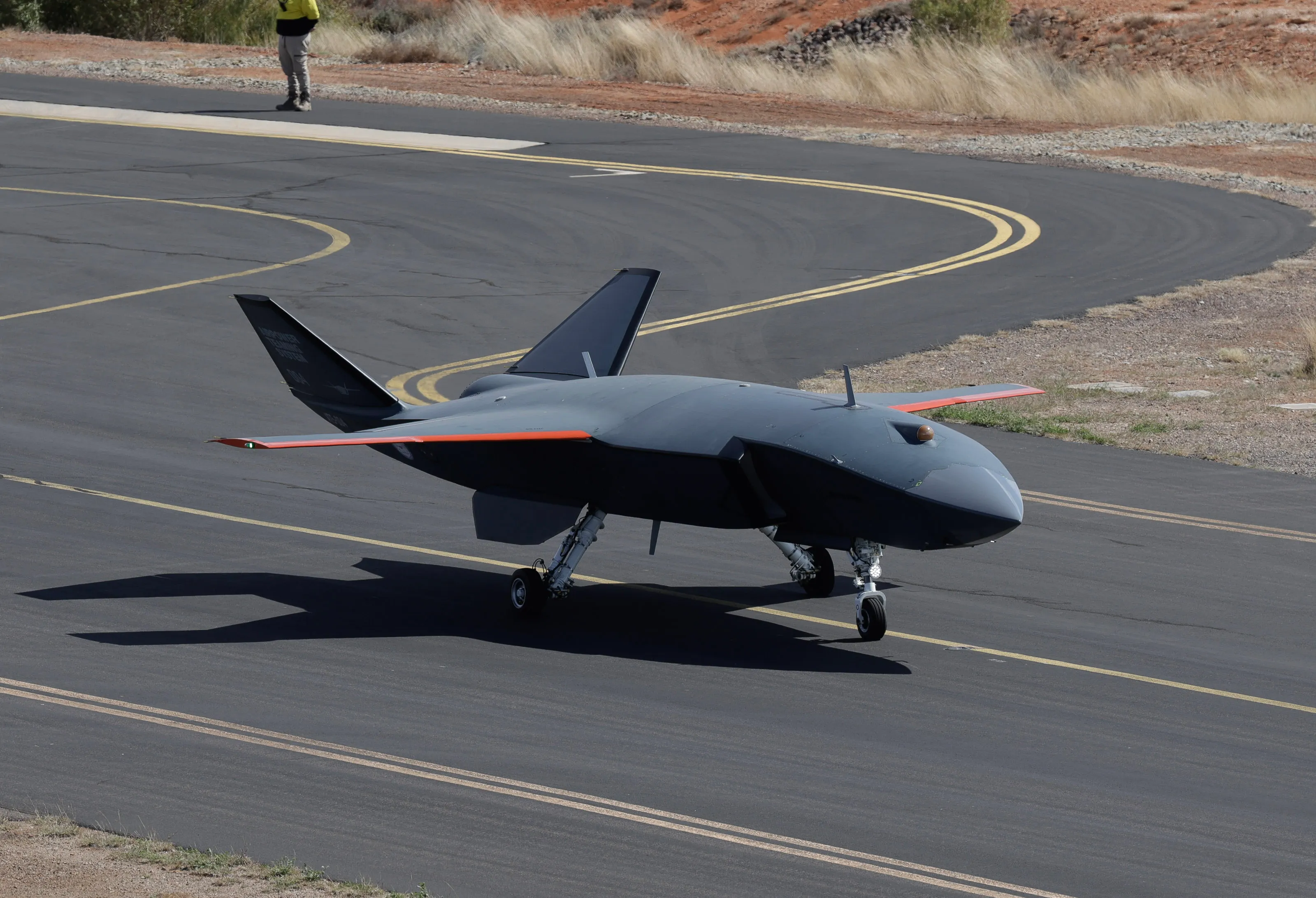
An MQ-28A Ghost Bat taxis prior to flight at Woomera, South Australia, in September 2025. Australian Department of Defense
Should Germany select the MQ-28 for its CCA requirement, Rheinmetall would serve as the system manager for the aircraft in Germany, overseeing system integration into the country’s existing and future command and weapon systems, and adaptation to national requirements. The company would also provide operational, maintenance, and logistical support. A major benefit of the platform is the fact that much of the development has already been paid for by Australia, and the resulting drone is more mature than anything else in Europe.
“With Boeing Defense Australia as a partner, we are laying the groundwork to optimally tailor the MQ-28 to the Bundeswehr’s requirements,” said Armin Papperger, CEO of Rheinmetall AG. “As a system integrator, we ensure that integration, operation, and further development come from a single source while simultaneously strengthening industrial value creation in the form of an industrial hub in Germany and Europe. We see revenue potential for Rheinmetall in the range of three-digit millions of euros.”
Australia has also contracted for the development of the enhanced Block 3 MQ-28, which will include an internal weapons bay. This will be scaled to accommodate one AMRAAM or two GBU-39/B Small Diameter Bombs (SDB) or equivalents, in terms of size. A pair of SDB IIs, also known as the GBU-53/B StormBreaker glide bomb, would be another option.
An AIM-120 AMRAAM loaded on an MQ-28A Ghost Bat. Australian Department of Defense
The next big milestones for the Royal Australian Air Force should come in 2028, with the planned service introduction of the Block 2 aircraft and the initial production of the Block 3 aircraft.
Interestingly, the Rheinmetall press release describes the MQ-28 being “ready to deliver air-to-ground capability to Germany by 2029.” It’s unclear at this point if this reflects Berlin’s requirement for an exclusive air-to-ground CCA platform, or if an air-to-air capability will be added at a later point.
A quartet of MQ-28s, the two in the middle having IRST sensors on top of their noses. Boeing
For Block 3, Boeing is working on three or four alternative sensor payloads, too. Integration of these would be facilitated by the fact that the entire nose can be swapped out to accommodate different payloads.
Speaking earlier this year to journalists, including from TWZ, Glen Ferguson, MQ-28 program director at Boeing, said he was unable to talk about any potential future customers other than Japan, but noted that the company was pursuing sales elsewhere in the Indo-Pacific region, specifically.
Meanwhile, in 2022, the Pentagon confirmed that it had acquired at least one MQ-28 to be used to support the U.S. Air Force’s advanced uncrewed aircraft and autonomy efforts. Meanwhile, the U.S. Navy has deployed a test and evaluation squadron to Australia to work on the aircraft, and an MQ-28 has also been operating out of Naval Air Station Point Mugu, California.
As we have discussed in the past, the MQ-28 seems uniquely suited for a cooperative production and operation program across multiple allied nations, and it’s perhaps not a coincidence that the Bundeswehr is increasingly looking at future operations in the Indo-Pacific region, something that has seen recent deployments of Luftwaffe Eurofighters, for example.
A Luftwaffe Eurofighter flies alongside an F/A-18F from the Royal Australian Air Force over Darwin, Australia, during the Pitch Black 2022 exercise. Bundeswehr/Christian Timmig
The Luftwaffe has long been seen as a candidate for a CCA-type drone. In the medium term, this would involve an uncrewed companion to work alongside the Eurofighter, which would be especially relevant for its forthcoming Eurofighter EK electronic warfare jets.
A rendering of a Typhoon EK for the German Air Force. Airbus
A drone of this kind could also be harnessed by other German Eurofighters, which undertake a range of air defense and air-to-ground missions, as well as the F-35A stealth fighters it also has on order. The F-35 is designed very much with CCAs in mind, with the combination of the stealth jet and complementary drones being a key part of the planned future U.S. Air Force force posture.
A CCA could be even more important for Germany depending on the fate of the pan-European Future Combat Air System (FCAS) program, at the heart of which will be the crewed New Generation Fighter (NGF). Both are expected to be in service by 2035, although that target is looking increasingly unlikely.
Concept artwork of the NGF fighter that is the centerpiece of the pan-European FCAS. Dassault Aviation
In fact, there is a good chance that rifts between France and Germany on the course that FCAS should take, especially when it comes to workshare, could see Germany walk away from the program entirely.
That would leave a significant gap in combat air ‘mass’ that a CCA could help mitigate.
With Germany in the market for a drone in this class, another partnership, announced last year, sees Airbus Defense and Space team up with Kratos Defense and Security Solutions to provide the stealthy XQ-58A to the German Luftwaffe.
Kratos says the new version of the Valkyrie would be “tuned” for the European mission, suggesting that it will feature specific modifications for operators in the region. New versions of the XQ-58 will be capable of runway launch, and the platform can be scaled to a degree, too.
A U.S. Marine Corps XQ-58A Valkyrie conducts a test flight with a U.S. Air Force F-16. U.S. Air Force photo
The same would likely apply to the MQ-28, which Rheinmetall could potentially offer to a range of other European nations, alongside Germany, potentially filling an emerging niche for ‘loyal wingman’-type drones, along with other roles, with several air forces. Again, depending on the fate of FCAS, that requirement could become even greater, and the new partnership gives the MQ-28 an anchor in Europe and an increasingly lucrative market.
Last year also saw the emergence of another possible contender for the Luftwaffe CCA, when German defense startup Helsing unveiled its CA-1 Europa. The company is targeting a first flight in 2027 for the drone, which looks very similar to the MQ-28.
CA-1 Europa: Autonomous Air Dominance
Meanwhile, in 2024, Airbus unveiled a stealthy CCA-like concept of its own, known as Wingman. At the time, the company said that the Luftwaffe had “expressed a clear need” for a drone that would be able to operate in conjunction with crewed fighters before the arrival in service of the FCAS. Airbus says the Wingman should provide a unit cost that’s equivalent to one-third that of a modern crewed fighter.
The Airbus Wingman concept aircraft at the Berlin Airshow in 2024. Thomas Newdick
Somewhat larger than the XQ-58A, the Wingman currently exists only as a concept aircraft, and its future is less certain now that Airbus is collaborating with Kratos on the Valkyrie.
Drones of the kind that are now referred to as CCAs are not entirely new territory for Germany.
Before the Wingman concept, Airbus worked on other advanced uncrewed aircraft programs, including the Barracuda, work on which began in 2003, initially as a ‘black program.’ The Barracuda was retired after six test campaigns. Experience and data from the drone have been fed into FCAS, which is also planned to include interaction of crewed and uncrewed aircraft, with “remote carrier” drones of different sizes being among the latter.
Ground crew working on the Barracuda technology demonstrator. Airbus
Whether Germany opts for the MQ-28 Ghost Bat or another rival solution, if current plans materialize, the Luftwaffe looks set to be operating some kind of advanced collaborative combat aircraft before the end of the decade.
The village was evacuated in 1943 when residents were given just one month to leave – now frozen in time, it’s a haunting tourist attraction
The abandoned church in the ghost village of Tyneham in Dorset, where locals left a heart-wrenching note(Image: Getty Images/iStockphoto)
A deserted Dorset village stands as a unique place in Britain, a relic from the past that hasn’t been erased from memory. Tragic events forced inhabitants to abandon their cherished homes many decades ago.
Tucked away on Dorset’s breathtaking Jurassic Coast, a visit to Tyneham village feels like travelling through time. Visitors can catch a window into the existence of the residents who were compelled to desert the village during the Second World War.
It was 1943 when the thriving settlement of Tyneham saw their world turned upside down forever. Britain was deep into World War Two when the military commandeered the village for training operations.
This meant heartbroken locals were handed just one month’s warning to evacuate their properties where countless families had resided for centuries.
The wartime government seized Tyneham village and its surrounding territory to establish a training facility for the Allied forces, due to its proximity to the Lulworth firing range.
Residents were convinced they were sacrificing their properties for the nation’s benefit and expected to come back after the war ended.
A message was attached to the church door, which stated: “Please treat the church and houses with care. We have given up our homes where many of us have lived for generations, to help win the war to keep men free. We will return one day and thank you for treating the village kindly.”
Tragically however, the villagers were never able to return to their homes in Tyneham as even after World War Two concluded, the village and surrounding area remained a training ground for military exercises.
Today the village, still preserved in time after more than 80 years, serves as a ‘thought-provoking and interesting’ visitor attraction. It welcomes guests at certain periods throughout the year and tourists praise its ‘fascinating insights into the lives of residents’.
When the village closes to visitors, the gates preventing entry are secured at dusk each evening.
One TripAdvisor review states: “This deserted village has such an interesting history. The boards within the church detailing the villagers fight to be allowed to return to the village and the current position are very moving.”
Another TripAdvisor user called it ‘a wonderful place – very atmospheric and sad but in a way that keeps drawing you back to visit’.
Tyneham’s final resident, Peter Wellman passed away aged 100 in April this year – the centenarian made one last journey to the village in 2024, to revisit the location where he was born and raised.
During his 2024 visit to Tyneham, Peter recalled his early years, telling the Dorset Echo at the time: “We had no electricity, no mains gas and no running water – we had to pump that from near the church.
“I remember going to the beach and fishing and we often had mackerel. We were happy until we got moved out.”
Tyneham village sits within the Isle of Purbeck, though it’s not truly an island but rather a peninsula surrounded by the English Channel in Dorset.