Gazas

Gaza’s tech workers code from rubble as Israel’s war destroys digital life | Israel-Palestine conflict News

In a territory where 81 percent of buildings lie damaged or destroyed, a small community of young Palestinians is fighting to preserve what remains of Gaza’s digital world.

Coders, repair technicians and freelance workers are labouring under impossible conditions to keep the besieged enclave connected to the outside world.

Recommended Stories

list of 3 itemsend of list

Against all odds, Gaza’s youths continue to adapt. They work offline, code in notebooks, store solar power whenever the sun is out, and wait for rare moments of connectivity to send their work to clients around the world.

In a war that has taken nearly everything, digital skills have become a form of survival – and resilience.

Many now also rely on online work to make a living. But even that fragile lifeline is now hanging by a thread after more than two years of Israel’s genocidal war.

Gaza coders
Palestinians work on laptops and mobile devices in Gaza despite widespread destruction of telecommunications infrastructure [Al Jazeera]

According to the Palestinian Central Bureau of Statistics, Israeli forces have “deliberately and systematically destroyed” the telecommunications infrastructure.

“We just always look for another way to get connected, always find another way,” said Shaima Abu Al Atta, a coder working from a displacement camp. “This is what actually gave us purpose because if we didn’t do this, we would just die surviving and not doing anything. We would die internally.”

Before the war erupted in October 2023, Gaza had a modest but vibrant tech scene. Innovation hubs hosted coding bootcamps, and hundreds of freelancers worked remotely for international clients. Much of that ecosystem now lies in ruins.

Shareef Naim, an engineer who led a technology hub, described what was lost. His building housed more than 12 programmers with contracts for companies outside Gaza, he said. “The team was very active,” Naim told Al Jazeera.

Today, the structure is destroyed, though some team members are still trying to work from tents and emergency shelters.

Gaza coders
Technicians in Gaza work to repair telecommunications equipment amid severe shortages of spare parts and electricity [Al Jazeera]

Computer technician A’aed Shamaly says, “The main challenge is electricity. Today, electricity is not available all the time, and if it is available, it is unstable,  and there will be a lot of cuts. Prices are also high.”

Electricity, when available at all, is unstable and prohibitively expensive, $12 per kilowatt compared with $1.50 for 10 kilowatts before the war, he said. “There are no spare parts,” he added, so technicians must scavenge components from broken equipment pulled from bombed buildings.

The scale of destruction is staggering. According to the United Nations Satellite Centre (UNOSAT), approximately 198,273 structures across Gaza have been damaged, with 123,464 completely destroyed. The telecommunications sector has been particularly hard hit.

Data from the Palestinian Central Bureau of Statistics reveals that 64 percent of mobile phone towers were out of service as of early April 2025. In Rafah, coverage has collapsed to just 27 percent, down from near-universal access before the war.

During the war, connectivity watchdog NetBlocks documented repeated disruptions, including what it called a “near-total telecoms blackout” in January 2024 that lasted for days.

Israel has long restricted Gaza to outdated 2G mobile technology while allowing 4G in the occupied West Bank.

The telecommunications sector’s value has cratered from $13m in 2023 to just $1.5m in 2024, an 89 percent collapse. Estimated losses exceed half a billion dollars, while reconstruction is projected to cost at least $90m.

Gaza coders
Palestinians struggle to maintain internet connectivity in Gaza, where most telecommunications infrastructure has been destroyed [Al Jazeera]

The consequences ripple across Gaza’s economy and society.

Remote work was a crucial income source in a territory where unemployment exceeded 79 percent even before October 2023. Now, erratic internet access has pushed many freelancers into joblessness just as Israeli-induced famine has sent food prices soaring.

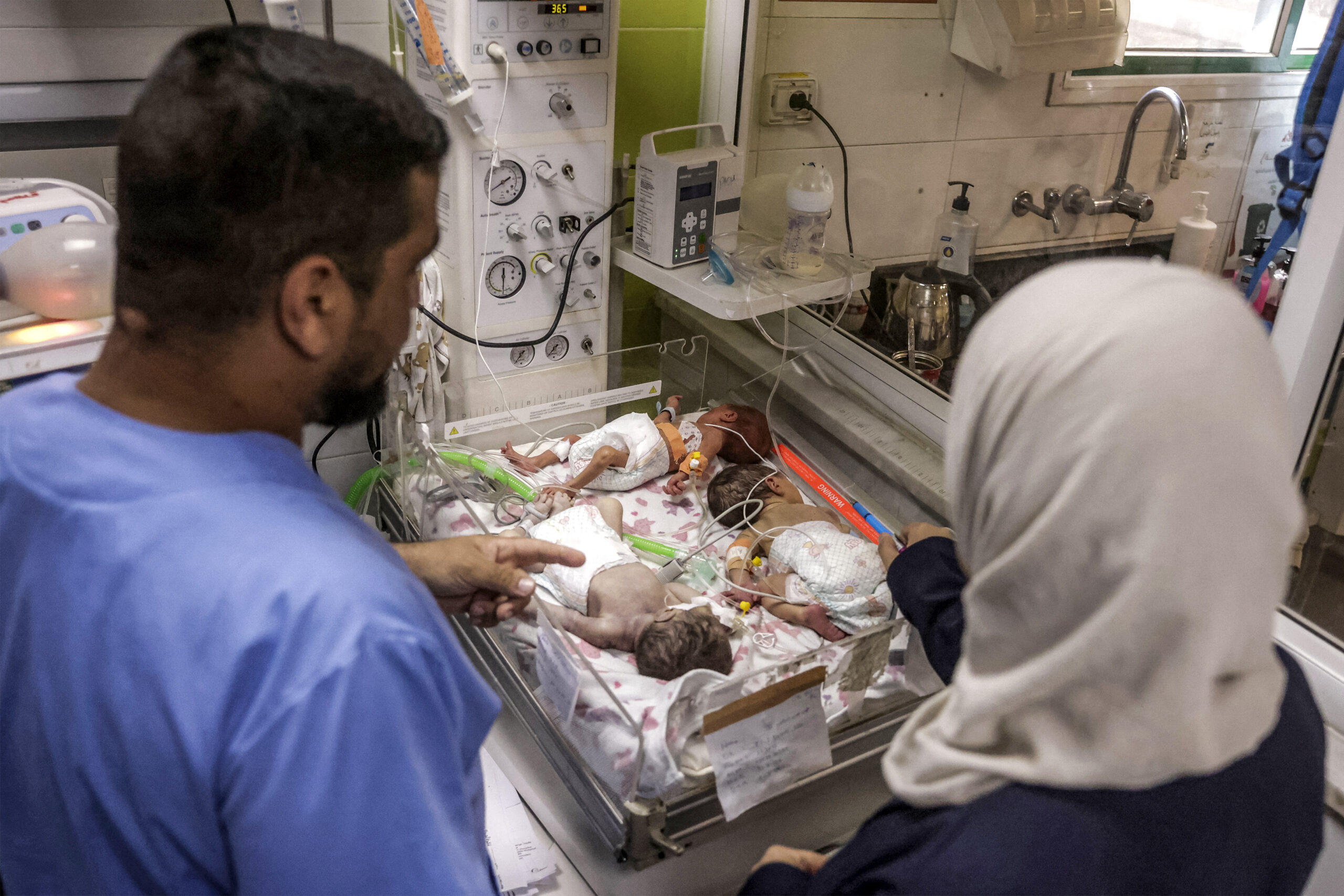
The telecommunications collapse has also paralysed the banking system, preventing money transfers and leaving families unable to access cash. Healthcare has been disrupted, with the World Health Organization documenting deaths caused by the inability to contact emergency services in time.

Even during the fragile ceasefire that took effect in October 2025, Israel has blocked essential repair equipment from entering Gaza. The restrictions form part of what analysts describe as a deliberate strategy to maintain control over Palestinian digital infrastructure and suppress the flow of information to the outside world.

The future remains deeply uncertain, as efforts to push a fragile ceasefire forward appear to stall and Israel threatens the possibility of returning to full-scale war.

Source link

We now see the ugly face of Gaza’s ‘new normal’ | Israel-Palestine conflict

Winter came to Gaza last month with a violent storm. I woke up at night to a disaster. Our tent was flooded with water which had transformed our “floor” into a shallow pool. The mattresses and pillows were completely soaked, cooking pots were submerged, the clothes were drenched, and even our bags— which function as our “closets”—were filled with water. Nothing inside remained dry.

As I tried to understand what was happening, I suddenly heard children crying at the entrance of our tent. I opened it quickly and found three children from the neighbouring tents, their lips blue from the cold, with their mother trembling behind them saying, “We are completely soaked… the rain leaked inside and the water reached everywhere.”

The same tragic scene was repeated all around us: women, children, and elderly people sitting in the street under the rain, their bedding drenched and their belongings scattered, while confusion and cries filled the air.

All 1.4 million displaced Palestinians who lack proper shelter suffered that day—people with no protection against the weather or its sudden storms.

For us, it took two full days for our belongings to dry because the sun barely appeared; everything stayed cold and damp. We didn’t move to another place—we stayed where we were, trying to salvage whatever we could, because there was simply nowhere else to go.

Only a week later, an even stronger winter storm arrived with severe rainfall. Tents were flooded again; little children froze in the rain again.

This week, when Storm Byron hit, we were flooded once again. Despite all our efforts to reinforce the tents, secure them tightly, and bring in stronger tarps, nothing worked. The winds were fiercer, the rain heavier, and the water pushed its way inside from every direction. The ground no longer absorbed anything. The water began rising rapidly beneath our feet, turning the entire area into a swamp.

According to the authorities, the strong winds destroyed at least 27,000 tents. These are 27,000 families who already struggled and now have nothing, no shelter, nowhere to hide from the rain and cold.

The rain also brought down damaged homes where people had been sheltering. Every time there is a storm or strong wind, we hear the sound of falling debris and concrete pillars from badly damaged buildings near us. This time, the situation was so bad that 11 people were killed by collapsed buildings.

It is clear that after everything we have endured, we – like other displaced Palestinians – cannot survive a third winter in these harsh conditions. We survived two winters in displacement, living in tents that protected neither from cold nor rain, waiting with exhausted patience for a ceasefire that would end our suffering. The ceasefire finally came, but relief did not. We remain in the same place, with bodies drained by malnutrition and illness, under tents worn out by the sun and wind.

We are a family of seven living in a tent that is four by four metres (13 feet by 13 feet). Among us are two children aged five and 10 and our grandmother, aged 80. We, the adults, can push through the cold and hardship. But how can the elderly and children bear what we live every day?

We sleep on mattresses pressed directly against the ground, with cold seeping in from below and above, with only two blankets that can’t shield us from the freezing nights. Everyone in the tent has two blankets each, barely enough to offer temporary warmth. There is no source of heating—no electricity, no heater—just tired bodies trying to share whatever warmth remains.

My grandmother cannot tolerate the cold at all. I watch her shiver through the night, her hand on her chest as if trying to hold herself together. All we can do is pile every blanket we have on top of her and watch anxiously until she is able to fall asleep.

Many people in Gaza live in conditions far worse than ours.

Most families who just want a modest tent over their heads cannot afford one. The price of tents can go as high as $1,000; the rent one has to pay to pitch a tent on a piece of land can be as much as $500. Those who cannot pay live in the street in makeshift shelters.

Salah al-Din Street, for example, is crowded with them. Most are simply blankets hung and wrapped around small spaces for minimal privacy, offering no protection from rain or cold. With any strong gust of wind, they burst open.

There are also children living directly in the streets, sleeping on the cold ground. Many have lost their mothers or fathers during the war. When you pass by, you see them—sometimes silent, sometimes crying, sometimes searching for something to eat.

Despite repeated promises of aid and reconstruction, the trickle of supplies that entered Gaza has made almost no difference on the ground. Earlier this month, the United Nations announced it had managed to distribute only 300 tents during November; 230,000 families received a single food parcel each.

We did not receive any food parcel—there are simply too many people in need, and the quantities are far too small for everyone to access. Even if we had received one, its contents wouldn’t have lasted us longer than a week or two.

Food prices continue to be high. Nutritious items like meat and eggs are either unavailable or cost too much. Most families have not eaten a proper protein meal in months.

There is no mass campaign to remove rubble or level the ground so people can pitch their tents due to an equipment shortage. No steps have been taken to provide permanent housing for families.

All of this means we now face a terrifying possibility: that life in a tent—one that can be flooded or ripped apart by the wind at any moment—may become our long-term reality. This is an unbearable thought.

During the bombardment, we lived with the constant fear of death, and perhaps the intensity of the war overshadowed everything else—the cold, the rain, the tents shaking above our heads. But now, after the mass bombing has stopped, we are facing the full ugliness of Gaza’s “new normal”.

I fear this winter will be much worse for Gaza. With no heating, no real shelter, and the weather getting worse each day, we are likely to see many deaths among the children, the elderly and the chronically ill. Already, the first deaths from hypothermia were reported – babies Rahaf Abu Jazar  and Taim al-Khawaja and nine-year-old Hadeel al-Masri. If the world is really committed to ending the genocide in Gaza, it needs to take real, urgent action and ensure that we have at least the basic conditions for survival: food, housing and medical care.

The views expressed in this article are the author’s own and do not necessarily reflect Al Jazeera’s editorial stance.

Source link

Gaza’s displaced face storm disaster with almost nothing | Israel-Palestine conflict News

In the large displacement camps of Gaza, rows upon rows of makeshift tents blanket debris, empty lots and what remains of flattened neighbourhoods. With Storm Byron descending upon the enclave, a sense of terror has seized a population already exhausted from two years of Israel’s genocidal war with its unrelenting bombardment, starvation and chaos.

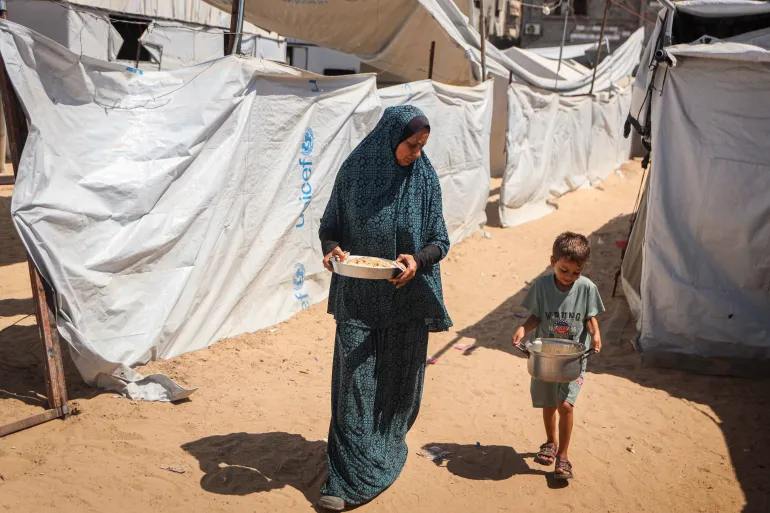
For the 1.5 million Palestinians living under plastic sheets and tattered tarps, the storm means something more than just bad weather. It’s another danger piled on top of the current battle for survival.

Recommended Stories

list of 4 itemsend of list

For several days, meteorologists have warned that heavy rainfall and strong winds could hit the strip today, tomorrow and over the weekend, risking flash flooding and significant wind damage. What is certain, though, is that Gaza is not facing this storm with ready infrastructure, stocked shelters or functioning drainage systems.

It faces it with tents propped up with pieces of scrap metal, paths that become mud rivers after only one night of rain and families who have nothing left to protect.

Solidarity a survival strategy

In the camps of Gaza City, the scenes of vulnerability are everywhere. Most tents are constructed from aid tarpaulins, pieces of plastic salvaged from rubble and blankets tied to recycled wooden poles. Many sag visibly in the middle; others are erected inadequately, so much so that they quiver and flap violently under the slightest breeze.

“When the wind starts, we all hold the poles to keep the tent from falling,” said Hani Ziara, a father sheltering in western Gaza City after his home was destroyed months ago.

His tent was flooded last night in the heavy rain, and his children had to stay outside in the cold. Hani wonders painfully what else he can do to protect his children from the rain and strong winds.

A Palestinian father taking shelter in a tent in Gaza City.
Hani Zaira, a Palestinian father taking shelter in a destroyed building in Gaza City [Hani Mahmoud/Al Jazeera]

In many camps, the ground was already soft from previous rainfall. Wet sand and mud stick to shoes, blankets and cooking pots as people shuffle through. Trenches dug by volunteers to divert water often collapse within hours. With nowhere else to go, families who live in low-lying areas are preparing for the worst: that floodwaters will be pushed directly into their tents.

Stocking up on food, storing clean water and securing shelter are the most basic steps when people prepare for a storm, but that is considered a luxury for the displaced of Gaza.

Most families receive scant water deliveries, going sometimes days without enough to cook or wash. Food supplies are equally strained, and while irregular aid distributions provide basics like rice or canned beans, the quantities seldom last more than a few days. Preparing for a storm by cooking ahead, gathering dry goods or storing fuel is simply not possible.

Mervit, a Palestinian mother of 5 children displaced near the Gaza Sea Port.
Mervit, a mother of five children displaced near the Gaza port [Hani Mahmoud/Al Jazeera]

“We could not sleep last night. Our tent was flooded with rainwater. Everything we had was flushed out by water. We want to prepare, but how?” asked Mervit, a mother of five children displaced near the Gaza port. She added, “We barely have enough food for tonight. We can’t save what we don’t have.”

Despite poverty, solidarity has become Gaza’s strongest survival strategy. Neighbours, with whatever they have, help secure the tents. Young men go through the rubble and scavenge for metal and wood remains to serve as temporary posts. The women organise collective cooking so that hot meals can be distributed to families in need, particularly those with young children or elderly family members, whenever possible.

These unofficial networks become more active the closer a storm gets. Volunteers trudge from tent to tent, helping families raise sleeping areas off the ground, patch holes in canopies with plastic sheets, and dig drainage channels. Crowds try to move those who are in precarious, extremely exposed areas to other locations, sharing information about safer places.

‘We are exhausted’

Beyond physical danger, the psychological impact is deep. After months of displacement, loss and deprivation, another crisis – this time, not war, but forces of nature – feels overwhelming.

“Our tents were destroyed. We are exhausted,” said Wissam Naser. “We have no strength left. Every day there is a new fear: hunger, cold, disease, now the storm.”

Wissam Naser, a displaced Palestinian sheltering in a tent in Gaza City.
Wissam Naser, a displaced Palestinian sheltering in a tent in Gaza City [Hani Mahmoud/Al Jazeera]

Many residents describe the feeling of being sandwiched between the sky and the ground, exposed on both ends and unable to protect their families from either.

As clouds mass along Gaza’s shore, families prepare to take a hit. Some weigh down tent walls against the wind with rocks and sandbags. Others push children’s blankets to the driest corner, hoping a roof will last. Most don’t have a plan. They just wait.

The storm will not be another single-night affair for the displaced in Gaza. It would be a further reminder of how fragile life has become, how survival depends not on preparedness but rather on endurance.

They wait because they have no alternative. They prepare with what little they have. They pray that this time, the winds will be merciful.

Source link