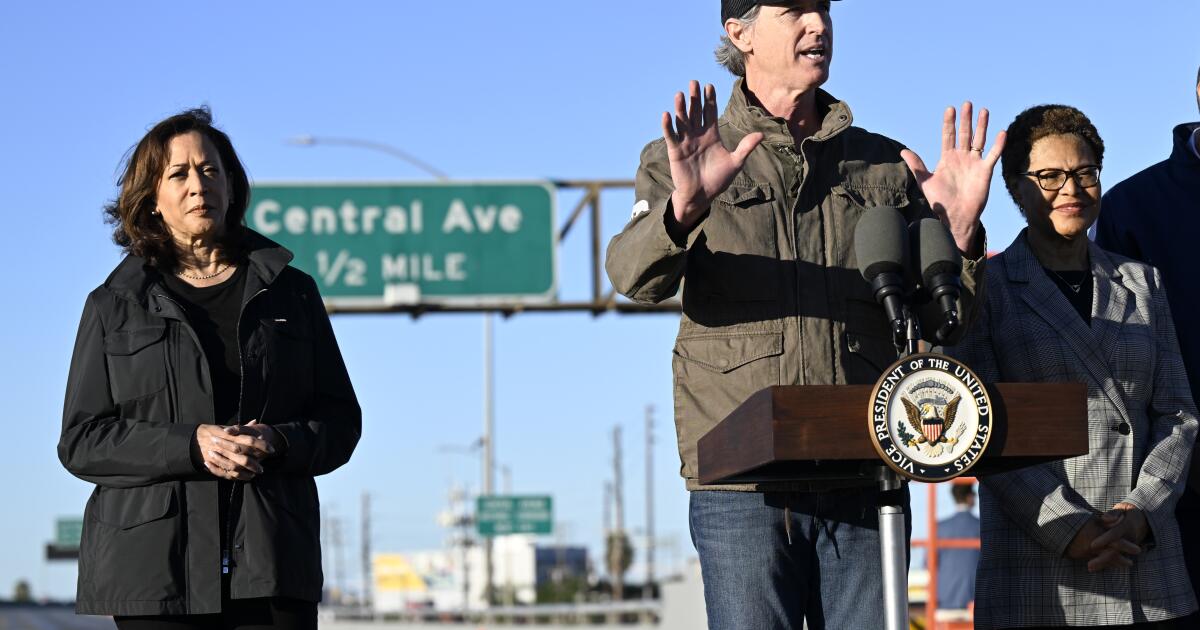
Harris, who’s mostly focused on writing and promoting her campaign autobiography — while giving a political speech here and there — hasn’t publicly declared she’ll seek the White House a third time. But, notably, she has yet to rule out the possibility.
In a CNN interview aired Sunday, Newsom was asked about the prospect of facing his longtime frenemy in a fight for the Democratic nomination. (California’s gallivanting governor is embarked on his own national book tour, promoting both the “memoir of discovery” that was published Tuesday and his all-but-declared presidential bid.)
“Well, I’m San Francisco now, she’s L.A.,” Newsom joked, referring to Harris’ post-Washington residency in Brentwood. “So there’s a little distance between the two of us.”
He then turned zen-like, saying fate would determine if the two face off in the 2028 primary contest. “You can only control what you can control,” Newsom told CNN host Dana Bash.
In 2015, Barbara Boxer said she would step down once she finished her fourth term in the U.S. Senate. The opening presented a rare opportunity for political advancement after years in which a clutch of aging incumbents held California’s top elected offices. Between Lt. Gov. Newsom and state Atty. Gen. Harris, there was no lack of pent-up ambition.
Once in their preferred roles, the two got along reasonably well. Each campaigned on the other’s behalf. But, privately, there has never been a great deal of mutual regard or affection.
Come 2028, there will doubtless be many Democrats seeking to replace President Trump. The party’s last wide-open contest, in 2020, drew more than two dozen major contestants. So it’s not as though Harris and Newsom would face each other in a one-on-one fight.
But dueling on the national stage, with the country’s top political prize at stake, is something that Hollywood might have scripted for Newsom and Harris as the way to settle, once and for all, their long-standing rivalry.
The two Californians would start out closely matched in good looks and charisma.
Those who know them well, having observed Newsom and Harris up close, cite other strengths and weaknesses.
Harris has thicker skin, they suggested, and is more disciplined. Her forte is set-piece events, like debates and big speeches.
Newsom is more of a policy wonk, a greater risk-taker and is more willing to venture into challenging and even hostile settings.
But Harris’ problem, it was widely agreed, is that she has run twice before and, worse, lost the last time to Trump.
“To a lot of voters, she’s yesterday’s news,” said one campaign strategist.
“She had her shot,” said another, channeling the perceived way Democratic primary voters would react to another Harris run. “You didn’t make it, so why should we give you another shot?”
(Those half-dozen kibbitzers who agreed to candidly assess the prospects of Newsom and Harris asked not to be identified, so they could preserve their relationships with the two.)
Most of the handicappers gave the edge to Newsom in a prospective match-up; one political operative familiar with both would have placed their wager on Harris had she not run before.
“I think her demographic appeal to Black women and coming up the ranks as a Black woman working in criminal justice is a very strong card,” said the campaign strategist. “The white guy from California, the pretty boy, is not as much of a primary draw.”
That said, this strategist, too, suggested that “being tagged as someone who not only lost but lost in this situation that has set the world on fire … is too big a cross to bear.”
The consensus among these cognoscenti is that Harris will not run again and that Newsom — notwithstanding any demurrals — will.
Of course, the only two who know for sure are those principals, and it’s quite possible neither Harris nor Newsom have entirely made up their minds.
Those who enjoy their politics cut with a dash of soap opera will just have to wait.
On January 20, 2004, I took a seat in the gallery of the House of Representatives to hear President Bush deliver his State of the Union address. The seat came courtesy of House Minority Leader Nancy Pelosi. Ten months earlier, Bush had made the decision to invade Iraq after his administration’s historic campaign of lies convinced the American people that Saddam Hussein possessed weapons of mass destruction. We would not extricate ourselves from that costly conflict for another seventeen years. Much of his speech that night was a further attempt to sell to the nation the justification for his war. “Had we failed to act, the dictator’s weapons of mass destruction programs would continue to this day,” Bush said. He characterized the Patriot Act, which had unleashed a new magnitude of spying on American citizens, as “one of those essential tools” in the war on terror.
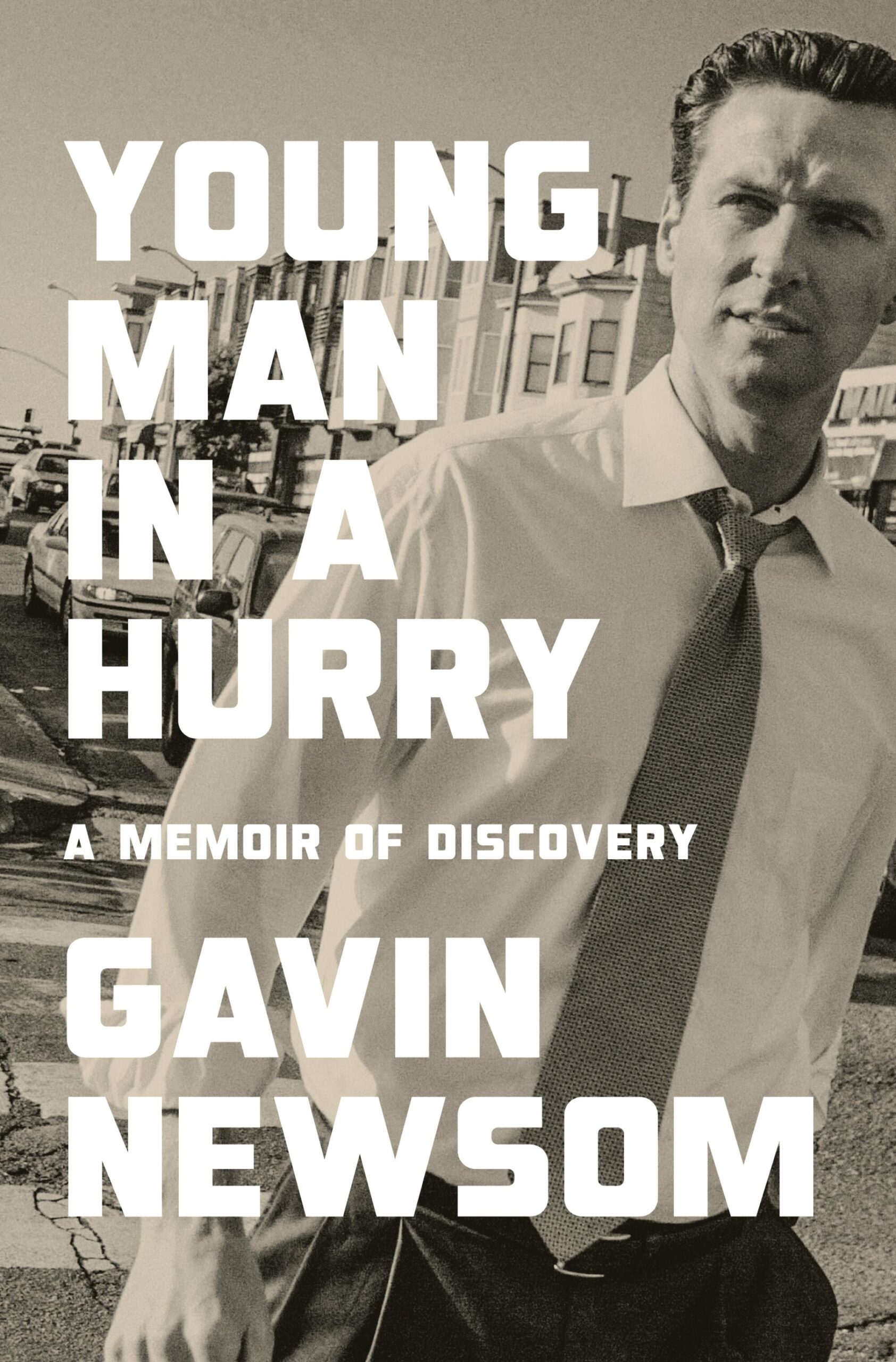
“Young Man in a Hurry: A Memoir of Discovery” by Gavin Newsom
(Penguin Press)
On the Shelf
Young Man in a Hurry: A Memoir of Discovery
By Gavin Newsom Penguin Press: 304 pages, $30
If you buy books linked on our site, The Times may earn a commission from Bookshop.org, whose fees support independent bookstores.
The rest of his speech was standard fare, ho-hum really, until he reached a section near the end about American values and the need for us to “work together to counter the negative influences of the culture and to send the right messages to our children.” He said he was troubled by activist judges in activist states who were threatening to undo the Defense of Marriage Act signed into law by his predecessor, President Bill Clinton. We had to “defend the sanctity of marriage” as the union of one man and one woman, he said. If need be, he would seek a constitutional amendment to ban same-sex marriage.
As I was leaving the chamber, a middle-aged couple next to me was talking about how pleased they were that their president was finally confronting the “homosexual agenda.” The word homosexual came out of their mouths bent by contempt. I was supposed to head downstairs for a reception with Congresswoman Pelosi and a delegation of California Democrats, but I needed a breath of fresh air. Outside the Capitol, I kept walking and muttering to myself. “These are my people Bush is attacking. My constituents. My staff. My closest advisers.” In the cold and dark of Washington, I called one of my aides back in San Francisco and pledged that I was “going to do something about it” as soon as I returned home.
The law in our state was no different from the law in every other state. Same-sex unions could not be recognized by the local assessor-recorder’s office. They were illegal. As I explained to aides my willingness to now defy that law, I held up a copy of the California Constitution. In Article I, the first section promises that “all people are by nature free and independent and have inalienable rights.” Among these rights are pursuing and obtaining “safety, happiness and privacy.” It was not until Section 7.5 that these rights were then abridged: “Only a marriage between a man and a woman is valid or recognized in California.” This not only contradicted the first section but was discriminatory on its face.
My top staff didn’t disagree with my reading, but almost to a person they were opposed to my taking on the issue. Steve Kawa, my chief of staff, a gay Bostonian whose accent cut through all nonsense, pulled me aside and spoke from his heart. His father had renounced him for being gay, and he wanted nothing more than to live in an America where homophobia was no longer the norm. But swinging open the doors to the city clerk’s office and inviting gay men and lesbian women to the marriage altar was political suicide, he argued. We were new to office, for one thing. And polls showed that less than one third of Californians supported gay marriage.
The “go it slow” admonition was the mother’s milk of Democratic politics. In the endless battle for the hearts and minds of moderates, it seemed the only feasible way for a Democrat to get elected and govern. But this was San Francisco, and we were talking about equal protection under the law for a class of people whose ostracism by family, friends, and community had brought them to San Francisco in the first place. If not here, where? Eric Jaye, one of my campaign consultants, could see my quandary. I was caught between my conscience and the sound political advice of the people closest to me. We had several late-night conversations on the phone. “What the f— are you doing here? Why did we work so hard to win if you can’t do something bold?” he asked. “This is a short life, Gavin. Your time as a politician to get things done is just a blip.”
I thought back to my model for the wine store. The entire purpose was to turn the staid on its head and create a new reality. I called Joyce Newstat, my policy director, who was also gay. “We need to do this,” I told her. She could hear in my voice that I had made up my mind. “OK, but we can’t afford to take a wrong step,” she said. “Gays and lesbians have a history of being blindsided, and you don’t want to become part of that narrative. Give me a week or two to reach out to the community.” Joyce sat down with Kate Kendell, the brilliant executive director of the National Center for Lesbian Rights, based in San Francisco. “Who is this guy?” Kendell wondered. “He can’t just come waltzing in here and upset the delicate balance we’ve taken years to achieve.” Joyce told her I couldn’t be talked out of it, that it had become internalized after I had gone to Washington and heard the words of bigotry ring out in the Capitol. “Well, OK. But if he’s going to do it, he has to do it right,” Kendell said. She directed her attorneys at the center to work with our team on fashioning a plan.
I then went to Mabel Teng, my former colleague on the board of supervisors who was now the assessor-recorder of San Francisco. I asked her what complications would be presented to her official duties if we allowed same-sex marriages at city hall. Mabel, who began her career in politics as an activist with Jesse Jackson’s Rainbow Coalition, did not surprise me with her reply. “It would be no problem at all, Mayor.” The marriage of a man and a man, or a woman and a woman, would require hardly any change to the paperwork. Rather than “man and wife,” they would show up in her computer as “Applicant One” and “Applicant Two.”
Alarmed by my plans, my father and Uncle Brennan and their close friend Joe Cotchett — each one steeped in law and politics but only Joe standing six foot four and a former Special Forces paratrooper —attempted a last-minute intervention. They lured me to the Balboa Cafe for dinner and wine. They weren’t the kind to beat around the bush. Did I realize that I was about to torpedo my political career?
Joe got right in my face. “Why are you doing this, Gavin?”
“I’ll tell you why I’m doing this,” I said defiantly. “Because it’s the right thing to do.”
I could not have given him a more simple and true answer, and it seemed to hit Joe, who had built his career out of representing the underdog, right in the gut.
“OK,” he said in a different voice. “Then let’s do it.”
With that, my father and uncle went quiet. Not another word was said about it. I left there that night thinking that even my Newsom kin, the ones who had my best interests at heart, could get it wrong from time to time. While I was open to skepticism and second-guessing, indeed I welcomed such a process, in the end I had to trust my own gut. On the matter of civil rights for all Californians, there was no turning back. As for big Joe Cotchett, he ended up joining the ranks of lawyers fighting for the legal right to same-sex marriage.
In his first five years as California’s lieutenant governor, Gavin Newsom made more than $4 million from his wineries, restaurants, hotels and other hospitality businesses.
And that’s on top of his government salary, which is $142,577 a year.
The former mayor of San Francisco is the first candidate in the 2018 race for governor to release his state and federal tax returns. He filed jointly with his wife, the actress and filmmaker Jennifer Siebel Newsom. On Monday, Newsom allowed reporters to review — but not photocopy — six years of the couple’s returns, from 2010 to 2015, at the San Francisco offices of his campaign consultants, SCN Strategies.
Newsom, the early front-runner in the June 2018 primary, cites his business expertise as a key credential in his campaign for governor. With the help of the wealthy Getty family, he opened a San Francisco wine store in 1992, expanding it over the last 25 years into a network of nearly two dozen businesses known as PlumpJack Group. They include Napa Valley wineries, hotels in Lake Tahoe and Palm Springs, and bars and restaurants in San Francisco.
Here’s what you should know about the tax documents:
The Newsoms reported an average of $1.4 million in income from 2010 to 2015
The Newsoms’ tax returns provided a window into a complex web of the family’s financial interests throughout California. The couple’s lowest adjusted gross income since 2011 was $1.37 million in 2013.
The Newsoms’ average income and tax bills in the years 2010-2015 were:
Adjusted gross income: $1.4 million.
Federal tax rate: 26.4%.
Rate of charitable giving compared to income: 6.8%.
Federal taxes paid: $384,687.
State taxes paid: $139,146.
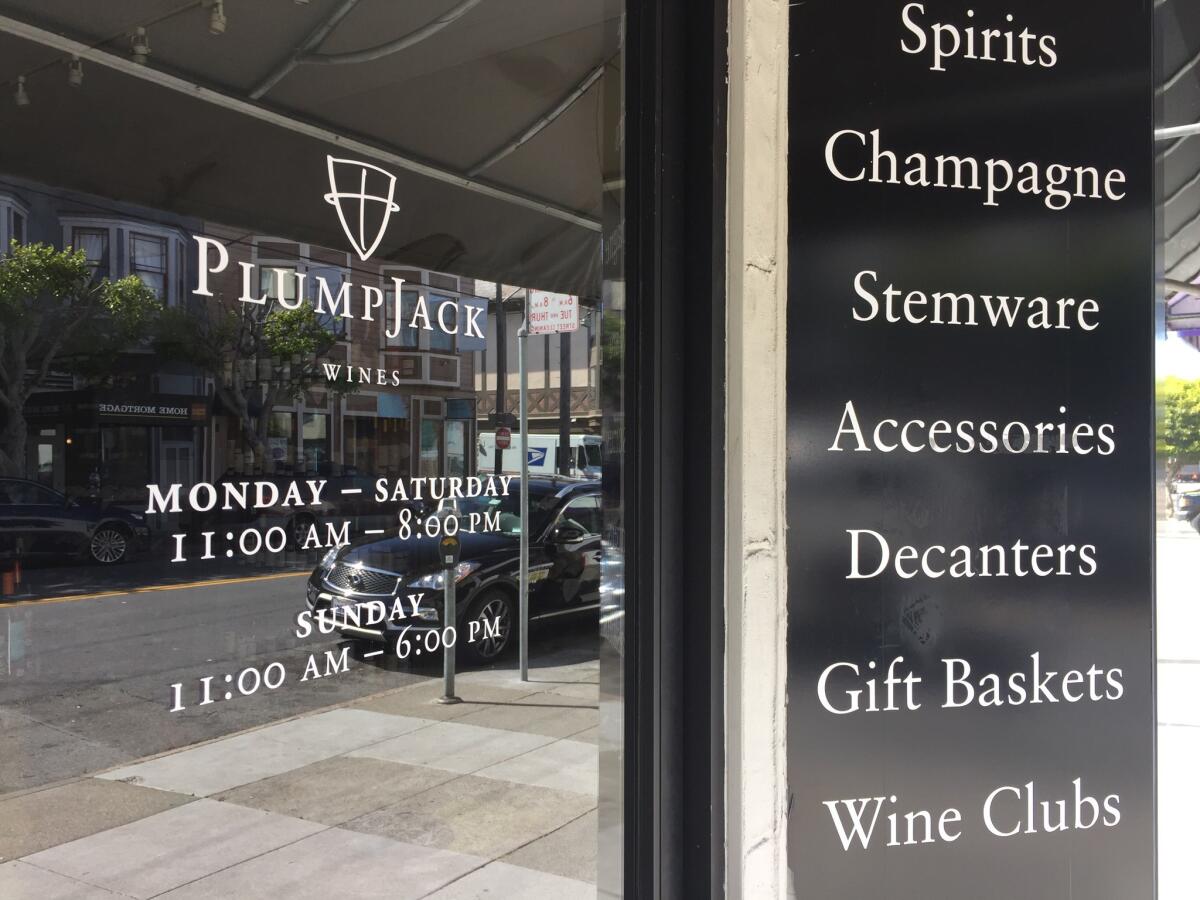
PlumpJack Group was founded by Lt. Gov. Gavin Newsom as PlumpJack Wine in 1992. Newsom is still a partner in the company, which has expanded to include restaurants, bars and resorts in addition to three wineries and two wine shops, including this store in San Francisco. (Phil Willon/Los Angeles Times)
(Phil Willon/Los Angeles Times)
2015 was a good year for the Newsoms
The couple, who now live in Marin County, reported an adjusted gross income of $1,720,383 in 2015, the highest amount they earned in the past six years. The Newsoms’ total tax bill came to $753,866, with $568,333 going to the Internal Revenue Service and $185,533 to the California treasury. They donated $62,973 to charity, including a $1,000 contribution to the Bay Area Discovery Museum.
The Newsoms’ biggest income source came from Airelle Wines Inc., which runs Napa wineries, at roughly $790,000.
They made hundreds of thousands of dollars selling silver bars — and donated more than $100,000 to charities each year
The tax returns show the Newsoms made hundreds of thousands of dollars trading silver bars during Newsom’s tenure as lieutenant governor. In 2011 alone, they turned a profit of $499,452 on the sale of silver bars.
Newsom’s 2013 book, “Citizenville,” appeared to be a moderate money-maker. From 2011 to 2015, Newsom reported a total of $370,325 in income as an author and by working in media. A spokesman for the lieutenant governor said he was unsure if some of that total included money Newsom was paid for his former talk show on Current TV, “The Gavin Newsom Show,” which aired in 2012 and 2013.
The Newsoms reported an average of $102,212 in charitable donations each year — nearly 7 percent of their income. But apart from clothing and toy donations to the Salvation Army and Goodwill, it was unclear which charities received money from the couple. Because the Newsoms hold interests in a wide network of partnerships, corporations and trusts, and most of their charitable donations were channeled through them, it is unclear which organizations received the money. A spokesman for Newsom’s political campaign said some of the charities the couple donated money to included the Law Center to Prevent Gun Violence, Best Buddies and Planned Parenthood LA.
Newsom owns a Tesla, and received tax credit for it
Over the years, the Newsoms have received a few tax breaks for their rapidly growing, environmentally conscious family.
Newsom received a $7,500 “Alternative Motor Vehicle Credit” on his 2012 taxes after buying a Tesla Model S.
He received a $500 tax credit in 2012 for installing energy-efficient doors, windows and insulation.
In 2010, the Newsoms’ daughter Montana was their only dependent. Then came their son Hunter in 2011. Daughter Brooklynn arrived in 2013. The Newsoms’ fourth child, Dutch, will make his grand entrance on the 2016 return.
Releasing his taxes ratchets up the pressure on his rivals to do the same
Newsom’s release of his tax returns puts pressure on his rivals to make theirs public too. The move could be a sign that the lieutenant governor is banking on revelations that he thinks could be useful to his campaign, such as information detailing Antonio Villaraigosa’s income sources in the years since he left office as mayor of Los Angeles.
Villaraigosa and Newsom’s other chief rival, state Treasurer John Chiang, have agreed to make public their tax returns, but have not yet specified when they will do so. Another candidate, Delaine Eastin, a former superintendent of public instruction, has also vowed to release her tax returns.
A spokesman for the leading Republican in the race, venture capitalist John Cox, said it was too early to say whether he would make his tax returns public.
SACRAMENTO — Gavin Newsom writes in his upcoming memoir about San Francisco’s highborn Getty family fitting him in Brioni suits “appropriate to meet a king” when he was 20 years old. Then he flew aboard their private “Jetty” to Spain for a royal princess’s debutante-style party.
Back home, real life wasn’t as grand.
In an annual performance for their single mom, Newsom and his sister would pretend to find problems with the fancy clothes his dad’s friends, the heirs of ruthless oil baron J. Paul Getty, sent for Christmas. Poor fit. Wrong color. Not my style. The ritual gave her an excuse to return the gifts and use the store credit on presents for her children she placed under the tree.
California’s 41st governor, a possible suitor for the White House, opens up about the duality of his upbringing in his new book. Newsom details the everyday struggle living with his mom after his parents divorced and occasional interludes into his father’s life charmed by the Gettys’ affluence, including that day when the Gettys outfitted him in designer clothes at a luxury department store.
“I walked out understanding that this was the split personality of my life,” Newsom writes in “Young Man in a Hurry.”
For years, Newsom asserted that his “one-dimensional” public image as a slick, privileged politician on a path to power paved with Getty oil money fails to tell the whole story.
“I’m not trying to be something I’m not,” Newsom said in a recent interview. “I’m not trying to talk about, you know, ‘I was born in a town called Hope with no running water.’ That’s not what this book is about. But it’s a very different portrayal than the one I think 9 out of 10 people believe.”
As he explores a 2028 presidential run and basks in the limelight as one of President Trump’s most vociferous critics, the book offers the Democratic politician a chance to write his own narrative and address the skeletons in his closet before opponents begin to exploit his past.
A book tour, which is set to begin Feb. 21 in Nashville, also gives Newsom a reason to travel the country, meet voters and promote his life story without officially entering the race. He’s expected to make additional stops in Georgia, South Carolina, New York, San Francisco and Los Angeles.
The governor describes the book as a “memoir of discovery” that sent him interviewing family members and friends and digging through troves of old documents about his lineage that his mother never spoke about and his father smoothed over. Learning about his family history, the good and the bad, Newsom said, helped him understand and accept himself. Mark Arax, an author and former Los Angeles Times journalist, was his ghostwriter.
“I’ve changed the opinion of myself,” Newsom said when asked if he believed the book would revise his glossy public image. “It kind of rocked so many parts of my life, and kind of cracked things open. And I started to understand where my anxieties come from and why I’m overcompensating in certain areas.”
Newsom writes that his interest in politics brought him and his father, William, closer. His mother, Tessa, on the other hand, didn’t share his father’s enthusiasm.
She warned him to get out while he still could, worried her only son would eschew his true self.
“My mother did not want that world for me: the shrewd marriage of tall husbands and tall wives that kept each year’s Cotillion Debutante Ball stocked with children of the same; the gritted teeth behind the social smiles; the spectator sport of who was in and who was out based on so-and-so’s dinner party guest list,” Newsom wrote.
At the heart of her concern was her belief that Newsom’s “obsessive drive” into business and politics was in response to his upbringing and an effort to solve “the riddle” of his identity from his learning disorder, dyslexia, and the two different worlds he inhabited.
“As I grew up trying to grasp which of these worlds, if either, suited me best, she had worried about the persona I was constructing to cover up what she considered a crack at my core,” Newsom writes. “If my remaking was skim plaster, she feared, it would crumble. It would not hold me into adulthood.”
Newsom’s mother was 19 years old when she married his father, then 32. He learned through writing the book that his mother hailed from a “family of brilliant and daring misfits who had carved new paths in botany and medicine and left-wing politics,” he writes.
There was also secret pain and struggles with mental health. His maternal grandfather, a World War II POW, turned to the bottle after returning home. One night he told his three young daughters to line up in front of the fireplace so he could shoot them, but stopped when his wife walked in the door and took the gun from his hand. He committed suicide years later.
Newsom’s father’s family was full of more traditional Democrats and Irish Catholic storytellers who worked in banking, homebuilding, law enforcement and law. Newsom describes his paternal grandfather as one of the “thinkers behind the throne” for former California Gov. Edmund “Pat” Brown, but his family never held public office despite his dad’s bids for the San Francisco Board of Supervisors and the California Legislature.
The failed campaigns left his father in financial and emotional turmoil that crippled his marriage when Newsom was a small boy. A divorce set the stage for an unusual contrasting existence for the would-be governor, offering him brief exposures to the wealth and power of the Gettys through his dad.
Newsom said he moved casually between the rich and poor neighborhoods of San Francisco as a boy.
“It was a wonder how effortlessly I glided because the two realms of my life, the characters of my mother’s world and the characters of my father’s world, did not fit together in the least,” Newsom writes.
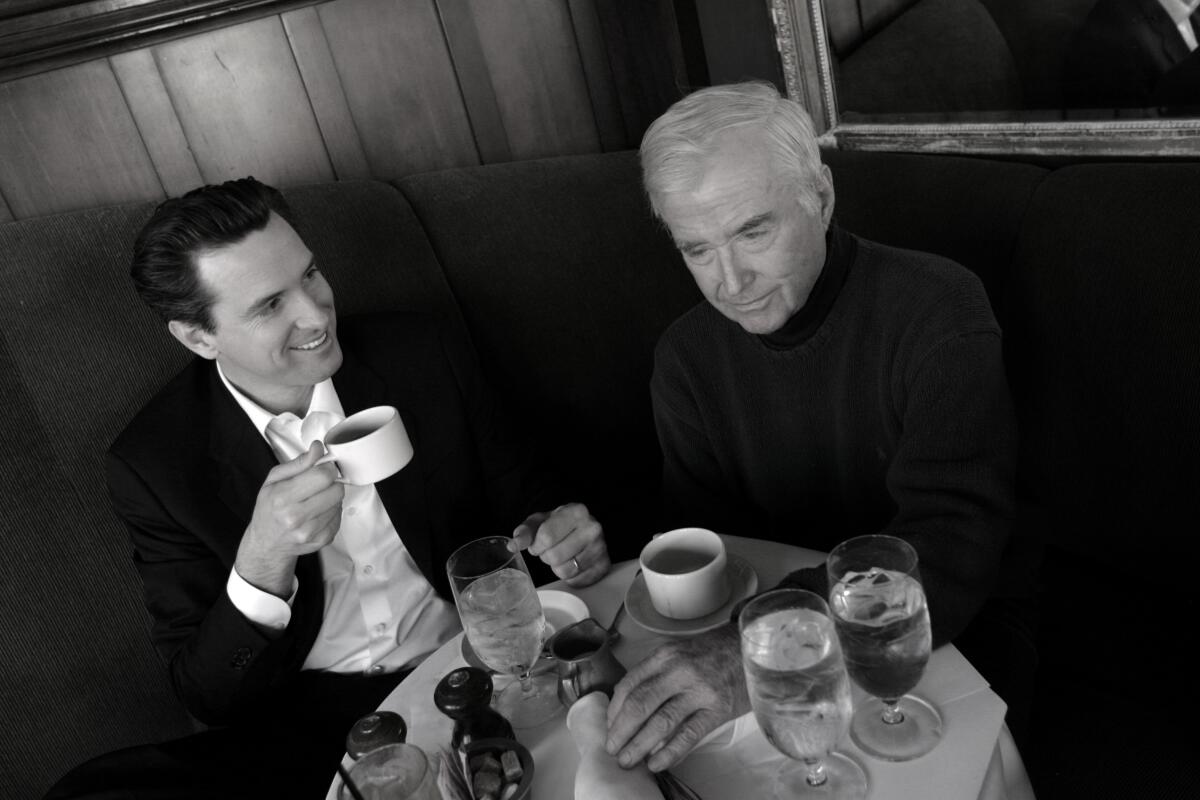
Mayor Gavin Newsom and his dad, Judge William Newsom, have lunch at the Balboa Cafe in San Francisco.
(Christina Koci Hernandez / San Francisco Chronicle via Getty Images)
Though William Alfred Newsom III went on to become an appellate court justice, Newsom’s father was best known for his role delivering ransom money to the kidnappers of J. Paul Getty’s grandson. He served as an adviser to the family without pay and a paid administrator of the $4 billion family trust.
The governor wrote in the book that the ties between the two families go back three generations. His father was close friends with Getty’s sons John Paul Jr. and Gordon since childhood when they became like his sixth and seventh siblings at Newsom’s grandparents’ house.
Gordon Getty in particular considered Newsom’s father his “best-best friend.” Newsom’s dad helped connect the eccentric music composer “to the outside world,” the governor wrote.
“My father had this way of creating a safe space for Gordon to open up,” Newsom writes. “He became Gordon’s whisperer, his interpreter and translator, a bridge to their friends, a bridge to Gordon’s own children.”
San Francisco Mayor Gavin Newsom and his sister, Hilary Newsom, in a promotional portrait for the Search for the Cause campaign, which raises funds for cancer research, on Nov. 21, 2025.
(Caroline Schiff/Getty Images)
His father’s friendship with Gordon Getty exposed Newsom and his younger sister, Hillary, to a world far beyond their family’s own means. Gordon’s wife, Ann, and Newsom’s father organized elaborate adventures for the Gettys’ four sons and the Newsom children.
Newsom describes fishing on the Rogue River and riding in a helicopter while studying polar bears on the shores of the Hudson Bay in Canada. He recalled donning tuxedos and carrying toy guns pretending to be James Bond on a European yacht vacation and soaring over the Serengeti in a hot air balloon during an East African safari.
Throughout his travels, Newsom often blended in with the Gettys’ brown-haired sons. He wrote that the actor Jack Nicholson once mistakenly called him one of the “Getty boys” at a party in a 16th-century palazzo in Venice where guests arrived via gondola. Newsom didn’t correct him.
“Had I shared this encounter with my mother, she likely would have asked me if deception was something I practiced whenever I hobnobbed with the Gettys,” Newsom said in the book. “Fact is, I was always aware of the line that separated us from the Gettys. Not because they went out of their way to make us aware of it but because we, as good Newsoms, paid constant mind to the distinction.”
Newsom wrote that his mother seemed to begrudge the excursions when her children returned home. She raised them in a much more ordinary existence. Newsom describes his father’s presence as “episodic.”
“For a day or two, she’d give us the silent treatment, and then we’d all fall back into the form of a life trying to make ends meet,” he wrote. “After enough vacations came and went, a cone of silence took hold.”
Newsom’s mother worked as an assistant retail buyer, a bookkeeper, a waitress at a Mexican restaurant, a development director for a nonprofit and a real estate agent — holding as many as three jobs at once — to provide for her children. His mother’s sister and brother-in-law helped care for them when they could, but he likened himself to a latchkey kid because of the amount of time he and his sister spent alone.
They moved five times in 10 years in search of a “better house in a better neighborhood” with good schools, taking the family from San Francisco to the Marin County suburbs. Though his mother owned a home, she often rented out rooms to bring in extra money.
Tired of his mother complaining about finances and his father not coming through, Newsom wrote that he took on a paper route.
In the book, Newsom describes his struggles with dyslexia and how the learning disorder undercut his self-esteem when he was an emotionally vulnerable child.
Eager to make himself something more than an awkward kid with sweaty palms and a bowl haircut who couldn’t read, Newsom mimicked Remington Steele, the suave character on the popular 1980s detective show. He chugged down glassfuls of raw eggs like Sylvester Stallone in “Rocky” and ran across town and back like a prizefighter in training.
He found confidence in high school sports, but his struggle to find himself continued into young adulthood. Newsom wrote that he watched tapes of motivational guru Tony Robbins and heeded his advice to remake yourself in the image of someone you admire. For Newsom, that became Robbins himself.
“Find a person who embodies all of the outward traits of personality, bearing, charisma, language, and power lacking in yourself,” Newsom described the philosophy in the book. “Study that person. Copy that person. The borrowed traits may fit awkwardly at first, but don’t fret. You’ll be surprised by how fast the pose becomes you, and you the pose.”
His father scoffed at the self-help gurus and nurtured his interest in business.
More than a half-dozen friends and family members, including Gordon Getty, invested equal shares to help him launch a wine shop in San Francisco. Newsom named the business, which expanded to include restaurants, hotels and wineries, “PlumpJack,” the nickname of Shakespeare’s fictional character Sir John Falstaff and the title of Gordon Getty’s opera.
“Gordon’s really inspired me to be bolder and more audacious. He’s inspired me to be more authentic,” Newsom said. “The risks I take in business … just trying to march to the beat of a different drummer and to be a little bolder. That’s my politics. But I also think he played a huge role in that, in terms of shaping me in that respect as well.”
Newsom described Gordon and Ann Getty as like family. The Gettys also became the biggest investors in his wineries and among his largest political donors.
In an interview, Newsom said there are many days when he feels his mother “absolutely” was right to worry about the facade of politics and the mold her son stuffed himself into.
Gavin Newsom heads for his home neighborhood on Nov. 3, 2003, to cast hisvote for San Francisco mayor.
(Mike Kepka / San Francisco Chronicle via Getty Images)
He described the day the recall against him qualified for the ballot amid the COVID-19 pandemic as humbling and humiliating, though it later failed by a wide margin. Still today, he said, there’s a voice in his head constantly questioning why he’s in politics, what he’s exposing his wife and children to and doing with his life.
By choosing a career as an elected official despite his mother’s warnings, Newsom ultimately picked his father’s world and accomplished his father’s dream of taking office. But he said the book taught him that so much of his own more gutsy positions, such as his early support for gay marriage, and his hustle were from his mother.
Newsom said he’s accepted that he can’t control which version of himself people choose to see. Writing the book felt cathartic, he said, and left him more comfortable taking off his mask.
“It allowed me to understand better my motivations, my purpose, my meaning, my mission… who my mom and dad were and who I am as a consequence of them and what truly motivates me,” Newsom said. “There’s a freedom. There’s a real freedom. And it’s nice. It’s just so much nicer than the plaster of the past.”
SACRAMENTO — Gov. Gavin Newsom signed a bill on Wednesday to provide $90 million to Planned Parenthood, a move intended to help offset the losses from recent federal cuts targeting abortion providers.
“These cuts were designed to attack and assault Planned Parenthood,” said Newsom, speaking at a news conference near the Capitol. “They were not abortion cuts; they were attacks on wellness and screenings and they were attacks on women’s healthcare.”
The Republican-backed “One Big Beautiful Bill Act,” signed last year by President Trump, blocked federal Medicaid funding from going to Planned Parenthood. More than 80% of the nearly 1.3 million annual patient visits to Planned Parenthood in California were previously reimbursed by Medi-Cal, the state’s version of Medicaid.
Sen. John Laird, who authored the legislation for the funding, Senate Bill 106, said the measure showed that California won’t back down. “This is us standing up to the immediate cut that was in that bill,” said Laird, (D-Santa Cruz). “This is how we are fighting back.”
Jodi Hicks, chief executive officer of Planned Parenthood Affiliates of California, thanked legislators for their support and said the organization could not survive without support from the state. She said Planned Parenthood would always fight against federal attacks but “needed an army” this time to stand beside them.
During the news conference, First Partner Jennifer Siebel Newsom expressed frustration with reporters for asking off-topic questions and said the media should be more concerned about women’s issues.
“All of these questions have really been about other issues,” she said. “This happens over and over and over again — (and we) wonder why we have such a horrific war on women in this country.”
Planned Parenthood offers a range of services, including abortions, birth control, cancer screenings and testings for sexually transmitted diseases. A coalition of states, including California, filed a lawsuit last year against the Trump administration over the cuts to the nonprofit. The states argue in the ongoing lawsuit that the measure violates the spending powers of Congress by singling out Planned Parenthood for negative treatment.
Senate Bill 106 has drawn ire from Republicans, who question why funding is going to Planned Parenthood when many hospitals in the state need more financial support.
“For rural Californians, this conversation is about access to care,” Sen. Megan Dahle (R-Bieber) said in a statement from the Senate Republican Caucus. “Hospitals are cutting services or facing closure, forcing families to drive hours for life-saving treatment. State lawmakers should prioritize stability for these communities.”
Penn State hockey star Gavin McKenna will not face a felony assault charge after allegedly striking another man in the face twice during an altercation last weekend.
A criminal complaint filed Wednesday by the State College Police Department charged McKenna with first-degree felony aggravated assault — which in Pennsylvania is punishable by up to 20 years in prison and $25,000 in fines — as well as misdemeanor simple assault, summary harassment and summary disorderly conduct.
The District’s Attorney’s Office of Centre County, Pa., said Friday that it is withdrawing the felony assault charge against the 18-year-old Canadian, who is expected to be one of the top picks in this year’s NHL draft,
“In order to establish probable cause for the crime of Aggravated Assault, the Commonwealth must establish that a person acted with the intent to cause serious bodily injury or acted recklessly under circumstances showing an extreme indifference to the value of human life,” the DA’s office said in a news release.
“Both the District Attorney’s Office and the State College Police Department have reviewed video evidence of this incident and do not believe that a charge of Aggravated Assault is supported by the evidence.”
The office added that “prosecution will go forward with the misdemeanor Simple Assault and other summary charges as they relate to the serious injuries suffered by the victim.”
The alleged incident took place around 8:45 p.m. Saturday near the Penn State campus, hours after McKenna had a goal and two assists during the Nittany Lions’ 5-4 overtime loss to Michigan State in an outdoor game played at Beaver Stadium.
“The complaint alleges that the victim was punched twice on the right side of his face by the defendant following an exchange of words between the alleged victim’s group and the group of people with Gavin McKenna,” prosecutors wrote. “The complaint further alleges that the victim sustained fractures to both sides of his jaw which would require surgery and that he was missing a tooth.
“Follow-up by State College Police has confirmed that the victim suffered two fractures to one side of his jaw, as opposed to both sides of his jaw, and that he is not missing a tooth. The victim has had surgery and is recovering.”
A college hockey star expected to be one of the top picks in this year’s NHL draft has been charged with felony assault after allegedly striking another man in the face during an altercation last weekend in State College, Pa.
Penn State freshman Gavin McKenna, 18, was arraigned Wednesday and released on $20,000 unsecured bail, according to the State College Police Department.
He is charged with first-degree felony aggravated assault — which in Pennsylvania is punishable by up to 20 years in prison and $25,000 in fines — as well as simple assault, harassment and disorderly conduct.
His preliminary hearing is scheduled for Feb. 11.
According to police, the incident occurred around 8:45 p.m. Saturday near the Penn State campus. The man allegedly struck by McKenna suffered facial injuries that required corrective surgery, police said.
Earlier that day, McKenna had a goal and two assists during the Nittany Lions’ 5-4 overtime loss to Michigan State in an outdoor game played in front of 74,575 fans at Beaver Stadium, home of the Penn State football team.
McKenna is tied for the team lead with 32 points this season. He has 11 goals and a team-high 21 assists. His availability for the Nittany Lions’ next game, Feb. 13 at Michigan, is unclear.
“We are aware that charges have been filed; however, as this is an ongoing legal matter, we will not have any further comment,” Penn State said in a statement emailed to The Times on Thursday morning.
A native of Whitehorse, Yukon, McKenna had four goals and 10 assists to help Canada win the bronze medal at the 2026 World Junior Championships, played from Dec. 26 to Jan. 5 in Minnesota. He is listed as the No. 1 North American skater on NHL.com’s midseason draft prospect rankings and is said to be making around $700,000 in an NIL deal this season at Penn State.
He drew disparaging notice during a presidential rant and captured headlines after being blocked from delivering a high-profile speech, allegedly at the behest of the White House.
All the while, another governor and Democratic presidential prospect was mixing and mingling in the rarefied Swiss air — though you probably wouldn’t know it.
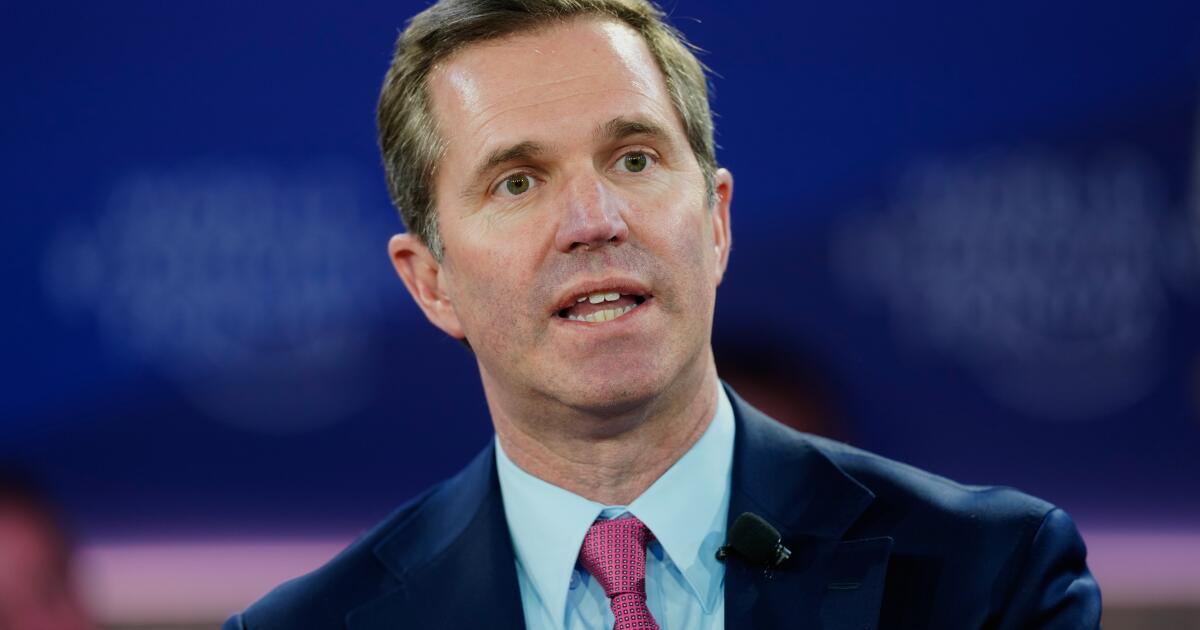
Flying far below the heat-seeking radar, Kentucky Gov. Andy Beshear leaned into the role of economic ambassador, focusing on job creation and other nutsy, boltsy stuff that doesn’t grab much notice in today’s performative political environment.
Like Newsom, Beshear is running-but-not-exactly-running for president. He didn’t set out to offer a stark contrast to California’s governor, the putative 2028 Democratic front-runner. But he’s doing so just the same.
“I think by the time we reach 2028, our Democratic voters are gonna be worn out,” Beshear said during a conversation in his state’s snowy capital. “They’re gonna be worn out by Trump, and they’re gonna be worn out by Democrats who respond to Trump like Trump. And they’re gonna want some stability in their lives.”
Every candidate enters a contest with a backstory and a record, which is condensed to a summary that serves as calling card, strategic foundation and a rationale for their run.
Here’s Andy Beshear’s: He’s the popular two-term governor of a red state that three times voted overwhelmingly for Trump.
He is fluent in the language of faith, well-liked by the kind of rural voters who have abandoned Democrats in droves and, at age 48, offers a fresh face and relative youth in a party that many voters have come to see as old and ossified.
Beshear’s not-yet-candidacy, still in the fledgling phase, offers a mix of aspiration and admonition.
Democrats, he said, need to talk more like regular people. Addiction, not substance use disorder. Hunger, not food assistance.
And, he suggested, they need to focus more on things regular people care about: jobs, healthcare, public safety, public education. Things that aren’t theoretical or abstract but materially affect their daily lives, like the costs of electricity, car insurance and groceries.
“I think the most important thing we should have learned from 2024 is [Democratic voters are] gonna be looking for somebody that can help them pay that next bill,” Beshear said.
He was seated in the Old Governor’s Mansion, now a historic site and Beshear’s temporary office while the nearby Capitol undergoes a years-long renovation.
The red-brick residence, built in the Federal style and completed in 1798, was Beshear’s home from age 6 to 10 when his father, Steve, lived there while serving as lieutenant governor. (Steve Beshear went on to serve two terms as the state’s chief executive, building a brand and a brand name that helped Andy win his first public office, attorney general, in 2015.)
It was 9 degrees outside. Icicles hung from the eaves and snowplows navigated Frankfort’s narrow, winding streets after an unusually cold winter blast.
Inside, Beshear was seated before an unlit fireplace, legs crossed, shirt collar unbuttoned, looking like the pleasantly unassuming Dad in a store-bought picture frame.
He bragged a bit, touting Kentucky’s economic success under his watch. He spoke of his religiosity — his grandfather and great-grandfather were Baptist preachers — and talked at length about the optimism, a political rarity these days, that undergirds his vision for the country.
“I think the American people feel like the pendulum swung too far in the Biden administration. Now they feel it’s swung way too far during the Trump administration,” Beshear said. “What they want is for it to stop swinging.”
He went on. “Most people when they wake up aren’t thinking about politics. They’re thinking about their job, their next doctor’s appointment, the roads and bridges they drive, the school they drop their kids off at, and whether they feel safe in their community.
“And I think they desperately want someone that can move the country, not right or left ideologically, but actually forward in those areas. And that’s how I think we heal.”
Beshear doesn’t shy from his Democratic pedigree, or stray from much of the party’s orthodoxy.
He’s walked the picket line with striking auto workers, signed an executive order making Juneteenth a state holiday and routinely vetoed anti-gay legislation, becoming the first Kentucky governor to attend an LGBTQ+ celebration in the Capitol Rotunda.
“Discrimination against our LGBTQ+ community is unacceptable,” he told an audience. “It holds us back and, in my Kentucky accent, it ain’t right.”
For all of that, Beshear doesn’t shrink from taking on Trump, which, essentially, has become a job requirement for any Democratic officeholder wishing to remain a Democratic officeholder.
“From insulting our allies to telling struggling Americans that he’s fixed inflation and the economy is amazing, the President is hurting both our families’ financial security and our national security,” Beshear posted on social media. “Oh, and Greenland is so important he’s calling it Iceland.”
But Beshear hasn’t turned Trump-bashing into a 24/7 vocation, or a weight-lifting contest where the winner is the critic wielding the heaviest bludgeon.
“I stand up to him in the way that I think a Democratic governor of Kentucky should. When he’s doing things that hurt my state, I speak out,” Beshear said. “I filed 20 lawsuits, I think, and we’ve won almost all of them, bringing dollars they were trying to stop from flowing into Kentucky.
“But,” he added, “when he does something positive for Kentucky, I also say that too, because that’s what our people expect.”
Asked about the towel-snapping Newsom and his dedicated staff of Trump trollers, Beshear defended California’s governor — or, at least, passed on the chance to get in a dig.
“Gavin’s in a very different situation than I’m in. I mean, he has the president attacking him and his state just about every day,” Beshear said. “So I don’t want to be critical of an approach from somebody that’s in a very different spot.
“But the approach also has to be unique to you. For me, I bring people together. We’ve been able to do that in this state. That’s my approach. And in the end, I’ve gotta stay true to who I am.”
And when — or make that if — both Newsom and Beshear launch a formal bid for president, they’ll present Democratic voters a clear choice.
Not just between two differing personalities. Also two considerably different approaches to politics and winning back the White House.