
gary patterson

Why USC’s Lincoln Riley is ready for a breakthrough fifth season

From behind his new desk, on the top floor of USC’s shining, new Bloom Football Performance Center, Lincoln Riley can gaze out upon a stunning view of the downtown L.A. skyline. It’s a nice perk when rounding out a $200-million facility.

And especially welcomed given that three-quarters of USC’s previous football home, the John McKay Center, could be classified as “subterranean.” But as Riley considers how far he’s come these past five years and how far USC has come in the meantime, the metaphor is just as meaningful to USC’s coach as the cityscape.

This view, this office, this program, really — it was all just a hypothetical when Riley accepted the USC job in November 2021. The wunderkind coach knew he was inheriting a football program in a years-long slump. What he couldn’t grasp was how far it actually fell. And what it would take to drag it back. He’d never even been on USC’s campus.

He admits he didn’t understand quite what USC needed then, in the beginning. Not like he does now, on the doorstep of his fifth season as the Trojans coach.

“There’s no other job like this, not in our sport,” Riley said Thursday. “There are some unique things that make this place really special, but also you have to understand how it works and how to harness it and how to use it, and I think that has probably been the biggest thing.”

“I know what direction we’re heading now. I know so much more about this place and how it works, and that’s been more helpful than just starting over at kind of your normal run-of-the-mill job in college football. … This one is just so unique and different. That’s what attracted me to it. And that’s what’s going to help make it great again.”

Riley certainly knows USC well enough now to understand his time to deliver on that promise is running out. The Trojans are 35-18 through four seasons under Riley, precisely the same record they were under his predecessor, Clay Helton, through 53 games. In that time, USC has yet to reach the College Football Playoff and only once played for a conference title, in Riley’s first season. And it hasn’t beat a ranked team in a true road game outside of L.A.

Meanwhile, the school has gone to great lengths to close the gap that existed between USC and its blueblood counterparts, revamping the whole front-office operation, hiring a Hall of Famer in Gary Patterson to coordinate the defense and investing millions in NIL in the nation’s top recruiting class in 2026.

Riley said multiple times this summer that he is now more “well-equipped” to win. And around USC, everyone seems inclined to agree. Meaning any excuse for why the Trojans aren’t breaking through will no longer suffice.

“It’s black and white,” USC general manager Chad Bowden said after last season. “You’re either in the Playoff or you’re not. You either win a championship or you don’t. … I’m sick to my stomach, you know, for people that might be unhappy with winning nine games. They should be unhappy, right?”

Whether nine wins in 2026 would be enough to ensure Riley sees a sixth season at USC in 2027 remains to be seen. Though, just getting back to that mark, with a schedule that includes Oregon and Ohio State at home and Indiana and Penn State on the road, might be more of an uphill climb than it was a season ago.

It would also probably mean falling short of the Playoff. When asked if Riley needed a Playoff berth this season, athletic director Jennifer Cohen told The Times in May she “tries not to think in hypotheticals” but added:

“The expectation has always been the same. I mean, that’s the thing, that’s the reason why I came here, is that the standard is high, that we do expect to make the Playoff. We do expect to have a championship run. We do expect to be competing for championships every single year.

“The expectation, I mean, we haven’t been shy about that. We expect to win, and I feel confident that we’re going to.”

So confident, in fact, that USC pasted its season mantra on billboards across the Southland, each of them not-so-subtly declaring that the “THE TIME IS : NOW”.

The message feels, in many ways, meant for Riley. And he isn’t shying away from it.

“Hell, that’s why I came here,” Riley told The Times this summer. “It’s progressively gotten better and better, I think to a point where everybody should be excited and the expectations should be through the roof.”

It’s hard to argue with the positive signs so far. The No. 1 recruiting class is already making a major impression, with five true freshmen earning starting spots and over a dozen appearing on the initial two-deep. With a top returning quarterback in Jayden Maiava, real depth along the offensive line and one of the Big Ten’s best backfield tandems in Waymond Jordan and King Miller, USC should once again have one of the nation’s top offenses.

The questions, as always, are on the other side of the ball. But in Patterson, Riley appears so far to have found someone he considers an equal on defense, the yin to his yang.

“You feel his presence in terms of the mentality of the group and how he pushes and pushes and pushes,” Riley said. “He’s very aggressive, and you never have to wonder about how he’s feeling or where he stands. For a little bit, I think it took our players some getting used to. It was a little different of an approach than what they had out of that position. But I think they’ve come to understand and respect the intensity that he brings every day and the demand for greatness. There’s no question on the practice field that you feel that from him.”

Riley, meanwhile, has not seemed like a head coach who’s feeling the heat heading into a make-or-break season at USC. In fact, with everything hanging on this season, he seems more at ease than ever.

“It’s taken a lot to come from where it was four years ago to now, a lot of people,” Riley said. “And so, I don’t want us to be bashful about it now. We’ve gotta go do it. And that’s the fun part of this. And it’s fun feeling like that you got the opportunity to do anything and everything that you want to do.

“I think this year will be the start of a run where USC football, we’re gonna feel like that for a while. That’s what we came here to do.”
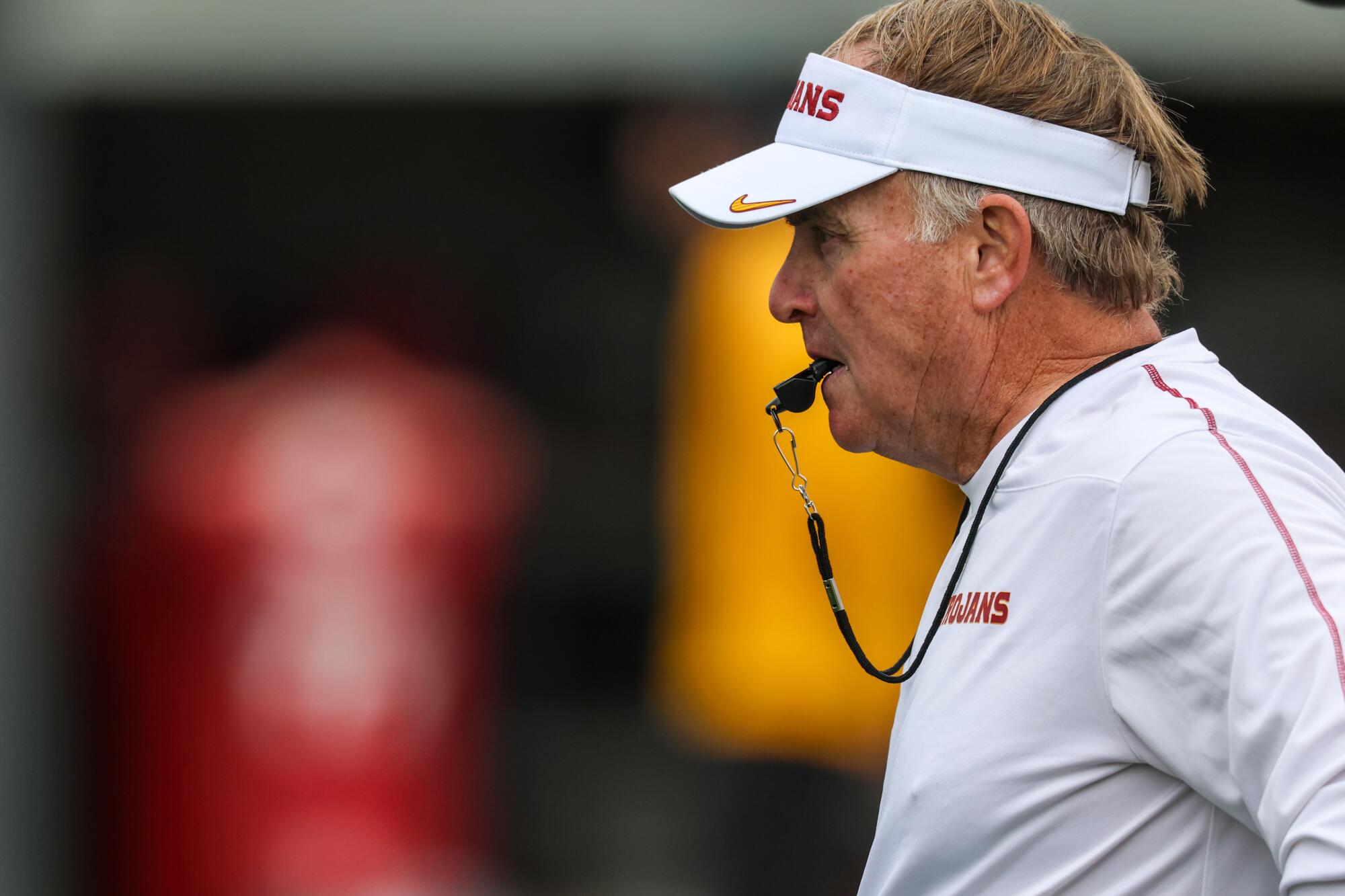
Source link

USC’s Gary Patterson out to prove college football critics wrong

As an aspiring young quarterback at Muleshoe High in the early 2000s, Lincoln Riley attended a football camp at Texas Christian University, run by a coach known even then as a mastermind of defense, a man whose ideas and 4-2-5 scheme would one day be disseminated across college football.

Gary Patterson had just been elevated from defensive coordinator to head coach at TCU, a job he would occupy for the next two decades. Around the same time, his staff saw something in Riley. They talked briefly about giving him a shot at safety on Patterson’s vaunted TCU defense.

“Needless to say,” Riley told The Oklahoman in 2018, “it didn’t turn out.”

But a quarter-century after first crossing paths at that camp, it’s now the young quarterback giving the old ball coach a chance to prove himself.

When USC announced it was hiring Patterson as Riley’s defensive coordinator in January, ears perked up across college football. On one hand, Patterson, 66, is a freshly minted College Football Hall of Famer and one of the great defensive minds of the modern era. On the other hand, he hasn’t led a college football team since 2021, when he was forced out at TCU, and a lot has changed in the sport since. Not to mention it’s been more than 25 years since Patterson last served as a coordinator.

Those were fair concerns, considering all that’s riding on Riley getting it right with Patterson, his third defensive coordinator in five seasons. But after seven months with him on the job, you won’t find anyone at USC — players, coaches or administrators alike — with an ounce of distress over Patterson’s stamina.

“I think I would have had more reservations had I not known him,” Riley said. “But that fire still burns very, very hot.”

That much was obvious in the spring when Patterson jumped into the middle of a tackling circuit to teach proper technique, and ended up running through the whole drill. He even delivered a blow at the end.

“He knocked the guy back,” said safeties coach Paul Gonzales, who coached with Patterson for a decade at TCU. “For a 60-year old guy, he still got some pop.”

USC defensive coordinator Gary Patterson watches practice in March.

USC defensive coordinator Gary Patterson watches practice in March.

(Robert Gauthier / Los Angeles Times)

Riley is betting big on that translating to the Trojans’ defense this fall. Over his four seasons as USC’s coach, there’s no mistaking what’s held Riley back from reaching the same heights at USC as he had at Oklahoma. The Trojans finished 124th, 104th, 87th and 65th in yards allowed per play during those years.

At TCU, Patterson’s defenses finished No. 1 in yards allowed five times during a 10-year stretch. Yet in the second half of his tenure at TCU, there was a noticeable decline, as his defenses finished in the top 25 of that same category just twice.

It was during that time that Riley’s offense went toe-to-toe with Patterson’s defense on numerous occasions. Riley, who was in his first head coaching job at Oklahoma, got the better of Patterson in each of their four meetings, piling up at least 498 total yards each time out.

“There was never anyone who was more of a pain to gameplan for or try to move the ball against than this guy,” Riley said.

During his five years away from coaching, Patterson said he actually spent more time studying the game than he had at TCU, where he was often consumed with other responsibilities. After consulting briefly at Texas and Baylor, Patterson took a job with an Amazon college football show, he says, primarily for the subscription service that came with it. Every Sunday morning, he’d watch whatever college game he wanted, just to stay fresh.

When he did return to coaching, Patterson didn’t just want to install the same scheme he used at TCU. So he closely studied Ohio State and Indiana’s defenses, which gave up a combined 32 touchdowns last season — seven fewer than USC’s defense (39). He took cues on how both clamped down better than anyone else in the red zone, where they each allowed opponents to convert touchdowns just 37% of the time.

“All I did was do football,” Patterson said. “I mean, it’s like getting married. I mean, it’s like I got nothing else. I wasn’t doing anything else.”

Those habits haven’t changed at USC. When other assistants took time for vacation this summer, Patterson stayed in the facility. He wanted to hone in on how to install his defense for a second time this fall. So he came in every day before 7 a.m., in a mostly empty office — just to beat the traffic.

“You want to change things, it’s a full-time job,” Patterson said. “It’s not one of those things that you do 70 or 80% of your time.”

It also gave him time to get to know his new players, each of whom have been summarily stunned by their veteran coach’s vitality.

“I don’t know how old he is, but he‘s out there like he’s 30,” linebacker Desman Stephens said. “He‘s still being active with us. He’s showing us drills. Like, if he want it done right, he gonna show you the exact way how to do it.”

So far, at USC, Patterson has had his hands on just about every detail of the defense. Which is precisely what Riley envisioned after watching him coach at TCU — and why he wasn’t worried about the game passing Patterson by.

“He was such a hands-on head coach,” Riley said. “He wasn’t a head coach just kind of doing a practice schedule, doing the speech, getting out early. He didn’t just straight CEO this thing, right? He was still calling defense, still game planning. He was very involved in every aspect of that program through all those years.”

USC defensive coordinator Gary Patterson fist bumps linebacker Desman Stephens during practice on Aug. 5.

USC defensive coordinator Gary Patterson fist bumps linebacker Desman Stephens during practice on Aug. 5.

(Eric Thayer / Los Angeles Times)

He won’t have to do that at USC. And Patterson seems perfectly fine with that.

But while others still wonder if he can make a successful return to college football, with a scheme that hasn’t been tested since 2021, Patterson is pretty confident his decades of experience count for something, too.

“It’s an advantage for me compared to somebody that’s 30 years old and doesn’t have kids, never been married, doesn’t know what it’s like to grow somebody up and raise a family and do things,” Patterson said.

“This is, I think, my 45th season. … “There’s not a lot of guys in this profession of the age where you can go back to all the things that I’ve learned through all the years.”

Source link