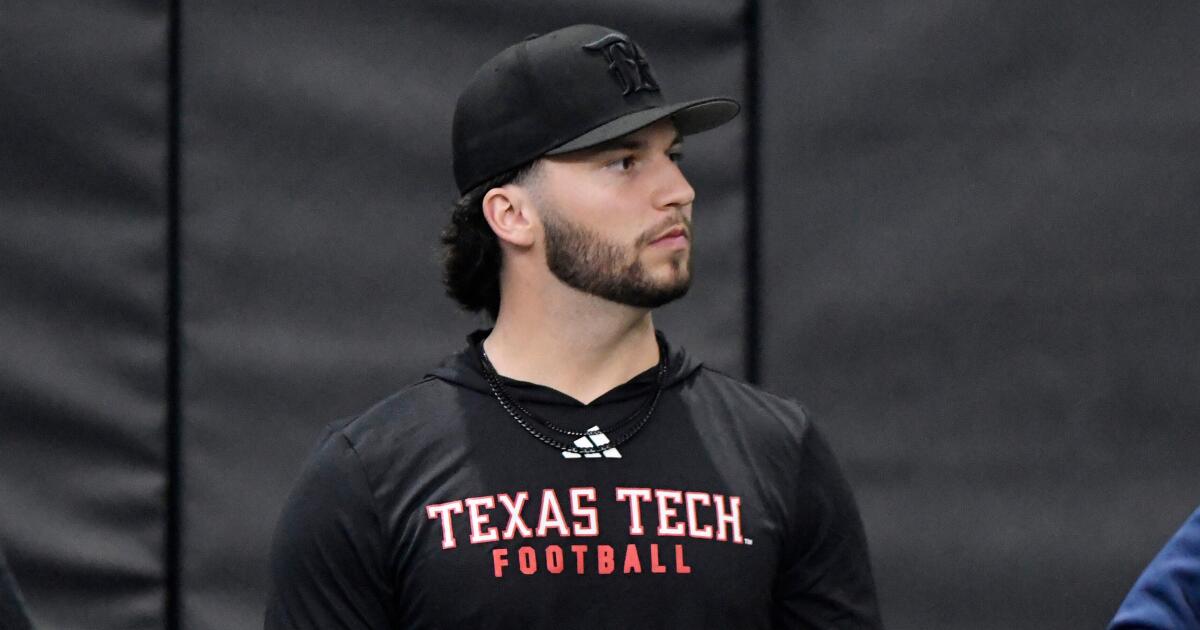
Texas Tech QB sues NCAA to play in 2026 despite gambling infractions
Texas Tech quarterback Brendan Sorsby has sued the NCAA in an attempt to be allowed to practice and play with the Red Raiders in 2026, his final season of college eligibility.
Late last month, Sorsby and the Red Raiders announced that the fifth-year player had entered a residential treatment program for gambling addiction and would be away from the team for an indefinite period of time.
A lawsuit filed Monday in Texas’ Lubbock County District Court requests that Sorsby be declared eligible for all team activities because the NCAA “failed to comply with its contractual commitments” to him as a student-athlete and therefore “is precluded from enforcing its gambling bylaws against Mr. Sorsby to deny or withhold his reinstatement.”
The filing also asks for “temporary and permanent injunctive relief enjoining the NCAA from interfering with his ability to practice, play, and participate fully as a member of the Texas Tech football team for the 2026 season.”
If he remains ineligible for college football, Sorsby intends to declare for this summer’s NFL supplemental draft. Athletes who enter that draft forfeit all remaining college eligibility.
“The relief is narrow: one student-athlete and one senior season,” the filing states. “The NCAA will suffer no cognizable harm from letting Mr. Sorsby play football while this case proceeds. But if this Court does not act, no future judgment can give Mr. Sorsby what the NCAA will have taken from him.”
As a freshman at Indiana and a low-ranked quarterback on the Hoosiers’ depth chart, the lawsuit states, Sorsby “placed small bets — typically between $5 and $50 — on the Indiana football team to win or for teammates to exceed expectations. He was not traveling with the team, and not privy to game plans; betting was his way of feeling connected to a team he could only watch from the sidelines.”
The most recent NCAA guidelines about sports wagering state that student-athletes who bet on their own games or on other sports at their school could “potentially face permanent loss of collegiate eligibility.”
Sorsby stopped betting on Indiana football once he became the backup quarterback, according to the filing, and since then hasn’t bet on any of his teams (he transferred to Cincinnati in 2024 and to Texas Tech this offseason). However, the lawsuit states, “his gambling escalated into a compulsion he could not control.”
According to the filing, Sorsby and Texas Tech were notified by the NCAA in mid-April that it had opened an investigation into the quarterback’s gambling.
“Mr. Sorsby did not deny, deflect, or delay in response,” the lawsuit states. “He immediately admitted to Texas Tech that he had placed bets in violation of NCAA rules, but he also emphasized that he never bet on a game he played in and never took any action to influence the outcome of any game because of a bet. He recognized he had a gambling addiction.
“In response, Texas Tech determined that it would declare Mr. Sorsby ineligible, as required by the Bylaws. But unlike the NCAA, Texas Tech decided to support him in seeking treatment for his addiction and to seek reinstatement of his eligibility in light of the undisputed evidence that Mr. Sorsby had not committed any integrity violation; his gambling was the product of a mental health disorder.”
The lawsuit states that Texas Tech has made multiple attempts to initiate Sorsby’s reinstatement with the NCAA. “Throughout the process, the NCAA has arbitrarily stalled at every turn,” the filing states, “despite the fact that it knows that the clock is ticking for Mr. Sorsby.”
The NCAA said in a statement to media outlets Monday that it “has not received a reinstatement request for this case.”
“The NCAA generally doesn’t comment on pending reinstatement requests, but the Association’s sports betting rules are clear, as are the reinstatement conditions,” the NCAA said. “When it comes to betting on one’s own team, these rules must be enforced in every case for the simple reason that the integrity of the game is at risk. Every sports league has these protections in place, and the NCAA will continue to apply them equally because every student-athlete competing deserves to know they’re playing a fair game.”
Texas Tech said in a statement emailed to The Times: “After finalizing an agreed-upon stipulation of facts between Texas Tech University, the NCAA and Brendan Sorsby, the University has declared Sorsby ineligible for competition. Texas Tech intends to quickly initiate the reinstatement process.
“Texas Tech’s primary focus remains supporting Sorsby’s health and well-being.”