It’s not only easy to get lost in the Los Angeles County Museum of Art’s new David Geffen Galleries, it’s inevitable, intentional — and one of the best things about the place.
The museum has deconstructed the traditional, boxy narrative of art history and rendered the story itself a matter of curves and continuities. Art in the collection is freed from its departmental silos and put into conversation across genre lines, place and time.
The museum has physically invalidated the binaries of center and periphery, major and minor arts. In a startling and largely gratifying way, LACMA has done what the poet Audre Lorde, alluding to a different but not unrelated aspect of patriarchal dominance, deemed impossible: used the master’s tools to dismantle the master’s house.
The change goes far beyond a remodel. It’s a reinvention, a recalibration, a revisionist fever dream.
The vision conceived by museum director and Chief Executive Michael Govan and architect Peter Zumthor is not perfect, and brings with it a modest set of frustrations, but as a whole, the installation registers as ravishing and bracingly fresh. It thrusts us midstream into the ageless, ceaseless flow of makers worldwide reckoning with life, earth and being.
It prompts us, as we bob about, to reflect on our own proclivities and preconceptions, our patterns of reception and perception.
It compels us to recognize that what matters is not just what we see in the museum but how we see, what pulls us close and why, what private histories we bring to the occasion, what expectations, what tools.
Over two visits to the new building, getting my physical bearings mattered less and less as I surrendered to the generative sensations of not knowing. The museum has produced a dense guidebook to the new galleries, whose title, “Wander,” doubles as invitation and imperative. Even at 430 pages, the book is only minimally useful as an orientation device. For help with that internal navigation, Rebecca Solnit’s moving 2005 book, “A Field Guide to Getting Lost,” proved a better compass.
LACMA’s guidebook to the David Geffen Galleries, called “Wander,” doubles as invitation and imperative.
(Museum Associates / LACMA)
Solnit, citing the cultural critic Walter Benjamin, writes, “to be lost is to be fully present, and to be fully present is to be capable of being in uncertainty and mystery.” She goes on to recall how roaming freely as a child was key to developing self-reliance, which feels apt to the LACMA strategy. We are put in charge of making our own way, through tapestries and tea sets, past ancient jug and contemporary sphinx, without heavy-handed authoritative direction.
The history of art reads here as one long, free verse poem-in-progress, gorgeous and absorbing. Even so, many of the most memorable moments come in the form of cogent micro-essays, smartly curated ensembles of work bearing a legible, lucid premise. Some of these are contained within four (rectilinear) walls; some occupy less demarcated spaces. “Tonal Variations: Photography and Music,” for instance, gathers images by Paul Caponigro, William Eggleston, Lisette Model and others. These artists were also serious pianists, attuned, no matter which instrument they were using, to the qualities of rhythm, pattern and progression.
Lisette Model, “Window at 5th Avenue,” 1940, Los Angeles County Museum of Art
(Museum Associates / LACMA)
In a section headed “The Global Appeal of Blue-and-White Ceramics,” a long display case houses a timeline articulated sculpturally. The sequence advances from a 9th century bowl made in Iraq to a 13th century vessel from China, a 14th century example from Thailand, another from 15th century Syria, up to work by a 20th century German artist who transformed a functional vessel into personal adornment by cutting a string of beads out of the planar surface of the bowl.
Dish, Turkey, Iznik, c. 1530-35, Los Angeles County Museum of Art
(Museum Associates / LACMA)
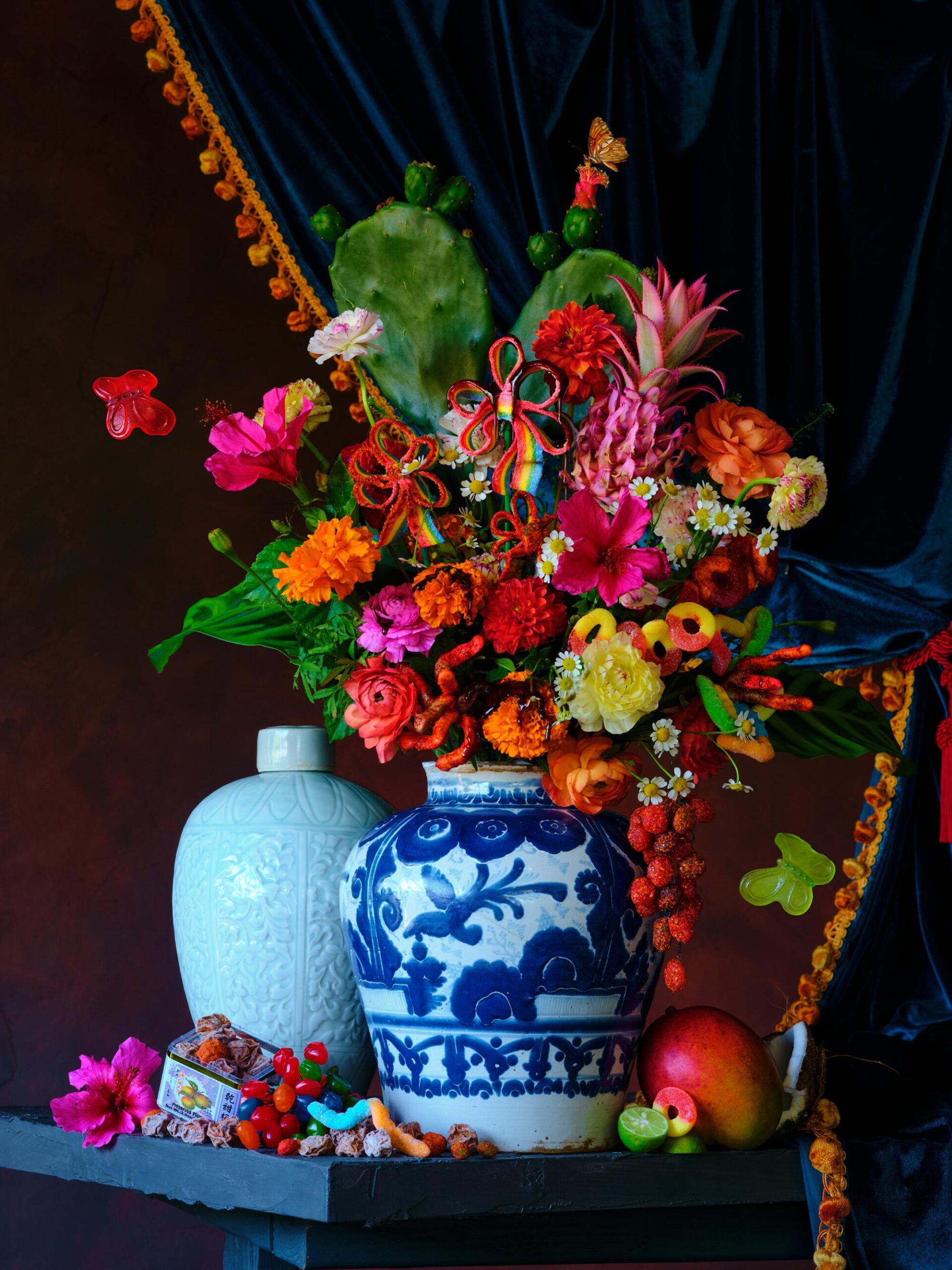
On the wall facing this display is a huge vitrine containing an 18th century Talavera jar from Mexico, paired with a 2025/26 color photograph by Brooklyn-based Stephanie H. Shih. In the still-life composition, a cheeky visual lesson on the collision and convergence of cultures, the jar holds flowers, cactus and edible Mexican treats influenced by Chinese and Filipino flavors.
Top, Stephanie H. Shih, 梅國 “(Still life with chamoy and Dirty T Tamarindo),” (2025- 26); bottom, Jar (c. 1700-50)
(Museum Associates / LACMA)
Shih is one of a handful of artists commissioned to create new work using the museum’s collection as muse. L.A.-based Lauren Halsey is another. Her formidable, untitled 2026 sphinx regally commands its space among ancient Egyptian and Roman sculpture, a marvel of the cross-temporal and cross-spatial, spiked with specific references to Black self-determination.
Setting recent works among older ones is an effective element of LACMA’s overall plan to shed outworn hierarchies. It recasts every piece of art by every artist throughout the single-story space as equally relevant. The seamless integration of old and new feels stealthy, and a touch subversive, a doubling-down on the museum’s approach to time as nonlinear, sinuous and delightfully slippery.
Lauren Halsey’s untitled 2026 sphinx.
(Museum Associates / LACMA)
That said, a few words readily available would help connect the dots without undermining the provocation. Text — where and how it appears, or doesn’t — is my only major complaint about the installation of the new galleries.
Text panels announce, in one or two paragraphs, the themes of each given section: “Images of the Divine in South Asia”; “The Evolution of Abstract Painting in Modern Korea”; “Textile Conversations: Africa and Black America.” Individual object labels are kept minimal, containing only basic identification about each work, no commentary. When asked about this decision during my first walkthrough, Govan replied that more time reading means less time looking — “and we have the internet.” Every thematic text panel has a QR code that links to the Bloomberg Connects app, an aggregate guide to museums and other cultural sites that offers selected, augmented entries.
Determining how much didactic information is insightful and sufficient, and how much constitutes excessive artsplaining, is a delicate, ongoing challenge for museums. Where LACMA landed on this contested plain strikes me as unfortunate and counterproductive.
A few lines of explanation or context on a wall label can add perspective for even the most informed visitor, and provides crucial support to those with less foundational exposure and access to art.
You can take or leave text on a wall without breaking your stride, but text accessed via QR code is another matter. (Never mind that connectivity is spotty inside a sprawling concrete shell, and several times when I tried to get information from the app, I couldn’t.) Encouraging us to shift our gaze from the wall to our devices — to assume that accursed downward tilt of the neck when splendors abound before our eyes — is simply detrimental. It breaks the spell of being fruitfully lost in the present, and retethers us to the digital distractions that dominate our days.
Wall text beside Francis Bacon’s “Three Studies of Lucian Freud” (1969), at Los Angeles County Museum of Art.
(Museum Associates / LACMA)
Shouldn’t the imaginative minds that created this space, this opportunity to revel in direct sensual experience, want us to keep our attention where our bodies are? Why this fallback to current convention, when the rest of the experience is about radical reinvention? This feels like a missed opportunity. I’m hoping a more experimental, exploratory approach to providing information, context and interpretation, in keeping with the rest of the enterprise, might yet come.
Does the new structure serve the art? Mostly, very well.
The lighting is varied, treated as another texture in the space, palpable and rich. There’s a generous amount of natural sunlight, but some spots are noticeably dim. Some gallery walls are glazed in deep hues (reddish and eggplant), and the intensity of the color is jarring at first. But neutral, white-box viewing spaces (with even, predictable lighting) can be found elsewhere on LACMA’s campus and pretty much anywhere art is shown. Here, the very irregularity of the interior environment, including the concrete surfaces — richer and more textured than I expected — heightened my alertness. And keener senses tend to make for more consequential experiences.
In deciding how to organize roughly 2,000 works of art across 110,000 square feet of exhibition space, LACMA devised a conceptual schema that isn’t apparent in the galleries themselves. The “Wander” guide maps out the division of the space into four regions correlating to bodies of water: the Indian, Atlantic and Pacific oceans, and the Mediterranean Sea. While the zones and their boundaries aren’t indicated by obvious signage, and I caught one laughable categorization (Ansel Adams’ photographs of the Pacific shoreline landing in the Atlantic section), this schema at least doesn’t get in the way.
And what does work about the propositional structure is its comprehensive realignment. It moves to retire art historical frameworks of the past, dependent on borders between places and times.
Throughout this installation, we are repeatedly reminded of the impact of trade and migration, the fluid movement of resources and belief systems. We’re reminded of porousness and simultaneity, and that all art histories are, in the end, propositional structures.
Here’s a new one, the Geffen Galleries say. Try it out. You might get lost. Indeed, you will get lost. And what wonders await you in the uncertainty and mystery.
During a recent Zoom interview from his studio in Switzerland, Peter Zumthor offered a candid look at the making of the Los Angeles County Museum of Art’s new David Geffen Galleries.
The Pritzker Prize-winning architect addressed long-standing criticisms of the building and answered questions about his craft. He noted that the structure is a rejection of the overly “slick” architecture he believes defines the present moment, and shed light on the building’s early development, describing a contained process in which the concept was shaped before being presented to the public.
Finally, he discussed the broader ambition of the endeavor: dissolving traditional circulation and prioritizing emotional experience over institutional order.
The following interview excerpts have been edited and condensed for length and clarity.
You are well–known as both an architect and a craftsman. I think the biggest place for that focus was the concrete. I’m curious about how you formed it. It’s not the typical museum concrete.
I work like an artist in building. This means I custom-make buildings. I can use a few standard details or products, like in the basement. But where the building has an identity, becomes visible, it’s almost all handmade. I have an image of what I want to do, what the building should do, how it should look. So I need people who can help me make custom-made products.
The people who did the formwork — the concrete pouring — [worked in] groups of 100 or more. They were fantastic. They loved their work. At the beginning, formwork leaked on a door, and it looked terrible. They said, “Peter, we’re sorry. We made a mistake. We can fix this. You will not see this afterwards.” But if you make a mistake, you cannot mend it, because what you’re doing here is a concrete sculpture. Sculptures are never mended.
It’s not a perfectly smooth concrete. I’m assuming that’s on purpose?
I love this kind of rawness. This was what I gladly learned. Michael [Govan] in a very friendly, careful way let me know that he would like more “American details” and fewer “European details.” OK, my European details, they stand. That’s what I did 20, 30 years ago. My background as a furniture maker shows, and I can do this. But the challenge in this museum is to get the right “American” roughness. And I think I pretty much succeeded.
What I learned in California [came] back to Europe, and many times we now say in the office, “Let’s do this more L.A.-style.” Because we have too many slick magazines in the world. We have this corporate architecture which doesn’t want to see any touch of a hand. No mistakes. What we need is not refinement. We need wholehearted directness. This is what I take back from America. There’s a certain freshness. It’s not overly refined. I’m proud of that. The roughness has to do with our times. Because our time is slick and glossy, right? The time to make refined, slick architecture is over.
Horizontal light enters from floor-to-ceiling windows around the perimeter of LACMA’s new David Geffen Galleries, which use concrete as a kind of living building material.
(Iwan Baan)
In a 2023 interview with [architecture critic] Christopher Hawthorne, you said there were no “Zumthor details” left in the building. Do you think there are any Zumthor details now?
Of course there are Zumthor details. And I love them. They are not Swiss details. I think Christopher got this wrong. I was actually proudly speaking of how I learned a new way of looking at details. It doesn’t have to be refined all the time.
[Editor’s note: Zumthor told Hawthorne verbatim, “There are no Zumthor details any more,” in the 2023 interview with the New York Times.]
There’s always a tension with every building when it comes to value engineering. Were there any other places where you would want [David Geffen Galleries] to be different?
Basically, I say no. I’m very proud of this building. This is what I wanted to do, and this is what Michael helped me to do. This is exactly it. It’s one of my children and I love it.
Do you see this approach as an evolution in your work? Or is it more specifically for L.A.?
L.A. has changed me. And it’s in a good way. I would [not] have changed and reacted to our slick times the same way without L.A.
There were complaints that the project, and the process, were not as public as some people thought they should be. What is your reaction to that criticism?
I think I can say this: Michael said, “We cannot make a competition or anything like it, because competitions in the U.S. always end up with a winner who doesn’t build because he found out his own way of staging this whole procedure. The first, the most important thing, is that we start on a small budget, just the two of us.” That’s what we did. So when we started to talk about this museum, it was him and me, basically, and he gave me a little bit of money. And he said, “There will come a time when we will have to show something to the public. Let’s see whether people say yes.” They could have said no, but I think what they saw at that point was already too convincing.
Architect Peter Zumthor speaks at the press preview for the David Geffen Galleries at Los Angeles County Museum of Art.
(LACMA/ Museum Associates / Gary Leonard)
Because the museum’s not organized in a traditional way, it might be harder than normal to navigate for some people. It might be a little confusing. What do you say to that concern?
This will take some time, to see the benefits of this new type of museum. I think if you start to like this building in one corner or in another, or you get lost, you start to understand what it is all about. When something new comes, you have to learn, right? But I hope you can see this building never looks down on you. This building is, in a way, deeply human. And it lets you have your opinion.
There are people who have said, very loudly, this space shouldn’t have lost square footage. What is your response to that?
Small museums are beautiful, big museums tend to be really difficult. And the bigger the museum gets, the more difficult it is to make it easily accessible. So I’m very glad that this is not bigger. But it feels bigger.
What is this with bigness? What kind of a hang-up is this? You don’t have to be big. It has the right scale. We were often asked, “Can you experience this building and this collection in one day?” And we said, “Maybe. But maybe it will be better to come back.” Start from the other end. You have your own personal path. And then you research a little bit further. I think these are the beautiful ideas of how to experience the building. And I think it’s endless.
The interior of LACMA’s new David Geffen Galleries encourages guests to wander and make their own connections rather than follow a linear path.
(Eric Thayer / Los Angeles Times)
Can you go back to the beginning and talk about the core concept for the museum?
There are three major things that I always have to answer, whatever I do. What does the building do with the place? Does it help the place? Does it interpret the place? And then, what is the content of the building? What does the building have to do? Why are we building this?
To start out, there was a museum here which was modeled a bit after Lincoln Center. Later, it got clogged up with new buildings and you didn’t recognize the initial idea anymore. These things we took away. Whenever a building is there, whether it’s beautiful or ugly, it will always have grown into the soul of somebody. There will always be people saying, “No, no, I want to keep it.” This is part of my life. I understand this kind of thing always comes up.
The place was rather difficult because I couldn’t see any big urbanistic concept in L.A. L.A. [is] not urban in the European sense with, for instance, the market square.
There was a master plan, which was made by Renzo Piano. And this presented a long axis, and I tried to follow it. It just did not feel right. So I started to react in a more organic way, inspired by the tar pits. This whole area, which to me, is the ancient part of the site, became the starting point.
There was more: like the idea that side light is the most human light. Yeah, no skylights. And another thing was the museum had to be open to its surroundings. So contemporary L.A. should be present at all times. It should come in, whenever you can look out.
Another important thing … was to create or enlarge the public space that Michael [Govan] had started to create between his buildings. Friday evenings, Saturday, you saw so many families there. There is a desire here, a wish, for public space. This is not exactly the strength of L.A. So I think it was amazing that we were allowed to lift up the building and have the whole ground free for people.
Also, let’s do the museum on one level only. Classical museums have a main level, then they have a second level and a third level, a south wing and north wing and so on. And then, as an artist, you can have your work on the main level in the most beautiful spot. But as an artist, you can also land top left, third level near to the attic. So let’s make a building type which treats everybody equal.
LACMA’s David Geffen Galleries are hoisted above the ground on discrete piers, allowing for ample public space below.
(Eric Thayer / Los Angeles Times)
And then we started to think about how we wanted something open for wandering, experiencing and dreaming. This is always difficult to explain — let’s have the knowledge of art, of the history of art, coming second. It’s not because I think this is a secondary thing. It’s just because our experience should come first.
As a boy, I saw the opposite. There’s a tour and there’s a guide, and the guide starts to tell you what you should think. And I never liked this. We thought we should lay out things on a big plane where you can stroll and wander and develop your interest in art. Follow your own path.
You’re overturning a lot of unspoken rules in the art world. And I guess that’s the point in a lot of ways?
This is our point. You see other rules. For instance, if you do a new museum, the conservators say art can be exposed to less daylight. I told them as a joke, “If it goes on like this, soon the art will be in the basement, locked away.”
We have a building wide and long enough that within the building, you can find strong daylight for, let’s say, china or pottery, which love daylight. Then you can go deep into the building where it gets darker, and you can put pieces you don’t want to expose too much to the light. All without having to flip a switch.
Finding a revolutionary artist during cocktail hour at the opening gala of Los Angeles County Museum of Art’s new David Geffen Galleries was like shooting fish in a barrel.
Gaze over the rim of your glass to notice Jeff Koons and Ed Ruscha talking closely beside the DJ booth. Mark Bradford strides by with a beneficent smile — towering over everyone, including AI art maker Refik Anadol. Todd Gray, whose 27-foot-long photo sculpture “Octavia’s Gaze” graces the hallway near the building’s south entrance, chats with Wim Wenders, who is making a documentary about architect Peter Zumthor’s controversial new $724 million concrete behemoth. Zumthor is there too — in bright red sneakers — talking to LACMA director and chief executive Michael Govan before Govan turns to take a selfie with immersive installation artist Do Ho Suh.
Jeff Koons, left, talks with Ed Ruscha at the opening gala for LACMA’s new David Geffen Galleries on Thursday.
(Jessica Gelt / Los Angeles Times)
Lauren Halsey walks by in her distinctive white shirt, long shorts and ball cap, beset on all sides by friends and admirers.
“It’s beautiful, it’s fantastic,” she said of Zumthor’s creation.
It’s an artist’s world on this breezy evening, as the sun sets golden over the looming gray concrete of the building, and the lights that gird the structure’s underbelly flicker on and twinkle like stars overhead. In this milieu, Hollywood A-listers like Will Ferrell and Sharon Stone, who occupy separate cliques nearby, pale in comparison to the mingling artistic luminaries.
Architect Peter Zumthor, left, and Michael Govan attend LACMA’s opening gala for the David Geffen Galleries. Govan said he hopes the building lasts 500 years.
(Gina Ferazzi / Los Angeles Times)
“It’s ready for us,” Bradford said of the building. “It’s ready for artists. I walked in and I was overwhelmed with a space that was made for us, and I can’t wait for everything I can do.”
“Snazzy. Does the job,” said Ruscha, looking bemused and speaking in short bursts of headline-style phrases like one of his famous paintings.
Gray said he was glad to see his art during “magic hour,” noting how the setting sun shone warm through the building’s glass windows — diffused by textile designer Reiko Sudo’s chromium spattered curtains — to imbue his photo installation with a distinctive warmth.
“I’ve never seen it at dusk,” Gray said with a smile. “It was a totally different experience to see it at that time of day. And [the light was] actually yellow, so the piece changed … and the concrete warmed up because of that warmer light. It was a lovely chromatic experience, which is wonderful because then you’re aware that you’re experiencing something in a very particular space and time.”
James Goldstein, the owner of architect John Lautner’s famed Sheats-Goldstein Residence, which he promised as a gift to LACMA in 2016, agreed with Gray that the gloaming light was lovely.
“If it were up to me the curtains wouldn’t be closed,” Goldstein said, noting that the curtains in his home — which is also made of concrete and glass — are never closed, and that the views from the Geffen Galleries are extraordinary and worth leaning into.
Koons said the building, and the moment in time that defines its unveiling, has the potential to bring the world together.
“It’s an amazing evening for all these people that love and believe in the value of art and humanity to be together and to celebrate architecture,” said Koons, noting that he looks forward to showing his art inside the new galleries. “LACMA is a place that’s here for future generations and Peter’s building is amazing.”
Will Ferrell and Viveca Paulin were among the major Hollywood stars at the gala.
(Gina Ferazzi / Los Angeles Times)
Chatter about the building could be heard in every cluster of guests. One group talked about how striking it was to see ancient Greek sculptures juxtaposed against the rush of traffic along Wilshire Boulevard; another discussed their hope for more landscaping, noting that the concrete ground and concrete building begged for some lush greenery.
Govan basked in the limelight nearby, shaking hands and doling out hugs and back pats. His vision for the building has been 20 years in the making, and he’s faced an enormous amount of pushback, but the structure is here and his enthusiasm for it has not waned.
“I’ve just always imagined people in the building — it’s for people,” Govan said. “And I want it to last 500 years, I want those little drill marks to accumulate, I want change. I want this to be something that generations will care for.”
Zumthor also seemed deeply pleased with the moment, saying, “I’ve always been happy,” and emphasized that working in L.A. taught him to embrace a certain frontier-like lack of refinement.
LACMA’s staff was elated, especially those who have been watching the project develop for decades and absorbing the large amounts of criticism that have accompanied its manifestation.
Stephanie Barron, LACMA’s senior curator and modern art department head, said, “This is the first night with our art world colleagues and donors, and it’s thrilling to see how they are responding, and how they are a little confused, at first, about where to go. Then they realize, that’s the point of this — and they are just going with the flow and they are smiling and happy and looking at the art. It’s a game changer.”
“I’ve been here nearly 20 years and seeing this going from concept to reality has been the greatest thing,” said Tiffany August, associate vice president of LACMA’s people and culture department, which oversees human resources. “So much soul and heart and effort went into this.”
Arun Mathai, budget officer and head of finance, has also been with the museum for 20 years and said it’s exciting to finally be on the other side of the project. “To see it happen in such a beautiful way is very gratifying. The notion of no hierarchy, of wandering around and seeing art from all over the world, from all time periods beautifully juxtaposed, it’s just so enlightening,” Mathai said.
Michael Govan, left, Peter Zumthor, Holly J. Mitchell and Mayor Karen Bass attend the opening gala.
(Gina Ferazzi / Los Angeles Times)
Later, during a four-course meal of broiled oysters, tuna tostadas, braised Wagyu short ribs and berry meringue, various LACMA supporters, including board co-chair Tony Ressler; life trustee and major donor Lynda Resnick; and L.A. County Supervisor Holly J. Mitchell, whose district houses LACMA, took to the stage in a tent set up west of the new building to sing the praises of the Geffen Galleries — and to note that the evening’s dinner raised a record-setting $11.5 million. (The Geffen Galleries’ ongoing fundraising campaign now stands at $869 million.)
“This is a great, great example of what can be achieved when government and philanthropy work hand in hand for the public good,” Ressler said before thanking Govan for “taking bold risks.” “Your legacy is now permanently etched in the stunning galleries that will open to the public very soon.”
Mitchell was full of praise for Govan and Zumthor.
“The Geffen Galleries didn’t come to fruition overnight. And frankly, nothing that changes the status quo ever does,” Mitchell said. “To Michael, Peter, David [Geffen] and our dear Elaine [Wynn], thank you for your patience, because visionaries like yourselves often have to wait for the rest of the world to catch up with you.”
Resnick got a big laugh when she described her first meeting with Govan and his wife 21 years ago.
“An exquisite couple walked into [vice chair of the board] Bobby Kotick’s house. There was Michael Govan, a true intellectual, Zen thinker, movie star handsome, and under consideration to run LACMA. By the end of the evening, I was sitting on his lap feeding him peeled grapes.”
She concluded on a more serious note, calling the Geffen Galleries a “masterpiece of public art.” “Only one person in the world could have done all this with the signature elegance and his provocative style,” she said of Govan. “Generations will cross that bridge and watch the cars stream below, and feel the power of being embraced by art above all the gorgeous chaos of our city.”
After a standing ovation, Govan introduced musicians Sean Watkins, Gabe Witcher and T Bone Burnett, who sang — quite fittingly — “The Times They Are A-Changin.’”
Want to sip on Hailey Bieber’s Strawberry Glaze Skin Smoothie after staring at Vincent van Gogh’s “Tarascon Stagecoach”? Los Angeles County Museum of Art has got you covered.
The museum announced Tuesday that it has partnered with Erewhon, the high-end L.A. health food chain and retailer, on a cafe located on the ground level of its new David Geffen galleries. The cafe, which has outdoor seating beside Alexander Calder’s fountain sculpture, “Three Quintains (Hello Girls),” will open Sunday for LACMA members visiting the David Geffen Galleries. The general public can get in on the coveted buffalo cauliflower when the new building opens to the public on May 4 — with the partnership continuing through the summer. No definite closure has been announced, so it’s possible the collaboration continues.
“We’re so proud to partner with LACMA, a meaningful milestone as our first museum collaboration,” said Tony Antoci, CEO and owner of Erewhon, and Josephine Antoci, president and owner of Erewhon in a statement. “It really feels like a celebration of Los Angeles, bringing Erewhon and LACMA together to nourish and inspire the community we love.”
The collaboration between the store, which enjoys a cult-like following, with one of the city’s most anticipated new cultural offerings is expected to draw an eager crowd. Guests can grab a ticket to the museum, or simply enjoy a drink while strolling around the museum’s 3.5 acres of new park space, and taking in a variety of newly installed public artwork including Jeff Koons’ towering topiary sculpture, “Split Rocker.”
Two additional drinking and dining options — a wine bar and a restaurant — will open later this year, but no establishments have been named yet for those spots.
Erewhon at LACMA will be open during museum hours.
This week saw the publication of The Times’ tremendous package on the imminent opening of Los Angeles County Museum of Art’s new David Geffen Galleries. The nearly $724-million new building designed by Pritzker Prize-winning architect Peter Zumthor, which opens to members on April 19, with general admission beginning May 3, has been a lightning rod for split opinions for nearly two decades — and it seems not much has changed.
Each article attracted its fair share of reader comments — for and against — the new building. I’m rounding up nine that best reflect reader consensus. (Note: Comments don’t have formal names attached.)
1. “Ugh. I hate that building. It does nothing to activate the street itself and Wilshire should be an active urban street with thousands of people walking. The design is a puddle of oil seeping high above and across the boulevard that conflicts with its surroundings. For all of that gross amount of money spent it should be universally positively recognized. But it’s not and most of the citizens that have commented about it don’t appear to be too happy with a building its creators expect to exist for hundreds of years. What a blotch.”
2. “One will always wonder: what would Frank have done if he had ended up with the commission for replacing LACMA’s core campus. Did he ever venture to tell anyone what approach he might have pursued?”
A high priest of design has given Los Angeles a plebian concrete maze (period) which demands that visitors ascend one story above the ground plane for the sake of art. Rather than the prospect of random wandering, this respondent wonders whether Mister Gehry may have otherwise had no fear of paying homage to the classical idea of hierarchy, would have elevated our better angels and given us a singular or particular reason (aspiration) to go upwards at a far greater extent, first off, then return to the ground plane mixing formal and random paths.
With Disney Hall he became an emotional hierarch of the city and his discountment from this project will always remain a great tragedy. He understood us.”
3. “I love LACMA’s collection and have been going several times a year for a long time. Very excited to check out the new galleries. Contrary to a lot of other commenters, I find the architecture of the new building fresh and exciting, and I appreciate how it hangs over Wilshire in a manner that incorporates the museum directly into the city.”
4. “I loved the old museum. I really hope I’m wrong, but I’m afraid the new one will be disappointing. Less display space, chaotic organization and galleries that on paper look like warehouse spaces make me wonder how successful the new museum will be. I look forward to visiting and finding out for myself.”
5. “I’m amazed that it is almost 11:00 AM and I am posting the first comment here. Does nobody reading the L.A. Times care about this very expensive reimagining of our County Art Museum, $125 million of which was funded by our taxpayers? What I want to know now is whether any these 17 pieces are adjacently-placed in some idiosyncratic curatorial thematic scheme that will elude both common sense and intuition of most museum visitors? How is this reduced gallery capacity with ever-changing displays providing access to art to the people that helped to fund it?”
6. “I look forward to visiting this museum and experiencing its uniqueness.”
7. “It’s one of the worst decisions in art-world history. Destroy perfectly functional galleries and spend hundreds of millions on smaller galleries. And they are ugly. It’s a mockery of art to place a beautiful painting on those concrete walls.”
8. “I knew there would be a bunch of negative Nellies in the comment section lol. I LOVE the new building and interior spaces (as pictured) I can’t wait to see and experience the unique curatorial displays!”
9. “How exciting for Los Angeles! I can’t wait to see it and love that we now have such a world class forward thinking art museum in L.A. Money well spent.”
I’m Arts editor Jessica Gelt, getting the conversation started. Here’s your arts and culture news for the week.
You’re reading Essential Arts
Our critics and reporters guide you through events and happenings of L.A.
By continuing, you agree to our Terms of Service, which include arbitration and a class action waiver. You agree that we and our third-party vendors may collect and use your information, including through cookies, pixels and similar technologies, for the purposes set forth in our Privacy Policy such as personalizing your experience and ads.
The week ahead: A curated calendar
FRIDAY Blue Kiss An SAT tutoring session takes unexpected twists and turns when a teacher learns his student is not who she claims to be in this drama by playwright Stephen Fife. Directed by Mike Reilly. 8 p.m. Fridays and Saturdays; 2 p.m. Sundays, through May 17. Ruskin Group Theatre, 2800 Airport Ave., Santa Monica. ruskingrouptheatre.com
Camerata Pacifica Principal pianist Gilles Vonsattel performs his second solo recital of the season featuring three piano sonatas by Beethoven. 7 p.m. Friday. Music Academy of the West, 1070 Fairway Road, Santa Barbara; 8 p.m. Sunday. Zipper Hall, 200 S. Grand Ave., downtown L.A. cameratapacifica.org
Danish String Quartet and Danish National Girls’ Choir Two of Denmark’s cultural treasures team up for an evening that includes a new work by Pulitzer Prize-winning composer David Lang. 7 p.m. Friday. Granada Theatre, 1214 State St., Santa Barbara. artsandlectures.ucsb.edu; 8 p.m. Saturday. Segerstrom Center for the Arts, 615 Town Center Drive, Costa Mesa. philharmonicsociety.org
Lise Davidsen and Freddie De Tommaso The celebrated opera singers return backed by an all-star orchestra of classical musicians. 7:30 p.m. BroadStage, Santa Monica College Performing Arts Center, 1310 11th St. broadstage.org
History of the Tango Violinist Martin Chalifour, in musical dialogue with guitarist Mak Grgic, reveals the evolution of Argentina’s iconic style. 8 p.m. Friday and Saturday. Sierra Madre Playhouse, 87 W. Sierra Madre Blvd. sierramadreplayhouse.org
Installation view, “Instant Theatre: Rachel Rosenthal and King Moody,” 2026. Roberts Projects, Los Angeles.
(Paul Salveson/Courtesy of the artist and Roberts Projects)
Instant Theatre: Rachel Rosenthal and King Moody Archival material and design elements set the scene for this exhibition exploring the experimental theatre movement founded by Rosenthal in 1955 and continued with her husband into the 1960s, an antecedent to the performance art of the 1960s and 1970s. Through May 23. Roberts Projects, 442 S. La Brea Ave. robertsprojectsla.com
Spectacular Brooding Writer, dancer and experimental filmmaker Harmony Holiday explores Black grief in this multimedia exhibition involving the preparation of a solo dance piece. On Wednesdays at noon, Holiday will take Katherine Dunham Technique classes with choreographer Bernard Brown in the gallery. Noon-6 p.m. Wednesday-Sunday; Through July 5. REDCAT, 631 W. 2nd St., downtown L.A. redcat.org
Turangalîla Australian conductor Simone Young leads the L.A. Phil, featuring Jean-Yves Thibaudet on piano and Cynthia Millar on the theremin-like 1920s instrument ondes martenot, in Olivier Messiaen’s symphony inspired by the tragic romance of Tristan and Isolde. 8 p.m. Friday and Saturday; 2 p.m. Sunday. Walt Disney Concert Hall, 111 S. Grand Ave., downtown L.A. laphil.com
Tyshawn Sorey Trio Featuring the Pulitzer Prize-winning composer and multi-instrumentalist, pianist Aaron Diehl and bassist Harish Raghavan, this modern jazz ensemble riffs on original compositions and breathes new life into the American Songbook. 8 p.m. UCLA Nimoy Theater, 1262 Westwood Blvd. cap.ucla.edu
SATURDAY The Baptist Witches of Shelbyville Mamie Gummer and Gigi Bermingham star in a new Southern Gothic comedy written by Julie Shavers and directed by Daniel O’Brien. 8 p.m. Saturday; April 17-18, April 25, May 1. Whitefire Theatre, 13500 Ventura Blvd. Sherman Oaks. whitefire.stagey.net
The Ifugao people of the Philippines leaving a harvest, from the immersive exhibition, “Mountain Spirits: Rice and Indigeneity in the Northern Luzon Highlands, Philippines.”
(Fowler Museum)
Mountain Spirits: Rice and Indigeneity in the Northern Luzon Highlands, Philippines An immersion into the world of the Ifugao, an Indigenous Filipino group known for high-altitude farming, via this exhibition’s carved guardians, ritual bowls, woven blankets, farming tools, soundscapes and video installations. Opening, 6-9 p.m. Saturday; Walkthrough, 1 p.m. Sunday; “Decolonizing Philippine History” talk, 6-8 p.m. Wednesday. Fowler Museum at UCLA, 308 Charles E. Young Drive North. fowler.ucla.edu
Mutate L.A. Dance Project presents this selection of multi-medium performances curated by Masha Cherezova, whose relationship to dance changed dramatically when she was diagnosed with acute myeloid leukemia. The evening includes performances from Skylar Campbell, former principal dancer of Canada National Ballet, and dancer Jaclyn Oakley, USC BFA student Garris Munez in a world premiere choreographed by Cherezova, and comedian and breast cancer survivor Julia Johns, plus film screenings from various artists. All profits will be donated to Blood Cancer United. 8 p.m. 2245 E. Washington Blvd., Los Angeles. ladanceproject.org
OperaFest LA The diverse festival returns to celebrate the city’s rich opera community. Participating companies and venues include Beth Morrison Projects, LA Opera, Long Beach Opera, Overtone Industries, Roy and Edna Disney CalArts Theater, Synchromy, the Industry, the Wallis, and USC Thornton School of Music. The opening week features selected performances from various groups and a panel discussion at the Wallis; Long Beach Opera commemorates the release of the first commercial recording of Anthony Davis’ Pulitzer Prize-winning opera “The Central Park Five,” which was commissioned and premiered by LBO in 2019 and remounted in 2022; and the Industry presents composer Veronika Krausas and Her Rogue’s Gallery performing selections from her work, including “Hopscotch,” “Ghost Opera,” “The Mortal Thoughts of Lady Macbeth.” Kickoff Panel & Performance, 4 p.m. Saturday. The Wallis, 9390 N. Santa Monica Blvd., Beverly Hills. 6 p.m. Saturday. “Celebrating the Central Park Five Opera,” 440 Elm, 440 Elm, Long Beach. Veronika Krausas, 7:30 p.m. Thursday. Monk Space, 4414 W. 2nd St., Los Angeles. OperaFest LA continues through May 30. operafestla.org
Temporal Echoes The Los Angeles Chamber Orchestra and music director Jaime Martín are joined by violinist Anne Akiko Meyers for the West Coast premiere of Eric Whitacre’s “The Pacific Has No Memory” and Vaughan Williams’ “The Lark Ascending.” a timeless ode to lyricism and light. Music Director Jaime Martín unveils Juhi Bansal’s celebratory new work for Sound Investment’s 25th anniversary, followed by the searing intensity of Shostakovich’s Chamber Symphony and the sparkling brilliance of Prokofiev’s “Classical” Symphony. A program of passion, poetry, power, and unforgettable resonance. 7:30 p.m. Zipper Hall, 200 S. Grand Ave., downtown L.A. laco.org
A Weekend with Bong Joon Ho The Oscar-winning filmmaker hosts screenings of the 2007 thriller “Zodiac,” with special guest, director David Fincher, and his own 2025 sci-fi satire “Mickey 17.” “Zodiac,” 7:30 p.m. Saturday; “Mickey 17,” 6:30 p.m. Sunday. Academy Museum, 6067 Wilshire Blvd. academymuseum.org
SUNDAY Chamber On The Mountain The duo Dyad — violinist Niv Ashkenazi and bassoonist Leah Kohn — performs their own arrangements of selections from Ernest Bloch, Wolfgang Amadeus Mozart, Niccolo Paganini, Irving Berlin, Bruce Babcock, Johann Sebastian Bach, Camille Saint-Saëns and George Gershwin. 3 p.m. Logan House at the Beatrice Wood Center for the Arts, 8585 Ojai-Santa Paula Road, Ojai. chamberonthemountain.com
Eat Me The world premiere of a play, written by Talene Monahon and directed by Caitlin Sullivan, about a group of foodies in search of fulfillment; part of SCR’s annual Pacific Playwrights Festival. Previews, 2 p.m. Sunday, 7:30 p.m. Tuesday-Thursday; Opening night, 7:30 p.m. April 17; continues through May 3. South Coast Repertory, 655 Town Center Drive, Costa Mesa. scr.org
Poetry in the Garden: Scores National Poetry Month and Earth Month find a natural juncture at this free, daylong event, co-presented with Dublab, featuring live poetry and music inspired by “The Scores Project: Experimental Notation in Music, Art, Poetry and Dance 1950-1975 .” The project is shaped by midcentury experimental artists like Yvonne Rainer, John Cage and Benjamin Patterson. Performers include contemporary DJs. musicians and poets. 11:30 a.m.–6:30 p.m. 1200 Getty Center Drive, L.A. getty.edu
MONDAY
Ruben Ochoa, “Class: C.” The Ochoa family’s former tortilla delivery van transformed into a mobile art gallery.
(Ruben Ochoa)
Breakdown/Breakthrough: Art and Infrastructure Part 1 of this two-part exhibition probing the ecological cost of L.A.’s human-made landscape presents the photography of Ruben Ochoa alongside works by Carlos Almaraz and Pat Gomez. Part 2 is “Class: C,” a pop-up gallery created by Ochoa, who transformed his family’s Chevy van into a mobile studio and exhibition space while a student at UC Irvine, and now repurposes it to present work by the school’s current students and alumni. An artist talk with Ochoa is scheduled for April 18. “Breakdown/Breakthrough: Art and Infrastructure,” 10 a.m.-4 p.m. Tuesdays–Saturdays, through May 16. UC Irvine Langson Museum Interim Gallery, 18881 Von Karman Ave., Irvine. “Class: C” pop-up gallery, Monday-April 18 at the Irvine Barclay Theatre Plaza, 4242 Campus Drive, Irvine; Artist Talk with Ochoa, 2 p.m. April 18. UC Irvine Langson Museum, 3333 Avenue of the Arts, Costa Mesa. imca.uci.edu
TUESDAY
John Waters
(The Luckman)
Going to Extremes: A John Waters 80th Birthday Celebration The boundary-pushing cult filmmaker and raconteur holds court with behind-the-scenes tales and commentary on the brink of his becoming an octogenarian (April 22). 8 p.m. The Luckman Fine Arts Complex at Cal State LA, 5151 State University Drive. theluckman.org
THURSDAY
An image from Barbara Kopple’s “Harlan County, U.S.A.’
(American Cinematheque)
This Is Not A Fiction The American Cinematheque’s celebration of documentary filmmaking kicks off with the 50th anniversary premiere of a 4k restoration of Barbara Kopple’s L.A.”Harlan County, USA” and a Q&A with the filmmaker. The festival continues with screenings and appearances by Ross McElwee (“Sherman’s March,” “Photographic Memory”) and Gianfranco Rossi (“Notturno”), plus anniversary screenings of “Popstar: Never Stop Never Stopping” and “Jackass Number Two” and more. 7:30 p.m. Thursday. Aero Theatre, 1328 Montana Ave., Santa Monica. The festival runs through April 24 at the Aero; Egyptian Theatre, 6712 Hollywood Blvd.; Los Feliz Theatre, 1822 N. Vermont Ave. americancinematheque.com
Arts Everywhere
New and recent releases of arts-related media.
Alice Neel: I Am the Century The catalog for the American artist’s first major retrospective in Italy, presented by the gallery Pinacoteca Agnelli in Turin through May 4, provides an artistic and biographical profile of the Pennsylvania-born painter (1900-1984). Neel defied the abstract expressionism of her contemporaries with a distinctive style of portraiture that exposed the psychological truth of her subjects. The bilingual text (English and Italian) features contributions from curators, scholars and artists, alongside 60 of Neel’s works and archival documents. Mousse Publishing: 272 pp. $50.
Daniel Radcliffe, left, Jonathan Groff and Lindsay Mendez in the movie “Merrily We Roll Along.”
(Sony Pictures Classics)
Merrily We Roll Along Daniel Radcliffe, Jonathan Groff and Lindsay Mendez star in Maria Friedman’s film of her acclaimed 2025 revival staging of the Stephen Sondheim musical that originally flopped in 1981. “Captured at the Hudson Theatre last year during its Tony-winning Broadway run, this ‘Merrily’ is stirring evidence of a hit production,” wrote Robert Abele in his December review for The Times when the film had a theatrical run. Its story, of a “tight-knit trio of New York creatives whose friendship, depicted backward across decades, feels like a shattered vase being reassembled so that we appreciate the cracks and cohesion.” Netflix, streaming.
Tyshawn Sorey
(John Rogers / Fully Altered Media)
The Susceptible Now Can’t get a ticket to the Tyshawn Sorey Trio’s gig at the Nimoy tonight? No problem. Check out their latest album from 2024, which features covers of some of Sorey’s favorite music. The four tracks, which range from 15 to 22 minutes in length, include “Peresina,” the McCoy Tyner classic from the album “Expansions”; Joni Mitchell and Charles Mingus’ collaboration, “A Chair in the Sky,” from her album “Mingus”; “Bealtine” from the Brad Mehldau Trio; and contemporary soul group Vividry’s “Your Good Lies.” Pi Recordings: Available on vinyl ($35), CD ($14) or digital download ($13).
— Kevin Crust
Culture news and the SoCal scene
Compton artist Fulton Leroy Washington — known as Mr. Wash — at his studio.
(Allen J. Schaben / Los Angeles Times)
Painter Fulton Leroy Washington — known as Mr. Wash — recently opened a new exhibit, “The City of Compton: Then & Now,” which serves as a fundraiser for a $15-million community arts center that Mr. Wash plans to build on his property. “The Art by Wash Studio & Community Center … is being designed to provide housing, studio space and support for formerly incarcerated artists with artistic talent,” writes contributor Jane Horowitz about the Morphosis Architects-designed complex.
Times classical music critic Mark Swed got the scoop on the latest Los Angeles Philharmonic appointment. “With Gustavo Dudamel’s final season as music and artistic director of the Los Angeles Philharmonic reaching its homestretch, the orchestra has announced the appointment of its latest not music director. Anna Handler, a former Dudamel fellow and rapidly rising young conductor, will be given the new title of conductor-in-residence for the next three seasons,” Swed writes.
On a recent trip to New York City Swed noticed how much the Big Apple owes to L.A. for its current cultural offerings. L.A. artists are reshaping New York’s major institutions, Swed writes, noting that Gustavo Dudamel is revitalizing the New York Philharmonic and Yuval Sharon of the Industry is directing the Met’s “Tristan und Isolde.”
Director Knud Adams is photographed at the Wallis in Beverly Hills.
(Christina House / Los Angeles Times)
Times theater critic Charles McNulty sat down for an interview with theater director Knud Adams, who has staged world premieres of back-to-back Pulitzer Prize-winning plays — both of which are heading to Los Angeles. “English” opened Thursday at the Wallis Annenberg Center, and “Primary Trust” will land at the Mark Taper Forum on May 20. “He has become one of the most prized directors of new work in the country, and now Los Angeles will get a sample of his textually nuanced, scenically surprising excellence,” McNulty writes of Adams.
Finally, Malia Mendez wrote a piece about the upcoming two-year closure of the Page Museum at the La Brea Tar Pits. Your last day, to visit is July 6. “Prior to closing, the Tar Pits will host a free public KCRW Summer Nights event June 12 and a members-only, disco-themed dance party June 27,” Mendez writes, noting that the closure will facilitate the “first significant overhaul in [the museum’s] 50-year history.”
Enjoying this newsletter? Consider subscribing to the Los Angeles Times
CineVita near SoFi Stadium is staging “Teen Beat Live,” an immersive concert experience, through May 17.
(Jason Armond / Los Angeles Times)
Remember CineVita — the 15,000-square-foot Spiegeltent at Hollywood Park next to SoFi Stadium? It’s staging a glitzy tribute to the upbeat, universally loved (or at least known) music of 1980s cinema, running through May 17. Called, “Teen Beat Live,” the immersive concert experience is sure to have you racing to find your old VHS copies of John Hughes films.
Did I tell you about the golden toilet installation on the promenade near the Lincoln Memorial? It was placed there by the satirical arts group Secret Handshake as a criticism of President Trump’s White House renovations. “This toilet, spray-painted gold and set on a faux-marble pedestal, is the latest in a series of protest artworks and installations taking aim at President Donald Trump and his administration. A plaque on each side of the structure reads: a Throne Fit for a King,” writes the Washington Post.
The Uffizi Galleries, home to Italy’s most precious art, were hit by a cyberattack, the museum said. The museum claims there was no data stolen. File Photo by Claudio Giovannini/EPA
April 3 (UPI) — The Uffizi Galleries in Florence, Italy, said Friday it suffered a cyberattack, but not a breach of data earlier this year.
The country’s top art museum said nothing had been damaged or stolen in the attack.
Italian newspaper Corriere della Sera reported that hackers had infiltrated the museums’ IT systems and taken access codes, internal maps and the locations of closed-circuit cameras and alarms, then demanded ransom.
But the museum disputed that report, saying its security systems are inaccessible from outside the museum, the BBC reported.
Corriere reported that the attackers moved through interconnected systems, computers and phones, learning the museum’s operations. It said a ransom demand was later sent to museum director Simone Verde’s personal phone threatening to sell data on the dark web.
The Uffizi houses priceless masterpieces by Michelangelo, Sandro Botticelli, Leonardo da Vinci and Raphael. It’s the home of The Birth of Venus, by Botticelli; Venus de’ Medici, a Greek sculpture by an unknown artist; and Annunciation by Leonardo.
Italian media have reported that the attack forced authorities to move some of the museum’s collection into secure vaults. But the Uffizi stressed in a note shared with Politico that the attack was “nothing like the Louvre,” referencing the $100 million jewel heist last year that eventually forced its director to resign. The items stolen from the Louvre have not been recovered.
The movement of items to vaults, which included Medici-era treasures, was because of ongoing renovations, the museum said.
Former Prime Minister and former Florence Mayor Matteo Renzi criticized Culture Minister Alessandro Giuli, an ally of Prime Minister Giorgia Meloni, for not protecting the important museum.
“Hackers are attacking the Uffizi Gallery and threatening our cultural heritage. I wonder: what is Minister Giuli doing and what has he done?” Renzi posted on X Thursday. “Did he notice or is he too busy playing the flute in honor of the god Pan … ? And what is the National Cybersecurity Agency doing? Or is Italians’ money just going into software like Paragon that spies on journalists? I’ll submit a question. I’m curious to see if anyone will have the courage to respond.”
On March 22, a three-minute heist resulted in the loss of three paintings by Renoir, Cezanne and Matisse from the Magnani-Rocca Foundation in Parma, Italy.