ga.

Peabo Bryson dies: R&B singer known for Disney classics was 75

Peabo Bryson, a Grammy-winning R&B singer known for his duets from Disney classics “Aladdin” and “Beauty and the Beast,” has died. He was 75.

His family confirmed to The Times that he died Tuesday in Marietta, Ga. The cause was complications from a stroke he suffered over the weekend.

“We are tremendously moved by the outpouring of love, prayers and support from fans, friends, and colleagues around the world,” the family shared. “While our hearts are broken, we find comfort in knowing how deeply Peabo was loved and how many lives were touched by his voice and his generous spirit. His legacy and music will live on for generations to come.”

Bryson was a fixture on the R&B scene for decades, scoring with such hits as “Tonight I Celebrate My Love” and “If Ever You’re in My Arms Again.”

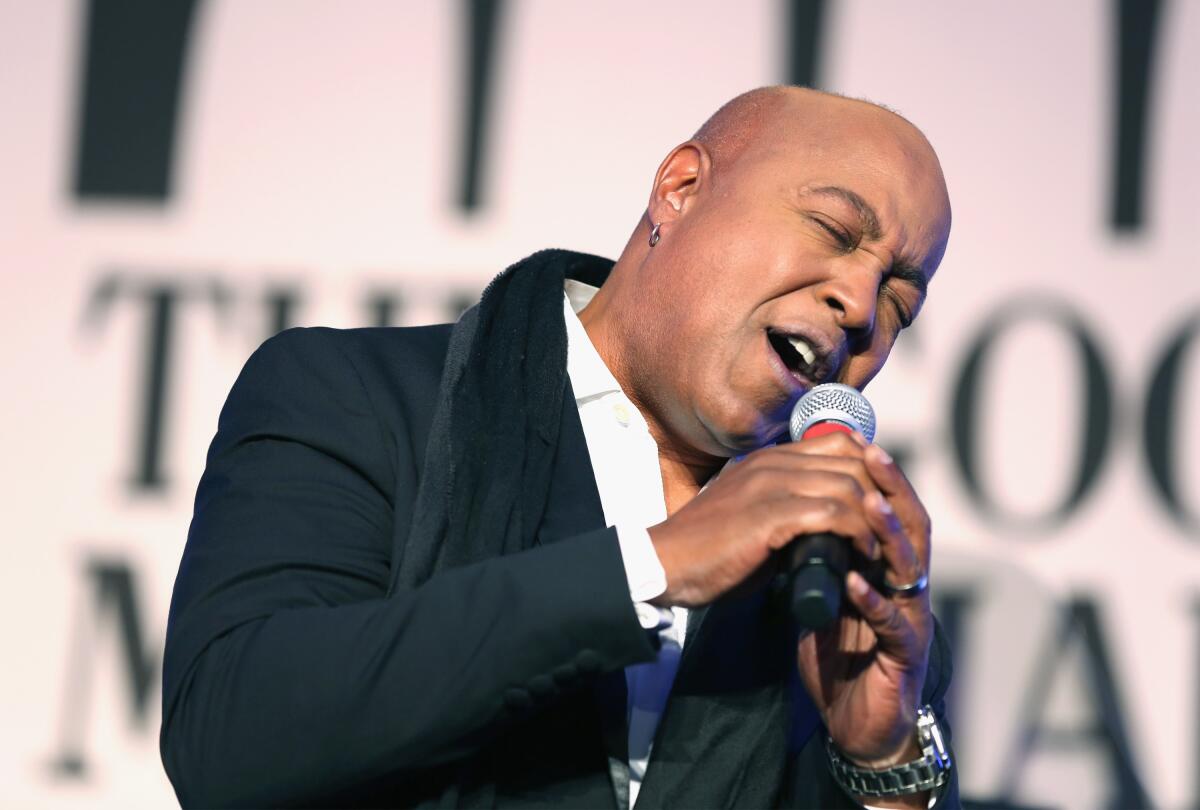
Peabo Bryson performs onstage during the Thurgood Marshall College Fund 28th Annual Awards Gala

Peabo Bryson, pictured performing in Washington, D.C., in 2016, won Grammy Awards in back-to-back years in 1993 and 1994.

(Teresa Kroeger / Getty Images)

In a career peak in 1992, the singer was featured on recordings that topped four separate charts: “A Whole New World,” a duet with Regina Belle from the Disney animated movie “Aladdin,” topped the Pop and Adult Contemporary charts; “The King and I” album, featuring Bryson, was No. 1 on the Classical Crossover charts, and Kenny G’s “Breathless” album, featuring Bryson on “By the Time the Night Is Over,” topped the Contemporary Jazz charts.

He nabbed two Grammy Awards back to back in 1993 and 1994 for his performance of “Beauty and the Beast” with Céline Dion, and his performance of “A Whole New World” with Regina Belle.

“I don’t think there’s anything I can’t do,” Bryson told The Times. “I see myself as a true Renaissance man. I don’t like one-dimensional concepts of myself.”

Robert Peapo Bryson was born on April 13, 1951, in Greenville, S.C. He grew up attending concerts his mother would bring the family to, and by the time he was in high school, he knew he wanted a career in music.

In 1978, he told David Nathan, an editor for Blues & Soul magazine, that his mother wasn’t thrilled about the prospect of him chasing his dreams in the rhythm-and-blues biz and worried he’d get into trouble.

“As far back as I can remember, I’ve always been into music,” Bryson said. “It’s all I ever wanted to really deal with. … I had to make that decision, when I was around 14, as to what I was going to get into, career-wise. Well, I’d thought about being a doctor or something like that, but I really felt that music was my thing.”

He cut his teeth as a backing vocalist in various groups, but none of his bandmates could properly pronounce “Peapo,” his French West Indian name, so he changed up the spelling to make it simpler. The stage name Peabo was born. In the late 1960s, he linked up with “My Elusive Dreams” hitmaker Moses Dillard. “I started out just singing, although I progressed into percussion, guitar and, much later, playing piano — that was basically when I started getting into songwriting,” he told Nathan.

In 1967, he signed his first record deal, with Bang Records, and in 1976, he made his solo debut with the single “Underground Music” and his eponymous album, “Peabo.” The next year, he hit it big time and signed with Capitol Records, where he put out back-to-back gold-selling albums: “Reaching for the Sky” in 1977 and “Crosswinds” in 1978.

Peabo Bryson performs during the Centennial Olympic Park's 4th of July Celebration at Centennial Olympic Park

Peabo Bryson performs at the Centennial Olympic Park’s Fourth of July Celebration in Atlanta.

(Robb D. Cohen / Invision / Associated Press)

By the ’90s, Bryson was at a career high, collected Grammy nominations and became the definitive voice of Disney duets. But the music scene was changing, and Bryson wasn’t keen on the new direction. He told The Times in 1994 that MTV had stopped considering talent as the criteria to be played on the music channel and that he thought mainstream music had taken a hostile and negative turn.

“I guess I [tick] people off because I don’t go away,” he said with a chuckle. “I’m like a tenacious forest fire — you snuff me out over here, and I’m still burning down the back 40 just when you think it’s over. I have a great faith in God, and because of my great faith in God, I have faith in the self.”

Fortunately for legions of fans of the soulful balladeer, Bryson was right and he wasn’t going anywhere for another couple of decades. The Grammy winner continued to grace stages with his flashy blazers and smooth baritone, and recently performed a concert with Jeffrey Osborne at Trilith Live in Fayetteville, Ga.

The event in early May was a standalone performance, apart from the crooner’s Golden Touch tour, which he announced last year, amid his celebration of 50 years in the music industry.

In recent years, Bryson said he had been hitting the gym and prioritizing his health after a scare seven years ago when the artist suffered a heart attack at his Georgia home. He told the Soul Train Cruise 2020 that he flat-lined for nearly 30 minutes, “long enough to make friends on the other side.”

“It turns out that dying is not that hard,” Bryson said. “Didn’t hurt that much. It’s the living afterwards that’s the really difficult part. I mean, why are you still here? You have to ask yourself those hard questions: Are you a good father? Are you a good husband? Are you a good friend? Are you a good brother? Are you a good human being?”

Bryson said he was able to answer yes.

“Then you have to ask yourself the question that makes the answer null and void — can you be better?”

Bryson is survived by his wife, Tanya Boniface Bryson; son Robert Bryson (who goes by Kit); daughter Linda Bryson; and three grandchildren.

Memorial arrangements will be announced at a later date.

Source link

Angels great Garrett Anderson was a Hall of Fame teammate

Garret Anderson was a Hall of Fame-caliber major league baseball player who never made the Hall of Fame. Baseball is a numbers game, and GA didn’t have enough of them.

When he finished his career and was eligible for the vote in 2016, he got just one vote. That represented 0.2% of the total. It also meant that he wasn’t even on the ballot the next year.

So, when he died Friday, way too soon at age 53, it presented an interesting twist. Had he lived into his 80s or 90s, there would have been few still around to remember anything about him but statistics. Now, the memory of his underrated greatness remains. What he did and how he did it is still in the frontal lobe of those who watched and those who wrote and broadcast about him.

He was the quiet man who played for various versions of the Angels for 15 seasons — the California Angels, the Anaheim Angels and the Los Angeles Angels. Right there, you have a Hall of Fame problem. A team struggling so hard to find its own identity does not attract the deep and passionate interest of the bulk of the writers/voters who live in time zones whose bed time is the same as game time in Anaheim.

It should have mattered that GA delivered the most important hit in Angels’ history, the game-winner in the 2002 World Series. It was Game 7, it was at Angel Stadium and the opponent was the San Francisco Giants, who had superstar slugger Barry Bonds and his line drives that created dents in outfield fences, except when they flew over them, which was often.

Anderson came to the plate in the third inning. The bases were loaded and Anderson took a shoulder-high fastball, slapped it down the right-field line and three runs came home. The Angels won 4-1 and haven’t come close to a World Series title, much less a World Series, since then. That at least got Anderson into the Angels Hall of Fame in 2016.

Mike Scioscia was the manager then and the most effective the team has had. He is the one who, Saturday, called Anderson’s Game 7 hit the greatest in team history.

“I remember looking out there when he went to the plate with the bases loaded,” Scioscia said, “and thinking he is exactly the guy I want there right now.”

Scioscia called Anderson’s death “a punch in the gut.” He said the player everybody called GA, didn’t have to be managed. “He was a resource for me,” Scioscia said. “He had an incredible inner drive. He was one of the most talented players I have been around. I’d call him a superstar.”

Scioscia, reminded that his “superstar” didn’t make baseball’s Hall of Fame, said, “Sometimes, great players slip through the cracks.”

Anderson’s not-quite-Hall-of-Fame performances included three All-Star game appearances. He was the game’s MVP in 2003 and also won the home run derby that year. He beat out Albert Pujols, then of the Cardinals. His career batting average was .293, he hit 287 home runs and had 1,365 runs batted in. He went to the plate to hit, not to watch. He never drew more than 38 walks in a season and never struck out more than 100 times.

Yet the statistic he felt gave him the best chance for the Hall of Fame was number of hits. Getting 3,000 hits would make him almost an automatic choice. He ended with 2,529, and near the end of his career with the Angels, he sat down with a reporter to discuss just that, plus one other thing.

Garret Anderson, left, talks with Jackie Autry, widow of Angels team owner Gene Autry.

Garret Anderson, left, talks with Jackie Autry, widow of Angels team owner Gene Autry, as he is inducted into the Angels Hall of Fame on Aug. 20, 2016.

(Reed Saxon / Associated Press)

It was uncharacteristic for Anderson to have this sort of conversation with anybody outside of his teammates, or maybe his family. It was lunch at Zov’s in Tustin and the question was how this voting system works and could maybe 200 more hits get him in. Could 2,750 do it? He wasn’t a big ego guy by any stretch of the imagination, but the Hall of Fame seemed to be dangling there and any baseball player who could see that for himself in the distance had to be intrigued.

There was no discussion of the intangibles, no consideration of the Angels being the Angels and what effect that will always have. Do voters even look much at other stats, such as his 24 walks and 35 home runs in the same season? The reporter wasn’t a great help. He wasn’t even a voter. Anderson wasn’t really stressed out over the Hall of Fame premise, just kind of fascinated. The reporter was probably more encouraging than realistic. Zov’s food was good, the company great.

Eventually, Anderson got to the second issue that had prompted the lunch: How to deal with Times columnist TJ Simers. He asked because the reporter was once Simers’ boss. Simers tended to probe and kid and seek to stir up things, but Anderson also recognized that he could be highly accurate, perceptive and even fun. Anderson, as a team star, was bracing for frequent visits. How should he handle it?

The answer was simple: Don’t lie to him. Don’t hide from him. If he is being a jerk, tell him so. He will accept that. If he is wrong, tell him that and tell him how. If he insults you, insult him back. He loves that.

Tim Mead, former director of public relations, when asked for his thoughts on Anderson, said that his perspective or quotes would not be as telling or as meaningful as simply watching the tape of Anderson’s three-run double that won the 2002 World Series for the Angels.

“Just watch it, just watch his reaction when he gets to second base,” Mead said Saturday.

And so we did. Anderson slaps his hit down the right field line, just fair. Angel Stadium goes crazy. Anderson stops at second base, claps his hands four times, then stands there quietly. Little emotion. Little hoopla. No contortions for “SportsCenter.” He has done his job. He has done what was expected of him. There are six more innings left. Let’s celebrate when it is truly over.

That was Garret Anderson, GA to his friends, a Hall of Fame player in all the ways that numbers don’t show.

Source link