funding bill

Senate approves funding bill to avoid a shutdown before the election

The Senate in an overnight vote Saturday approved a short-term measure to fund federal agencies into early December and avoid a potentially chaotic government shutdown during the middle of campaign season.

The late-summer action on a funding fix is unusual. Normally, Congress waits until the final days or hours of a funding deadline to pass short-term patches, but this time senators acted nearly two months before the end of the fiscal year on Sept. 30.

The 90-6 vote showed lawmakers are still smarting from the two historic shutdowns in the last year and want to avoid another before voters go to the polls.

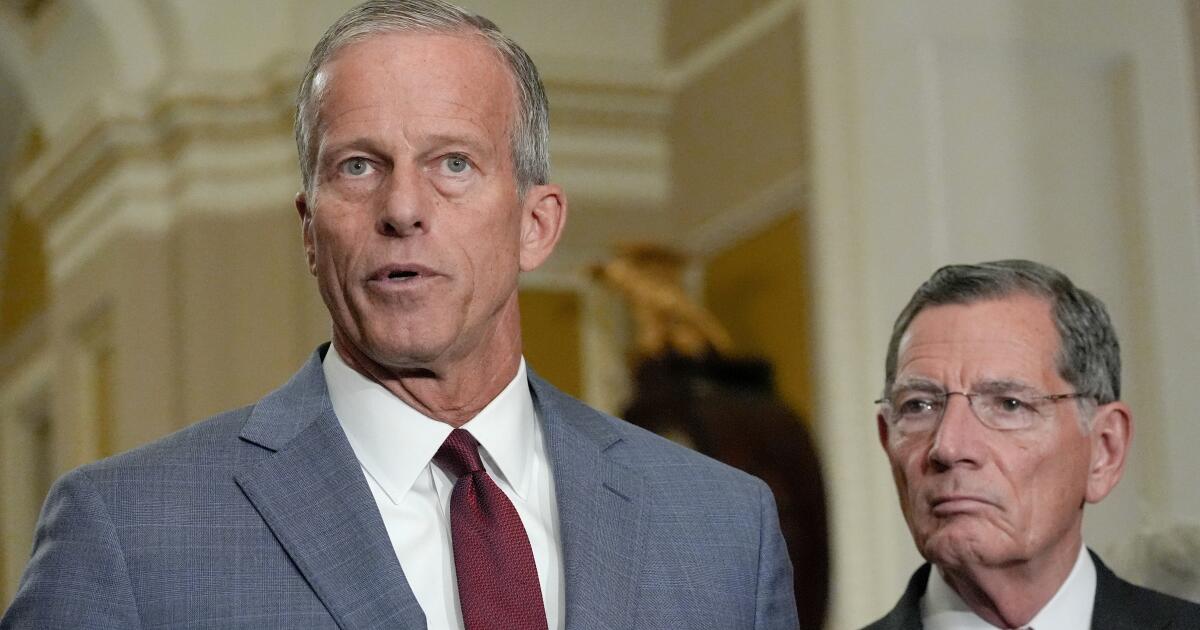
Senate Majority Leader John Thune (R-S.D.) wanted the funding dealt with before senators went home for the next five weeks to focus on their reelection campaigns and other matters. It got caught up with other issues that pushed votes into the night, but the bill had broad bipartisan support. The House will also have to approve the measure when members return from their August recess before it can go to President Trump’s desk for his signature.

The bill generally funds the federal government at current levels through Dec. 11, but includes a variety of exceptions that senators negotiated with the White House.

Democrats secured language to ensure no money could be transferred to the Border Patrol. They also rejected the White House’s request of $1 billion for early work on a new “Trump-class” battleship that the administration announced Dec. 22.

“The only person who wants these golden ships is Donald Trump so he can slap his name on them,” Senate Democratic leader Chuck Schumer (D-N.Y.) said.

Hemp provision

The bill also includes language delaying a national ban on most intoxicating hemp products. That one-month delay prompted outrage from some Senate Republicans who say that too many such products are falling into the hands of unsuspecting children. The packaging of the products often relies on bright colors and intentionally mimics popular snack brands to attract consumers.

Sen. Ted Budd (R-N.C.) said that since 2017 there has been nearly a tenfold increase in cannabis-related emergency room visits by minors in his home state.

“This is a public health crisis that deserves this Senate’s immediate attention,” Budd said. “Our children should never be the testing ground for an industry willing to exploit a loophole in federal law for profit.”

But the hemp industry said the delay buys time for Congress to craft legislation that protects hemp farmers and businesses while also putting in place safeguards to protect children.

Trump himself has called Budd to discuss the issue, though the president did not specifically ask the senator to drop his effort, Budd’s spokesman said.

“Sen. Budd had a friendly phone call with President Trump discussing the legislative efforts regarding THC,” said spokesman Christian McMullen. He said the senator outlined his concerns about “any delay to closing the hemp loophole.”

Budd tried to strip the hemp delay from the bill, but the Senate turned aside his effort.

Trump rule on grants delayed

Democratic lawmakers, along with Sen. Susan Collins (R-Maine), also got language in the bill that would block, for the duration of the funding patch, new regulations on federal grants. The regulations would require a senior political appointee to review grants before they are awarded to ensure, among other things, that they advance the president’s policy priorities. Democrats say it’s an effort to kill grants destined for Democratic-leaning states. The Trump administration recently admitted in a court filing denying clean-energy grants to California and other blue states based only on politics.

“They are not interested in making our tax dollars work better — they just want them to work for Donald Trump,” said Sen. Patty Murray of Washington state, the ranking Democrat on the Senate Appropriations Committee.

The White House Office of Management and Budget says its effort is about improving accountability to ensure taxpayer dollars aren’t wasted or misused. The issue is sure to be a topic of future negotiations on a full-year spending measure.

But Collins said the vast majority of the nearly 500,000 people and groups weighing in on the rule are opposed to it.

“I don’t think in my time that I’ve been privileged to serve in the Senate that I have ever seen a proposed rule generate that many negative comments,” Collins said.

Freking and Mascaro write for the Associated Press.

Source link

GOP senators balk at Trump’s $1.8-billion ‘anti-weaponization’ fund, force delay in key vote

President Trump’s grip on his party slipped on Thursday as anger boiled over among Senate Republicans about a growing list of issues.

In a striking display of defiance, GOP senators abruptly derailed plans to vote on legislation to fund Trump’s immigration crackdown amid deep disagreements over security funding for a White House ballroom and a $1.8-billion fund to pay people who claim to have been politically persecuted.

The discontent had been building for weeks. Many senators had grown frustrated over Trump’s decision to endorse candidates running against longtime Republican incumbents.

Others, worried about rising costs as a result from the war in Iran, had aired concerns ahead of the midterm elections. But the breaking point came when the Justice Department, with little warning, pushed to create what it termed the “anti-weaponization fund.”

Senate Majority Leader John Thune (R-S.D.) acknowledged the concerns over the fund Thursday after a reportedly contentious private meeting about it between Senate Republicans and acting Atty. Gen. Todd Blanche. He also conceded midterm politics had added to the tension.

“It’s hard to divorce anything that happens here from what’s happening in the political atmosphere around us,” Thune told reporters. “You can’t disconnect those things.”

A day earlier, Sen. Bill Cassidy, a Louisiana Republican who lost his primary race on Saturday to a Trump-backed challenger, expressed strong disagreement with the creation of the fund, which would be controlled by appointees without congressional oversight.

“People are concerned about paying their mortgage or rent, affording groceries and paying for gas, not putting together a $1.8 billion fund for the president and his allies to pay whomever they wish with no legal precedent or accountability,” Cassidy wrote on X. “If there needs to be a settlement, the administration should bring it to Congress to decide.”

Sen. Mitch McConnell (R-Ky.) also had harsh criticism for the fund.

“So the nation’s top law enforcement official is asking for a slush fund to pay people who assault cops? Utterly stupid, morally wrong — take your pick,” he said in a statement.

The discord was striking, partly because Republicans have largely steered clear of checking the president’s power, and Congress has been largely sidelined under the second Trump administration on the war in Iran and other issues.

“I don’t think the Republicans had any choice but to pull the plug until we come back in June, because they’re facing a bit of a mutiny within their conference,” Sen. Adam Schiff (D-Calif.) told The Times, saying he had heard that the meeting between Blanche and Republicans “didn’t go well.”

As tension simmered on the background, Trump seemed unbothered by the group of Republicans’ public rebellion against his agenda. When asked whether he was losing control of the Senate, he said he didn’t know.

“I only do what is right,” he told reporters in the Oval Office.

However, he expressed annoyance at lawmakers who would not support $1 billion in federal funding for security costs related to the ballroom project. He said the structure is being privately funded by him and other “great patriots.”

“We are making a gift to the United States,” Trump said. “This is being made as a gift from me and other people that are great patriots and spent a lot of money. We are building what will be the finest ballroom anywhere in the world.”

The $1 billion for security funding would be “very much a good expenditure,” he said. If Congress does not sign off on the money, Trump said the “White House won’t be a very secure place.”

Trump did not immediately comment on Thursday about the Senate’s delaying of the funding bill. The White House declined to comment on the matter.

Trump’s second-term actions have frequently tested the loyalty of Republican lawmakers, who have largely stayed in line. The settlement fund, with its ethical questions, appears to have crossed a line for some senators in a party that has traditionally opposed wasting taxpayer funds.

The money comes from the judgment fund, which is a Congress-approved ongoing appropriation that allows the Justice Department to settle cases and make payments.

Stephen Miller, a top aide to Trump, told reporters at the White House that the $1.8-billion settlement was “just a small measure of the justice” that many people are owed after being targeted by the federal government. Miller declined to say whether the White House was reaching out to senators to ease concerns about the fund.

Republicans in Congress decried the use of similar third-party settlements during the Obama administration, with House lawmakers repeatedly passing a bill aimed at stopping settlement slush funds, noted Molly Nixon, a senior fellow at the Cato Institute.

Though the Trump administration’s plan is novel because the settlement money isn’t going to a third party, the general concept has been offensive to Republicans in the past; the Republican-controlled House Judiciary Committee termed it an abuse in 2017.

“If you’re taking a consistent view, you’d be at least equally as opposed to this settlement,” Nixon said of Republican lawmakers.

That could be driving some of the opposition now, along with concerns about who is going to get the money and whether it could be distributed to people who wouldn’t have been able to make a successful case before a court of law, Nixon said.

“The fund is going to plaintiffs who were victims of lawfare or weaponization. … Those are pretty ambiguous terms. They’re sort of in the eye of the beholder,” Nixon said. “It’s pretty easy to see how this could very easily become a quiet political claims process.”

Police officers who defended the U.S. Capitol during the Jan. 6, 2021, riot have already filed a federal lawsuit seeking to block the creation of the fund, arguing in part that it would compensate extremist convicted of committing violent crimes.

“The fund’s mere existence sends a clear and chilling message: those who enact violence in President Trump’s name will not just avoid punishment, they will be rewarded with riches,” the lawsuit says.

When Trump returned to office in January 2025, one of his first acts was pardoning or commuting the prison sentences of the 1,500 people who were charged in connection with the attack. Vice President JD Vance on Wednesday did not rule out that settlement money could go to those rioters, saying the money would be given out on a “case-by-case basis.”

Thune told reporters on Thursday that the Justice Department would have to come up with some guardrails to ease concerns among senators.

“We need to get some clarity,” he said.

Though the number of Republicans angry with Trump is significant enough to make or break legislation, the caucus appeared far from falling apart.

Senate Republicans blocked an attempt by Sen. Alex Padilla (D-Calif.) on Thursday to pass a bill to prohibit federal funds from reaching Jan. 6 rioters, an attempt to prevent the fund from being used to compensate them.

“I’m encouraged hearing some of my Republican colleagues agreeing with me,” Padilla said on the Senate floor. “Let’s stand up for congressional oversight as a unified Senate.”

Sen. Tommy Tuberville (R-Ala.) objected to Padilla’s bill, later writing on X: “PROUD to object today to Senator Padilla’s RIDICULOUS bill and stand up for ALL FREEDOM-LOVING AMERICANS.”

Schiff, who is working on an amendment that would target the fund, said other Republican colleagues he spoke to Wednesday evening were unhappy with the position Trump has put them in. He said Trump’s actions have helped underscore Democrats’ arguments against his party.

“All [it’s] doing is helping us make the case that the Republicans couldn’t care less about people’s cost of living … that there’s plenty of money for golden ballrooms for the president, there’s plenty of money for the president’s cronies, but there’s no money for the average family,” Schiff said.

Source link