


The Government Accountability Office (GAO), a congressional watchdog, highlighted how Sentinel will impact Air Force Security Forces units in a brief report released earlier today. This comes a day after the Air Force put out its own update on the new ICBM program, stating that the current goal is for the restructuring effort to wrap up before the end of the year and for the first launch of a prototype LGM-35A to occur in 2027. The hope now is that Sentinel will begin entering operational service sometime in the early 2030s. The original schedule had called for the missiles to reach initial operational capability in 2029.
A three-stage test booster used in the ongoing development of the LGM-35A Sentinel intercontinental ballistic missile. USAF
“DOD will need to complete Sentinel launch facility test and evaluation activities early in the transition to inform DOD and Air Force security policy updates,” the GAO report says. “Because security forces incorporate these updates into unit-level operating instructions, these policy updates will be needed to train Air Force security forces for the transition.”
A rendering of a complete LGM-35A Sentinel missile. Northrop Grumman
The report does not elaborate on the changes that will be required. As noted, Security Forces personnel currently assigned to Air Force Missile wings train to protect the Minuteman III force above and below ground. There are currently 400 LGM-30Gs loaded into silos spread across five states. Sentinel is said to offer greater range and improved accuracy, as well as reliability and sustainability benefits, over the aging Minuteman IIIs, which first entered service in 1970. The development of a new ICBM also offers the opportunity for the inclusion of survivability improvements and other additional capabilities.
An infrared picture of a Minuteman III during a test launch. USAF An infrared image of an LGM-30G Minuteman III ICBM taken during a routine test launch. USAF
“The training simulated a hostile’s attempt to capture a nuclear asset. Security forces Airmen, who arrived by both Humvee and helicopter, began to combat the threat and worked their way toward retaking control of the launch facility. After neutralizing the threat, recapturing and securing the launch facility, the Airmen performed self-aid buddy care and tactical combat casualty care.”
The video below shows scenes from a recapture and recovery exercise conducted as part of the larger Global Thunder 23 exercise.
91st Missile Wing participates in Global Thunder 23
Terrorists or other hostile actors could also seek to break into silos or launch facilities just to damage or destroy them. Even if they could not trigger a nuclear detonation, blowing up an ICBM inside its silo would have significant operational, environmental, and other ramifications.
The Air Force had originally said it would reuse Minuteman III silos and other existing infrastructure for Sentinel, but subsequently determined that was no longer a viable course of action. As such, new silos and launch control facilities could easily come with substantially different physical layouts that would affect the tactics, techniques, and procedures for securing them. The LGM-35A missiles will also be completely different from the existing LGM-30Gs, and there could be additional notable differences in how the Sentinels are married together with their new ground-based infrastructure. All of this could further impact how Security Forces personnel prepare themselves for a variety of contingencies, including any potential for accidental detonations or launches.
Graphics depicting existing Minuteman III silos and launch facilities from the report that GAO released today. GAOA rendering of a future Sentinel launch facility, including the silo, which dates back at least to 2023. Northrop Grumman
In its update about Sentinel yesterday, the Air Force shared that prime contractor Northrop Grumman is set to start building a prototype launch silo at the company’s facility in Promontory, Utah, this month. “This crucial effort will allow engineers to test and refine modern construction techniques, validating the new silo design before work begins in the missile fields,” according to the release.
There’s a strong possibility that a prototype silo could also be used to help develop and refine new Security Forces TTPs in future, as well.
Site defense is also just one aspect of the elaborate and costly security ecosystem in place now for the Minuteman III force. This includes protection for ICBMs while they are being transported via transporter-erector trucks, as well as loaded or unloaded into silos. All of this will also have to adapt to the future Sentinel missiles and their new facilities. The Air Force has already been modernizing certain aspects of nuclear force protection capabilities, including the acquisition of new MH-139A Grey Wolf helicopters to replace aging UH-1Ns used to provide air support over the silo fields and for convoys on the move. An MH-139A was used to escort a Minuteman III convoy for the first time in January.
An MH-139A helicopter seen helping escort a Minuteman III convoy for the first time on January 8, 2026. USAF
In terms of other Sentinel-related infrastructure work, “this summer, prototyping activities at F.E. Warren AFB [Air Force Base, in Wyoming] will validate innovative utility corridor construction methods, which are key to streamlining the installation of thousands of miles of secure infrastructure and fielding the system faster,” the Air Force’s release added. “Meanwhile, foundational construction on permanent facilities is already well underway. The first of three new Wing Command Centers is taking shape at F.E. Warren AFB, and critical test facilities are being erected at Vandenberg SFB [Space Force Base, in California] to support the future flight test campaign.”
So-called Site Activation Task Force (SATAF) detachments are also helping lay the groundwork for the transition from Minuteman III to Sentinel at F.E. Warren and Vandenberg, as well as Malmstrom Air Force Base in Montana and Minot Air Force Base in North Dakota. It should be noted that Vandenberg does not currently host operational ICBMs, and is not set to do so in the future, but is used for routine test launches. The Air Force also says that the planned first launch of a Sentinel in 2027 will be from a pad rather than a silo.
US Air Force launches Minuteman III ICBM from Vandenberg in unarmed test
The Air Force is otherwise hopeful that the ongoing restructuring effort will reduce the chance for further schedule risks to the Sentinel program and, by extension, cost growth.
“We certainly have not lowered the bar, and we certainly have not taken on any risk by doing this,” Air Force Gen. Dale White, the new Direct Reporting Portfolio Manager (DRPM) for Critical Major Weapon Systems (CMWS), told Breaking Defense in an interview published yesterday. The DRPM CMWS role was established last August to create a “single empowered leader” to manage Sentinel and other top-priority Air Force weapon systems programs, including the F-47 sixth-generation fighter and B-21 Raider stealth bomber.
“The restructured program incorporates key lessons learned to ensure maximum efficiency,” the Air Force’s release explained. “The decision to build new silos, for example, avoids the unpredictable costs and safety hazards of excavating and retrofitting 450 unique structures built over 50 years ago, and is a prime example of choosing a path that delivers capability with greater speed and less risk.”
“Sentinel program officials continue to evaluate options to potentially redesign portions of the weapon system for cost reductions and are looking at avenues to minimize further schedule delays,” GAO’s report today also noted. “For example, the Air Force is reevaluating system requirements and evaluating changes to the acquisition strategy – both of which could limit further cost and schedule growth.”
GAO’s report did still highlight continued concerns about potential challenges for Sentinel, including in relation to software development for the missiles and work on the extensive new ground infrastructure. As noted, the need for all-new silos has already been a central factor in delays and cost overruns, despite the hope that this will prove less risky in the long run. There are also concerns about sustaining the Minuteman III force beyond 2036, when the transition to Sentinel was originally supposed to be complete. A seamless replacement process is critical to ensuring that the land-based leg of America’s nuclear triad remains a credible deterrent capability throughout.
A transporter-erector seen loading a Minuteman III into a silo at Malmstrom Air Force Base. USAF
“I think Sentinel is going to be a bit easier with some of the things we’re designing into the program, the digital infrastructure, the open architecture,” Air Force Gen. Stephen Davis, head of Air Force Global Strike Command (AFGSC), told TWZ in an interview last month. “I think it will make it easier to upgrade and keep that missile relevant. I don’t have any worries about being able to do that in the future.”
Overall, the Sentinel is categorized as “megaproject” by GAO, defined as something that “costs $1 billion or more, affects 1 million or more people, and runs for years.” Such efforts “are extremely risky ventures, notoriously difficult to manage, and often fail to achieve their original objectives,” according to the Congressional watchdog.
A revised cost for Sentinel has yet to be released. However, when the Air Force announced the restructuring effort back in 2024, the total acquisition costs were projected to rise to approximately $140.9 billion, an 81 percent increase over the original estimates.
Even if the restructured Sentinel plan holds going forward, the program will still be immensely complex and resource-intensive, and have many different facets, including changes to how Security Forces units operate going forward.
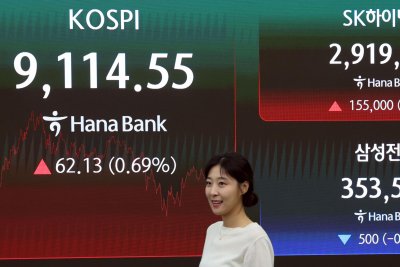
An electronic signboard at Hana Bank in Seoul shows that the Korea Composite Stock Price Index (KOSPI) topped the landmark 5,500-point mark on Thursday. Photo by Yonhap
South Korean stocks surpassed the landmark 5,500-point mark for the first time in history Thursday, boosted by sharp gains in blue-chip tech shares. The local currency gained ground against the U.S. dollar.
The benchmark Korea Composite Stock Price Index (KOSPI) surged 167.78 points, or 3.13 percent, to close at an all-time high of 5,522.27.
This marked the first time the KOSPI breached the 5,500-point threshold.
Trade volume was heavy at 739.2 million shares worth 31.8 trillion won (US$22 billion), with winners outnumbering losers 616 to 272.
Foreigners and institutions scooped up a net 3 trillion won and 1.37 trillion won, respectively, while retail investors sold a combined 4.45 trillion won for profit-taking.
“The KOSPI’s feat came despite the mixed performance of global stock markets amid uncertainties deriving from the planned replacement of the Federal Reserve chief and the release of the U.S. jobs report,” Lee Kyoung-min, an analyst at Daishin Securities, said.
“The KOSPI digested the uncertainties to move upwards based on the fundamentals of the market, with big-cap shares gaining ground,” he added.
Overnight, major U.S. indexes closed slightly lower as investors showed a mixed reaction to the stronger-than-expected U.S. jobs report, which raised hopes the U.S. economy would remain solid, and at the same time, concerns the Federal Reserve may keep its interest rates unchanged.
Lee said semiconductor and financial shares led Thursday’s rally, with secondary battery and the food and beverage sectors, which had been lagging behind recently, also showing a strong performance.
Semiconductor heavyweight Samsung Electronics shot up 6.44 percent to 178,600 won and its rival SK hynix soared 3.26 percent to 888,000 won. Hanmi Semiconductor skyrocketed 9.97 percent to 209,500 won.
Leading battery maker LG Energy Solution surged 4.59 percent to 410,000 won, and artificial intelligence investment firm SK Square jumped 7.14 percent to 570,000 won.
KB Financial climbed 2.43 percent to 168,500 won and Shinhan Financial escalated 5.05 percent to 106,000 won.
But automakers were mixed, with Hyundai Motor losing 0.59 percent to 506,000 won, while Kia rose 2.78 percent to 166,300 won.
Home appliances maker LG Electronics tumbled 5.08 percent to 121,400 won following a rally the previous day.
The Korean won was quoted at 1,440.2 won against the U.S. dollar at 3:30 p.m., up 9.9 won from the previous session.
Copyright (c) Yonhap News Agency prohibits its content from being redistributed or reprinted without consent, and forbids the content from being learned and used by artificial intelligence systems.
Love Island All Stars bombshell Jessy Potts has addressed her split from Joey Essex after making a dramatic entrance into the ITV2 villa
Samantha King Content Editor
22:48, 10 Feb 2026
Jessy opened up about her ex-partner to American bombshell Zac(Image: ITV)
Love Island All Stars bombshell Jessy Potts has lifted the lid on her romance with reality television personality Joey Essex following her explosive villa debut.
The 27-year-old caused quite a stir when she strutted into the ITV2 villa during last night’s heart rate challenge (February 9), planting kisses on Tommy and Scott’s lips whilst giving the remaining boys neck kisses. Tonight’s episode revealed her sultry black lace outfit had sent several boys’ heart rates soaring, much to the annoyance of some of the female contestants.
As the new arrival began mingling with her fellow Islanders, Love Island USA’s Zac was first on her agenda for a private conversation. She whisked the reality star away to the terrace whilst his partner Millie looked on, confessing: “I love an American.”
During their chat, she discussed her past romance with The Only Way Is Essex favourite Joey, who became Love Island’s inaugural celebrity bombshell when he joined the show’s eleventh series.
Jessy arrived in the villa later that season with the power to couple up with any boy she fancied. She chose Joey and the duo remained together until their fellow Islanders voted them both off the programme, reports OK!
However, just two months after their stint on the 2024 summer series, the pair decided to go their separate ways. At the time, they each released a statement, with Jessy saying: “I appreciate the Love Island experience I had with Joey, we tried to make it work but it wasn’t to be. I’m so grateful to everyone who supported us and look forward to all of the exciting opportunities ahead.”
Joey, on the other hand, stated: “Unfortunately, we have decided to call an end to the relationship but I hope we can continue to be friends. I truly wish Jessy the very best with whatever she does in the future.”
Now, Jessy has shed more light on what led to their break-up, revealing to Zac that they were simply “different people”.
After Zac apologised for not having watched her season, Jessy clarified: “Mine was a couple of years ago but I had quite an easy journey. I basically got in there, got in one couple and stayed in it the whole time.”
When Zac asked: “Why did it end?”, Jessy confessed: “It only lasted about a couple of months afterwards. It was just we’re definitely different people. So then you leave here and it’s like ‘Oh s***’. It’s a lot.”
She added: “He’d done TV before so he already had a lot of people that had opinions about him anyway. It just wasn’t for me but that’s ok.”
Love Island All Stars airs Sunday to Fridays at 9pm on ITV2 and ITVX.For the latest showbiz, TV, movie and streaming news, go to the new **Everything Gossip** website.
KERRY Katona has issued a health update after revealing that she was rushed to A&E at the end of last month with a painful medical condition.
The former Atomic Kitten singer, 45, said she was left “screaming in pain” before paramedics arrived.
Sign up for the Showbiz newsletter
Thank you!
Kerry has given her fans an update on how she’s doing following her trip to hospitalCredit: KerryKatona7-Instagram/BackgridShe was rushed there in excruciating pain that turned out to be caused by undiagnosed colitisCredit: KerryKatona7-Instagram/Backgrid
Following nearly three days in hospital the star was given a diagnosis of colitis, defined by the NHS as a chronic illness that causes inflammation of the rectum and colon.
Now Kerry has given her fans an update on how her treatment is going, spilling the details in her most recent New! magazine column.
She said: “As I revealed in last week’s column, I went into hospital in an ambulance because I was getting severe pains – I thought I was going to give birth!”
Medics gave her a CT scan that led to a colitis diagnosis.
“I was sent home with morphine and told only to eat bland food, which I’m gutted about because I love spicy food,” said Kerry.
“As lovely as the doctors and nurses were, I’m going to have to go private and find out what the hell’s going on. It’s nothing against the NHS though.”
She added that she feels fatigued and could sleep at any moment.
Last Friday at 2:10 in the morning, Kerry shared a video to her Instagram page where she was in bed with a cannula in her arm.
Speaking candidly about the discomfort she was feeling, Kerry opened up about first receiving the colitis diagnosis.
She said: “Hi guys it’s 2.10 in the morning and I have been in hospital since yesterday – yesterday morning,” she began.
She was one of the original members of Atomic Kitten who formed in 1998Credit: Splash
She panned her camera around to show the nearby nurses station.
“It’s very full so unfortunately, I’m on a bed in the hall. I have something called colitis – something to do with my bowel.
“So it’s been s*** – excuse the pun. I haven’t slept since yesterday, the day before. I’m in the right place.”
Kerry has decided she would like to pursue her colitis treatment privatelyCredit: KerryKatona7-Instagram/BackgridSince her girlband days Kerry has found big success on OnlyFansCredit: Splash
The Korea Composite Stock Price Index, which reached a new high, is shown on a screen inside the dealing room of Hana Bank in central Seoul on Tuesday. Photo by Yonhap
South Korean stocks shot up by the most in six years Tuesday, rebounding from the previous session’s deep trough, as investors brushed off concerns over the newly nominated Federal Reserve chair and went bargain hunting. The Korean won also rose against the U.S. dollar.
The benchmark Korea Composite Stock Price Index (KOSPI) climbed 338.41 points, or 6.84 percent, to close at a new high of 5,288.08, a sharp upturn from the previous day’s plummet.
It marked the steepest daily increase since March 24, 2020, when the index rose by 8.6 percent, according to data provided by the Korea Exchange (KRX), South Korea’s main bourse operator.
Trade volume was heavy at 666.5 million shares worth 29.3 trillion won (US$20.3 billion). Winners outnumbered losers 825 to 75.
Strong buying demand triggered the KRX to temporarily suspend stock purchases in early trading.
The temporary halt in trading, also known as a “sidecar” in Korea, came a day after the bourse operator issued a sidecar for sell orders, with the KOSPI plunging by more than 5 percent.
The last time when the KRX consecutively issued a sell-side and a buy-side sidecar was on April 7 and 8, following U.S. President Donald Trump‘s announcement of sweeping tariffs, Lee Kyoung-min, an analyst from Daishin Securities, said.
“As there was no change in the market’s fundamentals, the benchmark index recovered on bargain hunting,” he said.
On a similar note, JP Morgan raised its target for the KOSPI to a range of 6,000 to 7,500 in a report released Tuesday, citing strong delivery in other sectors, such as defense and shipbuilding.
Foreign and Institutional investors turned net buyers, scooping up 703.3 billion won and 2.2 trillion won of equities, respectively. Retail investors sold off a net 2.9 trillion won.
Large-cap shares ended higher across the board.
Market top-cap Samsung Electronics soared 11.37 percent to 167,500 won, while its rival SK hynix advanced 9.28 percent to 907,000 won.
Defense giant Hanwha Aerospace rose 4.84 percent to 1,299,000 won, top carmaker Hyundai Motor added 2.82 percent 491,500 won, and major financial group KB Financial closed up 3.81 percent to 138,800 won.
The local currency was quoted at 1,445.4 won against the greenback at 3:30 p.m., up 18.9 won from the previous session.
Copyright (c) Yonhap News Agency prohibits its content from being redistributed or reprinted without consent, and forbids the content from being learned and used by artificial intelligence systems.
VICTORIA and Nicola clashed again this week – but for once it wasn’t with each other.
The pair released brand new modelling shoots on exactly the same day as they made a bid to put Brooklyn’s statement behind them.
Sign up for the Showbiz newsletter
Thank you!
Victoria Beckham and Nicola Peltz clashed again this week – but for once it wasn’t with each otherCredit: GennyThe pair clashed at Paris Fashion Week, where Victoria launched her debut eyewear range on the same day that Nicola was showcasing her role with fashion brand GennyCredit: Victoria Beckham Eyewear/Mert and Marcus
As well as a pink trouser suit, Nicola wore a number of elaborate, colourful gowns for the brand.
Victoria meanwhile launched her debut eyewear range on the same day.
She posed up in a pair of her own frames and said: “I wanted strong, instantly recognisable silhouettes that felt effortless to wear, so the focus for this collection was really on refining shape and proportion.”