Freedom of the Press

Russian police raid book publisher accused of pushing ‘gay propaganda’ | Russia-Ukraine war News

Raid is part of Moscow’s hardline social conservatism and clampdown on political life.

Russian police have raided the country’s top publishing house on suspicion that it has been disseminating “homosexual propaganda”, local media report.

Police reportedly seized thousands of books on Tuesday and took Yevgeny Kapiev, the chief executive of Eksmo, in for questioning. The raid appears to be part of Moscow’s pivot to hardline social conservatism with repressive laws running alongside a clampdown on political life and aggressive foreign policy.

Recommended Stories

list of 4 itemsend of list

Police targeted Kapiev as part of a “criminal case on extremism” over the publication of books “dealing with LGBT themes”, Eksmo communications director Yekaterina Kozhanova told the AFP news agency.

The firm’s finance director, head of distribution and deputy commercial director were also interrogated, Kozhanova said.

Eksmo is suspected of unofficially marketing books, including novels, that promote “gay propaganda” to Russian youth, the broadcaster Ren-TV reported.

An investigation into Eksmo was opened last year when authorities said “LGBT propaganda” had been “detected” in books published by its Popcorn Books subsidiary and they arrested several members of its staff.

Ultraconservative turn

Books showing approval of same-sex relations have been banned in Russia for more than 10 years.

The law has been tightened recently, requiring publishers to remove publications and destroy entire editions if they depict same-sex relationships.

The persecution of LGBTQ individuals, organisations and communities has intensified in the past decade or so as the Kremlin heralds “traditional values”. That drive has included a crackdown on films, books, art and culture, among other areas of social life.

Cultural producers have faced significant pressure even when they focus on giants of Russian culture. Biographies of Mikhail Bulgakov, author of The Master and Margarita, and the poet, actor and singer Vladimir Vysotsky have to be marked with warning labels because they are seen as promoting drug-taking.

The ultraconservative social turn has accelerated since Russia launched its full-scale invasion of Ukraine in February 2022.

In 2023, Russia’s Supreme Court ruled that LGBTQ activists should be designated as “extremists” and banned activities of the “international LGBTQ movement”.

Courts have issued fines and jail sentences to people displaying LGBTQ “symbols”, such as clothes, jewellery or posters featuring the rainbow flag.

Out of 49 European countries, the Rainbow Europe organisation ranked Russia third from bottom in terms of tolerance of LGBTQ people.

Source link

UN experts urge investigation into Israel’s killing of Lebanese journalists | Israel attacks Lebanon News

UN experts say Israel ’emboldened by impunity’ for previous journalist killings in Lebanon, Gaza and the West Bank.

Three United Nations experts have called for an independent and thorough investigation into Israel’s recent killing of three journalists in Lebanon, denouncing the deadly incident as “another egregious attack on press freedom by Israeli forces”.

UN special rapporteurs Irene Khan, Morris Tidball-Binz and Ben Saul on Thursday noted that “journalists carrying out their professional duties in armed conflict are civilians and must not be targeted or made the object of attack”.

Recommended Stories

list of 3 itemsend of list

“The deliberate killing of journalists not directly participating in hostilities constitutes a serious violation of international human rights and humanitarian law and a war crime,” they said in a statement.

The Israeli military killed Al Mayadeen journalist Fatima Ftouni, her brother, freelance photojournalist Mohamad Ftouni, and Al-Manar’s Ali Shoaib in a targeted strike on their car in southern Lebanon on March 28.

Al Mayadeen and Al-Manar are pro-Hezbollah media outlets, and Israel accused Shoaib – without presenting any evidence – of being a fighter with the Lebanese armed group.

That claim was rejected by Shoaib’s colleagues as well as by the UN experts, who on Thursday also stressed that working for media outlets affiliated with an armed group does not mean journalists are directly participating in hostilities under international law.

“Israeli officials know this, yet they choose to ignore it – emboldened by impunity for their previous killings of journalists in Lebanon, Gaza and the West Bank,” they said.

In February, the Committee to Protect Journalists (CPJ) reported that Israel was responsible for two-thirds of all killings of journalists in 2024 and 2025.

More than 60 percent of the 86 members of the press killed by Israeli fire last year were Palestinian journalists reporting from the Gaza Strip amid Israel’s genocidal war in the coastal enclave, the advocacy group found.

After the killings in southern Lebanon last week, CPJ’s Middle East director Sara Qudah also warned that Lebanon is becoming “an increasingly deadly zone for journalists, despite their status as civilians who must not be targeted”.

“We have seen a disturbing pattern in this war and in the decades prior of Israel accusing journalists of being active combatants and terrorists without providing credible evidence,” Qudah said in a statement.

“Journalists are not legitimate targets, regardless of the outlet they work for.”

The UN experts also warned that Israel’s killing of Lebanese journalists is part of “an abominable push … to silence reporting on Israel’s current military action in Lebanon, and shut down news coverage of war crimes committed, just as it did in Gaza”.

At least 1,345 people have been killed and 4,040 wounded in intensified Israeli attacks across Lebanon since early March, according to the Lebanese Ministry of Health.

Source link

Off-duty London police officer filmed ‘intimidating’ Al Jazeera journalists | Freedom of the Press

NewsFeed

An off-duty Metropolitan Police officer was among a group filmed confronting Al Jazeera journalists reporting on a suspected arson attack in north London, the force has confirmed. The incident is raising questions about press freedom.

Source link

US judge sides with New York Times against Pentagon journalism policies | Donald Trump News

A federal judge in the United States has agreed to block the administration of President Donald Trump from enforcing a policy limiting news reporters’ access to the Pentagon.

Friday’s ruling sides with The New York Times in its argument that key portions of the new rules are unlawful.

Recommended Stories

list of 3 itemsend of list

US District Judge Paul Friedman in Washington, DC, ruled that the Pentagon policy illegally restricts the press credentials of reporters who walked out of the building rather than agree to the new rules.

The Times sued the Pentagon and Defense Secretary Pete Hegseth in December, claiming the credentialing policy violates the journalists’ constitutional rights to free speech and due process.

The current Pentagon press corps is comprised mostly of conservative outlets that agreed to the policy. Reporters from outlets that refused to consent to the new rules, including those from The Associated Press, have continued reporting on the military.

Friedman, who was nominated to the bench by Democratic President Bill Clinton, said the policy “fails to provide fair notice of what routine, lawful journalistic practices will result in the denial, suspension, or revocation” of Pentagon press credentials.

He ruled that the Pentagon policy ultimately violates the First and Fifth Amendment rights to free speech and due process.

“Those who drafted the First Amendment believed that the nation’s security requires a free press and an informed people and that such security is endangered by governmental suppression of political speech. That principle has preserved the nation’s security for almost 250 years. It must not be abandoned now,” the judge wrote.

Times lauds ruling

New York Times spokesperson Charlie Stadtlander said the newspaper believes the ruling “enforces the constitutionally protected rights for the free press in this country”.

“Americans deserve visibility into how their government is being run, and the actions the military is taking in their name and with their tax dollars,” Stadtlander said in a statement. “Today’s ruling reaffirms the right of The Times and other independent media to continue to ask questions on the public’s behalf.”

Theodore Boutrous, a lawyer who represented the Times at a hearing earlier this month, said in a statement that the court ruling is “a powerful rejection of the Pentagon’s effort to impede freedom of the press and the reporting of vital information to the American people during a time of war”.

The Pentagon did not immediately respond to a request for comment on the ruling.

It has argued that the policy imposes “common sense” rules that protect the military from the disclosure of national security information.

“The goal of that process is to prevent those who pose a security risk from having broad access to American military headquarters,” government lawyers wrote.

The Times’ legal team, meanwhile, claimed the policy is designed to silence unfavourable press coverage of President Trump’s administration.

“The First Amendment flatly prohibits the government from granting itself the unbridled power to restrict speech because the mere existence of such arbitrary authority can lead to self-censorship,” they wrote.

Weeding out ‘disfavoured’ journalists

The judge said he recognises that “national security must be protected, the security of our troops must be protected, and war plans must be protected”.

“But especially in light of the country’s recent incursion into Venezuela and its ongoing war with Iran, it is more important than ever that the public have access to information from a variety of perspectives about what its government is doing,” Friedman wrote.

Friedman said the “undisputed evidence” shows that the policy is designed to weed out “disfavored journalists” and replace them with those who are “on board and willing to serve” the government, a clear instance of illegal viewpoint discrimination.

“In sum, the Policy on its face makes any newsgathering and reporting not blessed by the Department a potential basis for the denial, suspension, or revocation of a journalist’s [credentials],” he wrote. “It provides no way for journalists to know how they may do their jobs without losing their credentials.”

The Pentagon had asked the judge to suspend his ruling for a week for an appeal. Friedman refused.

The judge ordered the Pentagon to reinstate the press credentials of seven Times journalists. But he said his decision to vacate the challenged policy terms applies to “all regulated parties”.

Friedman gave the Pentagon a week to file a written report on its compliance with the order.

The Times argued that the Pentagon has applied its own rules inconsistently. The newspaper noted that Trump ally Laura Loomer, a right-wing personality who agreed to the Pentagon policy, appeared to violate the Pentagon’s prohibition on soliciting unauthorised information by promoting her “tip line”.

The government didn’t object to Loomer’s tip line but concluded that a Washington Post tip line does violate its policy because it purportedly “targets” military personnel and department employees.

The judge said he does not see any meaningful difference between the two tip lines.

“But the problem is that nothing in the Policy explicitly prevents the Department from treating these two nearly identical tip lines differently,” Friedman added.

Source link

Trump administration threatens news outlets over critical coverage of Iran | US-Israel war on Iran News

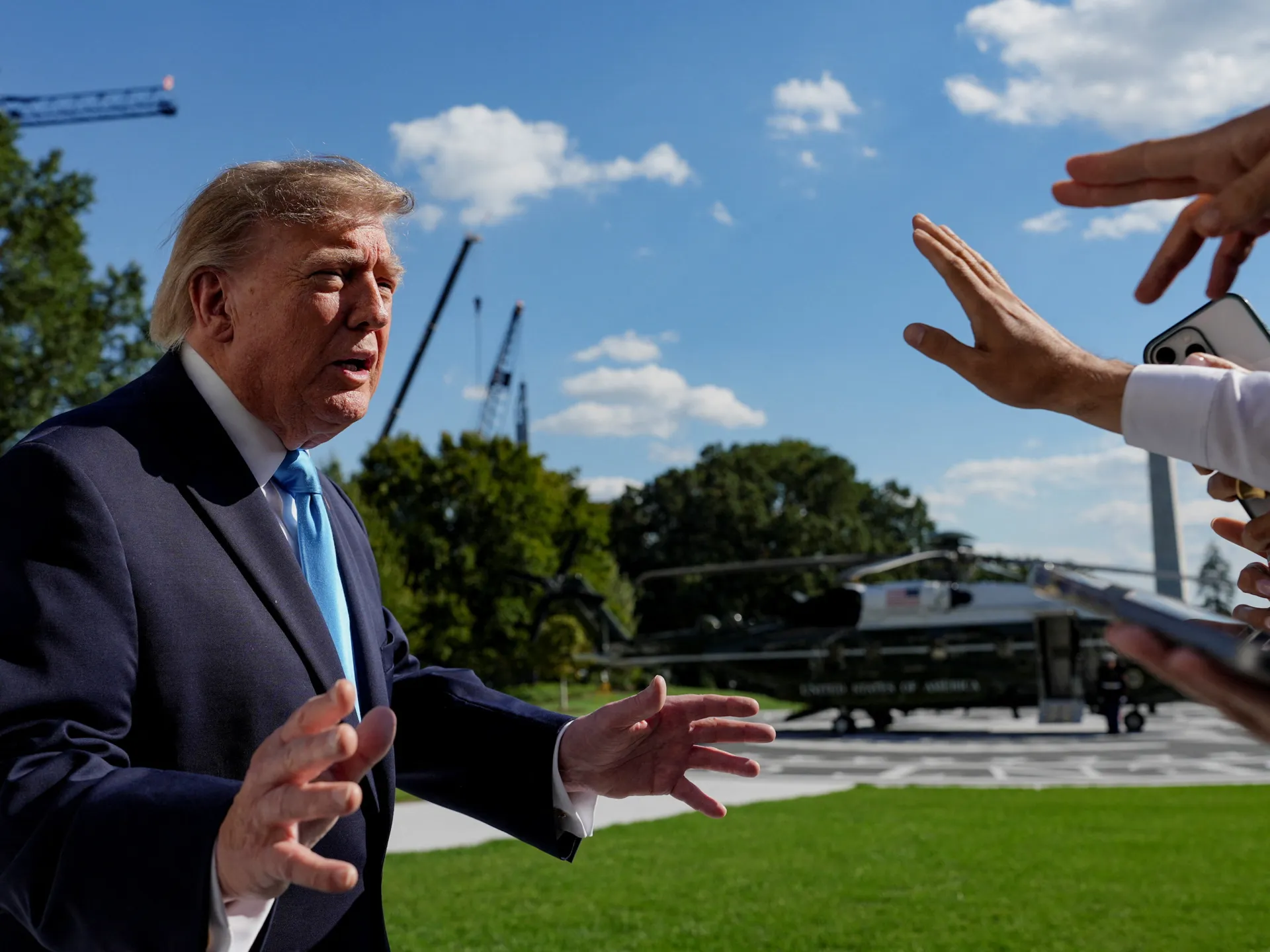
The administration of President Donald Trump has warned that news outlets could have their broadcasting licences revoked over critical reporting on the war against Iran, accusing the media of “distortions”.

Federal Communications Commission Chairman Brendan Carr said in a social media post on Saturday that broadcasters must “operate in the public interest”, or else lose their licences.

Recommended Stories

list of 3 itemsend of list

“Broadcasters that are running hoaxes and news distortions — also known as the fake news — have a chance now to correct course before their license renewals come up,” Carr wrote.

The warning was the latest apparent threat from Carr, who has repeatedly attracted scrutiny for statements that appear to pressure broadcasters to conform with Trump priorities.

Last year, for instance, Carr called on the channel ABC and its distributors to “find ways to change conduct, to take action” on comedian Jimmy Kimmel, whose late-night show had been critical of the president.

“We can do this the easy way or the hard way,” Carr said of Kimmel on a podcast. ABC temporarily suspended Kimmel’s show in the aftermath of those comments.

Carr’s latest statement prompted swift condemnation from politicians and free-speech advocates, who likened his remarks to censorship.

“This is a clear directive to provide positive war coverage or else licenses may not be renewed,” Senator Brian Schatz of Hawaii wrote.

“This is worse than the comedian stuff, and by a lot. The stakes here are much higher. He’s not talking about late night shows, he’s talking about how a war is covered.”

Aaron Terr, the director of public advocacy at the Foundation of Individual Rights and Expression (FIRE), likewise denounced Carr for seeking to silence negative war coverage.

“The First Amendment doesn’t allow the government to censor information about the war it’s waging,” Terr said.

Trump denounces war coverage

Carr’s latest statement came in response to a social media post from Trump, accusing the “fake news media” of reporting that US refuelling planes had been struck in an Iranian attack in Saudi Arabia.

“The base was hit a few days ago, but the planes were not ‘struck’ or ‘destroyed’,” Trump said in a Truth Social post. “Four of the five had virtually no damage, and are already back in service.”

He added that reporting to the contrary was intentionally misleading. “Lowlife ‘Papers’ and Media actually want us to lose the War,” he wrote.

The president and his allies have faced accusations that they use the power of the state to penalise dissent and critical news coverage, raising concerns about press freedom.

Polling shows that the war, launched by the US and Israel on February 28, is largely unpopular in the US.

A recent Quinnipiac poll found that 53 percent of voters oppose the military action against Iran, including 89 percent of Democrats and 60 percent of independent voters.

The war has also been condemned by legal experts as a clear violation of international law, which prohibits unprovoked attacks.

Trump, however, has offered shifting rationales as to why he believes Iran posed an imminent threat to US security.

He has also asserted that the war is proceeding successfully, despite ongoing Iranian attacks on US forces across the region and the shutdown of the Strait of Hormuz, a key trade artery.

“We’ve won. Let me tell you, we’ve won,” he told a rally this week in Kentucky. “In the first hour, it was over.”

His administration, meanwhile, has blamed the news media for turning public opinion against the war.

“Yet some in this crew, in the press, just can’t stop,” Secretary of Defense Pete Hegseth said during a briefing on Friday.

A former Fox News host, Hegseth called for “patriotic” reporters to write more optimistic headlines instead. He denounced TV banners that read, for example, “Mideast war intensifies.”

“What should the banner read instead? How about ‘Iran increasingly desperate’? Because they are. They know it, and so do you, if it can be admitted,” Hegseth said.

He criticised the news outlet CNN, in particular, for a report asserting that the Trump administration had underestimated the chances of Iran closing the Strait of Hormuz.

Hegseth quipped that he hoped a prospective deal would soon place CNN under the control of David Ellison, son of close Trump ally and tech executive Larry Ellison.

“The sooner David Ellison takes over that network, the better,” he added.

Source link

Press freedom declines in Americas, with US seeing sharpest drop: Report | Freedom of the Press News

A new report has expressed alarm at what it describes as backsliding press freedoms across the Americas, with the United States seeing the steepest decline.

The Inter American Press Association (IAPA) released its latest press freedom index on Tuesday, ranking last year as the lowest point for freedom of expression since the report began in 2020.

Recommended Stories

list of 3 itemsend of list

Researchers found that the Americas have experienced a “dramatic deterioration” in unrestricted speech, according to the report.

“This is one of the worst years for journalism in the region, marked by murders, arbitrary arrests, exile, and rampant impunity in countries such as Mexico, Honduras, Ecuador, Nicaragua, El Salvador, Guatemala, Colombia, Cuba, and Venezuela,” the report said.

It added that enhanced restrictions on free speech have occurred in countries of various ideological persuasions, whether right-wing or left-wing.

The US, however, was singled out as an area of “alarming decline”. In a ranking of 23 countries across the hemisphere, the US dropped from fourth place to 11th, indicating that journalists operate with increased restrictions.

Changes under President Donald Trump, who returned to office last year, were cited as a primary factor.

“Even though journalistic practice in the United States remains protected by the Constitution and laws, last year’s events saw the erosion of safeguards,” the report explained.

Trump, it said, had contributed to the “stigmatisation of critical journalism”. The report also pointed to developments like cuts to public media funding and the closure of Voice of America, a government-funded broadcaster, as detriments to the free press.

In total, the report tallied 170 attacks against journalists in the US last year, and it cited interactions with federal immigration agents as an area of concern.

The report also noted that Nicaragua and Venezuela continue to rank as “without freedom of expression”.

In Venezuela’s case, for instance, it cited the closure of more than 400 radio stations and the detention of 25 journalists in the wake of the controversial 2024 presidential election.

On a scale of 100, the report ranked press freedom in the country at 7.02. It remains in last place on the report’s list of 23 countries.

El Salvador also dropped in the index’s latest evaluation, now in 21st position on the press freedom list, just ahead of Nicaragua and Venezuela.

In an accompanying statement, Sergio Arauz, the president of the Association of Journalists of El Salvador (APES), denounced what he called the “escalating repression” under the government of President Nayib Bukele.

Arauz noted that 50 Salvadoran journalists had been pushed into exile in the last year amid a campaign of harassment by the government.

“There are no possibilities of practicing journalism fully without facing consequences when there is an Executive branch with virtually unlimited powers and no effective legal oversight,” said Arauz.

Since 2022, Bukele and his government have placed the country under a state of emergency that suspended key civil liberties and granted wide latitude to state security forces, in the name of addressing crime.

Tuesday’s report pointed to the state of emergency as a factor in undermining free speech, and also cited El Salvador’s new Foreign Agents Law, which gives the government the power to dissolve organisations that receive funding from abroad.

El Salvador is one of eight nations categorised in the index as “high restriction”, along with Ecuador, Bolivia, Honduras, Peru, Mexico, Haiti and Cuba.

The Dominican Republic, Chile, Canada and Brazil were ranked among the highest for protecting press freedoms.

Source link