Frank

A great city needs a walking path to Dodger Stadium. Do it, Frank McCourt

Dodgers fans generally hiss at the mention of Frank McCourt — the former owner took the team into bankruptcy, after all — but today is about tipping our cap to him.

Without him, fans would have no option to take public transit directly to Dodger Stadium. On his watch, the Dodgers helped secure government funding for the shuttle buses that provide free rides between Union Station and Dodger Stadium.

Sixteen years later, beyond the addition of a sister shuttle from the South Bay, that’s it.

The Dodgers boast the best team in the world. Shohei Ohtani is a tourist attraction. So is their historic ballpark. The Dodgers sold a record 4 million tickets last year.

In 1990, the last year Fernando Valenzuela pitched for the Dodgers, Los Angeles County unveiled a report that suggested ways to improve access to Dodger Stadium “for those who cannot or do not wish to drive.”

The options: a monorail, people mover, or light rail extension from the Chinatown Metro station; the shuttle buses that McCourt and Metro launched 20 years later; the gondola that McCourt first pitched in 2018 and continues to pursue; and a walking path.

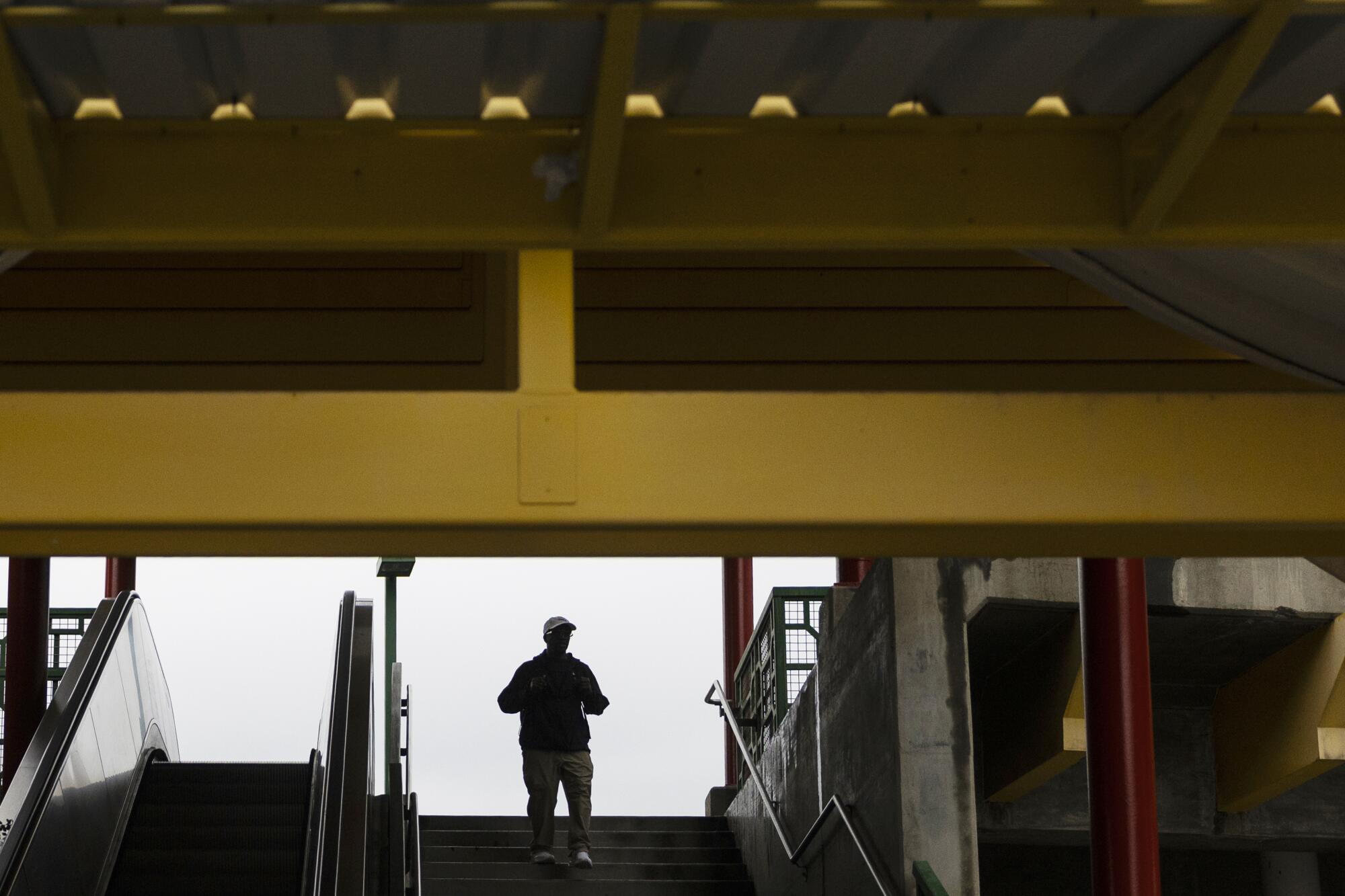
A passenger exits the Chinatown Metro station in January.

A passenger exits the Chinatown Metro station in January.

(Etienne Laurent/For The Times)

L.A. is all about the car. You will most likely drive to Dodger Stadium, and so will your children.

For decades, the Dodgers have promised to ease traffic by adding amenities that encourage fans to come early and stick around after the game. That has not materialized, and notorious congestion within and around the stadium is as much a tradition as Dodger Dogs.

What if you could walk, for real? What if you could head into the stadium along a beautifully landscaped and wide Dodgers-themed path, a blue ribbon of fans coalescing into a community, with decorations and food carts, shade and lighting, and chants of “Let’s Go Dodgers!” along the way?

You can walk now, sort of. It’s about a mile.

A map indicating the pedestrian path toward Dodger Stadium from the Chinatown Metro station.

There’s a map at the Chinatown Metro station displaying the pedestrian path toward Dodger Stadium.

(Etienne Laurent/For The Times)

At one end of the Chinatown station, there is a map with a pedestrian route, in a glass case that faces away from Dodger Stadium. If you walk out of the station at the other end, or if you just start heading in the direction of Dodger Stadium, good luck finding the map.

There are Metro signs leading you back to the station from Dodger Stadium, but none leading you along the route there.

The Dodgers actually would prefer you did not take that route, or at least the last part of it. I walked it with Alissa Walker, whose Torched newsletter is the go-to place to learn how major sporting events impact the everyday lives of Angelenos.

We entered the Dodger Stadium property at an intersection with no crosswalks, where cars enter and exit the 110 freeway. We stood atop a dirt patch next to a crumbling curb.

“To go a very short distance safely with a feeling that you’re not going to die,” Walker said, “is very difficult.”

With Game 3 of the World Series underway at Dodger Stadium last October, a few folks scurried across a pedestrian bridge with LED lights and blue glow sticks.

The bridge connects Chinatown with Dodger Stadium, traversing the 110. Without this bridge, there is no walking path to Dodger Stadium.

At night, the bridge offers magnificent views of downtown lights. But it had no lights of its own, so the volunteers used the LED lights and glow sticks to attach homemade Dodgers-themed signage to the fence that encloses the bridge.

“Our goal was, just by adding some lights, to make the really dark path at the top of the bridge at night a little bit brighter, so that it felt a little less scary,” transit advocate Jeremy Stutes said, “and to add a little bit of fun and whimsy.”

Pedestrian bridge over the 110 freeway connecting Chinatown to the area where the Dodger Stadium is located.

Glow sticks forming the “LA” logo of the Dodgers were placed on a pedestrian bridge over the 110 Freeway connecting Chinatown to the area where Dodger Stadium is located during the World Series and for several months after. As of last week, the glow sticks were no longer there.

(Etienne Laurent/For The Times)

From the Chinatown Metro station, the bridge is three blocks up College Street and one block down Yale Street. It’s an easy walk, and for now you pass an elementary school, a church, a row of Chinese restaurants, a dirt lot where a hospital once stood, parking lots, and an auto repair facility with a Dodgers flag hung on a wall.

When I did the walk last week, the trash at the foot of the bridge included a plastic cup, socks, a piece of rotting fruit, a half-full bottle of tequila, and half of a turkey sandwich, peeking out from torn plastic wrapping that indicated the sandwich had gone bad three days earlier. On the bridge: shopping bags, a pair of flip-flops, stray clothes scattered at one end, and graffiti everywhere.

A sign painted on the sidewalk indicates the direction toward the Chinatown Metro station.

A sign painted on the sidewalk indicates the direction toward the Chinatown Metro station.

(Etienne Laurent/For The Times)

That was the point those volunteers made last October: Clean up the bridge and light up the bridge — as they did for three days — and fans will walk there.

“It’s not that it’s not used,” Stutes said. “It’s not designed to be a safe space to use as an alternative to driving.”

When you cross the bridge, you can turn right or left along Stadium Way to get to a stadium entrance.

Turn right, as the map tells you to do, and you’ll encounter decaying sidewalks, with cracked and buckled concrete that turns a modest uphill walk into an obstacle course. Once you get onto the stadium grounds, the paint is fading along the pedestrian path, which offers you no protection from passing cars.

Turn left, and you’ll have to walk part of the way in the street, on an unprotected bike lane. You also could walk along the road behind the Fire Department training center, a path with no sidewalks and passing fire trucks. Either route takes longer than the one on the map, but you would enter Dodger Stadium through a pair of protected and brightly painted pedestrian paths. (That entrance, along Vin Scully Avenue, is a quarter-mile from Sunset Boulevard, where two Metro bus routes stop.)

If the primary choices for getting out of Dodger Stadium after a game are car congestion or Dodger Stadium Express shuttle bus congestion, a downhill walk to Chinatown Metro station — 12 minutes, Metro says — would be a nice option. That’s why those folks lit up the bridge over the freeway during the World Series.

“The lights were just a fun way,” transit advocate Kevin Dedicatoria said, “to show, ‘Hey, here’s a bridge so you don’t have to play, ‘Dude, where’s my car?’ or have to worry about waiting for the bus.’”

McCourt hails from Boston, where the local subway drops Red Sox fans a few short blocks from Fenway Park. When McCourt owned the Dodgers, I asked him if he could envision a subway or light rail extension to Dodger Stadium.

He’d love it, he said then, but the Dodgers were a private business, and government should pay for public transit.

Homes line a street in Eylsian Park, where Dodger Stadium is located.

Homes line a street in Eylsian Park, where Dodger Stadium is located.

(ETIENNE LAURENT/For The Times)

It was a fair point. The Dodgers pay taxes. In an era where teams regularly demand stadium and arena deals that exempt them from property tax, the Dodgers have paid $12.8 million in property taxes over the past three years, according to Los Angeles County tax collection records.

Would demand for public transit amid a car culture justify the investment? The Dodger Stadium Express indicates it could: Ridership has just about quadrupled since its inaugural season, from 122,273 in 2010 to 463,147 last year, according to Metro.

Even along the poorly maintained, poorly lit and poorly advertised pedestrian path, Metro said more than 700 riders returned to the Chinatown station on each of the three nights of World Series home games last year.

“As seen in social media videos during the 2025 postseason, the walking path continues to explode in popularity,” Metro spokesman Jose Ubaldo said.

Next steps?

“It’s astonishing to me that the Dodgers have not taken it upon themselves, as this great community partner, to fix this problem,” Walker said. “It is the city’s responsibility, but the Dodgers should be doing this, as part of what they want to represent to this community.”

The walking path includes segments along city streets, a Caltrans bridge, and Dodger Stadium property. Just who is the responsible party?

A Caltrans spokesman said the city is responsible for maintaining the bridge. A spokesman for the city’s department of street services did not provide an answer. A spokesman for the Dodgers declined to comment.

You could almost hear the sigh from city councilwoman Eunisses Hernandez, whose district includes Dodger Stadium.

“That’s what my job is: to bring people and agencies and organizations together to accomplish a goal,” Hernandez said. “We’re already in conversation with all these entities.

“We’re looking at some of the things we can enhance to make this a more walkable and accessible option for people.”

City Council member Eunisses Hernandez, center, talks with Circle outreach workers a homelessness response team.

City Council member Eunisses Hernandez, center, talks with Circle outreach workers in Los Angeles.

(Allen J. Schaben/Los Angeles Times)

How much might those enhancements cost?

Without a look at a city-commissioned Dodger Stadium traffic mitigation study, expected to be completed this fall, Hernandez said she could not put a price tag on it.

“What I can tell you,” she said, “is that it will be less than half a billion dollars, for sure.”

By year’s end, the Los Angeles City Council is expected to vote on McCourt’s gondola project, estimated to cost $500 million and proposed as privately financed. Last November, the council voted 12-1 to urge Metro to kill the project.

Metro granted its approval, but with conditions that included a requirement to explore supplementing the gondola with other Dodger Stadium transit options, including more buses along Sunset Boulevard and a designated walkway from there to the stadium.

The walking path proposed in that 1990 study would have avoided Sunset Boulevard and the current Stadium Way routes — the ones with crumbling sidewalks, or no sidewalks at all — by using escalators and walkways to get fans up and down the hill between Lookout Drive, just off Stadium Way, and Dodger Stadium.

“Pedestrians could be directed through Chinatown,” the study read, “where numerous restaurants, shops and pedestrian amenities are provided.”

It’s hard to sell Chinatown businesses on the benefits of the gondola when fans would ride between Union Station and Dodger Stadium, soaring over Chinatown. It would be easier if a walking path led at least some of those fans through Chinatown, even if only on the way back from the game.

Even if the gondola system really can accomplish what its proponents say it can — loading 35 people into a cabin every 23 seconds — thousands of riders leaving when the game ends could mean a long line to board.

One of the entrances to Dodger Stadium on Stadium Way, the easiest access when walking from Chinatown Metro station.

One of the entrances to Dodger Stadium on Stadium Way, the easiest access when walking from Chinatown Metro station.

(Etienne Laurent/For The Times)

“Also,” the 1990 study said, “passenger waiting following a game is psychologically perceived as being three to four times longer than actual waiting time.”

From this perspective, McCourt might win a few council votes by funding a first-class walking path. The cost, I’m told, would depend on what the enhancements include: signs, lights, trees, shade canopies, sidewalk repairs, escalators, and so on. For something close to $5 million — one one-hundredth of the projected cost of gondola construction — McCourt likely could do an exceptional job.

Is there any sign of progress here? Happily, yes.

In an internal report last December, Metro said Zero Emissions Transit (ZET) — the nonprofit organization now shepherding the gondola project — is pursuing ways to link pedestrians and bicyclists to the transit system and to Dodger Stadium. Those potential improvements include sidewalk repairs and a revitalized pedestrian pathway from the Chinatown Metro station to the bridge across the 110 and then across Stadium Way, to Lookout Drive and the hill above.

“Dodger Walk is envisioned as a series of switchbacks,” the report said, “inspired by the original walking path up Lookout Mountain that existed prior to the construction of Dodger Stadium.”

Whether such switchbacks would make the walk to the stadium longer or shorter than the current path remains to be determined.

In a statement, ZET said: “We embrace and include active transit solutions to increase pedestrian and bike access throughout the project area.” In particular, ZET said, it was “supportive” of a walking path to Dodger Stadium.

The Metro report cautioned the concepts “are in the early planning stage,” so L.A. might get an extravagant walking path, a utilitarian one, or none at all.

Here’s hoping McCourt gives us a path of some kind — whether the city approves the gondola or not — because a pretty walk generations can enjoy would be a prettier civic legacy than driving a team into bankruptcy.

Source link

Matt Grimes: Frank Lampard hopes Swansea City fans will stop booing ex-skipper

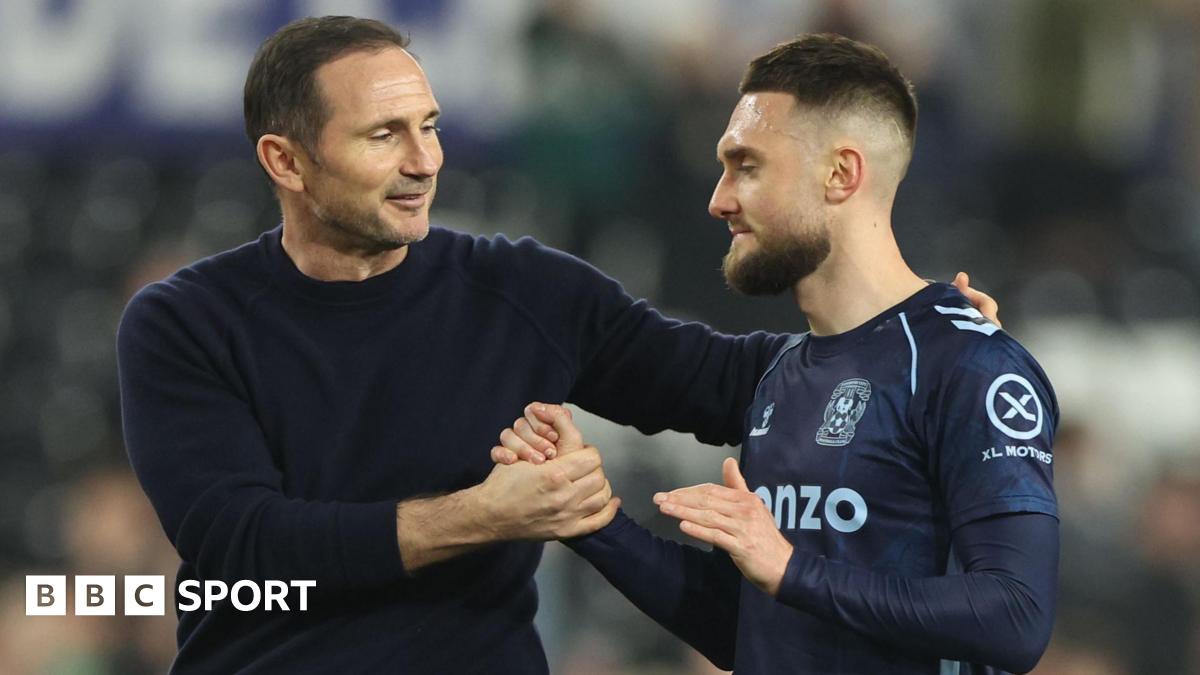
Frank Lampard hopes Matt Grimes’ “very classy” decision not to celebrate his goal against Swansea City will end the boos when the midfielder faces his old club.

Grimes was given an icy reception on his first return to the Swansea.com Stadium since ending a 10-year spell as a Swan when he joined Coventry City in January 2025.

Yet when he responded by scoring Coventry’s second goal in the Championship leaders’ 3-0 win on Saturday, the 30-year-old raised his hands in apology.

“A lot of people, maybe including me, would have had a little celebration having got booed, but it’s a sign of the man he is,” said Sky Blues boss Lampard.

Source link

Frank Gehry’s unrealized vision for Grand Avenue could transform DTLA

Spring is the season of creation, a time of renewal and new beginnings. In Los Angeles, alas, we were, last spring, a city of cinders. It was a time to mourn.

A hard year followed with floods, ICE, AI, etc., menacing our native optimism. Making matters worse, in December we lost L.A.’s grand visionary vizier, the architect who time and again built us out of civic funk and transformed L.A., inspiring the city he so loved to look good, feel good and do good.

But that is still the case. So many plans Frank Gehry imagined for L.A. still remain. Gehry bequeathed blueprints and models, sketches and concepts, for his large and devoted team of younger architects and next-generation visionaries equipped to fabricate our way out of angst.

Isn’t there supposed to be an Olympics on the way for which the city appears ill-prepared? Spring 2026 is the time to build.

A couple of springs ago, L.A. County dubbed the blocks around Gehry’s masterpiece, Walt Disney Concert Hall, the Grand Avenue Cultural District. This includes the rest of the Music Center, Museum of Contemporary Art, the Broad and Colburn School. The Grand, Gehry’s resplendent complex across the street from Disney, had recently opened and ground was about to be broken for the Colburn Center, a 1,000-seat concert hall equipped to also serve dance, opera and whatever yet-to-be-invented genres Gehry designed it to enable.

The Colburn Center is well on its way to completion next year. Bits of the building’s pink skin have started to peek out like spring blossoms on the construction site at 2nd and Olive. The Broad has begun an expansion. But after two years, nothing else has been done to make this the cultural district it must become, one unlike anything else in any city.

Four springs ago I toured Grand Avenue with Gehry to gather what he had in mind for an arts district. When Disney Hall opened in 2003, it instantly became an enduring symbol of L.A., overtaking the Hollywood sign in many cases. The Dodgers want to parade joy in winning their second World Series in row last October, where else but in front of Disney? But not in front of all Gehry had in mind.

We will soon have a pair of futuristic new museum buildings to show off this year: the David Geffen Galleries, the controversial Los Angeles County Museum of Art’s Peter Zumthor building (I predict it will prove a sensation), and the new Lucas Museum of Narrative Art (no predictions on that one) next door to the Coliseum. But the fact that each is a 15-minute ride away from the cultural district’s new Metro station only makes the district even more of a center.

A center, indeed. Gehry’s vision included completing the original plans cost-cut out of Disney a quarter-century ago, along with new modifications and much more throughout the area. Some are more costly than others. Enough could be done on Grand Avenue in time for the Olympics to make a difference if we begin this minute.

Since its opening, Disney has been — shamefully — the most poorly lit building of its stature in the world. Gehry had chosen the specific steel for its capacity to reflect light. His idea was to project on the building whatever concert was taking place that night. No sound, just imagery. Belt-tighteners didn’t want to commit the $2 or $3 million or whatever and go through the trouble.

It was spectacularly tested at the hall’s 10th anniversary, but with tacky prerecorded video and crummy amplification. Facilities are now included in the Grand for projectors. It would have been amazing in 2003 and will be amazing now. The Grand has been disappointingly slow to attract the restaurants, bars, cafes and shops it needs to create a scene. The projections could change all that and even create enough of a ruckus to get a reluctant, car-crazed city to make that Grand Avenue block pedestrian.

There is much more for Disney. Gehry wanted to turn BP Hall, where preconcert talks occur, into a small chamber music hall with a suspended balcony. He had plans for reconfiguring the seldom-used small outdoor Keck Amphitheater into an enclosed jazz club for Herbie Hancock and turning the little-used 1st Street entrance into a glass-enclosed bar that would be named the Ernest, in tribute to Ernest Fleischmann, the L.A. Phil executive director who was responsible for building Disney.

Disney was supposed to have a pit for the orchestra, allowing for staging opera and dance. The plans exist. That could be done in a summer for a couple million. Bottom-liners had also nixed Gehry’s original design for a more gracious lobby with a cafe out front, not the gloomy one installed against his will.

The Colburn Center has the potential for being another game changer for the area, a vibrant new hall where we are promised upward of 200 events a year from all walks of musical life, local and international. But Gehry had in mind even more.

He intended to lower the steep and pedestrian unfriendly 2nd Street hill, so that it would be an easy walk from the new Metro station two blocks away, and add two more pedestrian blocks by diverting traffic to the 2nd Street tunnel. This would connect the cultural district with Grand Central Market on one end and the Broad on the other. Then 2nd could itself become a lively street with the stores and restaurants a “district” needs.

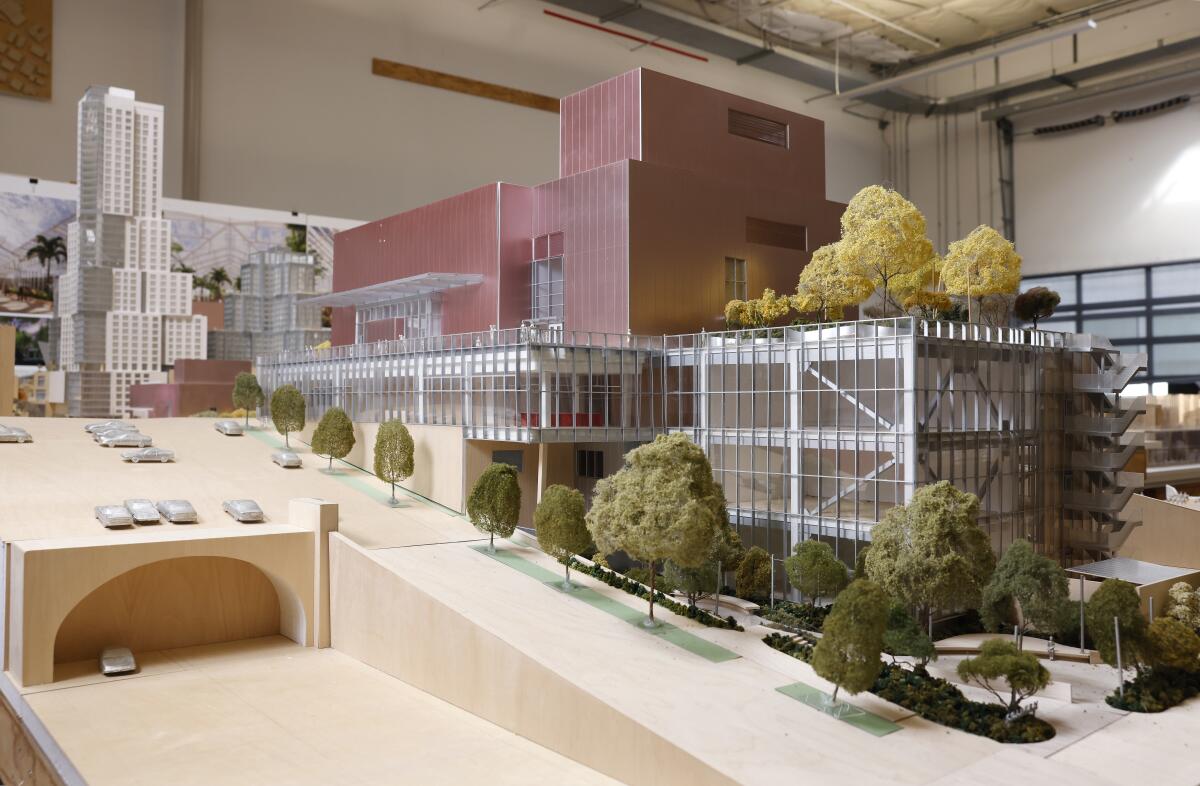
A model of architect Frank Gehry's design of an addition for Colburn School.

A model of architect Frank Gehry’s design of an addition for Colburn School.

(Christina House/Los Angeles Times)

The extraordinary original plans for the Colburn Center included turning the parking lot across 2nd from the hall into a public plaza with a giant video wall and high-end outdoor sound system, for projecting nightly concerts in the hall. Gehry was a devoted outdoor-indoor architect, and he designed for the hall a balcony on which musicians can perform.

That initiative has thus far been blocked by City Hall officials, fearful of the tunnel’s aging infrastructure. Although if that’s the case, I’m not all that eager to be in the tunnel as it currently is when the Big One comes along. This is where L.A. shows its moxie. Upgrade the tunnel. Now! If this were Beijing, New Delhi or Hanoi, it would be a no-brainer.

Gehry next proposed building low-cost artist housing in Grand Park directly across from the Music Center, which would further create a true arts community. There has been talk of renovating the Dorothy Chandler Pavilion for three decades and that’s all it’s been. The corporate-esque recent Music Center plaza could use a little excitement, maybe a Phase II.

Arts make a city. The Edinburgh Festival in Scotland was created after World War II to help bring the city back to life. After its fire-bombing, Tokyo founded a bevy of symphony orchestras as a phenomenal experiment in mass antidepression. Beethoven’s Ninth Symphony played no small role in lifting the collective mood, preparing Tokyo to create what now feels like the world’s most arresting capital.

Unlike Scotland, unlike England, unlike Germany, unlike France, unlike Italy, unlike Poland, unlike Russia, unlike Finland, unlike the Czech Republic, unlike China, unlike any number of countries, America has no major international arts festival these days. We had one in L.A. in 1984 with the Olympic Arts Festival. The Cultural Olympiad in 2028 has shown no bones. But if we make the cultural district what it could be, there would be no better place anywhere for a major festival.

We have the goods. L.A. artists helped make the modern Salzburg Festival the meaningful model for all others. In 1992, the summer before Esa-Pekka Salonen became music director of the Los Angeles Philharmonic, he and the orchestra were invited to shake up clinging Austrian tradition. With the help of director Peter Sellars, they staged Messiaen’s epic opera “Saint François d’Assise,” with pyramids of televisions, resulting in music and monitors upending, in Mozart’s hometown, the role of the modern opera and, so to speak, the sound of music.

Over succeeding decades, both Sellars and Salonen have been Salzburg Festival lodestars. Last summer they were back staging two monodramas, Schoenberg’s “Erwartung” and “Abschied” (the last movement of Mahler’s symphonic song cycle “Das Lied von der Erde”). Conductor and director looked with shocking depth into the “Expectation” of death and gave a “Farewell” to the “Song of the Earth” we all await. I saw it twice and can’t imagine how anyone came away from it quite the same person, not more alive, not more fragile. Art on the stage doesn’t get deeper than “One Morning Turns Into an Eternity,” as Sellars named the production. Salonen, who conducted the production with Vienna Philharmonic, is now about to become the L.A. Phil creative director in the fall and will bring the production to Disney with the L.A. Phil next season. It is thus far the most important opera news of next season in America. All the more reason to build that pit in the hall and get started on much bigger plans.

Salzburg, which manages to come up with around $80 million from here and there, also helped with the question I’ve evaded: Who’s going to pay for all this? I’ve evaded it because it’s the wrong question. Money only started pouring into the building of Disney Hall when people got wind of what it was going to become. Five years ago, Crypto.com paid more than $700 million to change the name of Staples Center. That amount, which created nothing but an advertisement for a product of dubious value to society, is the price of two Walt Disney Concert Halls and probably all of Gehry’s projects put together. It is the amount that could fund nearly nine Salzburg-scale festivals.

If we let ourselves believe that L.A. wealth only cares for mega-crypto advertising, mega-mansions and mega-yachts, then L.A. is over. It isn’t. Do we want to show only that to the world? Downtown, and prominently Crypto.com Arena in L.A. Live, have been designated a center for LA28, as we’re calling the Olympics. That makes a graciously glorifying cultural district, which functions as creation being existential not commercial, just up the road from L.A. Live, L.A. live.

When one morning turns into an eternity, you don’t ask for the bill.

Source link

‘The Bride!’ review: Maggie Gyllenhaal breathes fury into Frankenstein’s mate

“The Bride!” is a maniacal assemblage of ’30s musicals, ’40s noirs, 19th century literature and 21st century ideology. Every wacky second, you’re well aware how perilously close it is to falling apart at the seams. This spiritual sequel to “Frankenstein” is a romantic tale of obsession, possession and fantasy — adjectives that also apply to its filmmaker, Maggie Gyllenhaal, who expends massive quantities of energy jolting it to life. She succeeds by the skin of her teeth.

The monster’s missus comes with as much narrative anticipation as Godot. Mary Shelley’s 1818 novel has Dr. Frankenstein bicker with his creature about her potential existence before deciding against it in fear that “she might become ten thousand times more malignant than her mate.” Over a hundred years later, the debate continued, raging through nearly all of 1935’s “Bride of Frankenstein” which finally introduces Elsa Lanchester and her sky-high bouffant five minutes before the end credits, just enough time for her to make an iconic impression before her arranged husband blows them both to smithereens. Boris Karloff laments, “She hate me.” Lanchester’s Bride never speaks and quite possibly never knows what is happening to her at all.

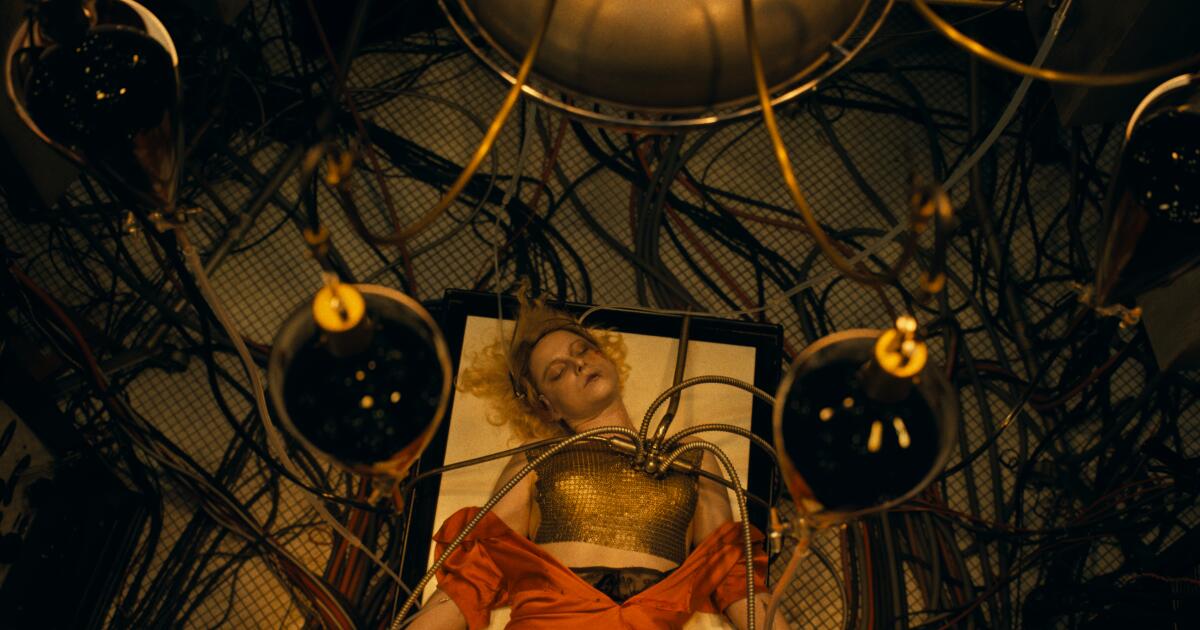
Gyllenhaal’s empowerment story, meanwhile, feels like an unhinged scream. Jessie Buckley (who starred in Gyllenhaal’s debut, “The Lost Daughter”) tackles the dual roles of the Bride and Shelley, a hat tip to Lanchester, who did the same thing. The action starts in Shelley’s grave where she’s spent centuries seething about the sequel she never dared to write, then cuts to an American nightclub, where her spirit suddenly possesses a drunken strumpet named Ida (Buckley) — not smoothly but herky-jerky, with the angry author causing this gangster’s moll to go on the fritz. Her accent alternates mid-sentence from city gal to snidely British, Ida loudly accusing a mob boss of murdering women. She’s right and she’s next.

Our setting is 1936 Chicago, but this is an exaggerated, fictional world, not ours or even Karloff’s. Elsewhere in town, the original creature, played by Christian Bale, has lurched here from Austria still on his lonely quest for companionship. (For simplicity’s sake, he goes by Frank.) He begs the ethically gray Dr. Euphronius (Annette Bening) to help him finally experience what he chivalrously calls, “a garden of pleasure.” The blunter and crasser Euphronius asks if Frank has a specific shape of mammaries in mind. (Her maid, played by Jeannie Berlin, is a riot.)

This Bride comes alive roughly and rudely not having given her consent either. Regardless, now that she’s here, she still has to figure out her next move, with or without Frank, and often without key pieces of information. Frank has convinced her she’s an amnesiac. Also, somehow, she doesn’t even know that she’s dead.

The theme is, of course, a woman’s right to choose. But what’s interesting about Gyllenhaal’s approach is that she expands Ida’s options beyond an enthusiastic yes and a priggish no into a dim sum menu that includes a dubious yes, an asterisked yes and a no that rejects even having to answer the question. She also overuses Bartleby the Scrivener’s line, “I would prefer not to.” I would prefer not to hear that quote a dozen times in two hours, but neither I nor the Bride get exactly what we want.

A perversity in the script is that Frank is a manipulator and a gaslighter but overall a pretty good dude. Their bond is messy and thrilling, with one of the most delightful romantic montages in ages. There’s a great scene where Frank exposes his unbeating heart to her and gets rejected, yet he laughs with delight because the Bride’s stubborn spirit is exactly what he likes about her.

The Bride also looks dynamite in her bias-cut coral dress and peekaboo black lace bra. Her zapping turns her entire head of hair — not just a streak — shocking white à la Jean Harlow, and leaves an oddly-appealing black blotch on her cheek. It’s a fabulous look, at once sexy and frightful, with an element of cartoonishness as the movie sends her speeding around the country pursued by gangsters and the police, changing stolen cars but never her clothes.

The movie makes no secret of its phony mechanics. In one scene, the Bride is the most famous outlaw in America; in the next, a cop doesn’t recognize her at all. There are several moments that force you to accept that the characters can become psychic at will, including one where Frank somehow mind-controls a party to dance the jitterbug — heck, we almost believe that he invented it — and the smart move is just to give in and enjoy the number.

Whatever Gyllenhaal wants to do, she does, which becomes its own act of captivation and reckless empowerment. It helps that Buckley and Bale are terrific, as is the ensemble at large. The full force of Lawrence Sher’s cinematography, Karen Murphy’s production design and Hildur Guðnadóttir’s orchestral score is fabulous, combining to make something seedy, moody and extravagant.

Gyllenhaal’s love for other variations of this story is right up there onscreen with brash callbacks to Mel Brooks’ 1974 “Young Frankenstein” and the underrated “Frankenhooker.” Yet “The Bride!” isn’t just assembled from her passion for those movies. It seems to be made of every movie: a wild and playful and overbearing ambulation of references.

Almost every role is a Frankencharacter of the director’s cinematic obsessions, like Penelope Cruz’s lady detective who is named for “The Thin Man’s” Myrna Loy, acts like “His Girl Friday’s” Rosalind Russell, and dresses like Barbara Stanwyck in “Double Indemnity.” I suspect that Gyllenhaal’s favorite movie might be the same as my own, the bitterly nostalgic ’80s-does-’30s Steve Martin musical “Pennies From Heaven.” Watch it and tell me if you agree and even if you don’t, at least you’ll have seen one of the greatest films of all time.

There’s a scene in which Frank meets his own idol, an alt-world version of Fred Astaire (played by Gyllenhaal’s brother Jake, who is good at mugging and singing), and vomits his fandom at him until the actor recoils. The intensity of devotion can feel a bit like that. It also exposes that our culture is ready for its own shock of invention. Shelley spawned the entire genre of modern science fiction; today’s talents often feel like remix artists.

Like the mad scientists she’s sending up, Gyllenhaal goes too far. She triply underlines her feminist themes and nearly sabotages her own clever creation. Ironically, she doesn’t trust the audience to think for itself either. The overkill hits its nadir when the Bride repeatedly wails the survivors’ hashtag, “Me too!” But grab a scalpel and cut 10 minutes out of it and “The Bride!” would be a rip-roaring dazzler. This monster is more than alive, it’s allliiiiiive.

‘The Bride!’

Rated: R, for strong/bloody violent content, sexual content/nudity and language

Running time: 2 hours, 6 minutes

Playing: In wide release Friday, Mar. 6

Source link