franchise

‘Zootopia 2’ review: Disney’s most effective animated sequel is punchier

Disney’s latest animated film, “Zootopia 2,” a sequel to its 2016 box-office juggernaut, isn’t exactly an adult political drama, though the stakes certainly feel grimmer. Members of Zootopia’s elite plan to expand their territory by displacing certain indigenous animals from an area they want to claim for themselves. And they will do so without pushback by convincing the rest of the population that their uprooted neighbors are dangerous. Any attempt by the victims of this injustice to reclaim their homeland and their dignity will be deemed a violent attack. In turn, anyone who sides with their cause will be labeled a criminal enabler, a disloyal pariah.

Meanwhile, tensions flare in law enforcement as pawtners Nick Wilde and Judy Hopps (voiced by Jason Bateman and Ginnifer Goodwin) — who in the previous film saved Zootopia from a power-hungry wolf in sheep’s clothing — have to prove their compatibility after their recklessness lands them in hot water with Chief Bogo (Idris Elba). Could their personalities be too disparate for them to make a dream team? Judy values justice above all things, while Nick prioritizes survival and comfort. In truth, the tie-wearing fox only became a cop because of his fondness for Judy, not out of a sense of dutiful conviction.

That push-and-pull tests the strength of their bond as they visit previously unseen areas of Zootopia, including a visit to the Marsh Market, where exiles live. These adventures occur as they search for Gary De’Snake (Ke Huy Quan), a fanny-pack-strapped viper, and Pawbert Lynxley (Andy Samberg), the socially conscious son of a wealthy family. They’re on a quest to find evidence that would clear the reputations of reptiles in Zootopia, all of whom have been forced to exist on the outskirts for decades.

Writer Jared Bush, who also co-directs with Byron Howard (both return from the first “Zootopia”), leans into Quan’s personal history as an immigrant whose family had to escape Vietnam to render Gary a resilient survivor with a noble soul. Leave it to Disney to make a giant snake look disarmingly adorable and to Quan to match that energy with his warm vocal performance. On top of the new characters, Judy and Nick’s emotional arc is adorned with cameos from fan-favorite minor players from the original (Flash, the sloth; Mr. Big, the shrew). The loaded narrative robs the picture of more time with Gary and Pawbert, even if Bush finds plot-effective ways to feature the supporting mammals.

Like its predecessor, “Zootopia 2” impresses visually, especially given the breadth of characters and environments it immerses the audience in. In the faces of new characters like the anxious Pawbert and friendly Gary, one can best appreciate the level of nuanced expressiveness that Disney’s animators, working at the highest level of 3-D CG technique, can achieve.

After several haphazard attempts with the “Frozen” and “Moana” franchises, “Zootopia 2” can take the title as Disney’s most effective animated sequel yet. In most regards, the formula that propelled the first one to hit status remains unchanged: an encyclopedia of animal puns, an upbeat tune by Shakira and a twist villain (in this case, an Elon Musk type desperate for approval that all the money in the world can’t buy). And yet, “Zootopia 2” arrives as an expansion with a punchier, more focused approach to its mature ideas. This is a movie where the antagonists are willing to kill for their nefarious goals, and where the heroes are willing to die in order to uphold what’s right.

The more one reads into the movie’s timeliness, though, the more obvious it becomes that there’s a dissonance between the artists making an animated feature such as this one and the company’s leadership, which continues to push artificial intelligence and capitulate to those who bemoan “wokeness.” Those people might certainly find “Zootopia 2” rather woke indeed. (Who knows, maybe in the next installment Judy and Nick will question their role in perpetuating the police state.) In our bizarro world, the “Zootopia” franchise serves as a vehicle for thought-provoking subjects disseminated by way of colorful anthropomorphic animals.

‘Zootopia 2’

Rated: PG, for action/violence and rude humor

Running time: 1 hour, 48 minutes

Playing: In wide release Wednesday, Nov. 26

Source link

‘Wicked: For Good’ flies to the top of the box office

Elphaba and Glinda have changed the box office, at least for this weekend.

“Wicked: For Good” — the conclusion to Universal Pictures’ two-part film franchise — hauled in an estimated $150 million in the U.S. and Canada this weekend, marking the second-highest domestic opening this year, trailing only blockbuster hit “A Minecraft Movie.” Globally, the film grossed about $226 million.

The opening weekend audience for “Wicked: For Good” skewed even more female (69%) than the first film, which counted 61% of its viewers as women, according to data from EntTelligence.

Lionsgate’s “Now You See Me: Now You Don’t” came in a distant second at the domestic box office with $9.1 million. The third installment of the illusionist franchise has now brought in a cumulative $36.8 million in the U.S. and Canada and a total of $109.4 million globally across its two weekends.

Disney’s 20th Century Studios’ “Predator: Badlands,” Paramount Pictures’ “The Running Man” and “Rental Family” from Searchlight Pictures rounded out this weekend’s top five.

The Cynthia Erivo and Ariana Grande-led film was bolstered by a massive marketing push that began early last year before the first “Wicked” movie debuted. Though the films are based on the hit Broadway play, Universal wanted to expand awareness of the story to markets that had been less exposed to the theatrical show.

As a result, the franchise has partnered with more than 100 brands, including toy companies like Lego and Mattel as well as more unexpected firms such as household goods giant P&G and online Asian supermarket Weee!, where director Jon M. Chu serves as chief creative officer.

The film’s opening weekend success also points to a demand for female-focused franchises.

After 2023’s “Barbie” grossed $1.4 billion at the global box office, there were countless calls for more films geared toward women. But this year, many of the big-budget movies were male-leaning, and the narrower returns at the box office have prompted questions about whether films were reaching all possible demographics.

“Women continue to be a really underserved audience,” said Shawn Robbins, director of movie analytics at Fandango and founder of the website Box Office Theory. “In terms of large blockbusters, it’s been a minute since there’s been a female-skewing movie on the scale of ‘Wicked’ or ‘Lilo & Stitch.’”

Source link

Former teen star, 54, has barely aged a day as she stuns in swimsuit 36 years after iconic movie franchise 

SHE was the blonde beauty that was catapulted into the spotlight after a starring role in this iconic 1989 movie.

The beloved Disney film was a box office success that would go on to span another two spin-offs, with fans lapping up the characters’ pint-sized adventures.

The 90s star reenacted the famous flick’s plot with a giant spoon and ‘cheerios’Credit: instagram/@amyoneillofficial
The actress stunned in a sexy blue swimsuit for the fan eventCredit: instagram/@amyoneillofficial
The star posed poolside with a giant popcorn bag that’s a hint to the 1989 film

Now all grown up, aged 54, the star recently took to Instagram and wowed with with some fun swimsuit photos while celebrating the film decades later.

Amy O’Neill was just 19 when she played the role of Amy Szalinski in the hit film Honey, I Shrunk The Kids – but her new pics show she seemingly hasn’t aged at all.

Amy stepped out for the Disney+ ‘Dive in Theatre’ screening of the original movie in a blue and pink racer swimsuit, ready to soak up the attractions on offer.

The former child star looked incredibly youthful and svelte in her swimwear, which she complemented with a wide wicker hat and a patterned blue beach skirt.

all stars

Death In Paradise signs up Brit comedian & Ted Lasso actor for Christmas special


WIZARD WIN

Brit Hollywood A-lister ‘set to join’ new Harry Potter series

In her Instagram caption, shared alongside the pictures, Amy enthused that the experience “transported us back to a different time and size”.

In one photo Amy is seen posing with a giant spoon and some giant ‘cheerios’ in a swimming pool, in what was a cheeky nod to her shrunken sized character.

The star later lounged poolside with her fellow movie-goers to rewatch the beloved movie and was snapped standing next to an old-school film screening sign bearing “Honey I Shrunk the Kids 1989 Now Showing”.

Talking to ABC’s On the Red carpet, Amy said: “This whole thing, when I saw the concept and got the invite I thought it was super cool.

“It’s been 36 years since Honey, I Shrunk the Kids came out.

“It’s only in the last couple of years that I’ve done fan events and I’ve gotten the chance to reconnect with fans and see how vibrant the movie still is in their lives and how meaningful it is to so many people.

Amy was also joined by co-star Thomas Wilson Brown, 51, who played Little Russ in the film, the neighbour’s offspring.

On her Instagram post, fans flocked to the comments, with one asking, “How was it reuniting with Thomas?”

Replying to her follower, Amy explained, “Wonderful as always. He brought his grandson to the screening- so adorable!”

While another said, “Just amazing! A shame the other child actors are absent!”

Amy replied, “I wish they’d been there also- but I wish all of you had been there too!”

A third fan penned, “Wow, that Thomas guy grew up to be a hottie!!”

Amy O’Neill starred in Honey, I Shrunk The KidsCredit: Alamy
The actress is still celebrating the film 36 years on from its release
Amy looked eternally youthful at the special screeningCredit: instagram/@amyoneillofficial
She uploaded a snap watching the film from the poolCredit: instagram/@amyoneillofficial

Another added, “Another of my favourite classic comedy of 80s, everything looks great.”

“Nice pictures Amy O’Neill and Thomas Wilson Brown and you’re looking well by being grown up,” said a fifth in the comments.

Someone concluded, “Very cool. Still one of the best movies of the 80s.”

The award-winning classic movie, starring Rick Moranis and Marcia Strassman, celebrated its 36th anniversary this year.

Amy played Moranis’ daughter in the movie, which produced two sequels, Honey, I Blew Up The Kid in 1992 and Honey, We Shrunk Ourselves in 1997.

The original followed the chaos that ensued when scientist Wayne Szalinksi (Moranis) accidentally minimised his children and the neighbour’s kids.

Ghostbusters star Moranis went on to star in Parenthood, The Flintstones and the two sequels to Honey, I Shrunk the Kids.

kell no

Jack Osbourne’s furious sister rips into ‘bully’ Kelly Brook after I’m A Celeb row


MUM PAIN

I was arrested in front of daughter for WhatsApp message, £20k won’t erase trauma

As for O’Neill, she had TV roles in Murder, She Wrote and The Young and Restless before Honey, I Shrunk the Kids.

She also appeared in the 1989 Christian Slater film Desperate for Love.

She starred alongside Thomas Wilson Brown in the 1989 filmCredit: Alamy
The two caught up at the special screening three decades on from the film’s release
The original movie went on for another two spin-offs which O’Neill also starred inCredit: Alamy
Fans couldn’t get enough of the original film with Rick MoranisCredit: Alamy

Source link

Executives Joey and Jesse Buss fired by the Lakers

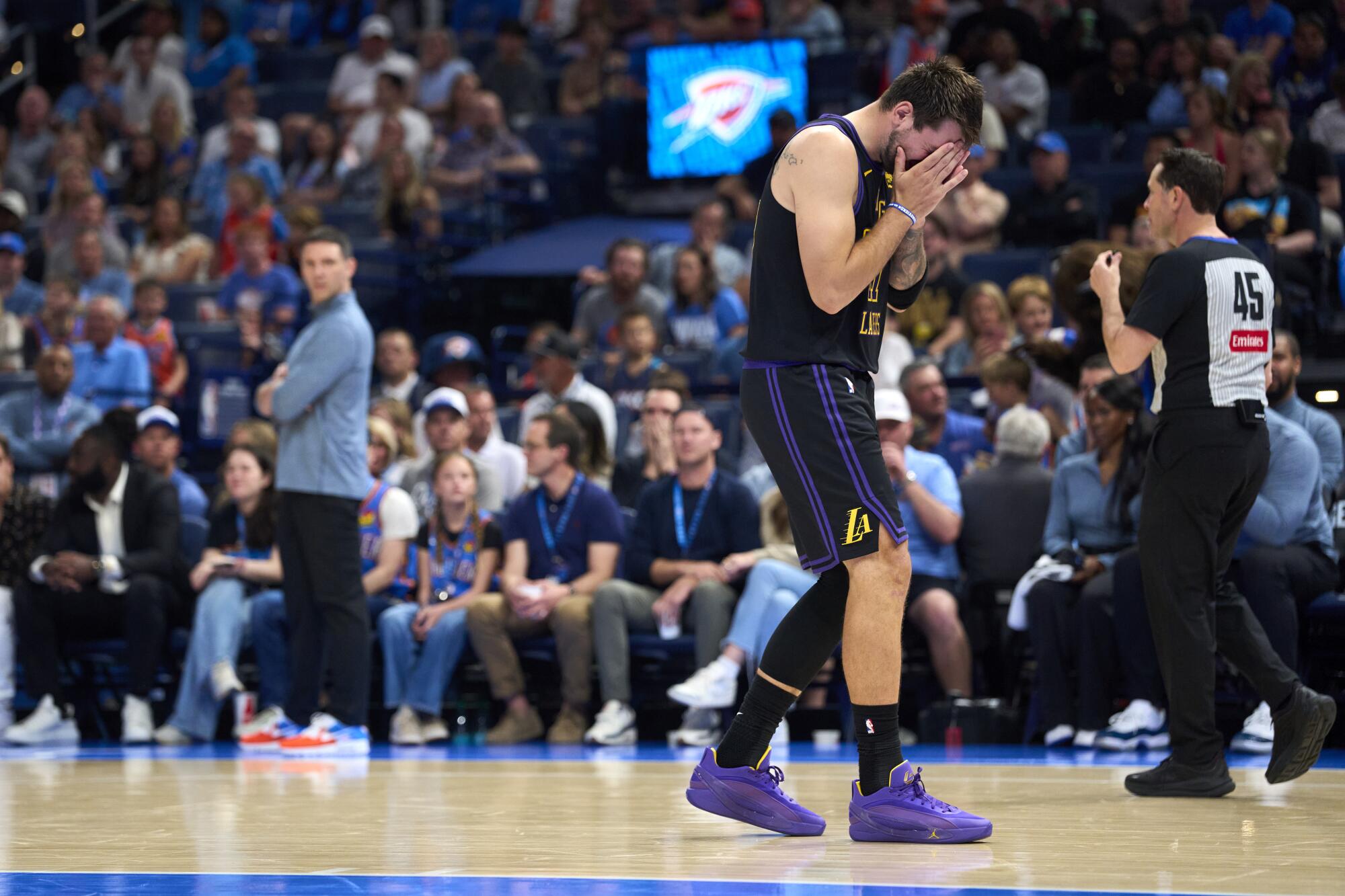
The Lakers confirmed that Joey and Jesse Buss, who both had been executives with the team, are no longer with the franchise.

The announcement was made Thursday in a move many figured would come later with changes to the Lakers’ basketball operations department after Mark Walter became the majority owner. The sale was at a $10-billion valuation and was approved by the NBA board of governors in October.

According to a person not authorized to speak publicly on the matter, everything with the Lakers is being evaluated and that included firing scouts on Thursday.

It was felt that starting the process now was the best course of action to take, according to one person who spoke on condition of anonymity, rather than wait.

Joey Buss was an alternate governor and vice president of research and development with the Lakers while Jesse was the team’s assistant general manager.

“We are extremely honored to have been part of this organization for the last 20 seasons,’ Joey and Jesse Buss said in a statement to ESPN, which first broke the story. “Thank you Laker Nation for embracing our family every step of the way. We wish things could be different with the way our time ended with the team. At times like this, we wish we could ask our Dad what he would think of it all.”

Their dad was Dr. Jerry Buss, who transformed the Lakers into a global franchise after buying the team, along with the Kings and the Forum, in 1979 for $67.5 million. Both Joey and Jesse worked alongside their sister, Jeanie Buss, who will continue to be the Lakers’ primary team governor for the foreseeable future.

Joey was team president and CEO of the Lakers’ G League team, the South Bay Lakers, and Jesse was the Lakers’ director of scouting. Each, along with their siblings, are still minority owners of the franchise.

The two were given a lot of credit for helping the Lakers find and develop Austin Reaves, Kyle Kuzma, Jordan Clarkson, Larry Nance Jr. and Max Christie.

The Lakers didn’t have a comment about the Buss brothers no longer being with the team.

“Yeah, I found out this morning that it was going to happen,” Lakers coach JJ Redick said after practice. “But I don’t have any comment on personnel decisions as it relates to the organization.”

The Lakers signed general manager Rob Pelinka to a contract extension in April and extended Redick‘s contract in September.

The sale of the Lakers was finalized on Oct. 30.

Fresh off winning a World Series with the Dodgers, Walter, who had been a minority owner of the Lakers since he bought 27% of the franchise with Todd Boehly in 2021, promptly sat courtside for the next Lakers home game on Nov. 2. He looked on when the Lakers honored the world champion Dodgers at a home game on Nov. 5.

Walter was part of the group that purchased the Dodgers for $2 billion in 2012. Since then, the team has won three World Series titles in five appearances with 13 consecutive playoff berths.

The swift reorganization process with the Lakers differs from Walter’s history with L.A.’s other pro sports headliner. After Walter bought the Dodgers, general manager Ned Colletti stayed with the organization through the 2014 season.

In addition to becoming the highest-spending team in baseball under the new ownership group, the Dodgers also bolstered their analytics department, improved nutrition programs for major and minor league players, and expanded clubhouses with the latest physical therapy technologies.

Source link

Oscar Isaac would return to ‘Star Wars’ under one condition

Don’t expect to see Oscar Isaac reprise his role as hot-shot pilot Poe Dameron in the “Star Wars” franchise any time soon.

The “Frankenstein” star admitted in a GQ interview released Monday that he’s not interested in working for the media company given its acquiescence to the Trump administration.

“I’d be open to [returning to ‘Star Wars’], although right now I’m not so open to working with Disney,” Isaac said. “But if they can kinda figure it out and, you know, not succumb to fascism, that would be great.”

The interview, while released this week, was conducted in the days immediately following the shooting death of conservative influencer Charlie Kirk and Walt Disney Co.-owned broadcaster ABC saying it was pulling “Jimmy Kimmel Live!” indefinitely following sharp backlash over the host’s remarks about Kirk’s death. Kimmel’s program ultimately returned to ABC on Sept. 23, after nearly a full week off air.

“But if that happens, then yeah, I’d be open to having a conversation about a galaxy far away. Or any number of other things,” Isaac continued.

The 46-year-old actor was also the lead in the 2022 Disney+ original series “Moon Knight,” based on the Marvel superhero of the same name who first appeared in print in 1975.

In a 2020 interview with Deadline, Isaac voiced hesitation about returning to the “Star Wars” franchise following 2019’s “The Rise of Skywalker.”

“I enjoyed the challenge of those films and working with a very large group of incredible artists and actors, prop makers, set designers and all that was really fun,” he said five years ago. “It’s not really what I set out to do. What I set out to do was to make handmade movies, and to work with people that inspire me.”

When asked point blank if he would accept a “Star Wars” role again, Isaac blankly answered in 2020, “Probably, but who knows. If I need another house or something.”

Responding to the flippant nature of his previous response, Isaac noted how seemingly obnoxious that quote sounded.

“Yeah. That was a real likable quote. Jesus Christ,” the “Dune” actor said in the recent GQ interview. “Y’know, people ask you things, you say stuff, you don’t really think about it that much. I said a slightly d— thing.”

Source link

Combate Global MMA franchise to move production to Burbank from Miami

In a small win for California’s film and TV industry, mixed martial arts franchise Combate Global will relocate production from Miami to Burbank.

The franchise, which will air on Spanish-language network Estrella TV after a six-year run on Univision, will film 20 live events at Estrella’s new networks studio, starting in February. That space seats 500 people and has been used to film the talent competition show “Tengo Talento Mucho Talento.”

The franchise wanted to relocate to Southern California because of the bigger media market, said Campbell McLaren, chief executive of Combate Global and co-creator of the UFC.

The move is expected to create about 60 jobs, and is estimated to have an economic impact of more than $1 million on an annual basis for the 20 shows, which is up from the eight produced this year, he said.

“It’s a bigger market, access to more talent, access to more behind-the-camera talent, access to more on-camera talent,” McLaren said. “We feel we’re making a big, big step.”

The move also allows the franchise to target the large Mexican American market in L.A. — Combate Global currently has its largest viewership in Mexico — as well as others who have not been as exposed to the mixed martial arts events, such as the Korean community. The sport’s Japan vs. Mexico nights have also been popular and could find broad appeal in in L.A., McLaren said.

“It’s a move to super serve our core audience,” he said. “We’re going to have real audience traction.”

The news comes as California tries to lure film and television productions back to the Golden State after many have relocated to other states and countries in search of more lucrative tax incentives.

Over the summer, state legislators bulked up the state’s film and TV tax credit program and agreed to more than double the annual amount allocated to it. So far, dozens of projects have been awarded tax credits, including 22 series and 52 movies. (Combate Global did not receive a tax credit because sports do not qualify for the program.)

Source link

‘Predator: Badlands’ Yautja expert explains alien language

When asked how much of the alien language used by the franchise’s central hunter species he is able to speak, “Predator: Badlands” director Dan Trachtenberg quickly answers, “Zero.”

“My mouth will not even permit me to utter [even] a phonic from it,” Trachtenberg says of the language created for his film, praising his actors for learning it. Linguist Britton Watkins “really developed the language as if it had evolved from the mouth shape and the throat sounds that we have heard before from the ‘Predator’ [movies], but it really fits the ecology of the Yautja species. And my throat won’t allow me to do it.”

“Predator: Badlands,” which opened to a franchise record $40 million at the domestic box office, is the first “Predator” installment where one of the alien hunters is the hero. The movie follows Dek (Dimitrius Schuster-Koloamatangi), a young Yautja outcast on a quest to prove his worth to his clan by hunting a massive, nearly unkillable beast on a deadly planet.

a woman strapped to the back of an alien

Thia (Elle Fanning) and Dek (Dimitrius Schuster-Koloamatangi) meet on a deadly planet in “Predator: Badlands.”

(20th Century Studios)

During his hunt, Dek encounters Thia (Elle Fanning), an android that has been separated from the rest of her research party — as well as the lower half of her body — and is happy to provide helpful intel on the planet’s lethal flora and fauna.

For Trachtenberg, who rejuvenated the long-running sci-fi franchise with the 2022 prequel “Prey,” it was important that the Yautja and their culture feel “as authentic and archaeological” as the human ones he has featured in his “Predator” films, which also include this summer’s animated anthology “Predator: Killer of Killers.”

“I wanted to make sure that the Yautja species was treated seriously and with dignity,” the filmmaker says. “We’re asking people to empathize with a monster, with something that was the slasher in a slasher movie to some degree, decades ago.”

That meant consulting an expert to fully construct a language for the Yautja. Watkins was recommended to the “Predator: Badlands” team by Paul Frommer, the linguist who created the Na’vi language for the “Avatar” films. He was tasked with developing both the spoken and written Yautja language, first introduced in “Killer of Killers.”

Watkins understood that “Badlands” would involve both the type of action that audiences expect from a “Predator” film as well as more quiet moments where characters are just talking to each other. This meant creating a language that was as faithful as it could be to the trills and roars of previous “Predator” movies while also being “a tonal match and a kind of atmospheric match” to English for scenes when both languages are used in conversation.

“I started, rather than with a complete language and vocabulary and everything, a framework that I could build out as things changed with the production,” Watkins says, explaining that this involved creating both phonological and grammatical rules. “I built the framework for a language that was never going to have sounds that didn’t belong in it, but could expand in terms of vocabulary and grammar to suit whatever we needed over the long course of filming.”

He also knew that once Yautja was introduced, there would be fans eager to dissect and learn it just like there have been for other constructed languages created for sci-fi and fantasy movies and TV shows.

“I knew that … people would want to pause [the movie] and they’d want to rewind and they’d want to figure it out,” Watkins says. “So I wanted to keep it simple, but it’s not dumbed down. It’s culturally appropriate but it’s approachable as a language [for] people [that] want to learn it.”

Here are a few tips from Watkins for those interested in learning Yautja.

The alphabet includes complex consonant clusters

a fictional alphabet chart with symbols made of assembled dash marks printed in red

The Yautja alphabet can be seen in the writing on some of the objects in “Predator: Badlands.”

(20th Century Studios)

When designing the phonology of the Yautja language, Watkins took into account the aliens’ physiology.

“They don’t have lips, so they can’t make ma or ba or fa [sounds] because they don’t have the lips to do that,” Watkins explains. “To supplement not having F and V and Th and M, we have consonant clusters like jl and cht … that we don’t have in English, but they can be made lower in the throat.”

These consonant clusters comprise multiple letters when written out in the Roman alphabet, but are one letter in the Yautja alphabet. The Yautja word for prey, for example, starts with the letter hrr.

Their alphabet “is optimized for visual efficiency for their sound system,” Watkins says. Yautja writing can be seen on weapons and other objects in “Badlands.”

Basic sentence structure is the reverse of English

In Yautja, the structure of a declarative sentence — one that makes a statement, provides a fact or offers an explanation — is the reverse of those in English.

“The object or the predicate comes first, the verb is in the middle and then the subject comes at the end,” says Watkins. “Once you establish a rule like that, you have to keep it unless you have a legitimate reason to break it, like we do in English.”

an alien drawing drawing a hi-tech laser bow and arrow

Dek (Dimitrius Schuster-Koloamatangi) in “Predator: Badlands.”

(20th Century Studios)

Listen for recurring words

Yautja words are largely analytical, meaning “there aren’t 14 versions of a single noun,” Watkins explains. This includes the first-person pronoun ‘I,’ which in Yautja is chish.

“When it’s ‘me’ earlier in the sentence, it’s chish [and] when it’s ‘I’ as a subject at the end of the sentence it’s still chish,” Watkins says. “It doesn’t change.”

Another sound to try to catch is nga. Ngai is the Yautja word for ‘no,’ so nga occurs in any word that has a negative element in it, like “nobody.”

You can tell how Yautja feel about you by what they call you

Unlike chish, the Yautja use different words when addressing or referring to others based on respect and affection.

“The words for ‘you’ and the words for ‘he’ or ‘she’ change depending on who’s speaking about whom,” Watkins explains. “It’s culturally appropriate for Yautja, in the Yautja culture, [to] talk about other people pejoratively.”

Think of it a bit like the difference between using or usted in Spanish. When addressing someone they look down on or are disrespecting, the Yautja use wul, while someone they respect would be addressed as dau. Kai is the word used when addressing a close friend.

Yautja isn’t a gendered language (for the most part)

Unlike languages such as French and Spanish, Yautja has no grammatical gender, so nouns aren’t assigned gender categories.

There is, however, a pronoun gender distinction for he and she, much like in English. Similarly, all Yautja use chish for “I” and “me” regardless of gender.

One of the reasons Yautja has no grammatical gender is because that was most practical.

“There was not a lot of time [to create Yautja], and adding gender like that is going to add complexity to the language,” Watkins says, explaining that this complexity would have made it more difficult to quickly turn around any adjustments to the script that needed to be made over the course of filming.

That it also helps keeps the language accessible for Yautja learners is a bonus.

Source link