form

Hugo Chávez: Truth as a Form of Struggle

Chávez never shied away from self-criticism and taking responsibility for his actions. (Archive)

In these times when it is once again fashionable to accuse Commander Chávez of mistakes, whether real or imagined. As we mark 13 years since his untimely death on March 5, 2013, I would like to highlight the value of truth in his political actions. Truth was manifest in the responsibility he assumed for his actions; the consistency between his words and deeds; the acknowledgment of his own mistakes, when it is easier for most people to point out the mistakes of others; and his sincere efforts to correct them. To the above, I would add that when he had to make tactical and strategic shifts in the course initially set, Chávez always had the political honesty to explain in detail why he was doing so, and he courageously took responsibility for them before the people.

There are countless examples which can be found in many of his speeches. I will mention just a few. Beginning with the day of his introduction to the Venezuelan people, February 4, 1992: “Unfortunately, for now, the objectives we set for ourselves were not achieved in the capital city, that is, we here in Caracas did not manage to control power… And I, before the country and before you, take responsibility…” Then in the streets and in the 1998 election campaign: “Let’s go to the Constituent Assembly,” and on February 2, 1999, in what would be his first act of government, he signed the decree calling for the constituent process, and we went to the Constituent Assembly.

In April 2002, he surrendered to the coup leaders, without thinking about saving his own “skin”: “I am an imprisoned president; you decide what to do with me.” After his release, with a cross in his hand, he stated that “it was necessary for all sectors of the country to make a greater effort, with all the goodwill we can muster, to be able to live together in peace, accepting the rules of the game.”

In 2005, he called for the Bolivarian Revolution to take on a socialist character. In the 2006 election campaign, he said, “Let’s go for socialism!” and explained in detail why this strategic shift was necessary. He outlined the characteristics of our socialism, 21st-century Bolivarian socialism, which, as he insisted until his last public words, had to be “essentially democratic” or it would not be socialism at all.

In the elections of December 6, 2006, Commander Chávez obtained the highest number of votes and was re-elected. In December 2007, while awaiting the results of the referendum on constitutional reform and hearing reports of a close count, he called a meeting of the party leadership in Miraflores. I said to him at that meeting: “President, let’s wait for the final count, and if we lost, we lost, but if we won, we won.” He replied with a sharp look: “I don’t want a victory like that, let’s go out and acknowledge defeat now.” And that’s what he did.

In September 2010, we won a majority in the National Assembly. Without a doubt, it was a resounding political victory. But Chávez identified a warning sign: in quantitative terms, the difference in votes between Chavismo and the opposition was minimal. Once again, he assumed political responsibility. In January 2011, he published the “Strategic Lines of Political Action,” a deeply self-critical document.

Late May 2011, he told me: “Elías, I feel like something is wrong with me.” June 2011, after undergoing the necessary tests, on national television: “Cancer cells have been detected in my body.” Easter Week 2012, during a mass in Barinas, broadcast live: “We must be aware that I have an illness that limits my life… Christ, give me your cross.”

On the night of December 8, 2012, in a public address, he raised the possibility of not continuing among us and explained in detail the constitutional procedures that would have to be followed if he were to be permanently incapacitated. That day, once again, he decided to tell us the truth, no matter how hard it was:

Some colleagues told me it wasn’t necessary, or have said in recent hours that it wasn’t necessary to say this. In truth, I could have said almost everything I said tonight from Havana… But I believe that the most important thing, what my soul, my heart, and my conscience tell me, the most important thing… has been this, Nicolás. The most important thing.

“The most important thing”: telling the truth, explaining the reality to the people, the decision he had made, and the steps that needed to be taken.

But that political honesty was not just an individual value. It was the political conviction that the people formed a collective wisdom, a conscious body that knew how to understand and draw its own conclusions about situations. That is why he was so careful to keep them informed at all times.

I once heard him say: “There are those who say that you shouldn’t speak plainly to the people, because then the adversary will seize on that truth and manipulate it against you.” That, Chávez said, is to think that the people are mentally eunuchs. The people understand, more often than not, more than some leaders. For Chávez, speaking the truth was always a decisive show of trust and respect for the people.

And “most importantly,” it was also to make clear for posterity his conviction about the democratic path of the revolution he had led:

In all circumstances, we must guarantee the progress of the Bolivarian Revolution, the victorious progress of this revolution, building the new democracy that is here mandated by the people in the Constituent Assembly; building the Venezuelan path to socialism, with broad participation and ample freedom, which are being demonstrated once again in this gubernatorial election campaign, with candidates here and candidates there. Freedom, complete freedom.

With the power of truth, the truth of his project and his life, Chávez managed to accumulate immense political strength based on the moral autoritas he gained by never peddling falsehoods or shirking his responsibilities, much less in defeat or when he made mistakes. That same moral authority comes not only from consistency between words and deeds, but also from trying to act despite difficult circumstances as well as from recognizing and explaining when and why it is not possible to achieve a certain goal. I stand by that way of doing politics. With Chávez forever!

The views expressed in this article are the author’s own and do not necessarily reflect those of the Venezuelanalysis editorial staff.

Translated by Venezuelanalysis.

Source: CEDES

Source link

Celebrate St. Patrick’s Day at L.A.’s best Irish pubs

In 1936, Irish Bostonian entertainment lawyer Tom Bergin founded L.A.’s first Irish pub, the Old Horseshoe Tavern, on Wilshire Boulevard. The bar was later renamed in his honor and relocated to its current Tudor Revival-style building off Fairfax Avenue in 1949.

The tavern claims to have introduced Irish coffee to the U.S. — though some argue that San Francisco’s Buena Vista Cafe holds that title. Either way, Tom Bergin’s is one of the oldest bars in continuous operation in L.A. and boasts the second-oldest liquor license in the city. And its Irish coffee is still one of the best you’ll find.

Today, L.A.’s Irish pub tradition extends to Santa Monica, Long Beach and Woodland Hills, with many founded by Irish immigrants seeking to bring a bit of their homeland to the West Coast in the form of Guinness pints, corned beef and cabbage and traditional Irish folk music.

Whether you’re celebrating St. Patrick’s Day or just looking for somewhere to split the G, here are 13 Irish pubs to check out in L.A. — Danielle Dorsey

Source link

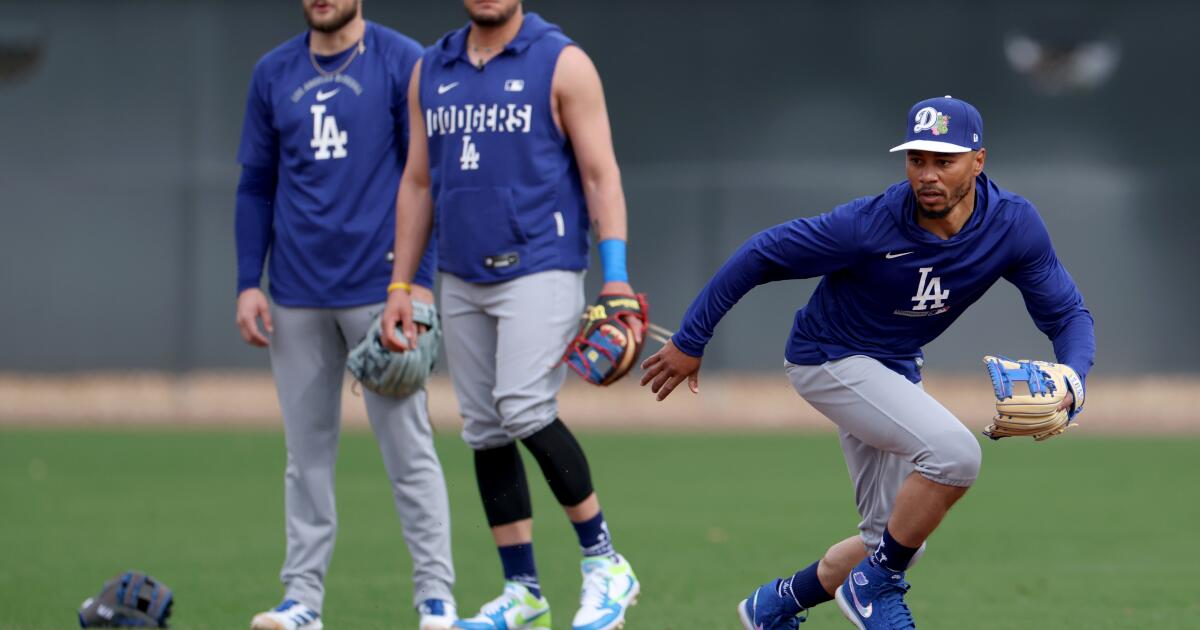
How the Dodgers’ Mookie Betts seeks to regain his All-Star form

p]:text-cms-story-body-color-text clearfix”>

Since his first full season in 2015, Mookie Betts had either been named an All-Star or received votes for most valuable player every year.

That held true until last year. In his sixth season with the Dodgers, Betts posted career lows in batting average (.258), on-base percentage (.326), and on-base-plus-slugging percentage (.732) while playing 148 games at shortstop.

Betts, now 33, believes last year was an outlier and he can get back to his previous form.

“That’s what I expect,” Betts said after making his Cactus League debut Sunday. “I haven’t felt this way in a long time. So, the way I feel now, I’m healthy, my swing’s in a really good spot. My head’s in a really good spot. I haven’t had any bad days in the cage. I haven’t had any bad days [taking batting practice]. Usually by now, I would have taken a thousand swings, trying to fix stuff, trying to get game-ready, and now I’m just cruising. I’m just cruising and I’m ready to go.”

This spring, manager Dave Roberts offered an unequivocal vote of confidence.

“He will be in the MVP conversation this year,” Roberts said. “But again, I think, speaking for Mookie, his main goal is to help us win a championship. So, I think whatever falls out from there, I think that will happen.”

A stomach bug that caused him to lose a considerable amount of weight put Betts behind last spring, and he never quite caught up. Through his first 103 games, he batted .231 with a .302 on-base percentage and .657 OPS. Enduring the longest cold spell of his career, Betts was forced to retool.

“It’s really just going back to what I what I do best, and really just honing in on it,” Betts said. “Instead of trying to fix problems, I was more able to just hone in on what I do best. And kind of groove those patterns instead of trying to fix old habits.”

Betts says in a bizarre way, he enjoyed his season of soul searching.

“I learned a lot about myself,” Betts said. “I learned a lot about how I operate. I was able to get in the right headspace, and sustain the right headspace. And then once I was able to kind of get in the right headspace and stay there, I haven’t been searching, I haven’t been doing anything since I’ve been here outside of just working and preparing.”

Things started to click in late summer. Over his final 47 games, he batted .317 with a .376 on-base percentage and .892 OPS.

It wasn’t the stats that bothered Betts as much as his lack of production through the first four months.

“Once I was able to help the boys, I was fine,” Betts said. But before that, I was really upset, not with the numbers per se, but not being able to help. Not doing my job, carrying my weight. Once I was able to do stuff, especially later on in the season, I was able to just take a step back and say, ‘You did pretty good.’”

Part of the plan for maximizing Betts’ abilities is minimizing his work in camp. Betts was the last healthy position player to appear in a spring game, starting Sunday after sitting for the first nine games. He was back in the lineup Monday, collecting his first hit with a single in three at-bats against the Colorado Rockies.

“It’s intentional,” Roberts said last week. “It’s load management. I wanted Mookie to start a little bit later, as far as not getting into spring training ready to go and kind of use spring training to build up, given it’s six weeks.”

Source link

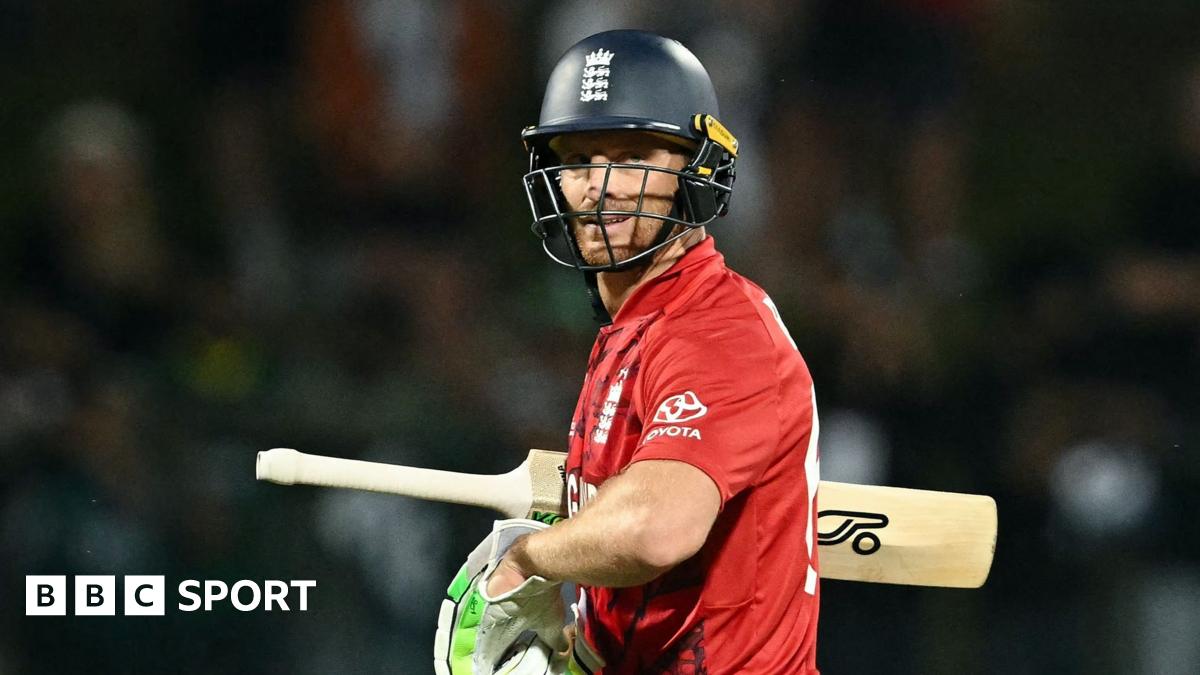
T20 World Cup: Jos Buttler’s form a problem for England

The most drastic option also appears the least likely.

Buttler, who signed a new two-year central contract last year, has been a mainstay of England’s white-ball teams for more than a decade. Could they really leave him out entirely for a World Cup semi-final?

That encounter may be at Mumbai’s Wankhede Stadium, where Buttler has made scores of 94 not out, 89 and 116 in the IPL.

Ben Duckett is the spare batter in England’s squad – another man struggling for form.

Duckett is averaging 18.88 across 12 matches this winter across all formats and was out for a first-ball duck in his most recent innings at the start of the month.

Leg-spinning all-rounder Rehan Ahmed would be a left-field replacement. That would be a massive call.

Perhaps Friday’s match against New Zealand, effectively a dead rubber for England given they are already through, is the perfect, pressure-free opportunity for Buttler to help make the hierarchy’s decision an easy one.

“Who is writing Jos Buttler off?,” said former England spinner Alex Hartley.

“If you are, get a grip. He is one of those players where it takes one shot crunched through the covers and he will be back.

“It would be a worry if England were not winning games. I have no doubt when push comes to shove Jos Buttler will be OK.”

Source link

‘Scrubs’ revival review: A return to form with brilliant additions

Suddenly it feels like the 2000s again, with a revived “Scrubs” premiering Wednesday on ABC and Tracy Morgan reincarnating the spirit of “30 Rock” in NBC’s “The Fall and Rise of Reggie Dinkins” — network television shows, too, as in the days when streaming was just something tears and traffic did.

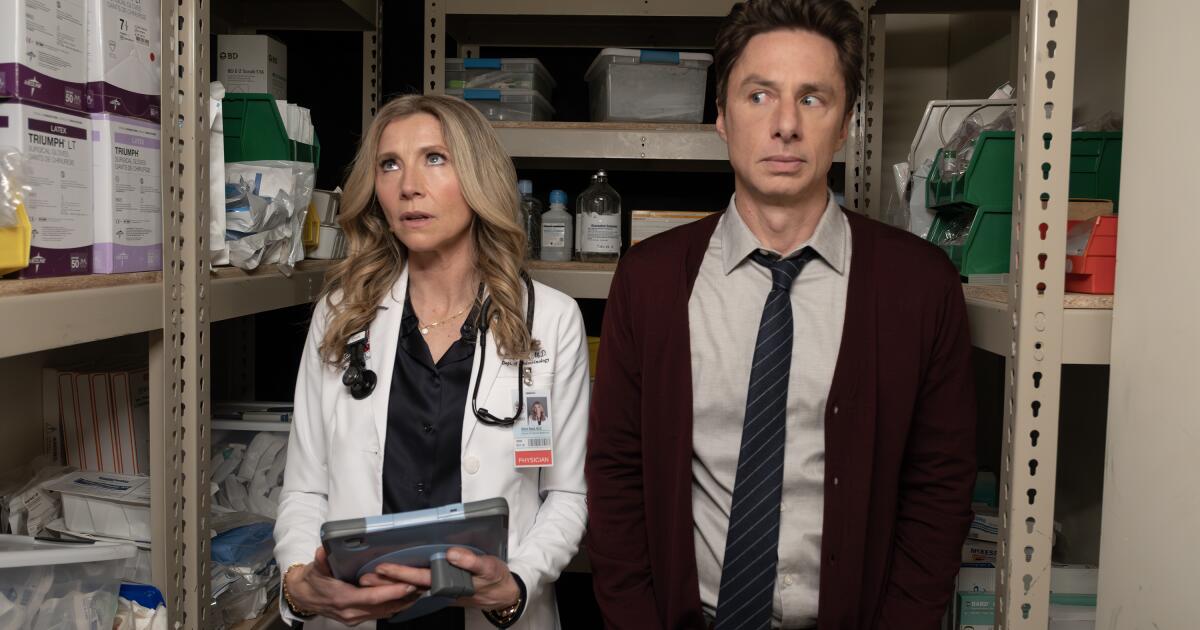
Beginning as a tale of new doctors at work and in love, “Scrubs” may also be seen as a looking-glass “Grey’s Anatomy,” although as “Scrubs” premiered first, it’s fairer to say that “Grey’s” is a straight-faced “Scrubs,” probably not a thought that ever crossed Shonda Rhimes’ mind. The show, then and now, combines a sentimental, satirical, soapy, sometimes surreal comedy with a straightforward medical show. Stars Zach Braff, Donald Faison and Sarah Chalke are back full-time, not quite in their old places, but arranged in close quarters, with Judy Reyes and John C. McGinley listed as recurring and other old faces slated to peek in.

The show left the air in 2010, after its ninth season, a virtual spin-off that has been declared noncanonical. The Season 8 finale saw protagonist, narrator and inveterate daydreamer J.D. (Braff), a person who really needs people — “I can’t do this all on my own” runs the show’s title song — looking into a happy future, married with a child to surgeon Elliot (Chalke). But that was just a dream, just a dream. The new season finds them at odds, and while a child is mentioned, it remains unseen, at least for the four episodes (of nine) out for review.

As we begin again, J.D. is working as a concierge doctor, tending to the minor ailments of the rich — cut toe, long-lasting chemically induced erection — when he’s drawn back to Sacred Heart Hospital to check on a patient. By the end of the first episode, his former mentor, the acerbic yet strangely sympathetic Dr. Cox (McGinley), will give him a job, of which is officially a spoiler to describe — even though it’s the premise of the show — noting his gift for teaching and reuniting J.D. with bromantic best friend Turk (Faison), the chief of surgery. (“Two chiefs!” is their chanted motto, followed by a special handshake. They are men who will be boys.) Turk is still married to head nurse Carla (Judy Reyes); they have four daughters, whom we do see, briefly. (J.D.’s appointment rankles Dr. Park, played by Joel Kim Booster, the series’ designated mean person.)

Moving into the space Turk, J.D. and Elliot occupied 25 years earlier are a new crop of interns, bringing youth appeal and naivete (the better to instruct them). Blake (David Gridley) is a cocky know-it-all, who will become a less cocky know-it-not-all; Asher (Jacob Dudman) is British, insecure and attracted to Amara (Layla Mohammadi), who is homeschooled (“I almost won prom queen twice but my brothers voted for my mom”) and a fan of Sam (Ava Bunn), a social media star who hangs her hands like Alexis Rose. Dashana (Amanda Morrow), the serious one, who sees Turk as an ally: “You’re, like, the only Black surgeon in this place; the rest of them just got, like, Coldplay on loop in the ER and say things like, ‘You’re so articulate.’” (“This brother likes Coldplay, too,” says Turk, pressing play on “Clocks.” Another lesson learned.)

As before, the show is fast-paced, packed with asides and ironic cutaways, with jokes riding on the back of jokes and some unexpected slapstick (the best kind), though it will shift into a lower gear when something capital-I important needs to be said. The world has changed in 16 years (“I am now supposed to watch every word that comes out of my mouth because apparently they are all fragile little Christmas ornaments,” grumbles Dr. Cox) and so the risqué material is left to the older characters, though the sex jokes now mostly amount to lack-of-sex jokes. (“She used to get worked up by ‘Bridgerton,’” Turk says of Carla, “but the new season doesn’t come out for another year.” “Spring 2027,” nods J.D.) Monitoring behavior is Vanessa Bayer as Sibby, a tightly wound administrator with an effortful smile, whom Turk calls “the feelings police.” (A longtime favorite of this department, Bayer is a brilliant addition. Told that Tarzan is a fictional character, Sibby replies, “I wouldn’t be so sure. They did make a movie about his life.”)

They say you can’t go home again, but with a good map and a good crew you can get pretty close. Not every bucket drawn up from the well of old IP will prove potable, but it often has: “Arrested Development,” “Veronica Mars,” “Party Down,” “Roseanne/The Conners,” “Frasier,” even “Dallas.” “Twin Peaks: The Return” is, of course, a work of art. Under the watchful eye of creator Bill Lawrence — later to co-create “Ted Lasso,” which is coming back for a fourth season even though it really ended after the third — with Aseem Batra, who wrote for the original series, as showrunner, it is very much the sitcom of old, older. (But everyone still looks good.)

There will undoubtedly be some who find nits to pick, but it’s hard to imagine any less-than-obsessed fans unhappy with this lagniappe, apart from its comparative brevity. And references to the original run notwithstanding — appletinis, “Star Wars,” a certain closet — it’s intelligible and funny on its own terms , and as full of love as ever. “When this work makes you fall apart,” says J.D., narrating, “someone is there to patch you up.”

New viewers will not be shut out.

Source link