Harrison Ford received a standing ovation Sunday as he accepted the SAG-AFTRA Life Achievement Award.
“It’s a little early isn’t it?” Ford joked, noting that “it’s a little weird to be getting a lifetime achievement award at the half-point of my career.”
The 83-year-old is one of the industry’s highest-grossing actors after catapulting to global stardom with his role as Han Solo in the “Star Wars” franchise, a legacy further cemented by his lead role in “Indiana Jones” movies.
Ford fought back tears, thanking his fellow actors, writers, directors and cast members. He “found a calling. A life in storytelling. An identity in pretending to be other people,” he said.
“While we’re all at different stages of our lives and careers in this room, we all share something fundamental. We share the privilege of working in the world of ideas, of empathy, or imagination,” Ford said. “Because of that privilege, I’ve come to know myself.”
Ford said he was “not an overnight success,” spending the first 15 years of his career jumping between acting and carpentry before landing an acting role.
Ford thanked film producer and casting director Fred Roos and his longtime manager Pat McQueeney, all of whom he said were integral to his success.
“They’re no longer with us, but it feels important that I think of them now. I feel them here tonight. They would be happy for me,” Ford said.
SAG-AFTRA’s recognition on Sunday is one of several lifetime achievement awards bestowed upon the actor over his extensive six-decade career, which is defined by two of Hollywood’s biggest film franchises.
A highlight reel of Ford’s various acting performances played ahead of his accepting the award.
The award was presented by actor Woody Harrelson, who lauded Ford’s varied achievements and called him a “timeless American treasure.”
“There’s too much of me in this tribute to Harrison, but I’m an actor, what do you expect?” Harrelson quipped. The actor first met Ford after following him into a sushi restaurant and the pair “sealed their friendship” over lunch, during which “at one point, we laughed — and I’m not kidding — for three minutes straight,” Harrelson said.
“This is a life achievement award and he has lived a full one,” Harrelson said.
Ford hasn’t shown signs of slowing down in recent years. The actor plays therapist Paul Rhoades in the Apple TV show “Shrinking,” which earned him his first-ever Emmy nomination last year. He also recently starred in the “Yellowstone” prequel “1923” and appeared in his first Marvel movie, “Captain America: Brave New World.”
Ford “thinks working more is the antidote to aging,” Harrelson said. The actor recently reprised his iconic role as a swashbuckling archaeologist in the 2023 sequel “Indiana Jones and the Dial of Destiny.”
Despite Ford’s massive success in the industry, the actor has yet to win a major competitive acting award. The Life Achievement Award is the first that Ford snagged from the guild. He was nominated last year for actor in a comedy series for his role in “Shrinking” but lost to Martin Short for his performance in “Only Murders in the Building.”
Ford said he was “quite humbled” to be honored with the award in a room full of actors, “many of whom are here because they’ve been nominated to receive a prize for their amazing work, while I’m here to receive a prize for being alive.”
“Sometimes we make entertainment. Sometimes we make art. Sometimes we’re lucky and we make them both at the same time,” Ford said.
The awards show’s highest honor is given to performers who foster the “finest ideals of the acting profession.” Ford joins a list of seasoned actors who have received the award, including Jane Fonda, Barbra Streisand, Morgan Freeman and Robert De Niro.
SAG-AFTRA described Ford as “one of cinema’s most enduring leading men” whose performances “have become woven into the fabric of our culture,” in a December release announcing the honor.
Weekly insights and analysis on the latest developments in military technology, strategy, and foreign policy.
The aircraft carrier USS Gerald R. Ford, its embarked airwing and elements of its carrier strike group (CSG) are now in the western Mediterranean. The Ford and the USS Mahan, one of its Arleigh Burke class guided missile destroyer escorts, transited the Strait of Gibraltar around 1 p.m. local time (7 a.m. Eastern), eyewitnesses told The War Zone. The Ford passed through the Strait from the Atlantic after leaving the Caribbean, where it took part in the mission to capture Venezuelan dictator Nicolas Maduro.
This marks the Ford‘s return to the Mediterranean since leaving its homeport of Norfolk on June 24, 2025. The Ford‘s deployment was extended for a second time to join a growing list of U.S. military assets in the Middle East, including the Lincoln Carrier Strike Group, as President Donald Trump considers an attack on Iran. You can read more about how the extension affects the ship and its crew in our story here.
Daniel Ferro, (@Gibdan1 on X), shared photos of the ships with us.
The aircraft carrier USS Gerald R. Ford transiting the Strait of Gibraltar. (Daniel Ferro) The Arleigh Burke class guided missile destroyer USS Mahan also crossed the Strait. (Daniel Ferro)
Another eyewitness, who runs the @maritimegraphy X account, provided to us videos of the ships crossing as well as a U.S. Navy P-8 Poseidon maritime patrol jet flying overhead. The P-8 is packed with sensors and they often provide overwatch for CSGs to detect potential threats on and under the water’s surface.
Both ship spotters said the U.S. Navy vessels were accompanied by at least one Spanish Navy Santa Maria class frigate. The Pentagon declined comment.
Ford Carrier Strike Groups Enters The Med On Feb. 20th, 2026
As noted earlier, the Ford CSG will eventually be joining the Lincoln CSG, already deployed to the Middle East, as well other Navy ships and scores of tactical jets, surveillance planes, tankers, airborne early warning and control aircraft, as well as additional air defense assets. The Ford‘s current location puts it about 2,500 miles east of the Israeli coast, meaning it could take a few more days to arrive there if that is indeed its intended station, as one report states. While patrolling there would help Israel defend against incoming barrages, the ship’s air wing would have to fly across Israel or Lebanon, Syria or Jordan, and Iraq, to reach Iranian territory.
In addition to the tactical jets already in theater or in bases in Europe preparing to fly there, reports have emerged that the U.S. has pulled F-35 Lighting II stealth fighters and other assets and troops out of NATO’s Cold Response exercise scheduled to take place in Norway next month. This move is another part of the U.S. buildup in the Middle East, according to Norwegian defense officials.
NATO declined comment and the Pentagon did not immediately respond to our query.
The United States is withdrawing much of its planned air power, including F-35 Lightning lls and other air assets, from NATO exercise Cold Response 2026, an annual exercise by the alliance in early to mid March across Northern Norway, due to ongoing rising tensions with Iran,… pic.twitter.com/nf7mIlNEz3
The influx of aviation assets has packed U.S. facilities in the Middle East and elsewhere. For instance, satellite images show 18 F-15E Strike Eagles, 18 F-35A Lightning II stealth fighters, 12 F-16 Fighting Falcons, six E/A-18G Growler electronic warfare jets and two MQ-9 Reaper drones visible at Muwaffaq Salti Air Base in Jordan alone. This does not include all the aircraft that cannot be seen under shelters and sun shades. Every designated spot for a tactical jet that is visible from space is now full at the packed installation.
Every designated tactical jet parking space visible from satellite is taken at Muwaffaq Salti Air Base in Jordan. Base is packed and this doesn’t include all the shades and shelters we can’t see under.
Lajes Air Field in the Azores has also seen a big uptick of aircraft. There were at least 11 KC-46 Pegasus aerial refueling tankers, 12 F-16 Fighting Falcons and a C-17 Globemaster II cargo jet there as of yesterday. This includes a KC-46 that had an aborted takeoff last month. The tankers at the island airfield are a critical component of the air bridge between the U.S. and Europe and the Middle East that enables the rapid buildup we have been seeing unfold.
Lajes Airfield in the Azores, Portugal saw its largest-ever surge of U.S. aircraft on Feb. 18–19.
At least 11 KC-46 tankers, 12 F-16 fighters, and a C-17 cargo jet, plus about 400 U.S. personnel, passed through the base. pic.twitter.com/vSTqcznnIS
Satellite imagery also shows an increase of refueling tanker activity at Prince Sultan Air Base in Saudi Arabia, while a continuous decrease at Al Udeid Air Base in Qatar, the largest U.S. military installation in the Middle East. The closer the base is to Iran, the more vulnerable it is to large scale barrages or ballistic missiles, cruise missiles and drones. Al Udeid sits right on the Persian Gulf. As we have previously noted, both Jordan and Saudi Arabia have both said they would not allow U.S. forces to use their territory or airspace for an attack against Iran. Whether that pledge sticks is doubtful.
High-definition satellite imagery reveals a continuous decrease in tanker aircraft at the Al Udeid Air Base, while there is an increase in tanker aircraft at the Prince Sultan Air Base in Saudi Arabia, and three E-3C aircraft have been deployed. Via Mizarvision #OSINTpic.twitter.com/VYKE0Unupw
Friday morning, Trump was asked if he is considering a “limited strike” against Iran if it does not agree to a deal to curtail its nuclear weapons ambitions. He replied in the affirmative. The president did not provide details of what that could entail or when it might be launched.
Reuters reported that advanced U.S. military planning includes options for targeting individuals, and possibly pursuing regime change.
!!!! (Reuters) – U.S. military planning on Iran has reached an advanced stage with options including targeting individuals as part of an attack and even pursuing regime change in Tehran, if ordered by President Donald Trump, two U.S. officials told Reuters.
Meanwhile, previous reporting suggested the U.S. leader was considering a weeks-long campaign against Iranian leadership, nuclear infrastructure, missile launch sites and associated industry, and other military installations and command and control nodes. His intentions at the moment remain unclear.
Though Trump is pushing for Iran to end its nuclear program, Iran’s Foreign Minister Seyed Abbas Araghchi denied that the U.S. has demanded zero uranium enrichment. He added that Iran has not offered the suspension of its uranium enrichment during the nuclear negotiations.
In a letter to the U.N., the Iranian delegation to the U.N. issued a warning that if attacked, “all bases, facilities and assets of the hostile force in the region would constitute legitimate targets in the context of Iran’s defensive response.”
The U.S. “would bear full and direct responsibility for any unpredictable and uncontrolled consequences,” the letter added.
🇮🇷🇺🇸Iran in a letter to UN Secretary General: “If attacked, all bases, facilities, and assets of the hostile force in the region would constitute legitimate targets in the context of Iran’s defensive response. The United States would bear full and direct responsibility for any… pic.twitter.com/Wnj76fkDOz
The Iranian letter also addressed a social media posting Trump made earlier this week, urging the British to allow the use of the Indian Ocean island of Diego Garcia in case it was needed for a strike against Iran. The U.K. has so far denied that, which you can read more about in our story here.
“Given the volatile situation and the persistent movement and build-up of military equipment and assets by the United States,” the Iranian letter continued, “such a belligerent statement by the president of the United States must not be treated as mere rhetoric; it signals a real risk of military aggression, the consequences of which would be catastrophic for the region and would constitute a grave threat to international peace and security.”
The fate of Diego Garcia (with its UK/US air base) is a massive problem for @Keir_Starmer & wider UK-US ties as Donald Trump is v clearly against it being given to Mauritius despite the State Department saying it supports the move.
Amid the negotiations and dueling rhetoric, Iran continues to prepare for an attack. New imagery shows that a concrete structure, covered by soil, was placed over the Parchin nuclear site to protect it against potential airstrikes.
Iran 🇮🇷 Taleghan 2 nuke weapon development related high explosive test chamber spotted 2 DAYS AGO in Parchin at
As for Israel, which is anticipated to take part in any action against Iran, officials say the security status remains unchanged.
“The IDF is monitoring regional developments and is attentive to public discourse on Iran,” Brig. Gen. Efi Defrin, an IDF spokesman, said Friday. “The IDF is on alert for defense. There is no change in instructions. Please follow the IDF Spokesperson and Home Front Command announcements only through official channels.”
A high-ranking IDF official told us that Israel is preparing for an attack on Iran that could come quickly.
“On the streets, there are no visible signs of anything unusual in the context of an imminent attack. However, within the defense and military establishment, the level of readiness is extremely high, and it appears that preparations are underway for a potential large-scale strike, possibly as soon as this coming weekend,” said the official, speaking on condition of anonymity to discuss operational details.
“It appears that the situation is approaching a critical point,” he explained. “There is also a possibility that Iran, if it concludes it has little to lose, could attempt a preemptive surprise attack of its own.”
We have seen various videos of military equipment being dispersed around Iran in recent days.
With the Ford now in the Mediterranean, the U.S. is now coming closer to culminating its build-up that could support a sustained air campaign against Iran if Trump makes the call to do so.
“How to Make a Killing” boasts an opening so strong that it buys enough audience goodwill to coast through nearly its entire running time. That’s priceless in a screwball murder movie in which everyone’s soul is for sale.
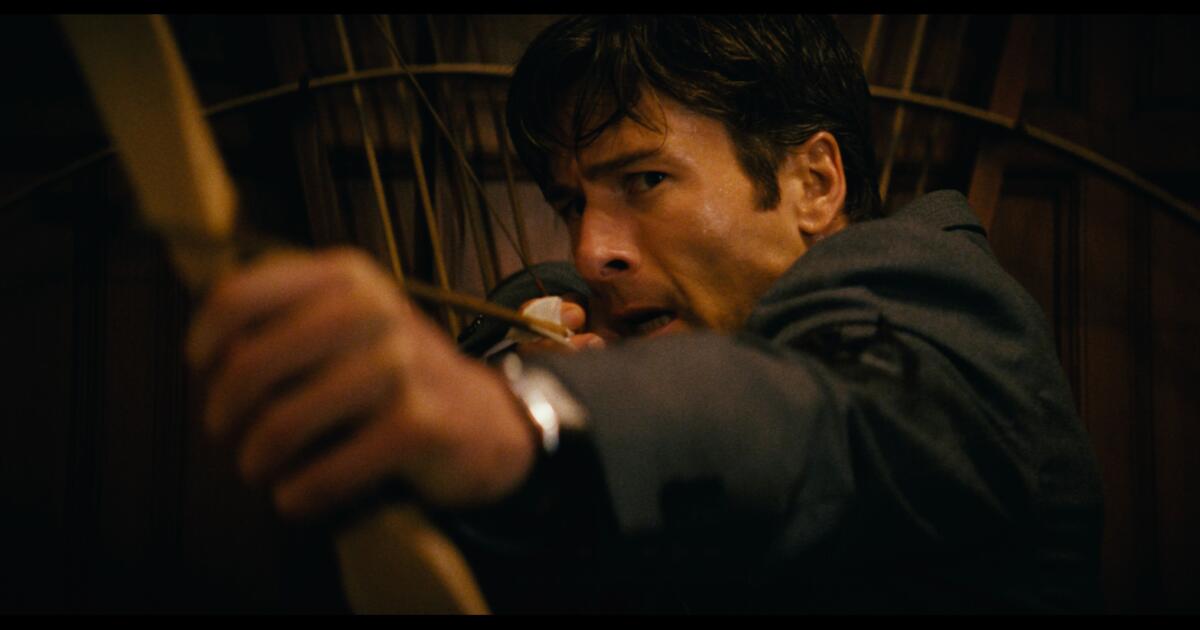
Death row inmate Becket Redfellow (Glen Powell) is four hours away from execution. A priest (Sean C. Michael) solemnly arrives to take his final confession and finds the condemned man lounging in a sleeping eye mask, griping that his last meal served him the wrong flavor of cheesecake. “Kill me now,” Becket quips.
This will be a tale of crime and punishment told in flashback, rewinding to Becket’s mother, an heiress excised from an eleven-figure fortune for giving birth as an unwed teenager. And it will be, as Becket insists, “a tragedy.”
But while the story’s framework is familiar, what gives this intro sequence zip is Powell’s sly nonchalance, the little bounce he makes on his cot when Becket pivots to give the flabbergasted priest his full attention. He has ours, too. Powell has yet to find his perfect role (this one’s close) but his confidence is why the industry is convinced that he’s the reincarnation of a classic leading man: Tom Cruise or Cary Grant if we’re lucky, or at least Bugs Bunny.
Writer-director John Patton Ford’s morally bleak comedy is itself a reincarnation of the 1949 British caper “Kind Hearts and Coronets,” which egged on an exiled sire as he avenges himself upon his royal family by murdering everyone between himself and dukedom. The 21st century American privilege that Becket is chasing in the remake doesn’t rely on formal titles. He wants cold hard cash, plus a couple of private islands, planes and ultra-luxury yachts. Besides, he’s already got a first name that sounds like a last name, signifying the American upper crust.
This Dickensian vengeance setup gives us an awful lot of people to murder, all caricatures of the elite. The original “Coronets” offed a posh feminist who scattered political leaflets across London from a hot air balloon, Ford spins that passé joke into a gag where Becket’s spoiled cousin (Raff Law) hovers in a helicopter sprinkling money over a pool party and then for good measure, cannonballs into the water to stuff bills in the crowd’s open and appreciative mouths. (For his next trick, perhaps Ford will remake Terry Southern’s outlandish satire “The Magic Christian,” which has a scene like that but five times filthier.)
Lore goes that when Alec Guinness received the “Coronets” script with an offer to play four of the ill-fated tycoons, he wrote back greedily and said, “Why not eight?” To our good fortune, Guinness did play all eight, even the suffragette. “How to Make a Killing” shares the wealth, giving cameos to a very funny Zach Woods as the scion who fancies himself a hipster artist (he takes photos of the unhoused) and Topher Grace as the Redfellow who found faith or, rather, a more sanctimonious spin on grift as a megachurch pastor. Likening himself to Jesus, Grace’s bleached blond huffs, “Don’t hate on me just because my dad’s a big deal.”
There’s a tease of real-world critique in how the preacher has decorated his office with framed photos of himself with various presidents and drug-runners, alluding to the inescapable suspicion that the world is run by a powerful club whose only admissions requirement is a bank balance with plenty of zeros. The jabs stop at allusions — they’re entertaining but as thin as a communion wafer. Still, I guffawed when Becket popped back into his present-day cell to poke fun at his audience, the Catholic priest: “The last thing the Church wanted was an investigation,” he says with a smirk. “I’m sure you know all about that.”
Like his lead character, Ford himself had to ascend in clout to direct this script, which he launched on the Black List in 2014. He instead made his debut with the much-smaller 2022 indie “Emily the Criminal,” which starred Aubrey Plaza as an art student desperate to pay off her student loans. His heart is with the strivers who find that our K-shaped economy makes it impossible to go straight.
Yet he hasn’t cracked whether the corpses in “How to Make a Killing” are victims themselves. The rich Redfellows get dispatched one by one in scenes that are fun but empty — neither cathartic nor comic, simply boxes to be checked off to great big poundings of thunder and harpsichords.
Surely, I thought, the film will figure out how it feels by the time it offs a Redfellow who’s merely ordinary-terrible: Bill Camp’s drunken, cowardly banker. But it doesn’t and the real victim of the indecision is Powell, who is rarely given a reaction to play. (Guilt? Rage? Glee?) He needs to give us an extra hint how he’s feeling — as an actor, Powell is so slick that even his regular smile comes across phony. I’d say he couldn’t be sincere if he tried, except Powell actually does try for one scene and the bleary, terrified look in his eyes is devastating.
While the promise of that gangbusters opening sequence goes a tad unfulfilled, “Killing” has two strong twists and plenty of reasons to enjoy the romp. I suspect that the movie might be too smart for its own good, or perhaps hemmed in by a cynicism that, everywhere we look lately, it appears that crime does pay. As Becket says early on, “We’re all adults here.” Ford sees all the wrong moves and isn’t sure-footed in choosing the right one, even though I think he has. Today’s crowd wants to smash Marie Antoinette’s cake and eat it, too.
At least along the way, there’s a playful love triangle between Julia (Margaret Qualley), the privileged nightmare who’s had Becket wrapped around her pinky finger since grade school, and Ruth (Jessica Henwick), a humble school teacher. Both characters stake out their polarized corners — the rich bitch versus the sweetheart — with Qualley somehow always arranging her legs to be seductively horizontal in her too-few scenes. Henwick is saddled with the more prosaic role and dialogue (“It’s scary to dream small,” she says). Nevertheless, her presence is so compelling that we root for Ruth every time she’s onscreen.
I’m glad that Ford is part of today’s guillotine crew making capers about economic inequality. But the best shot in the movie shows his promise as a romantic comedian: Becket and Ruth bump into each other in the rain and just as they make eye contact, the sun comes out and they share a smile. It’s a tiny moment of magic that gives you hope that these young lovers can work it out. Better still, it even gives you hope for humanity, even if the movie’s overall forecast for society is stormy.
‘How to Make a Killing’
Rated: Rated R, for language and some violence/bloody images
Feb. 13 (UPI) — The U.S. military is sending the USS Gerald R. Ford, the world’s largest aircraft carrier, to the Middle East as tensions with Tehran over its nuclear program ratchet up, President Donald Trump confirmed Friday.
Trump told reporters he’s sending the vessel because if the United States and Iran doesn’t “make a deal, we’ll need it,” The Hill reported.
The vessel and its supporting warships, which are in the Caribbean, will join the USS Abraham Lincoln in a trek that’s expected to take about three to four weeks, The Guardian reported.
“We have an armada that is heading there and another one might be going,” Trump said in an interview with Axios on Tuesday.
An unnamed official said Trump made the decision to send the USS Gerald R. Ford to the Middle East after his Thursday meeting with Israeli Prime Minister Benjamin Netanyahu.
The U.S. Southern Command said in a statement to The Hill that it was carrying out “mission-focused operations to counter illicit activities and malign actors in the Western Hemisphere.”
“While force posture evolves, our operational capability does not. SOUTHCOM forces remain fully ready to project power, defend themselves, and protect U.S. interests in the region.”
U.S. and Iranian leaders have been involved in negotiations over Iran’s nuclear arms program. Tehran has shown willingness to scale back its nuclear program in exchange for a lifting of economic sanctions, but has declined to consider requests to scale back its ballistic missile arsenal.
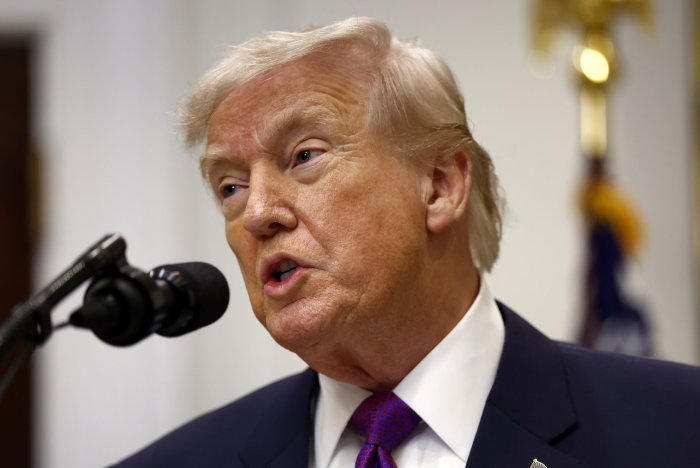
President Donald Trump speaks alongside Administrator of the Environmental Protection Agency Lee Zeldin in the Roosevelt Room of the White House on Thursday. The Trump administration has announced the finalization of rules that revoke the EPA’s ability to regulate climate pollution by ending the endangerment finding that determined six greenhouse gases could be categorized as dangerous to human health. Photo by Will Oliver/UPI | License Photo