Defense chief urges military to defend constitutional values 1 year after martial law bid

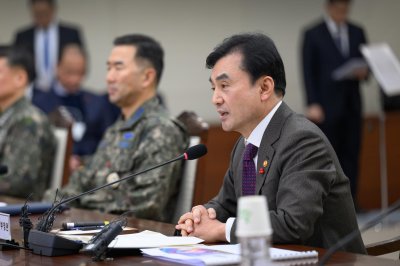
Defense Minister Ahn Gyu-back called for the military to defend constitutional values during a meeting of key military commanders on Wednesday. Photo courtesy of South Korea Ministry of Defense
Defense Minister Ahn Gyu-back on Wednesday presided over a meeting of key commanders and urged the military to strive to defend constitutional values, a year after the failed martial law bid that involved the former defense minister and a slew of military top brass.
The meeting comes a day after Ahn issued an apology over the military’s involvement in former President Yoon Suk Yeol’s short-lived martial law bid on Dec. 3 last year, when troops were deployed to the National Assembly to block lawmakers from voting down the decree.
“The attitude of general-level officers who took part in the insurrection, who could not discern an unconstitutional order and simply said they followed the orders, made the people view the military coldly. Our military should take this heavily to heart,” Ahn said during the meeting attended by some 150 key military officials.
Top generals appointed by Yoon, including former Army Chief of Staff Gen. Park An-su, who served as the martial law commander and former head of the Defense Counterintelligence Command, Lt. Gen. Yeo In-hyung, are currently under trial for playing a key role in the insurrection.
Following his appointment as the country’s first civilian defense chief in 64 years, Ahn, a five-term lawmaker, pledged to rebuild the military into one for the people and break from the past in which the military was “wasted as a tool for emergency martial law.”
In his opening remarks, Ahn said the military faces what he called a test of survival amid North Korea‘s continued nuclear and missile developments and hostile policy against South Korea, as well as an intensifying Sino-U.S. rivalry in the Indo-Pacific region.
The defense chief also stressed the need to restructure the military by 2040 to better adapt to changing trends in warfare and the country’s dwindling troop resources.
Participants discussed utilizing artificial intelligence-based technologies and unmanned assets for surveillance operations and expanding the civilian workforce as part of such efforts.
Alongside internal issues, Ahn reaffirmed South Korea’s push to regain wartime operational control from the United States within President Lee Jae Myung’s five-year term that ends in 2030.
“The transition of wartime operational control will go beyond the realm of a self-reliant defense and become a driving force and a powerful cornerstone supporting the peace and stability of the Indo-Pacific region,” Ahn said. “I firmly believe we are already prepared.”
In the allies’ annual security meeting held last month, Ahn and U.S. Defense Secretary Pete Hegseth shared the view that there was meaningful progress made during their bilateral evaluation on readiness posture and capabilities, and agreed to develop a road map to acquire the capabilities to expedite the conditions needed for the transition.
During Wednesday’s meeting, participants noted that next year will be a “watershed” for the transition push and exchanged opinions on the road map, in conjunction with combined drills conducted by the allies, according to the ministry.
The defense chiefs of South Korea and the U.S. have agreed to pursue the certification of full operational capability of the Future-Combined Forces Command headquarters in 2026 during the defense talks in November.
Copyright (c) Yonhap News Agency prohibits its content from being redistributed or reprinted without consent, and forbids the content from being learned and used by artificial intelligence systems.