
food stamp

Trump administration says ‘school lunch money’ could cover SNAP benefits

The Trump administration spent Friday fighting to avoid restoring $4 billion in food assistance in jeopardy due to the government shutdown, suggesting it might need to “raid school-lunch money” in order to comply with court orders.

The claim was part of a break-neck appeal in the 1st Circuit Court of Appeals on Friday, where the government hoped to duck a court order that would force it to pay out for food stamps — formally called the Supplemental Nutrition Assistance Program, or SNAP — through November.

“There is no lawful basis for an order that directs USDA to somehow find $4 billion in the metaphorical couch cushions,” Assistant Atty. Gen. Brett A. Shumate wrote in the appeal.

The administration’s only option would be to “to starve Peter to feed Paul” by cutting school lunch programs, Shumate wrote.

On Friday afternoon, the appellate court declined to immediately block the lower court’s order, and said it would quickly rule on the merits of the funding decree.

SNAP benefits are a key fight in the ongoing government shutdown. California is one of several states suing the administration to restore the safety net program while negotiations continue to end the stalemate.

Millions of Americans have struggled to afford groceries since benefits lapsed Nov. 1, inspiring many Republican lawmakers to join Democrats in demanding an emergency stopgap.

The Trump administration was previously ordered to release contingency funding for the program that it said would cover benefits for about half of November.

But the process has been “confusing and chaotic” and “rife with errors,” according to a brief filed by 25 states and the District of Columbia.

Some states, including California, have started disbursing SNAP benefits for the month. Others say the partial funding is a functional lockout.

“Many states’ existing systems require complete reprogramming to accomplish this task, and given the sudden — and suddenly changing — nature of USDA’s guidance, that task is impossible to complete quickly,” the brief said.

“Recalculations required by [the government’s] plan will delay November benefits for [state] residents for weeks or months.”

On Thursday, U.S. District Judge John McConnell Jr. of Rhode Island ordered the full food stamp payout by the end of the week. He accused the administration of withholding the benefit for political gain.

“Faced with a choice between advancing relief and entrenching delay, [the administration] chose the latter — an outcome that predictably magnifies harm and undermines the very purpose of the program it administers,” he wrote.

“This Court is not naïve to the administration’s true motivations,” McConnell wrote. “Far from being concerned with Child Nutrition funding, these statements make clear that the administration is withholding full SNAP benefits for political purposes.”

The appeal could extend that deadline by as little as a few hours, or nullify it entirely.

But the latter may be unlikely, especially following the appellate court’s decision late Friday. The 1st Circuit is currently the country’s most liberal, with five active judges, all of whom were named to the bench by Democratic presidents.

While the court deliberates, both sides are left sparring over how many children will go hungry if the other prevails.

More than 16 million children rely on SNAP benefits. Close to 30 million are fed through the National School Lunch Program, which the government now says it must gut to meet the court’s order.

But the same pool of cash has already been tapped to extend Women, Infants and Children, which is a federal program that pays for baby formula and other basics for some poor families.

“This clearly undermines the Defendants’ point, as WIC is an entirely separate program from the Child Nutrition Programs,” McConnell wrote.

In its Friday order, the 1st Circuit panel said it would issue a full ruling “as quickly as possible.”
Source link

L.A. County to ban ‘predatory solicitation’ linked to sex abuse claims

L.A. County supervisors want to bar “predatory” salespeople who they say prey on vulnerable residents seeking benefits from the region’s social services offices.

The supervisors unanimously voted Tuesday to explore creating a “buffer zone” outside county offices, prohibiting certain types of “aggressive” solicitation toward people seeking food stamps and cash aid. County lawyers have two months to figure out what such a zone would look like.

The looming crackdown follows a Times investigation that found seven people who said recruiters outside a social services office in South Los Angeles paid them to sue the county over sex abuse. Two more later told The Times they, too, were solicited for sex abuse lawsuits outside a county social services office in Long Beach, though they initially believed they were being recruited to be extras in a movie.

“We are painfully aware of the ongoing allegations of fraud and the pay-to-sue tactics used to recruit clients and file lawsuits against the county,” said Supervisor Janice Hahn, who announced she would push for the buffer zone after the Times investigation. “There must be greater accountability both to protect survivors seeking justice and to ensure that fraudulent claims and predatory solicitation are stopped at their source.”

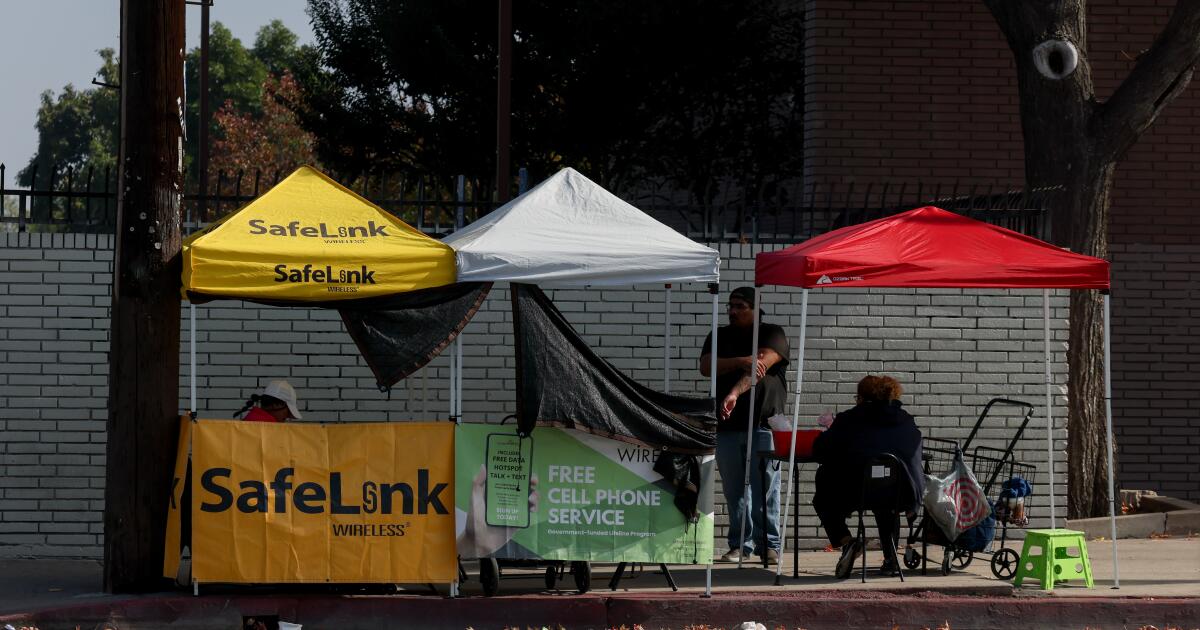
The county’s more than 40 social services offices act as one-stop shops for residents who need help applying for food, housing and cash assistance. Outside many of the larger offices in poorer areas, a bustling ecosystem thrives with vendors hawking goods and services to those in line.

The supervisors said Tuesday they were troubled by some of the offerings.

“Vendors asking for copies of people’s personal documents, trying to sell them products and even recruiting people into claims against the county — this behavior puts residents at real risk and undermines the trust in our public services,” said Supervisor Lindsey Horvath.

Supervisor Kathryn Barger said she wanted to see reforms that would protect both taxpayers and “vulnerable individuals who are being used as pawns to line the pockets of many of these attorneys.”

The motion passed 3 to 0. Supervisors Hilda Solis and Holly Mitchell, whose district includes the social services office where some of the lawsuit recruitment took place, were absent.

The Times spent two weeks outside the South L.A. office this fall and watched vendors seek out dozens of people with Medi-Cal, the state’s health insurance for low-income Californians. The vendors would pay them anywhere between $3 and $12 to undergo COVID and blood pressure tests, which they said would be billed to their state insurance. Some people said they routinely stopped by the location for quick cash.

Giveaways of free phones are also popular for those who are eligible through a government-subsidized program. Recipients have complained that the service on the phones was often short-lived, with some people returning to the kiosks within a few days after their number stopped working.

Leaders at the Department of Public Social Services, who oversee the offices, say they’re limited in what they can do outside their facilities. Many of the busiest locations are in Los Angeles or smaller cities, where the county has no authority. And regulating where vendors can go on public sidewalks has proved a reliable headache for local governments in the past.

Last year, the Los Angeles City Council eliminated the “no-vending zones” it had created in areas where it said street vendors would contribute to congestion. The ban was met with an outcry and a lawsuit from vendors who argued street vending had been decriminalized and the city could no longer outlaw the stands.

Eugene Volokh, a 1st Amendment professor and senior fellow at Stanford University’s Hoover Institution, said the county will have to be careful in defining what conduct is “predatory” and what is protected speech.

“The devil’s going to be in the details,” Volokh said. “Whenever you hear words like ‘predatory’ or ‘exploitative’ or ‘harassing’ or ‘bullying,’ you know you’re dealing with terms that are potentially very vague and often, by themselves, too vague to be legally usable terms.”

Source link