flooding

Democrats tackle outside groups flooding their primaries with campaign cash

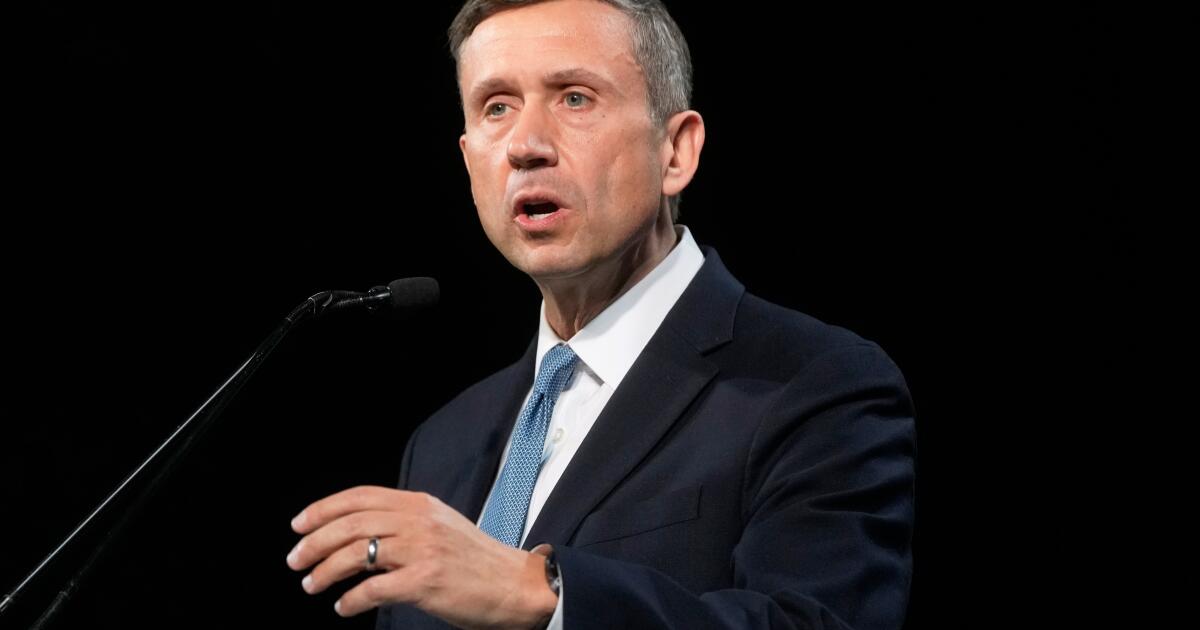
Democrats are struggling to come up for air after outside groups flooded their first round of midterm primaries with campaign cash.

As the Democratic Party fights to regain control of Congress, organizations affiliated with the American Israel Public Affairs Committee, cryptocurrency and artificial intelligence have dominated the airwaves, sometimes leaving candidates on the sidelines of their own campaigns.

Democratic pollster Zac McCrary said the primaries have “become proxy wars, and the candidates are almost afterthoughts in larger skirmishes.”

Now the Democratic National Committee is advancing a resolution at its New Orleans spring meeting to condemn the surge of spending that has scrambled its primaries and exacerbated tensions within the party.

Candidates who lost have pointed their fingers at special interests, blaming them for derailing their campaigns. Others who are still in the running are courting voters by denouncing deep-pocketed outside groups. Even those who have benefited from the spending have expressed concern.

“It’s definitely a brave new world,” McCrary said.

“We’re not talking about doubling of campaign expenditures,” he added. “We’re talking about 10 times or 20 times more.”

Dan Sena, a former executive director at the Democratic Congressional Campaign Committee, said party organizations are no longer the ones with the clout to push favored candidates.

“All that’s been completely smashed now,” Sena said. Even if Democrats regain control of the U.S. House, he warned that outside spending could damage the party in the long run.

Referring to House Minority Leader Hakeem Jeffries, he said, “You’re going to hand Jeffries a caucus that is divided.”

Democrats bear the brunt of big spending

So far this cycle, outside money in U.S. House races has largely targeted districts particularly friendly to Democrats, meaning the primaries will likely determine who will win the general election in November. After a record number of House members retired this year, many of those seats opened up for the first time in years, drawing dozens of Democratic hopefuls.

In Illinois, for example, there was more than $125 million in outside spending across five open Democratic primaries. In all but one of those congressional races, the outside spending exceeded candidate spending.

While it’s still early in the calendar, there are indicators that many more races could see big spending. Almost 40 seats have already seen more than $1 million in outside spending, according to Federal Election Commission filings.

In Illinois, the top three spenders in U.S. House races were groups affiliated with American Israel Public Affairs Committee, or AIPAC, according to AdImpact, which tracks ad buys in political races, followed by the cryptocurrency-affiliated Fairshake.

AIPAC was founded to support strong ties between the U.S. and Israel, a particularly controversial issue as Democratic hostility toward Israel rises over the war in Gaza. Some Democratic National Committee, or DNC, members wanted to call out AIPAC’s role in primaries, but the final resolution did not.

“We had various resolutions that focused on different industries and groups, and instead of going one-by-one, we passed a blanket repudiation,” DNC Chair Ken Martin said in a statement.

Campaign spending has divided Democrats

The latest DNC meeting marks another chapter in longstanding disputes between progressives and the party establishment.

Progressives want the party to adopt official language that all Democratic presidential contenders oppose money from dark-money groups, or super PACs that aren’t required to disclose their donors.

“It’s necessary that we actually have the party do something on this issue, not just say something,” said Larry Cohen, co-chair of Our Revolution, a progressive group founded by independent Sen. Bernie Sanders of Vermont, who caucuses with Democrats.

The resolution being advanced at the DNC meeting in New Orleans is viewed by progressives as a step toward that goal. However, some Democrats warn against weakening their candidates when facing a Republican Party that’s flush with cash.

“Provided that we don’t handcuff ourselves in the general elections — because if the Republicans are going to use dark money in general elections, we should be using our money in general elections, too — if you provide an even playing field, I think then that’s fine,” said Sen. Ruben Gallego, an Arizona Democrat. “But we just can’t be handcuffing ourselves in the general to lose races.”

Any DNC resolutions would not stop outside groups from surging funds into primary contests or general elections. But some Democrats believe the issue is core to the party’s values.

“We should eliminate any super PAC in a Democratic primary. And I think every presidential candidate in 2028 should pledge that they will not have any super PAC spending in a Democratic primary,” said Rep. Ro Khanna, a progressive and possible Democratic presidential contender who co-chaired Sanders’ 2020 presidential campaign.

“That should be a litmus test,” Khanna argued. “If you’re not willing to take that pledge, then you’re part of the problem.”

Askarinam, Brown and Sweedler write for the Associated Press. Brown reported from New York.
Source link

Contributor: Investigate the AI campaigns flooding public agencies with fake comments

California built its tradition of open government — including for citizen boards that set the rules for such functions as automotive repair and security guard licensing — precisely to keep well-funded corporate interests in check. Lobbyists and special interests are constantly scheming to defeat the will of the majority. Now they are able to do more damage using artificial intelligence to simulate fake grassroots opposition to clean air measures, and they are surreptitiously using the identities of real people to deceive regulators.

Last June, the South Coast Air Quality Management District received more than 20,000 comments opposing a pair of clean air rules that would have prevented 2,500 premature deaths and 10,000 new cases of asthma. A February investigation by the Los Angeles Times revealed that those comments were submitted through CiviClick, a Washington-based AI-powered comment generation platform, orchestrated by a local political consultant with ties to the natural gas industry. When the district’s cybersecurity team reached out to a small sample of commenters to verify their identities, a majority of respondents said that they had not submitted the comments in their names.

Even so, the flood of fake comments seemingly worked. These rules, vehemently opposed by the natural gas industry, already watered down by the district to near-toothlessness, were ultimately rejected by the board — apparently overwhelmed by the flood of fake opposition to even the mildest effort to limit pollution from gas-burning appliances.

This Southern California campaign was not an isolated incident. A recent investigation by the San Francisco Chronicle also revealed that an industry front group used Speak4, a platform that advertises its use of AI, to submit dozens of comments regurgitating talking points from the fossil fuel industry in an attempt to weaken and delay clean air rules in the Bay Area. The scheme was exposed when 10 residents whose identities were used on these emails said they absolutely did not send them, calling the messages “forged.”

In both cases, organizations submitted emails and comments to regulators using real people’s identities without their knowledge or consent. This playbook has been employed in other states: CiviClick was used by fossil fuel companies to support a gas-pipeline-expansion project in North Carolina last year. When elected officials reached out to a few respondents to verify the messages, some constituents stated they had no knowledge of the emails sent under their names.

The opposition campaign to South Coast’s clean air rules was run by one of the state’s most powerful lobbying firms. Its client list includes Sempra, the parent company of SoCalGas, which opposed the clean air standards, which would have encouraged the sale of pollution-free heat pumps and threatened the utility’s business.

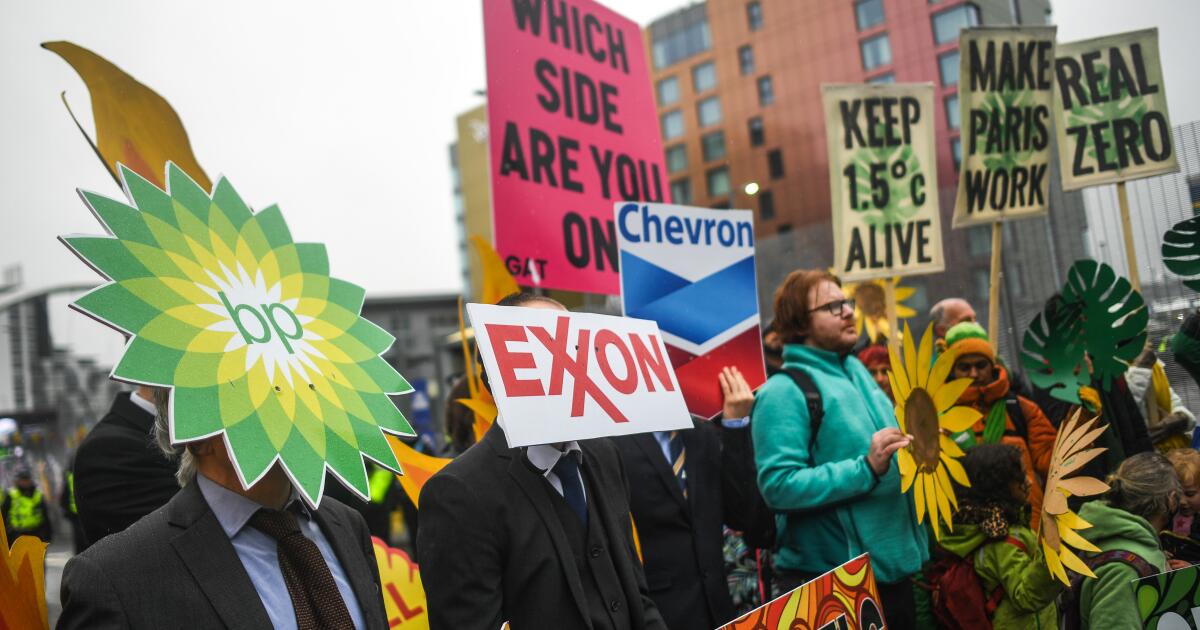
The industry front group using AI to undermine clean air rules in the Bay Area, Common Sense Coalition, also has ties to fossil fuel companies. Common Sense Coalition is a project of the Bay Area Council, a local business group that features members such as the Western States Petroleum Assn., Chevron, Martinez Refining Co. and Phillips 66.

The question of whether fossil fuel interests financed astroturf AI campaigns to defeat clean air rules should be answered through full investigations, which also ought to address whether the campaigns committed fraud and identity theft.

Californians deserve to know what is going on — how AI was used, where the lobbyists got the names and addresses they attached to the robo-messages and who paid for the deceptive campaigns. What’s most concerning is the use of actual residents’ identities — without their knowledge or consent — to oppose life-saving clean air standards.

Top law enforcement officials should be investigating — including Atty. Gen. Rob Bonta, Los Angeles Dist. Atty. Nathan Hochman and San Francisco Dist. Atty. Brooke Jenkins.
If the law on using a person’s name in a scheme to thwart action by a public agency is not clear enough to support prosecutions, then the law needs to be tightened up — and there is legislation, Senate Bill 1159, aiming to do that.

If this seems like a niche issue, I can assure you it is not. I spent 17 years at the helm of the California Air Resources Board, and I am deeply disturbed by the potential co-opting of public input processes using forgery through automated tools. Gathering public input is fundamental to the legitimacy of regulatory agencies.

We frequently heard from individuals or business associations concerned about the cost or burden of proposed regulation, and we worked hard to understand and tailor our rules to make them as streamlined and cost-effective as we could, while still making progress toward reducing the air and climate harms of a wide array of equipment and activities.

The destruction of meaningful public input through deceit isn’t just an environmental issue; it’s a democracy issue — and it demands urgent attention and accountability. California should draw the line to protect our democratic institutions.

Mary Nichols was chair of the California Air Resources Board, where she occupied the attorney seat. She is distinguished counsel to the Emmett Institute on Climate and Sustainability at UCLA Law School.

Source link