
A British family said they were forced to fly home early from their summer holiday to Greece after their four-star all-inclusive resort was ‘derelict’ and ‘horrific’

Adam and his family checked into a ‘derelict’ four-star resort in Greece, but flew home early(Image: Handout)
A family of four were left with no choice but to fly home early from their holiday after checking into a hotel that was ‘derelict’ with a ‘green swimming pool’ and ‘brown water slides’.
Adam, his wife and two kids booked a last-minute summer getaway with Love Holidays after seeing a tempting deal at a four-star all-inclusive resort in Kos, Greece. They paid £3,500 for a 10-night stay at Kipriotis Village Resort, which Adam said was almost half price, with rates ranging from around £5K to £6K, during the peak travel season.
“Everything advertised looked good, and Love Holidays advertised it as a four-star, all-inclusive hotel. We read the reviews, and they were ok, so we booked it,” Adam exclusively told the Mirror. “We didn’t expect the Ritz, but we did expect cleanliness and something that was livable.” But before they even reached the hotel, Adam was given a worrying warning. “We got a taxi from the airport, and the guy said, ‘Kipriotis Village?’, and I said, ‘Yeah’, and he went, ‘Oh dear’, so I sat there and thought, oh no.”
Have you experienced a holiday from hell? Email webtravel@reachplc.com
‘It was derelict and dangerous’
The family checked into the Kipriotis Village Resort in Kos at around midnight on Friday, 14 August, but as soon as they walked into their room, they were stunned by its condition. “Honestly, in all my years of travel, I’ve never seen a room like what was presented”, Adam revealed. “There were holes all in the walls, the floorboards were all up, they were manky all around the bed.
“The air conditioning wasn’t working, there were cobwebs and clearly the room hadn’t been cleaned for years. The toilet was constantly running, the flush wouldn’t work, and there was mould around the bath. It was basically derelict.” Love Holidays said the hotel’s four-star rating is based on Greece’s official hotel rating system and aligns with local standards.
In addition to its conditions, the father of two said: “It was a mezzanine room, so the idea was that we had the main bit downstairs and the top part was for the kids’ bed, but the safety bannister was rocking like mad, and if they leaned on it in the night, and they fell off that, it would have killed them.”
No other choice
Horrified by the room, they complained at the hotel reception and declared, ‘We can’t have this.’ Adam claimed that the hotel staff told them, ‘Well, it’s tough, because we’ve got no rooms’, and said, “they were not interested in dealing with us”. He said he called Love Holidays to help with the situation and was allegedly told, ‘We’re just an agent, deal with the hotel’.
Adam said they had “no choice” but to spend the night, as there were no other hotels available. He claimed that at reception the next morning, “the queue was unbelievable”, and said, “everyone had the same problem, all the rooms were falling apart”. Adam claimed: “Love Holidays haven’t checked it, assessed it or done any of the groundwork whatsoever, and they’ve advertised it with old pictures.” He said he spoke to Love Holidays again, to which he was allegedly told, ‘We tried to contact the hotel, they’re not answering, you’ll have to deal with it yourself’.
On their second morning, the hotel offered them an upgraded room. They viewed the room, but Adam said it was “nothing like the photos, but it was all on one level, and the floorboards were intact.” He added, “There were no other hotels I could book. I needed something safe for my kids. What do I do? So I thought, right, I’ll take it.”
The father of two claimed that he was “presented with a waiver form” and was told, ‘You can only have the upgraded room if you sign this’, with article three alleging stating, ‘I waive all my rights for any claims against the hotel’. The dad said he refused to sign it.
Adam claimed the form was “snatched away” from him and was told, ‘Right, you’ll stay where you are then’. But in a bid to get the upgraded room, Adam said he asked how much it would be without signing the waiver, and was told €280. “It’s not ideal, nothing that was advertised, it’s horrific, but at least it’s a safe room for the kids, because I can’t get anything else,” he told the Mirror.
‘Green swimming pool and raw food’
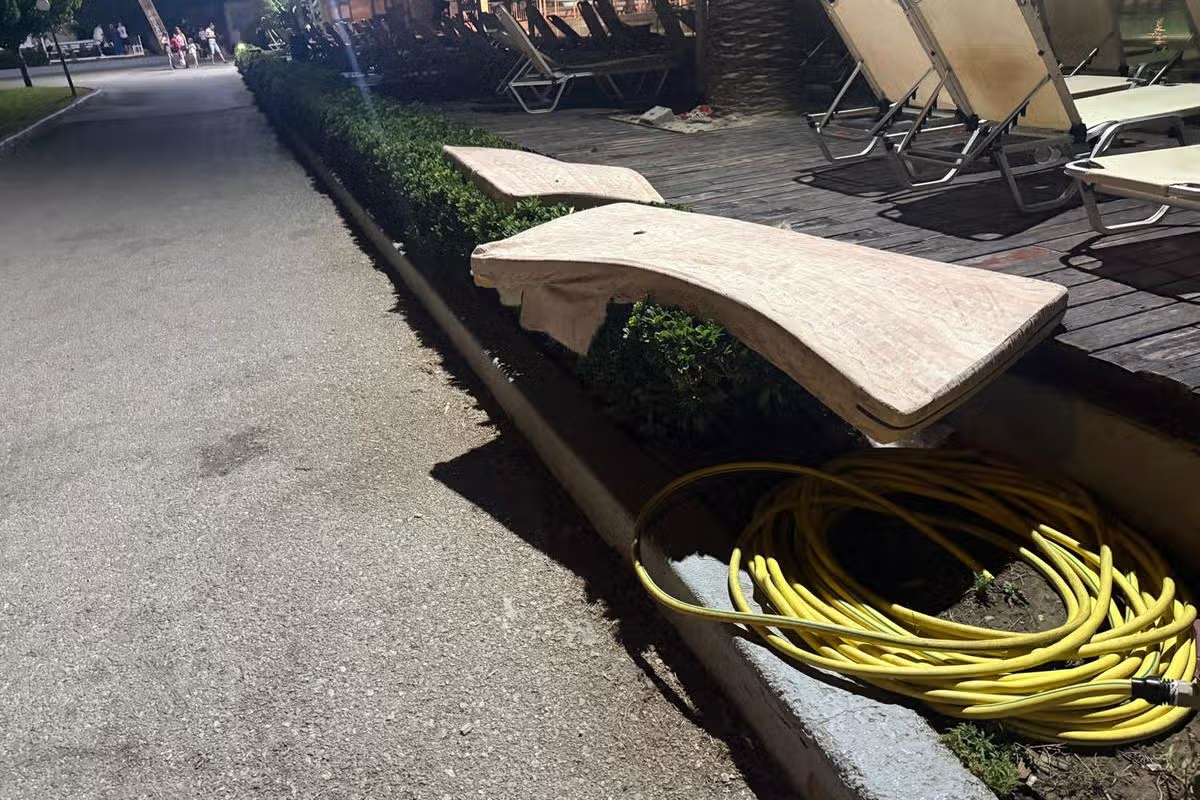
Yet it wasn’t just the rooms that seemed to be inadequate. “The resort was derelict,” Adam said. “The swimming pool was green, there were green stains around the rim, and the drains were green. There were some kids’ slides with brown, sewage-smelling water at the bottom, and some people were letting their kids go down them. The sunbeds had obviously been there for 20 years, just rotting.
“The tennis courts were just dug up, you couldn’t even walk on the surface and were all closed up. The football pitch was a mess, and the kids’ club was non-existent. The cleanliness of the place was horrific; I couldn’t let my kids go in the communal toilets.” He added: “The food, I can’t tell you how bad it was. People were getting raw food. I went for a chicken skewer, and it was just raw inside. The food was really bad. The trays the food was served in will turn your stomach.”
For the first few days of the trip, the father of two said he spent days at reception but “got nowhere”, so in the end, left the hotel every day for aslong as long as possible. “We literally slept in the bed, went out for planned days out, to waterparks and boat trips. I can’t tell you how bad the place was.”
Flying home early
Just when they thought it couldn’t get any worse, Adam said they had “a really bad sewage smell” in the new room. He stated he emailed Love Holidays back and forth, but said, “they were not interested and kept saying, ‘speak to the hotel’.” In the end, the family flew home three days early, “just to get out of there”. “It was just horrific,” Adam added.
He claimed: “Love Holidays have been absolutely horrific with everything. The lack of support and accountability, and lack of remorse from Love Holidays was just so bad, and they would try to fob us off to a hotel that just wouldn’t listen. It’s not necessarily about me. There are people out there who are genuinely saving all year to put money aside to take their families on holidays, and when they get to a place that hasn’t even been checked by Love Holidays, it’s in such a state and so bad.”
A Love Holidays spokesperson said: “We are very sorry that Adam and his family’s recent experience at their hotel in Greece fell short of our usual high standards, and we are investigating the issues raised directly with the hotel. We have contacted Adam to offer our sincere apologies and reimburse him £1,799, covering 50% of his total accommodation costs and out of pocket expenses.”
The Mirror has contacted Kipriotis Village Resort in Kos for comment.
‘Prison cell’ hotel room
This isn’t the first time Kipriotis Village Resort in Kos has been called out for its ‘derelict’ condition. Just last month, a mum told the Express that she paid £1,500 for a ‘holiday from hell’ with a room that compared to ‘a prison cell’ after checking into a room at the same hotel.
Linda Martin, from Cardiff, said: “It was a big place, with massive grounds. We dragged our suitcases down the steps and dragged them through buckets of vomit. So I immediately thought, red flag, this is disgusting.” She explained: “I opened the door to enter what I can only describe as prison cell block H. We were hit by stifling heat, it was stinky, and there were mosquitoes flying everywhere.
“There were three single beds, which were rock hard. The room did not resemble in any fashion the photos in the brochure. It was dilapidated. The curtains were not wide enough, so they couldn’t be closed, and the room was dirty. We had separate rooms, and my daughter looked at the room, and she just burst into tears and said, ‘I’m not staying here, I want to go home, I just want to go back to the airport’.”
The holidaymaker added: “When we walked around the pool area, it was derelict, the sun loungers were hanging, and I had seen nothing like it.” In the end, Linda and her daughter were forced to book another hotel in the area, and Love Holidays reimbursed her £1,772, covering 50% of her total accommodation costs and her taxi expenses.