March 2 (UPI) — Belgium has seized a Russian oil tanker believed to be part of a shadow fleet of vessels the Kremlin uses to sell its energy products blocked by sanctions, Belgium’s defense minister said.
The armed forces of the European nation, with the support of French navy helicopters, boarded the oil tanker in the North Sea over the weekend, Defense Minister Theo Francken said in a statement.
The vessel was being escorted to the Belgian port city of Zeebrugge where it would be seized by authorities, he said.
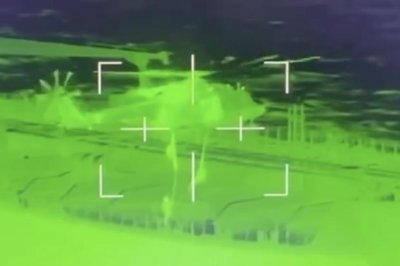
French President Emmanuel Macron, who announced that French helicopters were used in Operation Blue Intruder, published a 23-second video online of clips from the night siege edited together, showing soldiers rappelling down ropes from a helicopter to the vessel’s deck.
A major blow to the shadow fleet: in the North Sea, our French Navy helicopters helped last night in the boarding by Belgian forces of an oil tanker under international sanctions.
Europeans are determined to cut off the sources of funding for Russia’s war of aggression… pic.twitter.com/CnoxyND7BB— Emmanuel Macron (@EmmanuelMacron) March 1, 2026
Macron described the mission as having dealt “a major blow to the shadow fleet.”
“Europeans are determined to cut off the sources of funding for Russia’s war of aggression in Ukraine by enforcing sanctions,” he said.
The vessel was identified by Belgian federal prosecutors as the Guinean flag-flying Ethera. The federal prosecutor’s office said it has opened an investigation into potential violations of the Belgian Navigation Code.
The office said an on-board inspection confirmed evidence of a “false flag,” public broadcaster RTBF reported, which said the operation was conducted over Saturday night and into Sunday morning.
The vessel had departed the Moroccan west coast port city of Mohammedia on Feb. 21 and arrived in Zeebrugge on Sunday morning, according to Marinetraffic.com.
British, European and U.S. governments had all previously sanctioned the vessel.
Ukrainian President Volodymyr Zelensky said despite its repeated blacklisting, Ethera continued to illegally transport Russian oil with the use of a false flag and forged documents.
“We welcome this strong action against Moscow’s floating purse and thank France for supporting the operation,” he said in a social media statement.
“We must be resolute. Russia operates like a mafia organization, and the response must match that reality,” he continued, calling for modern European laws permitting tankers carrying Moscow oil to be seized and its oil repurposed for Europe’s security.
“If they reject the rules for the sake of war, the rules must foresee a clear and firm answer.”
The seizure comes as Europe has been targeting Russia’s shadow fleet of vessels to further increase the impact of sanctions.
Western allies have imposed thousands of sanctions on Russia over its four-year invasion of Ukraine. It is now the most blacklisted in the world.
Oil is a significant revenue source for the Kremlin, and Ukraine’s allies are trying to hinder is ability to pay for its war.
This shadow fleet consists of between 600 and 2,500 ships, according to an October 2025 document from the European Union. An S&P Global report from the month before estimated the fleet consisted of 978 tankers alone. Meanwhile, a Brookings report estimated the fleet comprised 343 tankers, though stating its true scope is likely far larger.
With the seizure, Belgium is the second European nation to detain a tanker of Russia’s shadow fleet. France became the first in January when its forces seized the Grinch oil tanker.
Footage shows a huge fire reportedly ignited by an Iranian strike on a US naval facility at Bahrain’s Salman Port. The port houses the US Navy’s Central Command and Fifth Fleet.
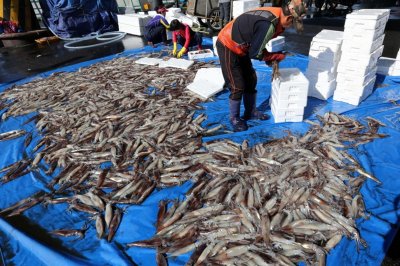
Fishermen pack squid into boxes at Jumunjin Port on South Korea’s east coast, 04 June 2015, as the busy squid-fishing season gets under way. File. Photo by YONHAP / EPA
Feb. 20 (Asia Today) — The number of fishing vessels over 10 tons in North Gyeongsang Province has fallen nearly 16% over the past five years as squid stocks along South Korea’s East Sea coast continue to decline, government data show.
According to the Ministry of Oceans and Fisheries’ fisheries statistics portal, 369 vessels exceeding 10 tons were registered in Gyeongbuk in 2024, down from 438 in 2020, a 15.7% decrease.
Local fishermen have long relied on squid as a primary source of income. In 2020, catches of Pacific flying squid in the region reached 20,653 tons, accounting for more than half of total production. By 2023, that figure had plunged to 2,793 tons, an 86% drop in four years.
Analysts attribute the decline in part to rising sea temperatures that have pushed spawning and feeding grounds northward, causing juvenile squid to remain longer in northern Gangwon Province and waters near North Korea.
Some observers also point to large-scale fishing activity by Chinese vessels in North Korean waters. In 2020, Global Fishing Watch, a nonprofit monitoring group, reported that squid populations in South Korean and Japanese waters had fallen about 80% since 2003, linking the decline to foreign fishing in North Korean waters.
The group said more than 900 large Chinese vessels were found operating in the area in violation of U.N. sanctions and estimated they harvested more than 160,000 tons of Pacific flying squid worth roughly $500 million between 2017 and 2018 – an amount comparable to the combined annual catch of South Korea and Japan.
As nearshore squid stocks dwindle, distant-water fishing has expanded. In Busan, the number of vessels over 200 tons rose 18%, from 273 in 2020 to 321 in 2024, even as mid-sized vessels declined.
Overall registered fishing vessels in Busan remained relatively stable at 3,339 in 2024, compared with 3,333 four years earlier, but the fleet composition shifted toward larger ships.
Government data show distant-water squid production nearly doubled from 31,500 tons in 2023 to 63,200 tons in 2024.
Industry groups said a recently passed amendment to the Coastal and Inshore Fisheries Structural Improvement Act could provide a more stable exit path for fishing households facing financial strain.
Weekly insights and analysis on the latest developments in military technology, strategy, and foreign policy.
In the past two days, the U.S. Air Force has sent six of its 16 E-3 Sentry Airborne Warning and Control System (AWACS) radar planes to bases in Europe. Two of those jets are now headed to the Middle East, and the others will likely follow, as a massive buildup of U.S. airpower continues ahead of potential strikes on Iran. The deployment of nearly 40 percent of all Air Force E-3s underscores how critical the aircraft remain, but also the challenges of meeting intense operational demands with a rapidly aging and shrunken-down fleet. It also further calls into question a puzzling Pentagon move to axe the purchase of replacement E-7 Wedgetail jets, which Congress has now reversed.
Readers can first get caught up on the full scope of the U.S. buildup around the Middle East in our recent reporting here.
As of yesterday, a pair of E-3s had arrived at RAF Mildenhall in the United Kingdom after traveling from their home station at Elmendorf Air Force Base in Alaska. Four more AWACS jets from Tinker Air Force Base in Oklahoma had also touched down at Ramstein Air Base in Germany. Online flight tracking data shows that the E-3s at Mildenhall have now departed and are headed toward the Middle East. There is widespread expectation that those aircraft, as well as the ones at Ramstein, will eventually make their way to Prince Sultan Air Base in Saudi Arabia.
Update: At least 4 #USAF E-3G Sentry AWACS at Ramstein AB 🇩🇪 are currently relocating to Prince Sultan AB 🇸🇦 before the strikes on Iran 🇮🇷. I’m unclear if the 2 @ RAF Mildenhall 🇬🇧 are also in transit to 🇸🇦.
As noted, the U.S. Air Force currently has just 16 E-3s remaining in its inventory, roughly half the size of what it was just a few years ago. Six aircraft represent 37.5 percent of the total fleet. However, not all Sentry radar planes are available for operational tasking at any one time. For example, the average mission-capable rate for the E-3 fleet during the 2024 Fiscal Year was 55.68 percent, according to a story last year from Air & Space Forces Magazine. At the time of writing, this appears to be the most recent readiness data the Air Force has released for the E-3s. As such, the six forward-deployed AWACS jets represent an even larger percentage of the aircraft that can actually be sent out on real-world missions. This includes providing radar coverage for alert scrambles of fighter jets defending the homeland. This happens in some circumstances in the lower 48 states, but it is standard practice in Alaska, where there are usually a couple of E-3s typically stationed, with one on alert to launch in support of the fighters, which happens regularly. This is something we will come back to later on.
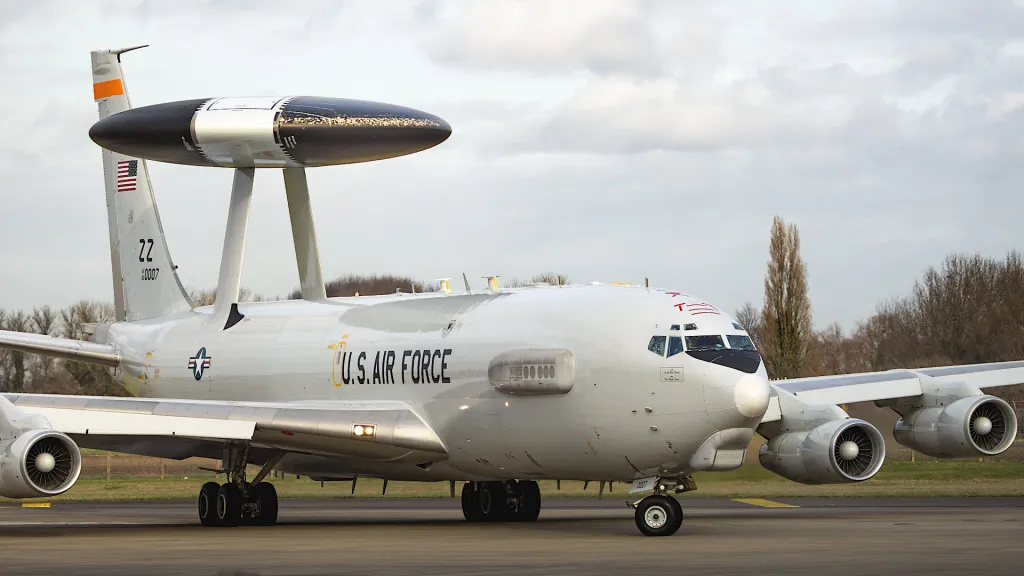
One of the E-3 AWACS aircraft that recently passed through RAF Mildenhall in the United Kingdom. Harry Moulton / @havoc_aviation on X
The E-3 is best known as a flying radar station, with its array contained inside a spinning dome mounted on top of the rear of the fuselage. From its perch, the Sentry can track hostile and friendly air and naval movements across a broad area of the battlespace. Its look-down radar capability offers particular advantages for spotting and tracking lower flying threats, including drones and cruise missiles. Kamikaze drones, as well as cruise and ballistic missiles, would be a central feature in any Iranian retaliatory attacks on American assets on land and at sea in the Middle East.
However, each Sentry, which typically flies with 13 to 19 mission specialists onboard in addition to a four-person flight crew, is much more than just its radar. It has other passive sensors and an advanced communications suite. Its combined capabilities make it a key battle management node during operations, and not just in the aerial domain.
“The radar and computer subsystems on the E-3 Sentry can gather and present broad and detailed battlefield information. This includes position and tracking information on enemy aircraft and ships, and location and status of friendly aircraft and naval vessels. The information can be sent to major command and control centers in rear areas or aboard ships,” according to the Air Force. “In support of air-to-ground operations, the Sentry can provide direct information needed for interdiction, reconnaissance, airlift and close-air support for friendly ground forces. It can also provide information for commanders of air operations to gain and maintain control of the air battle.”
Altgoether, E-3 crews run the air battle, and also serve as a key battle management node during operations outside of the aerial domain. These command and control functions would be key in any future offensive operations against Iran, as well as for defending against any retaliation.
At the same time, the Air Force has been open for years now about the increasing challenges involved in operating and sustaining the E-3 fleet. The last new production Sentry aircraft were delivered in 1992, and were also some of the last derivatives of the Boeing 707 airliner to ever be produced. Air Force E-3s have received substantial upgrades since then, but the underlying aircraft are still aging and are increasingly difficult to support. Between 2023 and 2024, the Sentry fleet notably shrank from 31 aircraft down to its present size, in part to try to help improve overall readiness. The fact that U.S. E-3s are powered by long-out-of-production low-bypass Pratt & Whitney TF33 turbofans has been cited as a particular issue.
US Air Force E-3 Sentry aircraft undergoing maintenance. USAF
“The first thing I would offer is there’s already – whether there’s 31 airplanes or 16 airplanes – there’s a gap today,” now-retired Gen. Mark Kelly, then head of Air Combat Command, told TWZ and other outlets at the Air & Space Forces Association’s main annual conference in 2022. “There’s a reason why there’s exactly zero airlines on planet earth that fly the 707 with TF-33 engines.”
“The last airline was Saha Airlines in Iran,” Kelly added at that time. “We basically have 31 airplanes in hospice care, the most expensive care there is. And we need to get into the maternity business and out of hospices.”
As already noted, the remaining E-3 fleet has continued to struggle with readiness issues amid consistently high demand. These issues have been compounded by resistance over the years to acquiring a direct replacement. When the Air Force finally did decide to supplant at least a portion of the Sentry fleet with newer and more capable E-7 Wedgetail airborne early warning and control aircraft, that effort turned into a protracted saga.
The Air Force officially started down the road of acquiring E-7s in 2022, but the program became mired in delays and cost overruns. Last year, the Pentagon revealed its intention to axe the Wedgetail purchases in favor of an interim solution involving buying more of the U.S. Navy’s E-2 Hawkeye airborne early warning and control planes. That, in turn, would serve as a bridge to a longer-term Air Force goal of pushing most, if not all, airborne target tracking sensor layer tasks into space. Questions about the survivability of the E-7 were also cited as having contributed to the decision.
A rendering of an E-7 Wedgetail in US Air Force service. Boeing
Questions were immediately raised about the new plan, especially about the viability of the E-2, a lower and slower flying aircraft designed around carrier-based operations, to meet Air Force needs, as TWZ has explored in the past. The service has also said that it does not expect new space-based capabilities to be operational before, at best, the early 2030s. Traditional airborne early warning and control aircraft are expected to continue playing important roles even after that milestone is reached.
“I have been concerned. We have E-3 capability up north, of course, but we were all counting on the E-7 Wedgetail coming our way. We’re kind of limping along up north right now, which is unfortunate. And the budget proposes terminating the program,” Sen. Lisa Murkowski, a Republican from Alaska, had said during a June 2025 Senate Appropriations Committee hearing, where the E-7 cancellation plans first emerged publicly. “Again, the E-3 fleet [is] barely operational now, and I understand the intent to shift towards the space-based – you call it the ‘air moving target indicators’ – but my concern is that you’ve got a situation where you’re not going to be able to use more duct tape to hold things together until you put this system in place. And, so, how we maintain that level of operational readiness and coverage, I’m not sure how you make it.”
Congress has since taken action to save the E-7, but the program may now be even more delayed as a result of the impasse over the past year. Legislators have also taken steps to block any further E-3 retirements, at least through the end of Fiscal Year 2026.
Still, the truncated E-3 fleet clearly remains under immense strain. Sen. Murkowski’s comments last Summer also remain particularly relevant in light of the fact that two of the six E-3s recently sent across the Atlantic came from Elmendorf in Alaska. Recent tracking data suggests that there may only be one Sentry at Elmendorf now to meet operational needs in and around the High North, a part of the world that has only grown in strategic significance in recent years.
There is also a question now about the availability of E-3 coverage should a crisis break out somewhere in the Indo-Pacific. If a major contingency were to emerge in the region tomorrow, the Air Force would be faced with a situation compounded not just by low availability rates and high demand elsewhere globally, but also the so-called ‘tyranny of distance.’ The sheer expanse of the Pacific, much of which is water, presents additional requirements when it comes to total coverage area and sortie generation rates to maintain a steady flow of aircraft on station around designated operating areas. Just getting to those areas and back could take many hours. Any future conflict in the region could occur over a massive total area, as well, which would be problematic for such a tiny fleet. All this is exacerbated by the age of the airframes and copious amount of maintenance to keep them flying in the best of conditions, let alone when deployed to the Pacific.
As a point of comparison, China’s People’s Liberation Army (PLA), which would be fighting from its home turf during a major conflict in the Pacific, has made significant investments in a diverse and still growing array of airborne early warning and control aircraft. The Chinese see a force-multiplying need for these aircraft, and for large numbers of them to be able to cover a lot of territory at once, as you can read more about in this past TWZ feature.
Moving capabilities into space is an admirable goal, and has many advantages in theory, but the capabilities are not available now. Further, while some of the sensing can be distributed to other platforms and leveraged via advanced networking, there still is a place for an integrated and powerful airborne early warning and control solution, at least till the ‘all-seeing’ space layer is actually in place. Saving money now by leaving such a glaring gap, especially in the current security environment globally, appears bizarrely short-sighted.
A US Air Force E-3 Sentry seen departing Al Dhafra Air Base in the United Arab Emirates in 2022. USAF
It does remain to be seen whether or not the United States ultimately launches a new major air campaign against Iran. U.S. and Iranian officials have now met twice to try to reach some type of diplomatic agreement, with the focus largely on the latter country’s nuclear ambitions. At the same time, the ongoing build-up in U.S. airpower around the Middle East, and not just limited to the E-3s, aligns with recent reports that assets are being positioned at least for possiblity of a sustained, weeks-long operation.
“The boss [President Trump] is getting fed up,” an unnamed Trump adviser said, according to a report today from Axios. “Some people around him warn him against going to war with Iran, but I think there is 90% chance we see kinetic action in the next few weeks.”
“One thing about the negotiation I will say this morning is, in some ways it went well. They agreed to meet afterwards,” Vice President J.D. Vance said during an interview on Fox News yesterday following the second round of negotiations. “But in other ways it was very clear that the President has set some red lines that the Iranians are not yet willing to actually acknowledge and work through.”
VP VANCE on negotiations with Iran: “One thing about the negotiation I will say this morning is, in some ways it went well. They agreed to meet afterwards, but in other ways it was very clear that the president has set some red lines that the Iranians are not yet willing to… pic.twitter.com/AbgH9t3lY0
Regardless, as mentioned, the deployment of the six E-3s is one of the strongest signs that the last pieces needed for a new major operation against Iran are increasingly in position. All of this puts a particular spotlight on the critical capabilities that the AWACS aircraft provide, but also the new strain that has been put on such a highly in-demand, but shrinking fleet, as well as the puzzling decision to slow-roll or entirely eliminate their replacement.
Weekly insights and analysis on the latest developments in military technology, strategy, and foreign policy.
The U.S. Air Force is exploring new ways to protect aerial refueling tankers and other high-value support aircraft by physically defeating incoming threats rather than trying to jam them or otherwise throw them off course. The service says a “kinetic” self-defense option could provide a valuable last line of defense against anti-air interceptors that might be resistant or even immune to certain kinds of electronic warfare attacks or decoys.
Kevin Stamey, the Air Force’s Program Executive Officer (PEO) for Mobility and the Director of the Air Force Life Cycle Management Center’s (AFLCMC) Mobility Directorate, talked about kinetic self-protection capability in an official interview published earlier this week. The service’s current “mobility” portfolio includes the KC-46 and KC-135 tankers and the C-130, C-17, and C-5 cargo aircraft. Aviation Week was first to report on Stamey’s remarks.
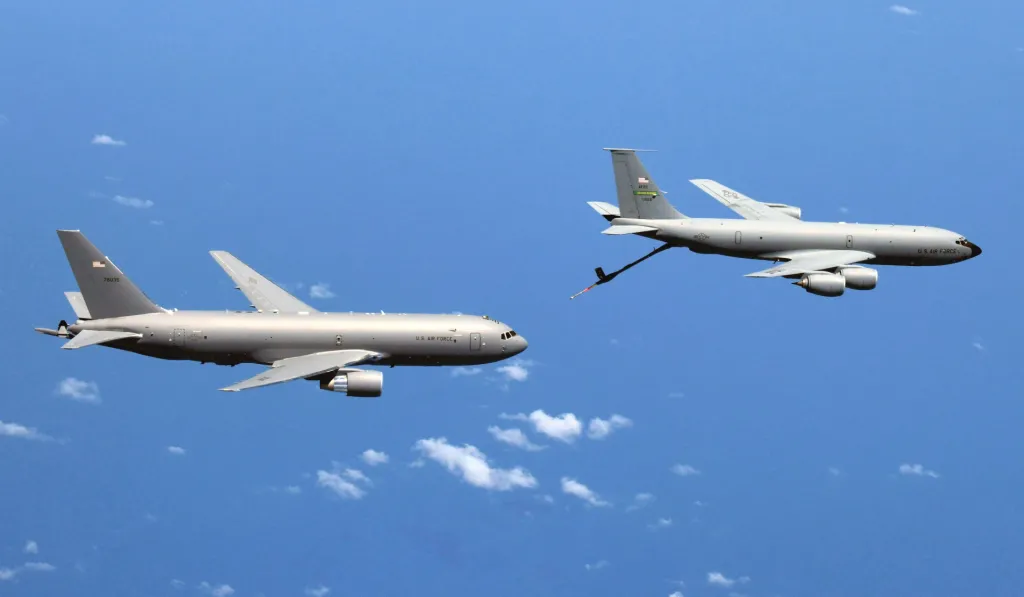
A KC-46, at left, moves in to refuel from a KC-135, at right, during a test. USAF
“Some technology that we are really looking at is kinetic self-protection for our high-value airborne assets,” Stamey said. “Because the threat is evolving, we are trying to develop a capability to protect the tanker that is independent of that threat.”
“We consider kinetic self-defense to be sort of a last line of protection. If all else fails and a threat somehow breaks the kill chain, we’ll still have a means to protect the tanker,” he added. “Whether it’s an IR seeker or a radar seeker, if we have a means of taking it out kinetically, we don’t have to electronically attack it or use decoys that are effective against some things, but not others.”
Stamey did not elaborate in the interview on what a “kinetic self-protection” system might entail, but a design capable of launching some type of miniature missile is one especially likely option. The Air Force has already been working on exactly this kind of capability, at least on the experimental level, for years now.
In 2015, an Air Force Research Laboratory (AFRL) project dubbed the Miniature Self-Defense Munition (MSDM) emerged publicly. At that time, AFRL said it was looking for an “extremely agile, highly-responsive” miniature missile with a “very-low-cost passive seeker” and overall length of around 3.3 feet (one meter). For comparison, this is roughly one-third of the length of an AIM-9X Sidewinder, and even shorter proportionally than an AIM-120 Advanced Medium-Range Air-to-Air Missile (AMRAAM).
A broad overview of the MSDM program as of 2015. USAFA graphic from 2019 describing “tech enablers” for various AFRL projects, including the MSDM’s seeker. USAF
AFRL initially hired both Raytheon and Lockheed Martin to work on the MSDM program. In 2020, Raytheon received an additional contract for what was described then as a “miniature self-defense missile.” The stated scope of work for the new deal included “research and development of a flight-test ready missile.” This all seemed very much to be a continuation of the previously announced MSDM effort, despite the slight name change. To date, Raytheon does not appear to have shown even a concept for an MSDM interceptor publicly.
It’s also worth noting that Northrop Grumman received a patent in 2017 for a kinetic aircraft protection system based around a miniature interceptor. Accompanying drawings, some of which are seen below, depicted the system installed on a conceptual “futuristic” combat aircraft. TWZhad explored the potential benefits and limitations of such a system in detail at the time.
USPTO
In 2018, the U.S. Navy also put out a largely open-ended call for information about potential options for a Hard Kill Self Protection Countermeasure System (HKSPCS) for transport, tanker, and other combat support aircraft. It also suggested the system could be used on future drones. The HKSPCS notice raised the possibility of a system designed to launch a salvo of miniature, highly maneuverable interceptor missiles, and that could offer an “alternative and/or adjunct to more conventional electronic self-protection solutions.”
Other concepts for kinetic self-protection for aircraft have been put forward in the past that do not involve firing a miniature missile at another missile. In 2012, Israeli firm Rafael demonstrated what was essentially an armored vehicle hard-kill active protection system designed to be integrated onto a helicopter. For a time, at least in the 2010s, the U.S. Navy also had a program called Helicopter Active RPG Protection, which seemed centered on a similar, if not identical, concept.
A series of images showing Rafael’s kinetic aircraft protection system intercepting a rocket-propelled grenade during a test. Rafael
Lastly, in recent years, the Air Force has been testing the ability of its KC-135 tankers to launch small drones for self-protection and a variety of other purposes. Compared to a miniature missile, an unmanned aerial system could offer valuable loitering capability, giving it different options for engaging or re-engaging incoming threats, especially if they are fired in salvos. This, in turn, could help prevent interceptors from being wasted if the target they are fired at initially is destroyed by something else first.
Magazine depth remains one of the bigger challenges facing kinetic self-protection systems for aircraft, as well as platforms down below. An installation on a larger aircraft would open up different possibilities for reloading in flight from within the fuselage. The aforementioned drone launchers that the Air Force has been testing on the KC-135 notably offer that capability through the use of standardized Common Launch Tubes (CLT), which can be loaded with a wide array of payloads.
Directed energy capabilities could also be part of the future ecosystem of self-protection capabilities, which could also help address magazine depth concerns. Laser-based directional infrared countermeasures (DIRCM) systems are already found on tankers and airlifters across the U.S. military, but are designed to blind and confuse heat-seeking missiles, rather than destroy them. They have no impact on radar-guided interceptors. Efforts to develop aerial directed energy weapons capable of destroying targets, including incoming missiles, have faced significant challenges and have yet to produce an operational capability.
DIRCM Live Fire
The Air Force has also been developing self-protection systems for tankers and other high-value aircraft contained within modified Multipoint Refueling System (MPRS) pods normally used to send gas to receivers via the probe-and-drogue method. Repurposed MPRS pods configured to provide additional airborne communications and data-sharing capabilites are also in service now.
Any kinetic self-protection would also have to be tied to sensors, including infrared search and track systems (IRST) and/or radars, to spot incoming threats, which could be moving very fast, and cue interceptors to engage them. Ever-improving networking capabilities, which are another top Air Force priority for its mobility fleets, could enable the use of a distributed sensor network spread across multiple platforms. The use of loyal wingman-type drones is another area the Air Force has already been exploring to help protect tankers, in particular.
Regardless, the Air Force has clearly identified an ongoing desire for a kinetic self-protection capability for tankers and other valuable support aircraft. Though Mobility PEO Stamey did not explicitly say it in his interview, his remarks certainly hint at concerns that work on new and improved electronic warfare capabilities and decoys are having trouble keeping up with adversaries developing and fielding ever-more capable anti-air missiles.
Weapons that use imaging infrared seekers are notably immune to radiofrequency electronic warfare jamming, as well as radar cross-section-reducing design features. They are also passive in nature, meaning that they don’t pump out signals that can alert aircraft crews to the fact that they are under attack. Increased use of infrared sensor capabilities on aircraft and as part of surface-to-air missile systems only creates further challenges when it comes to detecting threats, let alone responding to them.
Yemeni Houthis intercepted Saudi F-15 by Fatter-1 missile ( it’s SA-6 SAM that were restored or supposedly modernized with Iranian assistance). Judging by how close the missile exploded it was quite likely that F-15 could have been damaged, but still managed to fly away. pic.twitter.com/Qmdpb9ER2Q
Questions about the right mix of active and passive defenses are also likely to be central in the Air Force’s ongoing refinement of plans for future tankers and airlifters.
“We are working on the Next Generation Air Refueling System, NGAS, as it’s effectively known. Put the finishing touches on that last year. And that was a really wide look at how we would do air refueling in the future,” Air Force Gen. John Lamontagne, head of Air Mobility Command (AMC), told TWZ and other outlets at the Air & Space Forces Association’s main annual conference last September. “When I say a wide look, looking at conventional tankers [as] we know it today, you know something like a [KC-]135 or KC-46 as is; something with a bunch of mission systems added to it, with a defense systems [sic], connectivity, intelligence and more; a business jet; a blended wing body; or a signature-managed [stealthy] tanker.”
Stealthy tanker designs like the Lockheed Martin Skunk Works concept shown here are just one of many options the Air Force is now looking at for its future aerial refueling ecosystem. Lockheed Martin Skunk Works
This, in turn, only raises the prospect that critical supporting assets like tankers will find themselves at risk, even if they are flying far from where the main fighting is occurring.
“The [kinetic self-protection] technology is necessary if we’re going to be successful in pushing tankers into what we call the weapons engagement zone,” Mobility PEO Stamey said in the interview published this week. “Our adversaries are building long-range threats specifically to push assets like our tankers further back. They believe it’s easier to target and shoot a tanker than an F-35 or F-47.”
Stamey’s comments make clear that the Air Force is still very interested in making it harder for adversaries to do that by adding kinetic self-defense systems to the mix.