The new series of ITV’s Long Lost Family begins with an emotional story of a search for a family.

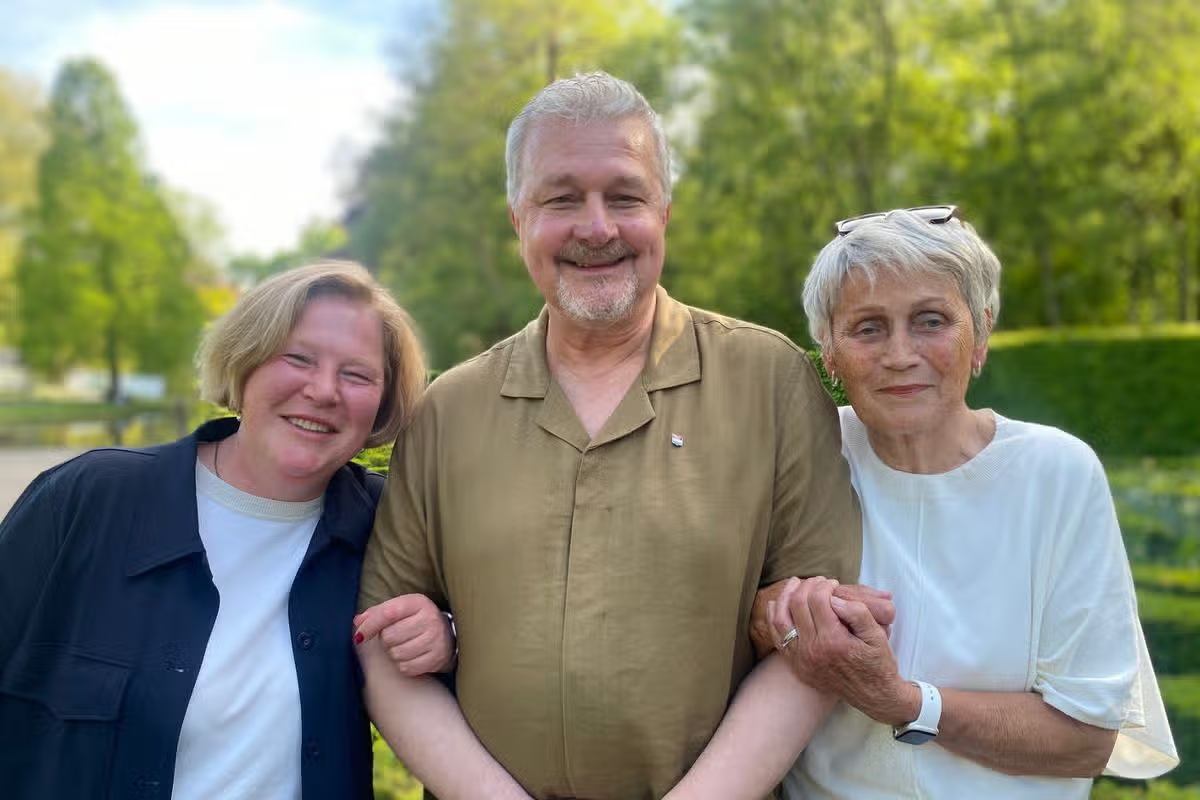
David has now met his family including his aunt Marianne and cousin Saskia.(Image: ITV)
A remarkable new series of Long Lost Family on ITV uses DNA technology and painstaking detective work to reunite two foundlings with family members they lost contact with or never met.
In December 1960, David Stevenson was discovered inside a locked apartment block in North-West London. He was found in the corridor up on the second floor, outside one of the flats. He was several days old and cold, but well fed. For Long Lost Family: Born Without Trace, 65-year-old David returns to the flats more than six decades on still with burning questions about why he was left in such a specific place and whether this provides any clues as to who his birth parents are.
David says: “This place is part of me and part of my identity, no question. This is where my story starts here, so coming back here is emotional. Babies are often left at a police station or a hospital. Whoever put me here…this is a locked private block. Were some of the other residents somehow involved? The WPC arrived and discovered me on the floor with people milling round.”
Although some residents were investigated by the police, enquiries failed to help identify David’s birth parents or link them to him. David was adopted by the Stevenson family and had a happy childhood in nearby Edgware. He grew up knowing about his start in life, but for a long time he wasn’t curious to know more.
“I did know that I was a foundling but as far as I was concerned I had a mum and dad and it wasn’t a problem for me.”
He now has three sons of his own. They reflect on the risks involved with searching – the answers could be upsetting. David is also conscious of the experience of his birth mother.
“If I find my birth mother and she didn’t tell anyone and she wasn’t keen on that secret turning up that would be hard because it would be rejection all over again. The consensus from the police doctor was that I was a result of an unattended birth. and that must be a traumatic experience for any woman,” he says.
With his sons now grown up, David remarried and now lives with his second wife Julie. In 2009 they launched a national appeal for information. Ultimately it did not provide answers, but it did mark the start of a decade of their own extensive investigative work.
Using the apartment building as their primary clue, they developed several hypotheses about the residents. More recently David has turned to searching through DNA, which revealed that he has both Dutch and French heritage. While this is a significant development, the search has stalled, leaving him still not knowing who his birth parents are. Thankfully the LLF team get a breakthrough on David’s search.
There is a strong connection to a particular Dutch family. Two family members, including a woman called Marianne agree to take DNA tests. The pair of them testing enables LLF expert Ariel Bruce to – with certainty – identify David’s birth mother. Her name is Petra and she sadly died in 2010. Upon seeing a photo of David, the family immediately see a likeness to Petra.
Show host Nicky Campbell travels to the Netherlands to meet with Marianne – David’s aunt and his first cousins Saskia and Bart. He wants to see how they are dealing with the news and to learn more about Petra. It transpires that nobody in the family ever knew that she was pregnant and gave up a baby in London. They are left with mixed feelings. They are desperately sad that Petra had to endure this alone but delighted to be able to meet their new cousin and welcome him into the family.
After finishing school, Petra moved to Paris to work as an Au Pair and was living there when David was conceived. This tallies with David’s French DNA and the thinking that his birth father is French. She then moved to London and subsequently parted with David.
She grew up in a strict Catholic household where news of her pregnancy would not have been tolerated. Marianne says: “It was parents after Second World War. They would be angry.”
Bart adds: “They were Catholic and they would also have been very concerned with what society would think of having a child born out of wedlock.”
The sad news that Petra has died is shared with David away from the cameras. French privacy laws mean that DNA testing is very uncommon in France and so Ariel and the team are not able to identify his birth father. Referring to the death of Petra, David tells host Davina McCall: “It’s a shame because it closed an avenue that might have been open to me.”
Davina explains that the nature of Petra’s relationship with David’s birth father is unknown, along with any possible connections to the building where David was found. She describes Petra’s strict upbringing in The Netherlands and explains that she never confided in her family about giving birth at 20. David is quite affected by learning that after returning to the Netherlands, she did not have any more children.
David says: “Oh wow. I find that surprising. And quite sad actually, you know, not having a family, having given up the one child that she did have.”
Davina then reveals that Petra has family members in Rotterdam who were all too willing to take DNA tests. She passes on a letter that they have written him, where they explain that they would love to meet and share as much information about Petra as they can. David is moved by this gesture.
He says: “To meet people close to Petra would be very nice. To put a name to my mother and a picture, it’s a profound feeling. That is amazing.
“I’ve often said I’m not looking for another family, you know. All I want to know is where did I come from? But seeing these[photos] and reading the letter, you know, I want to meet these people. Yeah, that’s as big as it can be.”
After travelling to Rotterdam and has an emotional first meeting with Marianne, Bart, Saskia and another first cousin Jan. They share details about Petra, her personality and interests. David concludes: “One of the most rewarding things…is to hear them talk about her, and, and it’s helped me form an idea of her character. I’m very excited abut the future. There was nothing but love from them.”
Petra’s sister Marianne tells him: “She would love you and you would love her.”
The other search on next week’s programme sees Sarah Gray search for her birth mother.
She was found inside a Leicester telephone box in June 1983. Just a newborn baby, she was discovered by a woman going to make a phone call. Now a mother herself of 3-year-old twins, she often reflects on her own beginnings. She had a very happy and fulfilling adoption but her start in life was never openly discussed.
“I think you know in your family the conversations that can come up freely, and I think there’s a time and a place for certain things and I didn’t push it.”
Returning to the telephone box she sees that it’s on a busy road where there would have been lots of passers-by.
Sarah, 43, said: “Whoever it was has left me in a public phone box right next to a bus stop, next to a community centre… they definitely wanted me to be found.”
The search team make incredible strides with Sarah’s case and identify her birth mother. Davina is able to finally bring Sarah some answers about who she is and where she comes from, Sarah’s mother – who is alive – wants contact and a meeting to be done off camera.
* Long Lost Family: Born Without Trace Series 8 begins on Monday night at 9pm on ITV and ITVX.
Like this story? For more of the latest showbiz news and gossip, follow Mirror Celebs on TikTok, Snapchat, Instagram, Twitter, Facebook, YouTube and Threads.