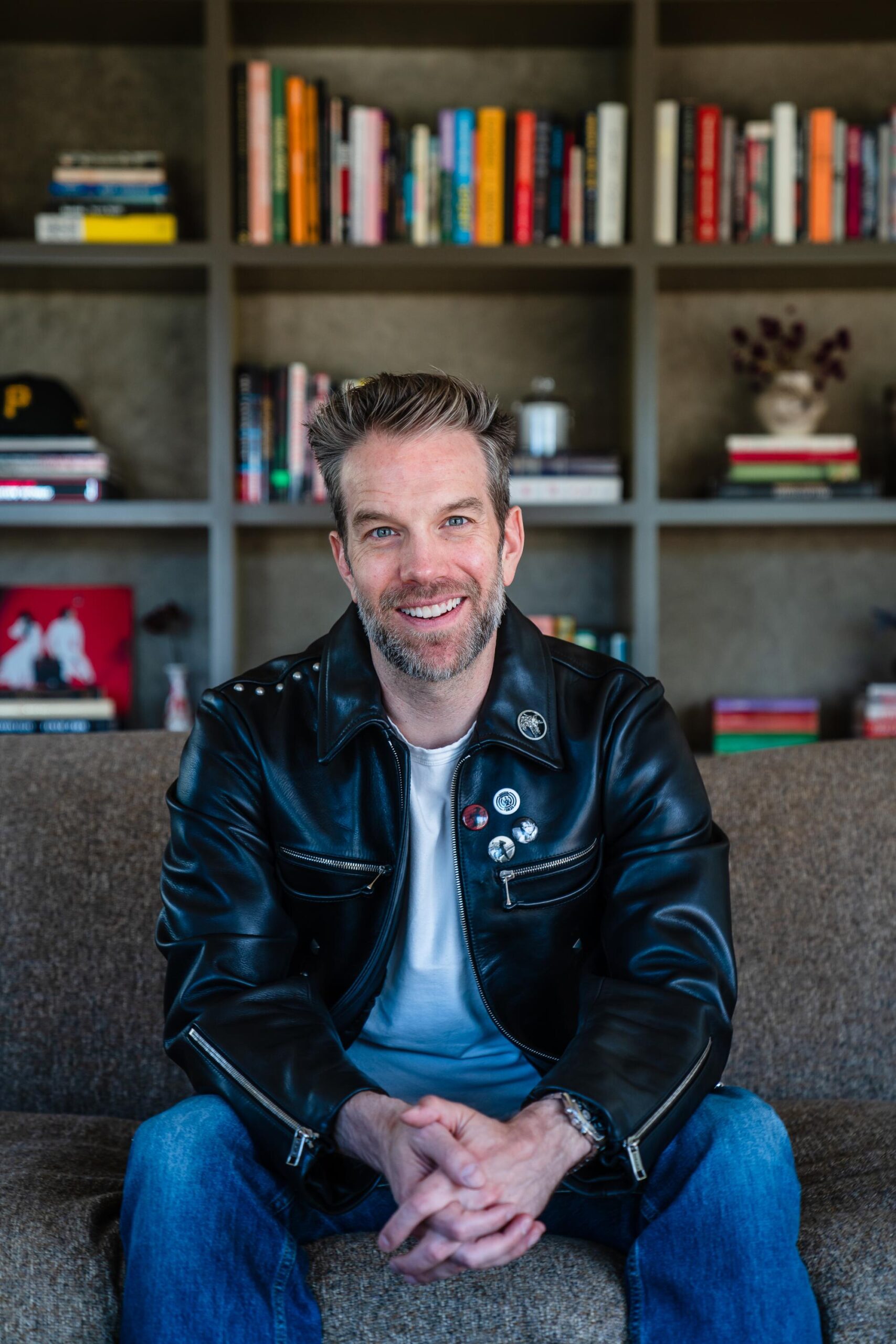
Inside the Jeselnik Book Club: How Anthony Jeselnik is making reading cool
Years ago, at the height of his success, Anthony Jeselnik couldn’t sleep. It was making him crazy. Hoping to find relief, the comedian sought help from a therapist he assumed would guide him back to a healthy sleep schedule. Instead, he encountered an apathy that stunned him.
“So what?” he recalls her saying. “So what if you don’t sleep? If you wake up, read a book. Find ways to be productive in your loneliness.”

Anthony Jeselnik grows earnest when he talks about his love for books.
(Ariana Drehsler / For The Times)
The advice resonated. Today, the comedian is still reading alone, only now he has a dog — and an audience. A lifelong reader, Jeselnik has transformed his literary habit into a popular online book club, Jeselnik Book Club, where he recommends novels and invites discussion on his YouTube channel. His first video, posted in January and reviewing Jim Thompson’s “The Getaway,” garnered over 31,000 views. Each month, he chooses a novel and offers it up for discussion.
“My goal was to curate and give people their best shot at enjoying reading,” he says. It’s a valiant effort, considering that reading has been in a steady decline. Last year, it was reported that the number of American readers had declined by 40% over the previous two decades.
“People will say, ‘Oh, I don’t like reading books.’ You’re choosing the wrong books,” says Jeselnik, his voice likely ringing with his signature snark because he, for the most part, knows otherwise. In 2022, bestselling writer Isaac Fitzgerald, who recently released the anticipated “American Rambler: Walking the Trail of Johnny Appleseed,” witnessed the power of a Jeselnik recommendation.

“It helps with the masculinity crisis in that reading is masculine. It is a masculine thing to do,” Anthony Jeselnik argues, advocating that young men trade online conspiracy forums for literature.
(Ariana Drehsler / For The Times)
“A friend texted me that Anthony Jeselnik, a comedian whom I loved — but had never met nor interacted with — shouted out his love of my memoir, ‘Dirtbag, Massachusetts,’ on his podcast. I was thrilled,” Fitzgerald says. “At my events, both in Chicago and throughout the rest of that year, more and more people in my signing lines told me they’d heard of the book from Jeselnik’s podcast. I was also buoyed by how many of the people in the signing lines were young men.”
Since then, despite Jeselnik’s self-proclaimed loner status, Fitzgerald and Jeselnik have struck up a friendship. “The man is a real lover of books, with excellent taste and, unsurprisingly, confidence in his convictions,” Fitzgerald says. Earlier this year, the author held a book launch event for “American Rambler” at Skylight Books in Los Feliz. Jeselnik hosted. “I think he may have single-handedly invented a new way to do literary events. I don’t know what to call it … a literary roast?” Fitzgerald says. “Everyone laughed for an hour straight.”
In a sun-drenched luxury apartment above Hollywood Boulevard, Jeselnik explains that he mostly avoids the press — because he says he’s become weary of cancel culture and identity politics, conversations that have mired comedy.
Still, he welcomes the chance to discuss books, his voice swelling with excitement at the mention of authors Emily St. John Mandel and Ottessa Moshfegh — both personal favorites. Almost an hour into the conversation, the comedian reveals that he has Joan Didion’s author photo tattooed on his chest. His hand rests on his heart as he evangelizes her writing — a surprisingly tender moment of sentimentality from a comedian who has made a career out of stinging misanthropy.
“She has the cleanest prose. I think she’s the best writer of all time,” Jeselnik says. “I’ve read all of her novels, a lot of her essays. Her book about her husband dying is one of the most heartbreaking books.”
In fact, Didion is a natural match for the comedian. He is renowned for his precise and restrained use of language, delivering provocative truths about people’s ugliest impulses and asking the audience to laugh at them.
In the comedy world, Jeselnik has become legendary for his razor-edged one-liners, each joke ending with a dark reversal. He’s gained a reputation as the provocative bad boy of comedy with irresistible charm. Over the course of his career, he has enjoyed toying with this stage persona, which he jokes is that of a “borderline psychopath.” His roast of Donald Trump catapulted him to stardom, and he has released five hourlong comedy specials, the most recent of which, “Bones and All,” debuted in 2024. On Instagram, he has over 1 million followers.
“I was trying to be the devil onstage and somehow ended up as likable anyway,” he says of his storied career. This interests him in literature too — transcending reputation through good art. “Edgar Allan Poe wrote these books about psychopaths and killers. Authors do not equal their persona.”

“I’m trying to make reading cool again,” Anthony Jeselnik says. “Reading is a solitary act in the way that stand-up comedy is a solitary art form.”
(Ariana Drehsler / For The Times)
Jeselnik’s book club recommendations are eclectic and literary — the kind of titles name-dropped in MFA writing workshops and met with impressed nods at dinner parties. Most recently, he recommended “Stoner” by John Williams, “Dept. of Speculation” by Jenny Offill, and “Paradais” by Fernanda Melchor. He curates his recommendations painstakingly, choosing brisk reads of around 250 pages that he hopes will hook new readers.
“I’m trying to make reading cool again,” Jeselnik notes. “Reading is a solitary act in the way that stand-up comedy is a solitary art form.”
He hopes his fan base embraces a life of reading. Similarly, in 2025, comedian John Mulaney also began recommending books on social media. “There are so few books for guys that are literary. There’s a lot of John Grisham and Jack Reacher, but there’s not something literary that a guy can sink his teeth into,” Jeselnik says. “If it’s well written, and the writer is great, then I’ll go on any kind of journey they take me on. I don’t always understand everything that I read, either. But reading a great writer, it’s like listening to classical music.”
With anti-intellectualism in comedy on the rise, he says his book club stands as an antidote to the manosphere. Young men passing time on conspiracy theory-infested corners of Reddit should instead pick up a novel, the comedian argues. “It helps with the masculinity crisis in that reading is masculine. It is a masculine thing to do,” he says. “The Hemingways of the world were out there. It used to be a badass thing to be a writer, and a brave thing to put your thoughts onto the page and publish them.”
The comedian has been a voracious reader since childhood. When he was in a Montessori school, the teachers discovered that reading would soothe Jeselnik. “I could go sit in a corner, and you can be a juvenile delinquent reading juvenile delinquent books.” Reading gave him a sense of accomplishment and satisfaction that followed him into early adulthood — a penchant he would like to stoke in his fans.
Early on, when Jeselnik discovered Bret Easton Ellis’ work, it felt revelatory. “Once you got outside of the curriculum, it was revolutionary to me to read Bret Easton Ellis; to read about sex, gay sex, to read about drugs, and people, young people, doing this was fascinating.”
Starting a book club felt like a natural progression for Jeselnik’s decadelong career, he explains. “In terms of how I do things and my approach to stand-up, instead of doing a podcast, having a book club seems like a natural extension of that.” There’s an earnestness in his appreciation of great literature that translates to his videos. “You can tell that I like the book and want people to enjoy it at the same level.”
Jeselnik, 47, imagines his comedy career is winding down. Thankfully for his fans, he has other creative ambitions. “I’d love to take a crack at either short stories or writing a novel.”
He reflects on the trend of comedians who, later in their careers, seek new legitimacy. “You see a guy like Jim Carrey: the last thing he wants to do is make anyone laugh anymore. He wants to be taken so seriously,” he says. Jeselnik believes his stage persona spared him from that particular crisis of self. “People are afraid of me. Fans who approach me are careful because my stage persona is borderline psychopath,” he says. “I don’t feel that same need to be taken seriously. I think I am taken seriously.”
His comedic sensibility explores cruelty, shock, transgressions and antiheroes — and it’s also what continues to draw him to literature. “I love bank robbers. I love the idea of the villain winning. That is revolutionary to me. You’re raised on TV, and things have to be wrapped up in half an hour, and the moral has to hold,” Jeselnik says. “I love that books don’t have to play by those rules.”
Connors is a culture journalist in L.A. She covers books, food, entertainment and offbeat Los Angeles. She’s currently at work on a book of essays about tourism in all its forms.